Most GPS watch reviews end at the summit photo. This one goes into the tent.
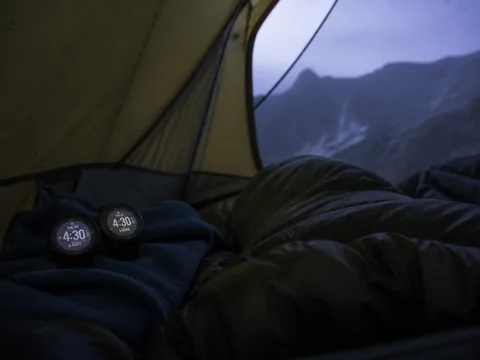
I spent five days in Wyoming's Wind River Range and three more in the Cairngorms wearing four watches at once — two per wrist, which looks precisely as ridiculous as it sounds — because the question I wanted answered isn't the one reviews of GPS watches usually ask. Not can it navigate. They all navigate now, more or less. The question was whether the sleep and recovery telemetry in watchOS is good enough to change what a tired person does about coffee on day four, with 4,100 metres of accumulated climbing in the legs and a col to cross before the afternoon weather.
The verdict, in one sentence: watchOS 26 has become a genuinely capable backcountry navigator with the worst battery life on the mountain, and its sleep numbers are legible, plausible, and resting on a fifty-year-old assumption that almost nobody re-examines because the output looks so clean.
That's the review. The rest of this is why, and it starts a long way before Apple shipped a titanium watch with a siren in it.
A short history of a confident number
1978: the wrist starts guessing
Everything your watch says about your sleep descends from one idea: if the wrist isn't moving, the person is probably asleep. That's it. That's the foundation. Daniel Kripke and colleagues in San Diego were strapping accelerometers to wrists and checking them against polysomnography in the late 1970s, and by the early 1980s wrist actigraphy was a respectable research instrument — cheap, tolerable to wear for weeks, and reasonably good at one specific job: estimating total sleep time in people who sleep normally.
The field has always been candid about the limits. Actigraphy is decent at total sleep time and poor at the inverse problem — telling quiet wakefulness from sleep. Lie still in the dark and stew about tomorrow's river crossing and an actigraph will score you asleep. That failure mode is not a bug someone forgot to fix. It is what happens when your only sensor is motion.
Consumer watches added a second sensor, and the guessing got more elaborate rather than more grounded. Apple shipped sleep stages in watchOS 9, in 2022, by combining the accelerometer with heart rate. In watchOS 26 it added a Sleep Score: a single 0–100 number built from how long you slept, how consistent your bedtime was, and how many interruptions it detected. I watched that number move for eight nights, and duration clearly dominates it. Sleep an hour less and the score falls hard. Sleep the same amount an hour later than usual and it falls a little.
Which means the headline number is mostly a restatement of the thing actigraphy was always decent at, wrapped in the language of quality. That's not fraud. It's just a much smaller claim than a score out of a hundred implies.
2013: twelve people and 400 milligrams
Now the other half of the belief — the one that sent me up there with a kitchen scale and pre-weighed instant coffee.
Ask anyone where the "stop caffeine six hours before bed" rule comes from and you'll get a shrug and a citation-shaped noise. The rule has a real source. In 2013, a group led by Christopher Drake published a crossover trial in the Journal of Clinical Sleep Medicine in which participants took 400 mg of caffeine — or placebo — at zero, three, and six hours before bedtime. The six-hour dose still measurably disturbed sleep. Sound methodology. Genuinely useful finding.
Twelve people. Twelve healthy normal sleepers, one dose size, one lab.
And 400 mg is not a cup of coffee. It's roughly a double-shot flat white plus a large brewed coffee plus most of another, taken as a single hit. The study wasn't modelling anyone's actual afternoon. It was establishing that the effect exists and persists — which it did, convincingly.
What happened next is the interesting part. Twelve subjects and one large dose became a universal cutoff time, printed on wellness apps and repeated in every sleep-hygiene handout on earth, applied identically to a 45 kg person nursing a 60 mg cup at four in the afternoon and a 100 kg one drinking 300 mg at six. Caffeine's half-life is usually quoted at around five hours, but the spread across individuals is wide enough that the average is nearly useless for any specific human — CYP1A2 variants, hormonal contraceptives, smoking, and pregnancy all shove it around by hours in either direction.
So: one belief resting on a motion sensor's assumption, another resting on twelve people. Both delivered to me on a wrist, in numbers, with two significant figures. That asymmetry between the confidence of the display and the thinness of the source is the whole reason I ran this.
What I carried, and what I measured
Four watches: Apple Watch Ultra 3 (49 mm, $799), Garmin Fenix 8 51 mm AMOLED ($1,199), Coros Vertix 2S ($699), and Garmin Instinct 3 Solar 50 mm ($499) as the budget entry. Everything tracked every day. The Ultra 3 and the Fenix ran sleep tracking every night; the Instinct did too; the Vertix logged sleep but says less about it, which turns out to be a virtue.

Caffeine protocol, such as it was. Pre-weighed instant in labelled sachets, 80 mg per sachet as measured against the manufacturer's stated content, which I'll take on faith because I had no way to assay it in a tent. Baseline days: 160 mg at 06:15, 80 mg at 12:30. Late days: 160 mg at 06:15, 80 mg at 17:00. Four nights each, alternating, across both trips. Camp elevation in the Wind Rivers ranged from 3,080 m at Island Lake to 3,240 m on the shelf below Knapsack Col. The Cairngorms nights were at 550–700 m, which matters more than I expected.
My own measurement, independent of the watches: a paper card and a headlamp. Lights-out time written down, then my honest estimate of when I stopped being awake, recorded in the morning. Crude. But it's the same crude instrument every night, and it gave me something to hold the watches against.
What I did not have: polysomnography, blinding, a control subject, or a sample size worth the word. I knew which nights were late-caffeine nights. I am a person with opinions about caffeine writing an article about caffeine. Treat everything downstream of that accordingly.
Navigation: watchOS is finally competent, and then it isn't
Credit where it's due, because for years the honest answer to "can I navigate on an Apple Watch" was technically.
In the Wind Rivers, the Ultra 3 was good. Downloaded topographic maps rendered fast, panned without the lag that made watchOS 10 feel like a proof of concept, and the contour detail was adequate for picking a line up to the col. Waypoints work the way you want them to: drop one at the tent before wandering off to filter water at dusk, and the Compass app gives you a bearing and a straight-line distance back. Backtrack — which records your route in the background and reverses it — earned its keep exactly once, in twenty minutes of thick weather on a boulder field where every cairn looks like every other cairn. Once is enough. That's what these features are for.
Satellite messaging is the genuine step change, and it's the reason the Ultra 3 is on this list rather than being a curiosity. Being able to send a text with no cell coverage collapses a category of anxiety that used to require a separate device on a separate subscription. I sent three messages over five days, waited between 40 seconds and just under four minutes each time for a clear sky handshake, and got all three through.
Then I flew home and the map layer disappeared. Apple's topographic coverage was US-only when I checked before the Cairngorms leg, and there is no polite way to describe standing in the Lairig Ghru with a $799 watch showing you a road map. The fix is a third-party app — WorkOutDoors, about $8, which loads vector OpenStreetMap tiles offline and has been the actual answer for Apple Watch navigation for years. It's excellent. It's also a one-man app doing the job the hardware is marketed on, and if it ever stops being updated, the Ultra becomes a compass with a good screen outside the United States.
The rest of the watchOS feature list, briefly and without ceremony. Low Power Mode during a workout thins out GPS and heart rate sampling and buys real hours — more on that below. The 86 dB siren is loud enough to be worth knowing about and I hope never to use it. The Depth app is irrelevant to anyone reading this. The new wrist-flick dismissal gesture does not reliably register through a hardshell cuff and a glove, which is when you most want it. Workout Buddy has nothing to say to a person on day four of a trek. Vitals — overnight heart rate, respiratory rate, wrist temperature, blood oxygen, shown as in-range or out — is the most useful sleep-adjacent feature Apple has shipped, and I'll come back to why.
The comparison, in the only terms that matter on day four
Measured over five consecutive days in the Wind Rivers, averaging 7 hours 10 minutes of tracked activity per day, all-day wear, sleep tracking every night, display settings left at defaults.
| Watch | Price | State after 5 days | Offline maps | Its sleep number |
|---|---|---|---|---|
| Apple Watch Ultra 3 | $799 | Two full recharges required | Apple topo (US only, my testing) or WorkOutDoors | Most legible, least explained |
| Garmin Fenix 8 51 mm AMOLED | $1,199 | 46% remaining | Full onboard TopoActive, global | Sleep Score plus Body Battery; overconfident |
| Coros Vertix 2S | $699 | 61% remaining | Free global topo, offline | Sparse, and honest about being sparse |
| Garmin Instinct 3 Solar 50 mm | $499 | 71% remaining | None — breadcrumb trail only | Basic and adequate |
The Ultra 3 numbers deserve detail, because "two recharges" is the sentence that decides this purchase for a lot of people. Day one cost 34% for 7 hours 14 minutes of full-power GPS tracking, plus all-day wear and a night of sleep tracking — call it 55% of a day's budget gone by breakfast the next morning. Low Power Mode with reduced GPS sampling roughly doubled my tracking hours per charge and cost me nothing I could detect in the recorded track. Even so, I charged on the evening of day two and again on day four. The puck and a 10,000 mAh bank came to 232 g in my pack. That is not a rounding error at the end of a long week, and it is the single hardest fact in this review.

The Fenix earns its price on exactly this axis and nowhere else that I found. It's the only watch here where full onboard global topography and multi-day GPS coexist with no asterisks. It also produces the most confidently wrong recovery numbers of the four, which brings us to the point.
What eight nights said about caffeine, and what they couldn't
My Sleep Score at home sits in the low 80s. At 3,100 m it ran 54 to 61. Every night. Regardless of caffeine timing.
My own logged sleep-onset estimate went from a home median of about 9 minutes to 22 minutes at altitude. On the four late-caffeine nights, the median was 24 minutes; on the four early-cutoff nights, 21. Three minutes, unblinded, n=1, with a self-reported instrument. That is not a finding. It's a shrug with a decimal point. Apple counted 14 interruptions on the worst late night and 11 on the worst early night — also noise, at this sample size, and I'd say the same about anyone else's four-night comparison.
What did move, unambiguously and on every device that measures it, was respiratory rate: 14 breaths per minute at home, 17 at altitude, flagged out-of-range in Vitals two mornings out of five. That's the real signal, and it isn't about coffee. Above roughly 2,500 m, sleep fragments on its own — periodic breathing, the cyclical rise and fall of ventilation that wakes you in a way you may not consciously register. It is the dominant variable in that tent by a distance no afternoon coffee can compete with.
And here the tidy story frays further. Caffeine is a respiratory stimulant. Caffeine citrate is the standard drug for apnea of prematurity in neonatal units — the thing you give to make a struggling patient breathe more regularly. Which means the naive model, caffeine bad for sleep, therefore cut it off earlier at altitude, is asserting more than anyone has established. I am not telling you to drink an evening espresso at 3,200 m. I'm telling you that the confident rule you're following was built at sea level on twelve people with a dose nobody actually drinks in one sitting, and that the mechanism at altitude runs in more than one direction.
The honest use of the watch, then, was not the score. It was Vitals — a raw respiratory rate I could compare to my own baseline, presented without a verdict attached. The score told me I'd slept badly. I knew that. The respiratory rate told me why, and "why" is the thing you can act on. On the two flagged mornings I moved slower, ate more, and dropped 200 m to camp earlier than planned. That's a decision. No number out of a hundred produced one.
Who this is for
Buy the Ultra 3 if your trips are American, you're already inside Apple's ecosystem, and you'll genuinely carry a battery bank — that last condition is not optional and everyone pretends it is. Satellite messaging plus competent offline topo plus a screen you can read in flat light is a real package, and I no longer think choosing it makes you unserious.
Buy the Vertix 2S if the trip is the priority and the phone integration isn't. Sixty-one percent after five hard days means a week-long traverse needs no cable at all, and free global offline topo removes the last excuse for Garmin's map pricing.
Buy the Fenix 8 if you want everything onboard, globally, with no third-party app propping up the headline feature, and $1,199 is a number you can absorb without resentment.
Buy the Instinct 3 Solar if you navigate with paper and want a tracker, not a map. Breadcrumbs and a compass, weeks of battery, half the price of the Fenix. Know what you're giving up: there is no map on it, and no amount of firmware will add one.
Who it isn't for
If your longest walk this year is six hours with a car at the end, none of this applies — a mid-range running watch does everything you need and the battery conversation never starts. If you count grams and carry a compass on principle, you already knew you weren't buying any of these, and I'm not going to pretend a watch replaced your map, because it didn't; it replaced my willingness to stop and take the map out, which is a different and slightly worse thing.
And if you're buying one of these specifically to optimise your sleep at altitude, buy the cheapest one that shows you a raw overnight respiratory rate against your own baseline, and spend the difference on an extra night of acclimatisation. That will do more than every score on this page combined.
The winner
Coros Vertix 2S, $699 — the only watch here that navigated a full week off-grid, offline, globally, without a cable in my pack. The Ultra 3 is the most capable watch and the most demanding one; whether that trade works is a question about your charging discipline, not about Apple.
As for the number on the screen at 2:40 in the morning, the one that made me consider moving my afternoon coffee three hours earlier for the rest of my life:
Twelve people, one oversized dose, thirteen years ago — that's the whole case against your afternoon coffee. Your watch didn't add evidence. It added confidence.