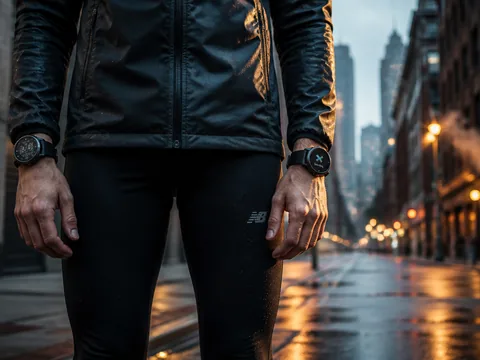
This smartwatch product review began with a spec-sheet claim I didn't believe: ten days of battery from a £229 GPS watch that also records every run, every commute and every night of sleep. I wore the review unit on my left wrist for 28 days. On my right I wore a reference watch that costs about three times as much, and I added a chest strap for the hard sessions. I logged the battery percentage at fixed points in each day.
The verdict: the GPS is better than the price suggests, but the ten-day figure doesn't hold for anyone who trains and sleeps in the watch. I averaged 6.7 days per charge, and the blood-oxygen sensor used more power overnight than all of my running did.
My logging points follow a morning cup of coffee through the body. I organise my mornings that way anyway, and it turned out to be a fair map of where the power goes.
06:40 — The first sip, and the satellite search
Caffeine absorbs quickly from the gut. Most of a cup reaches the bloodstream within 45 minutes, and blood levels usually peak somewhere between 30 and 60 minutes. During that window I was standing on the pavement waiting for a GPS lock.
A cold lock (the first run after charging, or after a day without GPS) took a median of 48 seconds across nine attempts. A warm lock took 9 seconds. On one narrow street between six-storey buildings, the cold lock took 1 minute 52 seconds both times I tried it. The watch lets you start before it has a lock, and on those two runs the first 200 metres showed up as a straight line through a block of flats.
The search itself cost almost nothing: under 1% of battery, even at its slowest.
07:15 — Peak caffeine, peak draw: the run
The caffeine peaks at about the time I'm properly into a run. On coffee mornings my easy-pace heart rate ran 3 to 4 bpm higher than on the two decaf mornings I tried. Both watches recorded the difference, so the cause was me and not the sensor. Two mornings is not a study, and I'm not presenting it as one.
GPS drain
In standard GPS mode the watch used 4.1% an hour, which works out to about 24 hours of tracking against the claimed 30. All-systems dual-band mode used 7.3% an hour, or roughly 13.7 hours against the claimed 18.
GPS accuracy
My regular loop is 10.2 km along a river and then back through the financial district. Over eleven runs in standard mode, the watch measured an average of 1.3% long against the reference. On the stretch between office towers the error rose to 3.8%, and the track jumped to the far pavement and back. Dual-band mode brought that stretch down to 1.6%.
That is the important trade-off for city runners. Between tall buildings you need dual-band, and dual-band nearly doubles the power cost. Three 14 km cycling commutes in standard mode gave clean tracks. Roads are wider than pavements, and the watch had an easier time on them.
Heart rate
On steady runs the optical sensor stayed within 2 bpm of the chest strap on average. In intervals it lagged 15 to 25 seconds behind the strap at the start of each rep. In one session it locked onto my cadence and showed 168 bpm for 90 seconds while the strap read 151. Optical sensors in this price range usually behave like this, and this one is no worse than most.
10:00 to 17:00 — The long half-life
Caffeine's half-life in healthy adults is around five hours, though it varies a lot from person to person. Half of the 7am cup is still in circulation at noon. The watch's equivalent of that long tail is idle drain: step counting, continuous heart rate and buzzing for notifications.
With raise-to-wake, idle drain was 0.45% an hour. The always-on display raised it to 1.1% an hour, which would have cut the battery life nearly in half, so I switched it off for all the averages in this piece. Switching it off takes four levels of menus, and nothing on the way tells you which setting is using the power.
There were other daily annoyances. Notification text cuts off at about sixty characters, so the watch tells you a message arrived without letting you read it. The lower-right button works as both back and lap. In interval sessions I ended a lap by accident twice while trying to leave a menu, and one of those laps was in the middle of a rep.
21:30 — Clearance, and the night shift
By bedtime about a quarter of the morning's caffeine is still in the blood, and an afternoon cup matters much more than the first one. The watch tracks sleep by default and can also take blood-oxygen readings overnight.
With blood-oxygen on, the watch lost 4.2% per night. With it off, it lost 1.8%. Over a week, blood-oxygen alone costs about 17% of the battery. That is more than four 45-minute dual-band runs cost me, which surprised me more than anything else in the test. The ten-day claim is only reachable with blood-oxygen off and a lighter training load than most runners have.
Does it know when I fell asleep?
For 14 nights I kept a paper diary with lights-out time and my estimate of how long I took to fall asleep. On average the watch put sleep onset 9 minutes earlier than my estimate. On the four nights after a 2pm coffee, my diary averaged 31 minutes to fall asleep and the watch averaged 17. It detects stillness, not sleep, and a caffeinated body can lie still while wide awake. To its credit, it marked three of those four nights as restless.
This test has clear limits. My diary is subjective, fourteen nights is a small sample, and I had no sleep lab to check either of us against.
Claimed vs measured
| Metric | Claimed | Measured |
|---|---|---|
| Battery, smartwatch mode | 10 days | 6.7 days (my routine) |
| Standard GPS | 30 h | ~24 h |
| Dual-band GPS | 18 h | ~13.7 h |
| Overnight drain, blood-oxygen on | not stated | 4.2% per night |
| Charge, 0–100% | 90 min | 97 min |
Where the power actually went
A typical week for me was four 45-minute dual-band runs and two cycling commutes. The battery split roughly like this:
- Runs and rides: about 27%
- Nights, with blood-oxygen on: about 29%
- Daytime idle: about 49%
That adds up to a little over 100% a week, or a charge about every six and a half to seven days. The running, which the watch is sold on, used the least power of the three.
Who this is for, and who it isn't
It's for city runners and cyclists who train three to five times a week for under an hour a session, who care whether a 10 km run really measures 10 km, and who don't mind charging on Sunday nights. For that reader, the distance numbers are better than you'd expect from a watch at this price.
It isn't for anyone who wants overnight blood-oxygen and also charges rarely, ultrarunners, or anyone who needs tidy menus. If you want a GPS watch review that ends with the watch disappearing into your life, this isn't that watch. You'll be managing its settings for the first fortnight.
One line decides it. On open roads it's a week-long watch. If you run between tall buildings, plan on about five days.
I can't tell you how well it holds up after a year, because I had it for a month. I also can't speak for wrists darker or hairier than mine, where optical sensors often do worse.
The run was never the expensive part. The sleep was.


