The advice has been the same in every thread I've read since the Pixel Watch 5 landed: if the new one leaves you cold, buy on battery. Charge cadence beats everything else, the reasoning goes, because a watch parked on a nightstand puck at 11pm is a watch that measures nothing. Among Android smartwatches this is now close to received wisdom, and it's repeated with real confidence by people who have clearly tested the watches. I wanted to know whether it survives contact with the only question this magazine cares about: can a wearable actually see what a late coffee does to you?
It mostly survives, but for the wrong reason. Battery life decides whether you wear the thing; it says almost nothing about whether the numbers it collects are fine-grained enough to catch a 4pm double espresso. Over ten weeks those turned out to be two separate purchases wearing the same shape.
The claim I set out to test
Buy-on-battery assumes wear time is the binding constraint. Miss six nights a month to charging and your data has holes; a watch that runs five days has no holes, therefore the five-day watch wins. That logic is airtight right up until you ask what's in the data on the nights you did wear it. Nobody in those threads was asking. The spec that gets quoted is milliamp-hours. The spec that decided this experiment was sampling rate, and not one of the three boxes prints it.
What I did, and what I couldn't
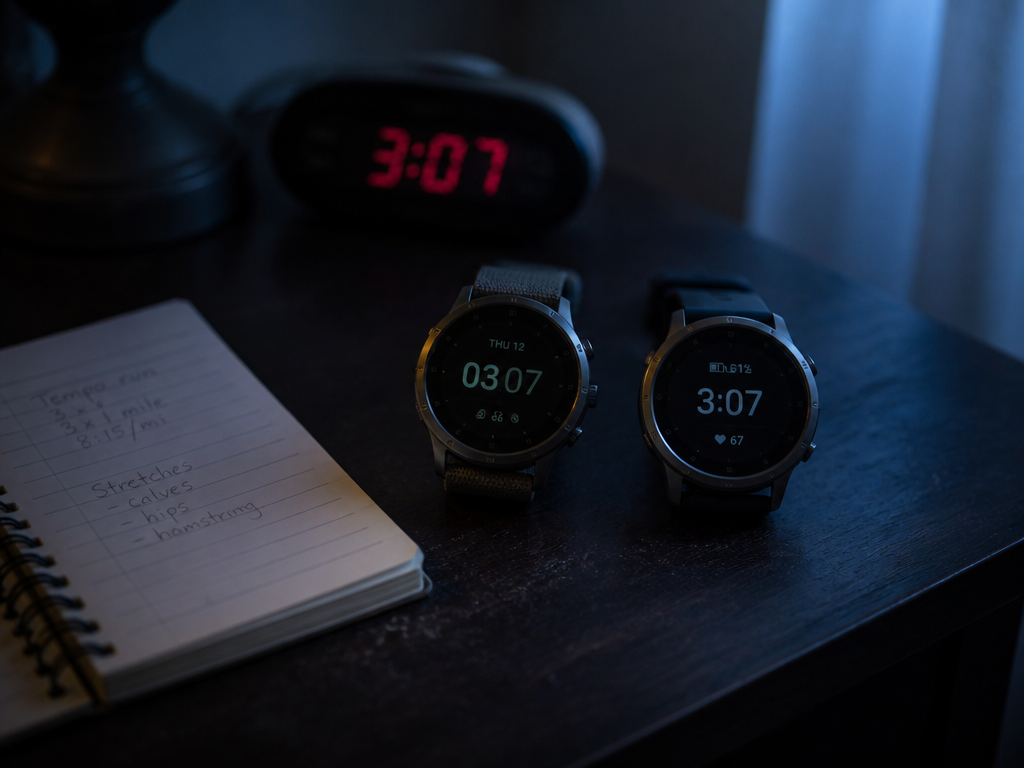
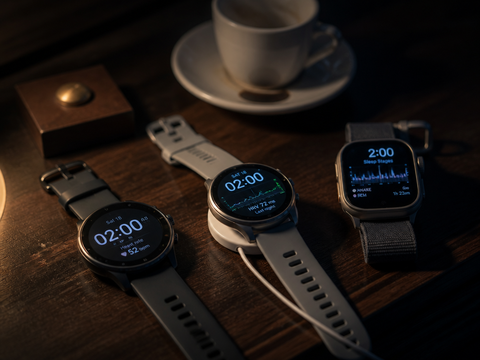
Ten weeks, roughly seventy nights. Three watches worn simultaneously — OnePlus Watch 3 and Pixel Watch 5 stacked on the left forearm, Galaxy Watch Ultra 2 on the right — rotating positions weekly so no watch kept the good wrist. It looks ridiculous. My partner has photographs.
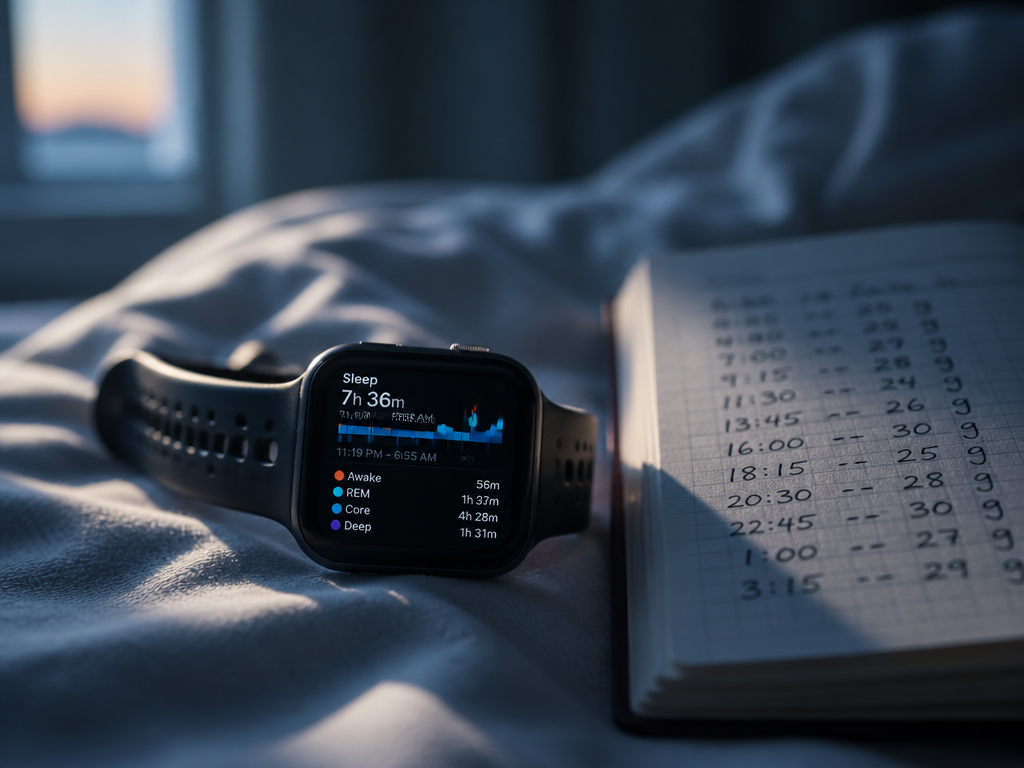
Thirty nights carried a measured dose at 4:00pm: 18g in, 36g out, about 120mg of caffeine by the roaster's own figure. Thirty control nights got a decaf pulled on the same recipe from the same grinder. Ten nights were discarded — travel, one bout of flu, one film that ran to 1am. Assignment was a coin flip each morning.
What I couldn't do: any of this properly. There was no polysomnography, so I have no ground truth for sleep stages or for the actual moment I fell asleep. My reference was a physical button on the nightstand that timestamped lights-out, which tells you when reading stopped and nothing more. The study wasn't blinded either — decaf tastes like decaf, and I knew every night which arm I was in. So what follows is each watch's disagreement with my lights-out stamp and with the other two, not accuracy in any absolute sense. Reviews that report sleep-tracking accuracy without a lab reference are guessing with better graphics.
Where the advice is right
Completely right, on its own terms. With continuous heart rate and all-night SpO2 enabled, the Pixel Watch 5 drank 14–16% per night, which on top of daytime use meant a charge every 30-odd hours. Across ten weeks I lost six nights of Pixel data to the puck. The OnePlus Watch 3 used 3–5% overnight, ran about five days with a daily run in the mix, and went 0–100 in 58 minutes — long enough to grind and brew the week's beans on a Sunday. It lost zero nights. The Ultra 2 sat between them: around 9% overnight, a real-world cycle of two and a half to three days, two nights missed.
Six holes versus zero is not a rounding error. If your question is "does my sleep get worse in weeks I train hard," you need months of unbroken nights, and the five-day watch is the only honest answer.
Where it falls apart
The OnePlus was the watch I wore most and the watch that told me least.
On 26 of 30 caffeine nights it logged sleep onset within four minutes of my lights-out stamp — including nights I distinctly remember lying there rearranging the same thought. Its mean difference in reported onset between caffeine and control nights was about two minutes. That's noise. The Ultra 2 put the same gap at eleven minutes, and its wake-after-sleep-onset figure moved from 22 minutes on control nights to 41 on caffeine nights, the single clearest signal anything produced. Fitbit's engine on the Pixel split the difference at four minutes of onset and 19 to 27 minutes of WASO, but it smooths aggressively; short awakenings I logged by hand simply weren't there in the morning.
Here's the part the buying advice misses. The OnePlus's battery advantage is partly paid for in samples. It reads sparsely overnight because that's how you get five days out of a wrist computer, and sparse reading is exactly what blurs a 15-minute stretch of lying awake into "asleep at 23:04." Nocturnal resting heart rate makes it visible: on caffeine nights the Ultra 2 recorded a mean rise of 5.4bpm, the Pixel 2.9bpm, the OnePlus 1.8bpm. Same body, same night, same coffee. The differences are the instrument, not the physiology.
Stage data from all three is unusable and I'd say so about any watch at any price. On one representative night their deep-sleep totals spanned 38 minutes. Pick the number you like best; that's not measurement, that's shopping.
Getting the data out matters too, and it's uneven. Samsung Health hands you per-minute heart rate through Health Connect without argument. The OnePlus exports, but at intervals coarse enough that you're re-reading its own summary. Fitbit shows you a lovely graph and puts the granular export behind Premium, which for a piece of hardware you already bought is a choice I find hard to be generous about.
The grid
| Watch | Overnight drain / full cycle | Caffeine-vs-control onset gap | Nocturnal HR rise on caffeine | Data you can actually export |
|---|---|---|---|---|
| OnePlus Watch 3 | 3–5% / ~5 days | ~2 min (noise) | +1.8 bpm | Coarse intervals via Health Connect |
| Galaxy Watch Ultra 2 | ~9% / 2.5–3 days | ~11 min | +5.4 bpm | Per-minute HR, no paywall |
| Pixel Watch 5 | 14–16% / ~30 hrs | ~4 min | +2.9 bpm | Summaries free, granular behind Premium |
Who each one is for
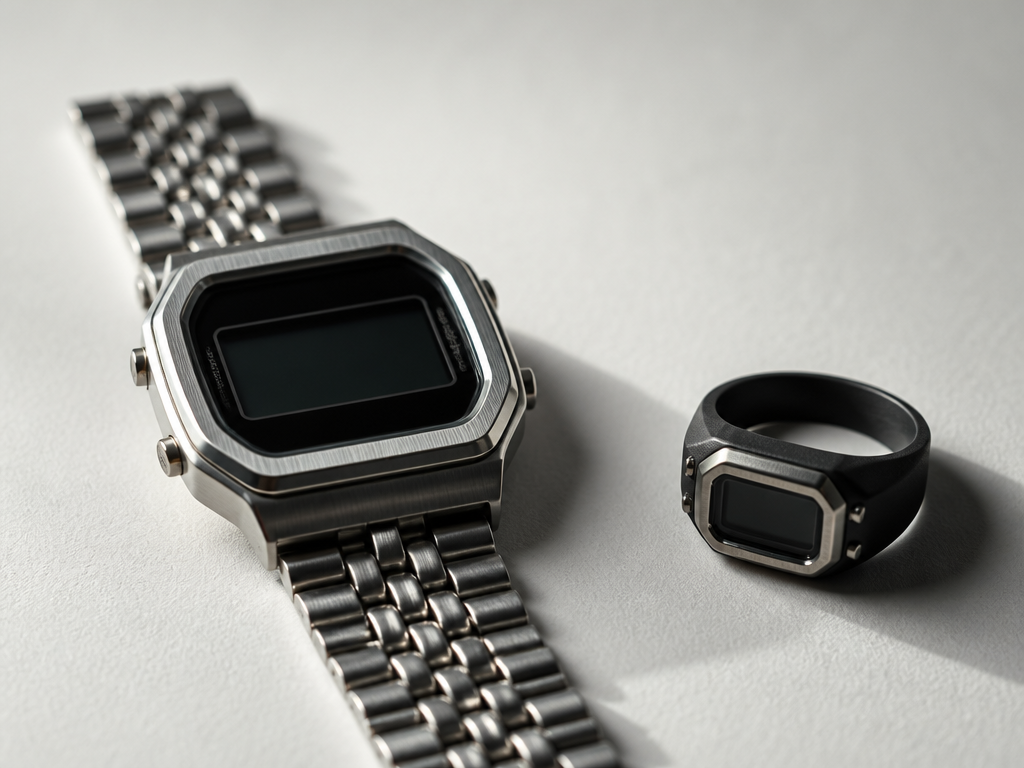
The nightly wearer. If this watch is going on your wrist every night for a year and you want an unbroken record, the OnePlus Watch 3. It's the only one I never once took off for logistical reasons, and its classical case reads as a watch rather than a gadget, which matters if you'd rather not explain yourself at dinner. Accept that it will show you trends, not events.
The question-asker. If you're changing something — cutoff time, dose, a switch to decaf after two — the Galaxy Watch Ultra 2, and budget for the charging. It's the only one of the three whose overnight numbers moved enough on caffeine nights to be worth arguing with, and the only one that hands over the raw series so you can check its work.
The comfort-first buyer. The Pixel Watch 5 is the one I forgot I was wearing. It's small, it's smooth on the underside, and it never woke me. If you've abandoned sleep tracking before because a watch dug into your wrist at 3am, comfort is a spec and this wins it.
If you're buying one watch to wear every night for a year, buy the OnePlus Watch 3. If you're buying a watch to answer a question about your own body, buy the Galaxy Watch Ultra 2 and treat the cable as part of the price.
Who these aren't for
Anyone who wants trustworthy sleep stages. None of them deliver it, and I'd be suspicious of the next Wear OS watch that claims to. Anyone hoping a wearable will settle whether caffeine affects them personally — it can suggest, and with 30 nights per arm I'd call the Ultra 2's WASO gap suggestive, not settled. And anyone who wants one watch to do both jobs. That watch doesn't exist yet on this platform.
The honest version of the rule
Don't buy on battery. Buy on what the watch is for. If it's for adherence — a long unbroken record you'll look at in six months — battery is the right first filter and the OnePlus wins it outright. If it's for answering a specific question in the next six weeks, ignore battery entirely and buy on sampling rate and data export, which means the Samsung, which means charging every third day. Decide which of those two you're shopping for before you open a single spec page, because the specs are optimised to make you forget the question.
The OnePlus is on my wrist as I type this. The Ultra 2 lives in a drawer with its puck taped to the box, and comes out for a fortnight whenever I change something. It came out last Tuesday, because I moved the second cup from 2:10pm to 11:40am and I'd rather know inside a month than a season.