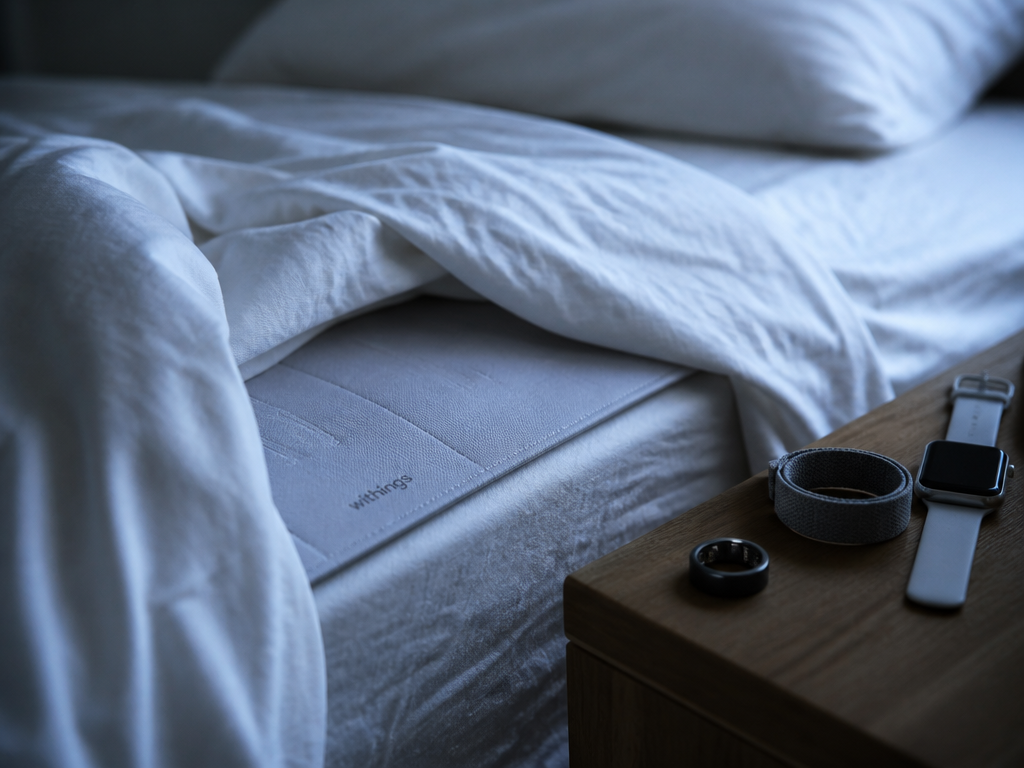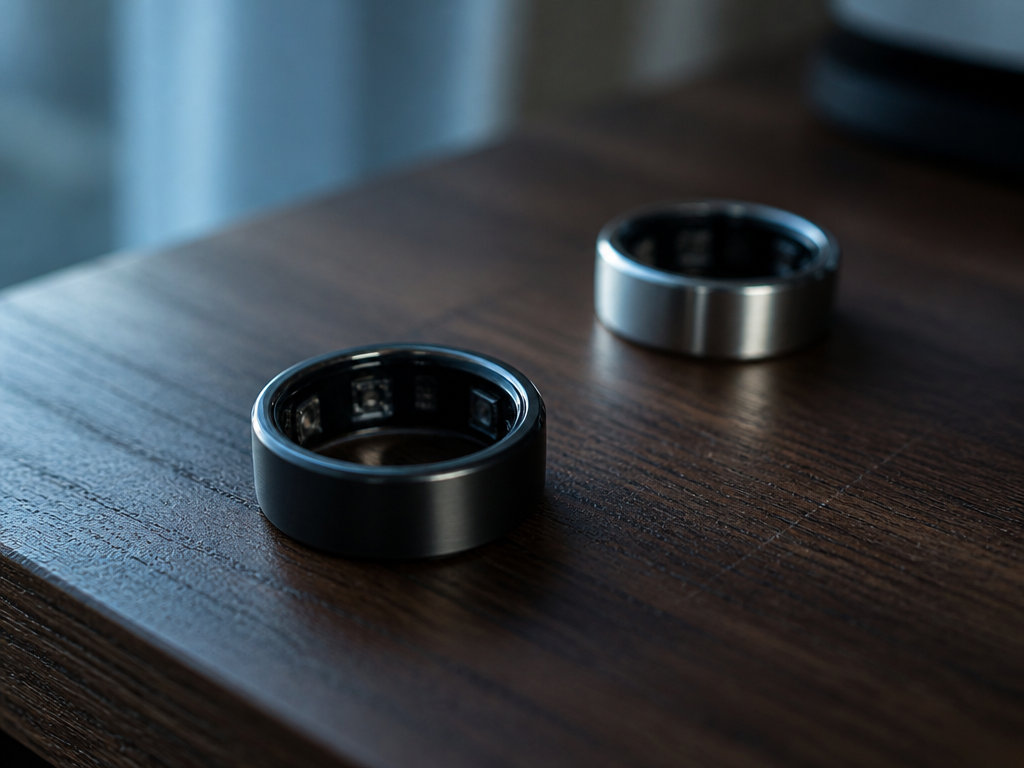
The advice is not stupid, which is why it is everywhere: if you want to know whether your caffeine cutoff is working, measure your sleep. Buy the ring, buy the band, watch the sleep onset latency number, move the cutoff earlier until the number comes down. I have given a version of that advice myself, in print. This summer I tested it by doing the opposite — I spent six weeks wearing Casio wearables that cannot see me sleep at all. A coin-cell smart ring that counts steps and calories and nothing else. A $14.99 quartz watch that counts nothing whatsoever. The comparison device, a fourth-generation Oura, stayed on my other hand the entire time with its app deleted from my phone.
The verdict: the device that told me the least moved my caffeine cutoff the furthest — about eighty minutes earlier per day on average — but the credit belongs to a paper log in milligrams, not to the ring. The ring's real contribution was that it never gave me a score to argue with.
The timing was not entirely mine. Casio has spent the past year quietly widening a strange little product line — a smart ring that reads like a shrunken 1980s digital watch, and now, per Japanese retail listings, two vintage-styled watches that count steps over Bluetooth. None of the new hardware measures sleep. That absence is the interesting part, and it is what made me want to run the test at all.
What the listings actually claim
Start with the caveat that governs this whole section: I have not held any of the new models. What follows is listing data and machine-translated spec text from Casio's Japanese storefront, and I am reporting it as such.
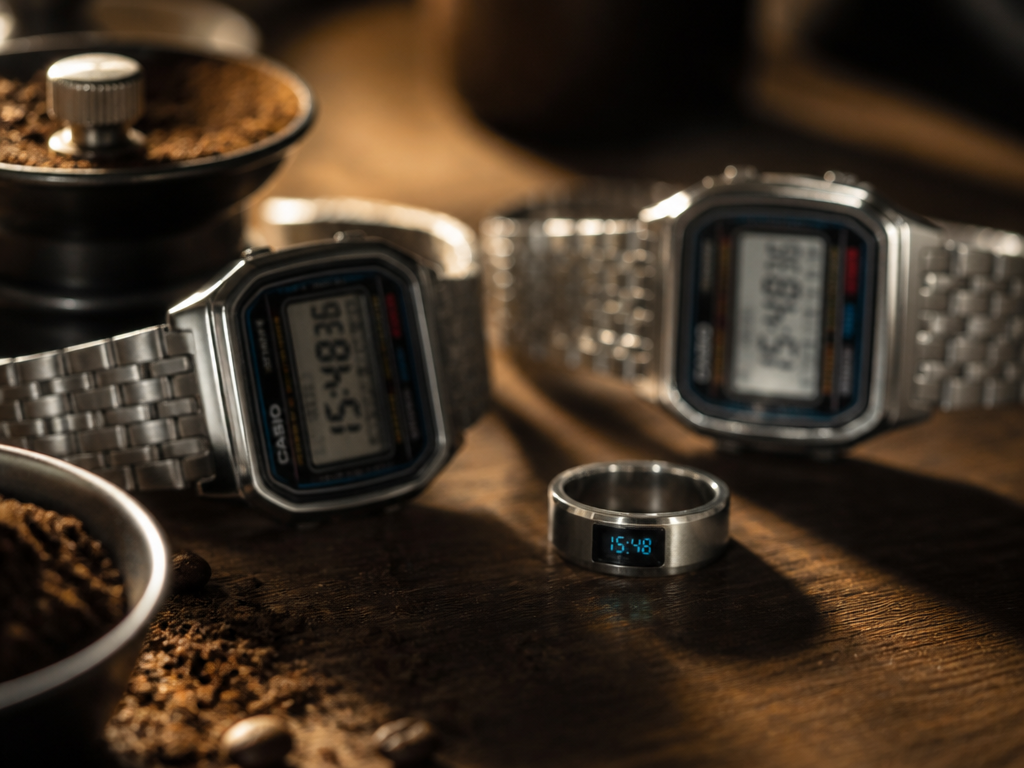
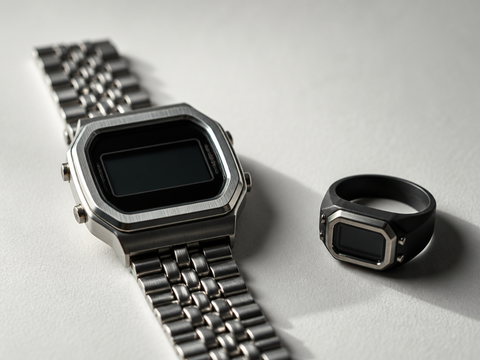
The headline item is a successor to the 2024 smart ring, the one that looks like someone shrank a resin-and-steel digital watch until it fit a finger. Per the listing, the changes are modest and mostly address the loudest complaint about the original:
- Two case sizes instead of one, which matters more than it sounds like it should
- An activity graph in the companion app rather than a bare daily step total
- The same coin-cell power arrangement, quoted at roughly a year of typical use
- Still no heart rate sensor, no accelerometer-based sleep estimate, no SpO2
That last line is the whole product. It counts steps, estimates calories from those steps, keeps time in two zones, runs a stopwatch and a timer, and syncs the step history to a phone when you ask it to. It does not attempt to tell you how you slept, because it has no way of knowing.
The two watches are the odder announcement. Both are revivals of thin steel cases from the era when a digital watch was still slightly futuristic, both on multi-link bracelets, and both — again, per the listing — carry Bluetooth step counting with app sync. The pricing I can read comes to roughly ¥27,500 and ¥30,800 including tax, which lands around $190 and $210 at the rate I paid this month, though import duty and proxy fees will make a mess of that for anyone outside Japan. There is no heart rate, no sleep staging, no GPS. It is step counting bolted onto a watch that would sell perfectly well without it.
Availability is where this stops being a product story and starts being a waiting story. Everything here is a Japanese listing. The 2024 ring did eventually reach other markets after a long delay, so the precedent is mildly encouraging, but nobody at Casio has said anything about a wider release for the new three, and I would not plan a purchase around the assumption. If you want one now, you are looking at a proxy buying service and a shipping estimate longer than the return window.
The one I could actually buy
What I have on my hand is the 2024 ring, the CRW-001-1JR, ordered through a proxy service in January. List price in Japan was ¥19,800 including tax. Landed cost to me, with the service fee, international shipping, and my own country's import handling, was $186. That is $37 more than a used Oura and $171 more than the quartz watch on my other wrist, which is a useful frame for everything that follows.
It is fixed-size — that is the complaint the successor apparently addresses — and mine is a half-size loose. It spins on my index finger when I type, which means the step count is optimistic by something like four to seven percent against my phone's pedometer over a matched hour. The display is a small monochrome LCD, legible in daylight, essentially invisible in a dark bedroom unless you press the light. Water resistance is enough for hand-washing and rain, not enough that I would swim in it. Seven months in there has been no low-battery indicator, so I cannot confirm or refute the roughly-one-year figure yet.
Syncing is a deliberate act. You open the app, you hold a button, it transfers the step history. There is no background trickle of data, no morning notification, no readiness score waiting for you at 6:40 a.m. During the test I opened that app four times in forty-one days, and two of those were to check that it still worked.
How I ran it
Forty-one consecutive nights, June 2 through July 12. Two blocks.
Block A, twenty-one nights: normal instrumented life. Oura on the left index finger, app on the phone, sleep score and onset latency read each morning before coffee, as I have done for about two years.

Block B, twenty nights: Oura still on the left index finger, still recording, app deleted from my phone. The only wearable feedback I could see was the Casio ring's step total on the right hand and the time on an F-91W. At the end of the block I reinstalled the app on a laptop and exported the whole period at once, so I had ground truth for nights I had spent blind.
Caffeine was logged in milligrams on paper both blocks, using dose weights rather than cup counts: 18 g of my usual medium roast pulled as a double, called 130 mg. A 350 ml mug of batch brew, 165 mg. Cold brew from the bottle in the fridge, 200 mg per 250 ml serving because that is what the roaster prints. Decaf counted at 7 mg per cup and I logged it anyway, because leaving it out would have made the afternoon column look emptier than my afternoons actually were.
Sleep onset came from two sources: the Oura estimate, hidden during block B and read only at the end, and a bedside notebook where I wrote the lights-out time and, in the morning, the last clock reading I remembered seeing. The notebook method is crude and biased toward overestimating how long I was awake. I used it anyway because it is the method available to a person wearing a step counter, which was the point.
Where the standard advice holds up
It holds up on the things you cannot feel.
The export at the end of block B showed something my notebook had entirely missed: on eight nights I woke for stretches of nine to nineteen minutes and had no memory of it in the morning. Six of those eight followed days over 300 mg. My paper record for those nights said, in effect, fine. The sensor said otherwise, and the sensor was measuring something real — my notebook cannot detect an awakening I do not remember, and no amount of attention will fix that.
It also held up on direction. When I finally read the export, the block B nights averaged 19 minutes to sleep onset against 24 minutes in block A. That is exactly the change I had guessed from the notebook, but I would not have trusted the guess without it. A five-minute difference across twenty nights is the kind of thing self-report invents when it wants to be right. Having it corroborated by a device that had no idea what I was hoping for is the single most useful thing any tracker did for me during this test.
And there is a version of the advice that survives everything I am about to say against it: if you have never measured, measure. Two weeks of data will tell you things about your own caffeine sensitivity that no general rule can. My own half-life appears to sit on the slow end — a 130 mg espresso at 4 p.m. is still doing something to me at 11 — and I only know that because a sensor told me before my notebook did.
Where it breaks down
The score becomes the thing you optimize. On six nights in block A I went to bed later than I wanted to, on purpose, because I had been up past midnight the night before and going to bed at 10 would have produced a fragmented, low-scoring night that dragged the weekly average down. That is a sentence about a number, not about sleep. Four of those six nights I was tired at 10 p.m. and stayed up anyway. Nothing in block B produced a decision like that, because the Casio ring's step count is not a verdict on the previous eight hours of your unconscious life. It is a count of steps.
Precision does an impression of accuracy. The app gives onset latency to the minute. It is an estimate built from movement and heart rate, validated against lab polysomnography with a margin considerably wider than a minute, and I know that, and I still read "23 min" as though it were 23. During block B, my notebook produced entries like "lights out 10:40, last saw 11:00-ish" — which is less precise and much more honest about what I actually know. The rougher instrument encouraged rougher, more accurate thinking.
The rule is keyed to the wrong event. Every cutoff rule I have ever read is anchored to a clock hour, and the clock hour is chosen for the time you intend to be asleep. Caffeine does not care about your intentions. The usual figure quoted for its half-life is around five hours, with real person-to-person variation somewhere between three and seven, so the meaningful anchor is the moment you actually fall asleep — which, in my case, was routinely fifty minutes later than the moment I planned to. A 2 p.m. cutoff aimed at an 11 p.m. bedtime is a 2 p.m. cutoff aimed at an 11:50 p.m. sleep onset, and those are not the same instruction.
The comparison
Four instruments, forty-one days. The last column is the one I care about: the number of days each thing changed something I actually did.
| Instrument | What I saw each morning | What it cannot do | Days it changed a decision |
|---|---|---|---|
| Oura Gen 4 ($349 + $5.99/mo) | Sleep score, onset latency, HRV, readiness | Tell me why; distinguish 23 min from 31 min honestly | 6 — but 4 of those in the wrong direction |
| Casio smart ring ($186 landed) | Yesterday's step total | Measure sleep in any form | 2 |
| Casio F-91W ($14.99) | The time | Everything | 0 |
| Paper log in mg (free) | Yesterday's caffeine, by hour | Detect anything I didn't notice | 19 |

If you are buying one thing to fix your caffeine timing, buy a notebook and a set of milligram figures for the coffee you actually drink. It cost nothing and it outperformed a $349 ring three to one.
That is not a knock on the sensor. It is a claim about which piece of the system was doing the work, and in my six weeks the work was being done by the act of writing down 130 mg at 3:40 p.m. and having to look at it the next morning.
The caffeine numbers
Block A: mean intake 312 mg per day, mean time of last dose 3:12 p.m., mean onset latency 24 minutes.
Block B: mean intake 268 mg per day, mean time of last dose 1:48 p.m., mean onset latency 19 minutes.
The cutoff moved 84 minutes earlier. Intake fell 44 mg, which is roughly a third of an espresso and not a number I would defend hard.
Split the whole forty-one nights by last-dose time instead of by block, and it gets more legible. Nights where my last caffeine landed before 2 p.m. (17 nights) averaged 17 minutes to sleep onset. Nights after 4 p.m. (11 nights) averaged 29 minutes. The middle band did what middle bands do and sat between them without much conviction.
I am not going to compute a correlation coefficient on forty-one nights of one person's data and present it as though it means something. The confounds are obvious and I lived through all of them: I ran more in the second block, the weather turned, and I knew what I was hoping to find. What I will say is that the direction is consistent, the size is large enough to notice without instruments, and it matches the slow-metabolizer pattern I already suspected.
What I couldn't test
The new hardware, first and most importantly. I have read listings. I have not worn the successor ring or either steel-bracelet watch, I do not know whether the second case size fixes the spin problem that makes my step count optimistic, and I have no idea what the new activity graph looks like in practice.
I could not blind myself. I knew which block I was in and I knew what I expected. A better version of this test has someone else hold the caffeine schedule.
One person, forty-one nights, one metabolism. If your own caffeine clearance runs fast, the entire back half of this article may describe a problem you do not have.
And I still cannot confirm the ring's battery claim. Seven months, no warning. Ask me in the spring.
Who this is for, and who it isn't
It is for people who already have sleep data and have stopped acting on it. If you have two years of scores and your behaviour has not changed in eighteen months, the marginal sensor is not your problem, and something that refuses to grade you might genuinely help. It is also for people who like a small, strange, well-built object and are honest that the step counting is a garnish — that is a legitimate reason to buy a watch, and Casio's newer wearables are aimed squarely at it.
It is not for anyone who has never measured. Start with the sensor; you need the baseline. It is not for people investigating a real sleep problem, where fragmentation and breathing events matter and a step counter is worse than useless because it looks like it is helping. And it is not for anyone outside Japan who wants the new models this quarter — the proxy fees are real, the wait is real, and the sensible move is to wait for a wider release that may not come.
The honest version of the rule
The advice I would now give, having tried to break it: stop caffeine eight hours before the time you actually fall asleep, not eight hours before the time you plan to be in bed. Find that gap once with a sensor, then write it down, because the gap is the part people get wrong and no device will correct it for you.
And on hardware: buy the instrument whose output can change what you do before noon tomorrow. A number that only makes you feel graded is decoration, however precise it is. That standard clears a paper log easily. It clears a step counter, barely, on the two days it made me walk after dinner. It clears a sleep score maybe a third of the time, which for $349 and a subscription is a worse ratio than I had been telling myself.
What this looks like at 1:30 p.m.
There is a 250 ml bottle of decaf cold brew in the door of my fridge, brewed the night before with beans that cost more than the caffeinated ones, so that the reach at 3 p.m. does not have to be a decision. The last real coffee goes in at 1:30, which is eight hours before 9:30, which is when I actually fall asleep rather than when I get into bed. The Oura app is still not on my phone; I export it on a laptop on the first Sunday of the month and look at it for about ten minutes. The Casio ring is still on my right index finger, still spinning slightly when I type, still telling me nothing about last night.