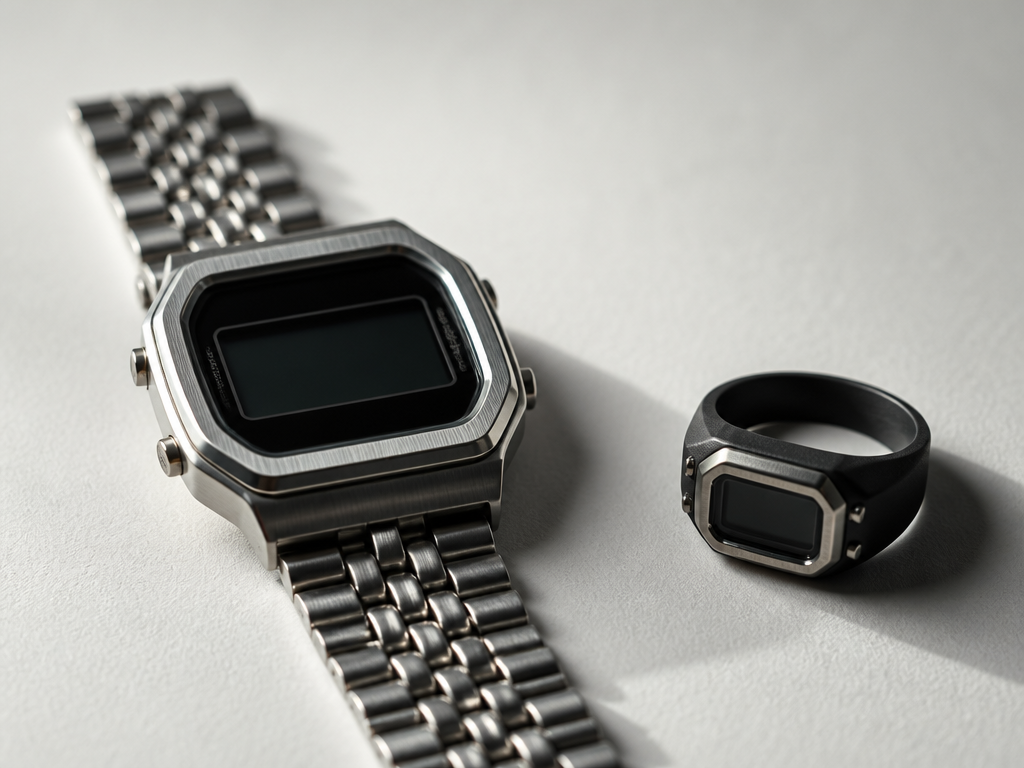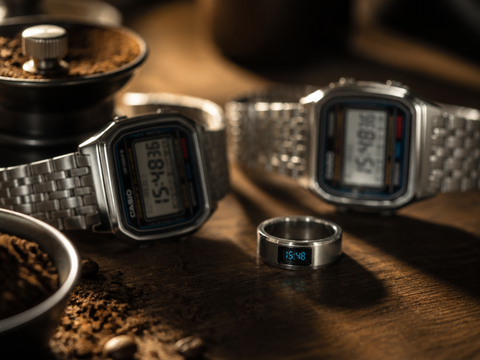
The three Casio wearables I bought for this piece cost ¥52,000 before a forwarding service in Chiba charged me another ¥5,800 to put them in an envelope. Two are digital watches from the square-and-plastic lineage everyone's wrist knows from 1989, now with Bluetooth and a step counter. The third is the CRW-001-1JR, the ring, which is a watch you wear on a finger and which I have now explained to four separate people at four separate coffee bars.
I did not buy them to review the step counter. I bought them because I wanted to spend a month testing the most repeated claim in caffeine culture — that coffee after 2 p.m. will cost you sleep — and I was curious whether the current wave of retro fitness hardware could contribute anything at all to answering it.
The verdict: the caffeine rule held up in my own 31 nights, but only in a much weaker and later form than the version people repeat, and none of the three Casios measured any part of it — which turned out to be the honest and interesting thing about them.
The hardware, and what it actually does
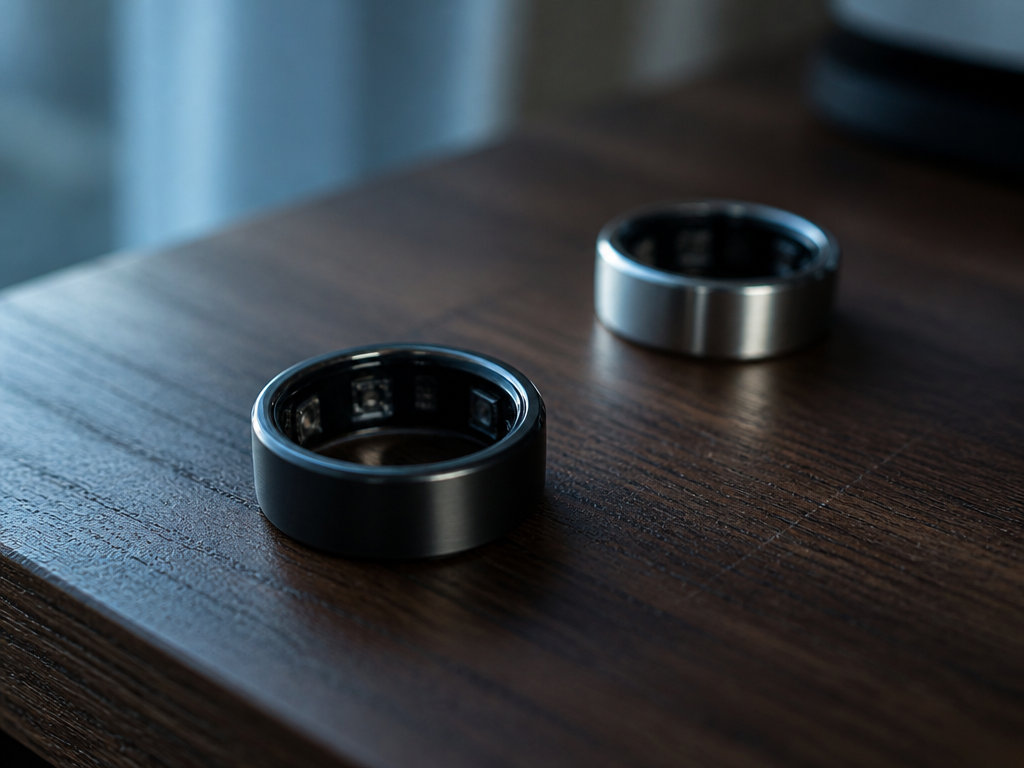
Start with the ring, because it's the one that makes people ask. The CRW-001-1JR is a stainless band with a genuinely tiny digital module — the display is about the width of a grain of rice, and you read it the way you read the date window on a mechanical watch, by pointing your knuckle at a light source and squinting. It shows time, and it counts steps, and it will hand those steps to a phone app over Bluetooth. That's the feature list. It is not a heart-rate sensor, there is no accelerometer-based sleep staging, and there is nothing under the band touching skin except more band.
The two watches are the same proposition in the shape people already own. Casio's Japanese SKUs run to eleven characters and I'll spare you; call them the square one and the rounded one. Both are the vintage silhouette with a multi-link steel bracelet, both have a coin cell rated in years rather than days, and both now do a pedometer with a daily goal and a Bluetooth handoff. The square one is the better watch by a margin that has nothing to do with tracking: the display contrast is higher, and the step count lives on the second screen rather than fighting the time for space.
| Device | What it measures | Sync | Battery | Price (Japan) |
|---|---|---|---|---|
| CRW-001-1JR ring | Steps, estimated distance | Bluetooth, manual pull | ~2 weeks claimed | ¥19,800 |
| Square digital | Steps, daily goal, time | Bluetooth | Coin cell, years | ¥17,600 |
| Rounded digital | Steps, daily goal, time | Bluetooth | Coin cell, years | ¥19,800 |
| Control ring (mine, 2 yrs old) | Sleep stages, HR, HRV, skin temp | Bluetooth, automatic | 5–6 days | $349 + subscription |
Step accuracy, for what it's worth: over ten deliberate 1,000-step walks, the square watch averaged 991 and never missed by more than 3%. The ring averaged 1,046 and once logged 1,180, which I traced to twenty minutes of hand-grinding coffee. A pedometer on a finger counts your hands. That is not a defect so much as a physics problem, but if you grind by hand, or knit, or play an instrument, your daily total is fiction in a specific direction.
So: it counts steps, badly on one device and well on two, and that's the whole health story. Not much of a fitness tracker. Still more than a watch that does nothing.
Where the 2 p.m. rule actually comes from
Here is what I assumed before I started reading: that somewhere behind "no coffee after 2 p.m." was a study of people drinking coffee at 2 p.m.
There isn't one. The rule has a lineage, and the lineage is thinner than the confidence it gets repeated with.
The oldest layer is sleep hygiene itself, a phrase usually credited to Peter Hauri in the late 1970s. Hauri's rules were a clinical checklist for insomnia patients — keep a regular schedule, don't lie in bed awake, don't drink caffeine in the evening. Evening. No clock time, no milligram figure, and crucially it was advice for people already sleeping badly, not a general population instruction. It was a starting point for a conversation with a clinician, and it worked the way checklists work: by being memorable and slightly over-broad on purpose.
The second layer is pharmacology, and this is where the number gets manufactured. Caffeine's half-life in a healthy adult is usually given as five to six hours, and the arithmetic is irresistible: 200 mg at 2 p.m. means about 100 mg still circulating at 8 p.m., which is roughly a strong cup, which sounds like a lot to be carrying into bed. Do that arithmetic backward from a 10 p.m. bedtime and you land on 2 p.m. That's the whole derivation. It is a division problem wearing the clothes of a finding.

The arithmetic also quietly discards the most important part of the pharmacology, which is the spread. That five-to-six-hour figure is a population midpoint sitting on top of enormous individual variation — a range that runs from something like two hours to well past eight, driven substantially by a liver enzyme, CYP1A2, whose activity is partly genetic. Oral contraceptives can roughly double the half-life. Smoking cuts it. Pregnancy stretches it dramatically. The single number that makes the 2 p.m. calculation work is the one number that varies most between the people being advised.
The third layer is the study everyone is actually gesturing at, usually without naming it: a 2013 paper in the Journal of Clinical Sleep Medicine by Drake and colleagues, testing caffeine taken 0, 3, or 6 hours before bed. It's a real, careful, double-blind, placebo-controlled trial, and it found what it's cited for — 400 mg six hours before bedtime measurably disturbed sleep, and the people taking it largely didn't notice.
Twelve participants. Four hundred milligrams, which is four cups, not one. Healthy normal sleepers, not the population most worried about this. And the sleep measurement, alongside diaries, came from a consumer EEG headband — the Zeo — sold by a company that folded the same year the paper came out. I want to be careful here, because "small study" is a lazy dismissal and this isn't a bad paper. It's a well-designed pilot doing exactly what a pilot does. The problem is entirely downstream: a twelve-person crossover trial of a four-cup dose at three fixed intervals became, by the time it reached podcasts and app onboarding screens, a universal clock time that the study never tested with a dose most people never drink.
And there's a detail I keep turning over, because it's the reason I'm writing this for a magazine about caffeine while wearing three Japanese pedometers. The canonical evidence for the caffeine-and-sleep rule was generated by a consumer wearable that no longer exists, made by a company that couldn't survive its own market. Every claim in this space rests on some device's scoring algorithm, and those algorithms are proprietary, revised without notice, and occasionally discontinued entirely. We inherit the numbers and lose the instruments.
What I actually did
Thirty-one nights, one subject, no blinding, and a fixed afternoon dose: one 20 g pourover in a 350 ml cup, somewhere between 180 and 220 mg depending on which caffeine table you trust. Morning coffee was unchanged and unrestricted, because I was not going to survive a month otherwise, and because the claim under test is about the afternoon.
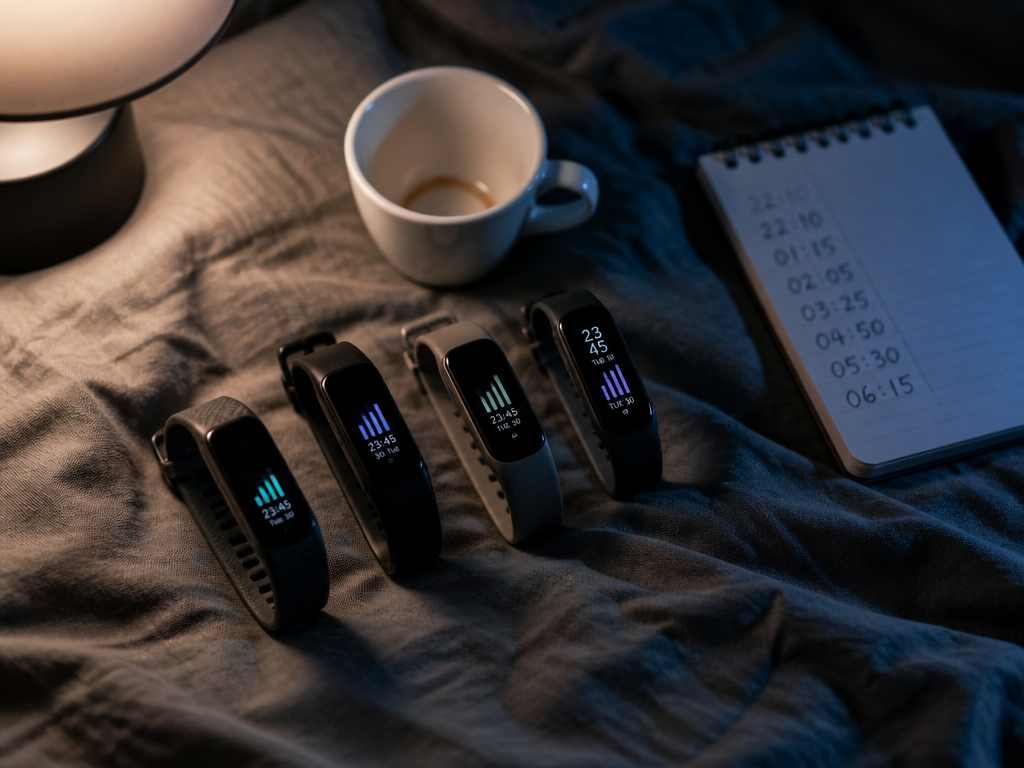
I randomized the cutoff each night by drawing from a bag of four folded slips: last caffeine before noon, 12–2 p.m., 2–5 p.m., or after 5 p.m. Bedtime was held between 10:30 and 11:15. I logged perceived sleep onset in a paper diary before I slept — writing down the time I put the book down — and read the control ring's onset and wake-after-sleep-onset numbers only at the end of the month, in a batch, so I wasn't scoring tonight against yesterday's dashboard.
The Casios were in the study as instruments and, as it turned out, as controls on my own enthusiasm. I wore the square watch and the ring daily. Their contribution to the sleep question was zero, by design, and I'll get to why that's the more useful finding.
The numbers
| Last caffeine | Nights | Median onset (diary) | Median WASO (control ring) |
|---|---|---|---|
| Before noon | 9 | 12 min | 31 min |
| 12–2 p.m. | 8 | 14 min | 34 min |
| 2–5 p.m. | 7 | 17 min | 38 min |
| After 5 p.m. | 7 | 26 min | 51 min |
Read that table the way I do: three of the four rows are indistinguishable from each other, and one isn't.
The gap between "before noon" and "12–2 p.m." is two minutes of self-reported onset, which is smaller than my error in reading a bedside clock. The 2–5 p.m. bucket is three minutes worse than that, on seven nights, unblinded, by a person who knew what he was hoping to find. If you handed me that data cold I would tell you it shows nothing.
The after-5 p.m. row is different in kind. Twenty-six minutes to fall asleep against twelve, and a fifty-one-minute chunk of fragmented night after that, on nights I mostly did not experience as bad — which is the part of the 2013 finding that matched my own month most cleanly. I did not feel wrecked. The ring said I was awake for the better part of an hour I have no memory of. Two nights in that bucket were the worst of the month and I'd have blamed either of them on something else: a late argument, a warm room.

So my own thirty-one nights say the following, and nothing more: a strong cup within roughly five hours of bed cost me real, measurable, unfelt sleep, and a strong cup at 2 p.m. — the actual hour in the actual rule — did essentially nothing I could distinguish from noise. My sample is one person. My palate for this is untrained; I have no idea whether the effect I found is average, mild, or extreme. Anyone with a slower CYP1A2 could run the identical protocol and find the 2 p.m. bucket miserable.
What the retro casing is doing
The fair critique of the two watches is that a pedometer in a 1989 shell is a marketing decision, and the fair defense is that the shell is the honest part. The square Casio tells you the time and how many steps you took. It does not produce a readiness score, a recovery percentage, a stress index, or any of the composite numbers whose provenance is a spreadsheet inside a company you can't audit. Its claims are small enough that you can check every one of them, which I did, with a hallway and a counter.
That's the connection I didn't expect to find with the caffeine rule, and it's the reason both halves of this piece belong in the same article. "No coffee after 2 p.m." is popular for the same reason the A-series is: it fits on a watch face. It's a single legible number that survives being repeated by someone who never read the source. The retro casing and the round-numbered rule are both compressions, and compressions travel — which is a virtue when what's inside is a step count and a problem when what's inside is a twelve-person pilot and a division problem.
Where the retro pitch strains is the ring. The CRW-001-1JR is a lovely object and a genuinely strange one, and I've worn it every day for reasons that have nothing to do with data. But it's the device most likely to be bought as a fitness tracker by someone who has seen a smart ring advertised, and it's the one that will disappoint hardest: it counts your hands, it holds no history worth reading, and it competes in a shelf position occupied by rings that do sleep staging. Sold as jewelry with a step counter, it's charming. Sold as a wearable, it's outmatched by hardware costing twice as much and doing ten times more.
Availability, which is still the actual story
All three were Japan-market listings when I ordered. Getting them meant a forwarding address, a customs declaration I filled out wrong the first time, and about a 30% premium on the ring's sticker price once shipping and the service fee landed. Three weeks door to door.
Casio has widened distribution on this kind of release before, and the ring's predecessor generation did eventually surface outside Japan, so the pattern suggests patience is rewarded. But there's no announced date, no confirmed international SKU for the step-counting watches, and no pricing outside yen. If you're tracking this line as a product story, that's where it sits: the hardware exists, it does roughly what the spec sheet says, and the constraint is a shipping label rather than a feature.
Who this is for, and who it isn't
Buy the square digital if you already like this watch, want a step count you can verify, and consider a two-year battery a feature rather than a compromise. Buy the ring if you want an odd, well-made object on your finger and you'd have bought it with no sensors at all.
Don't buy any of them to answer a question about your sleep. They cannot see sleep. They are not built to and don't claim to, and I'd rather say that plainly than praise them for restraint they never marketed. If the caffeine question is what you're after, you need something that measures the night, and — as this month reminded me — even then you're trusting a proprietary scoring algorithm that might not outlive the company that wrote it.
And don't import at a 30% premium for the tracking. Wait for the wider release, which the CRW-001 line's history suggests is likelier than not. If you're buying for the watch, the premium is a matter of how much you want it now. If you're buying for the pedometer, it isn't a close call.
The square digital is the only one of the three I'd buy again, and it's the one that measures the least.
The end of it
I ran this test hoping the retro wearables would surprise me, and they didn't; they did the one thing on the box and left the interesting question alone. That's more than I can say for the rule I was testing, which claims a precision that its own sources never produced.
The myth is that caffeine after 2 p.m. will keep you awake.
The more accurate version is that a four-cup dose within about six hours of bed measurably disturbed the sleep of twelve people in one small trial, that your own caffeine half-life may be half or double theirs, and that 2 p.m. was never a finding — it's a clock reading somebody arrived at by doing long division backward from bedtime.