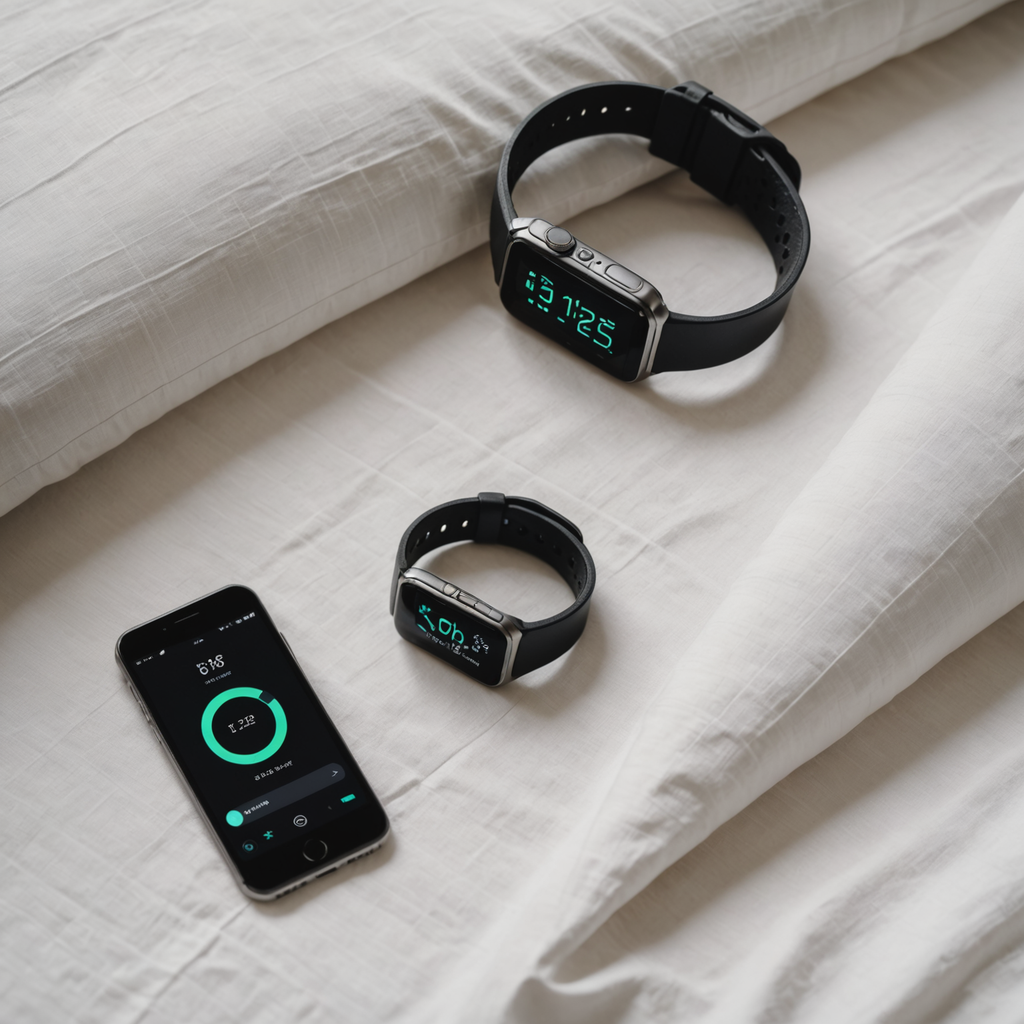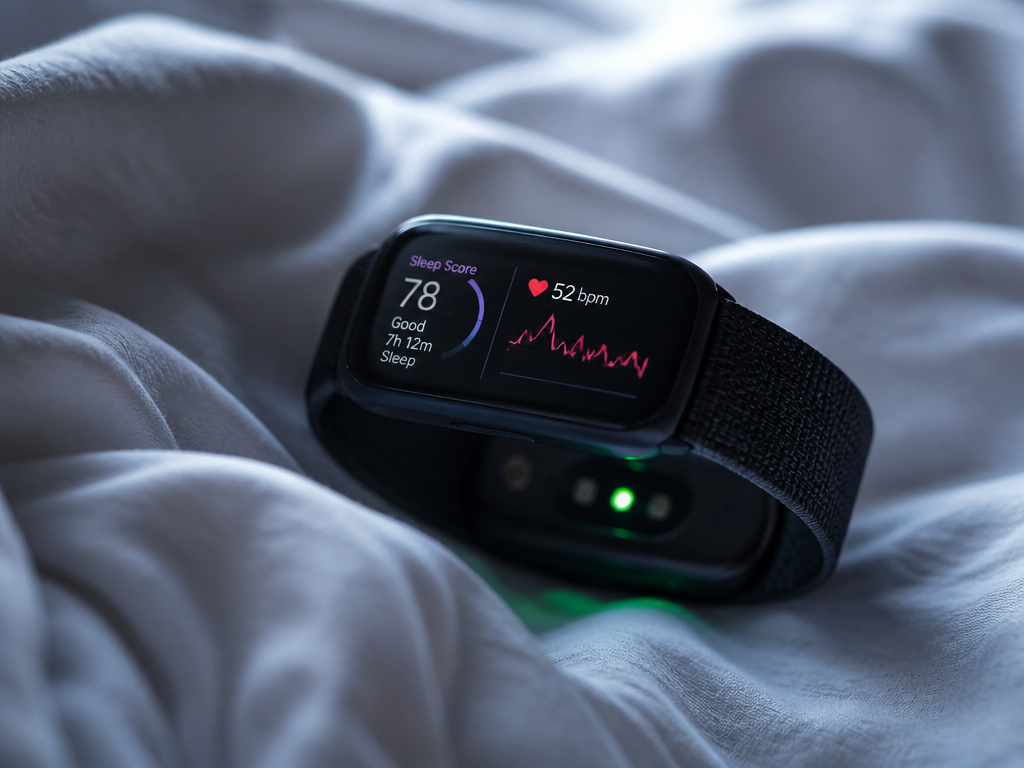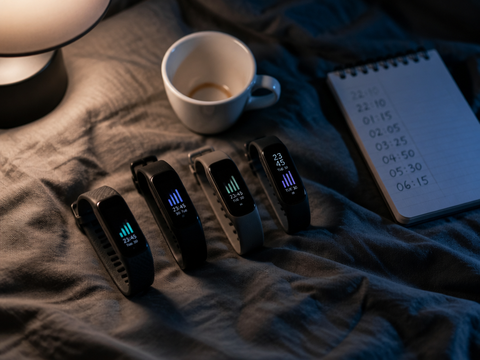
Every second week an Australian deal newsletter drops a fitness tracker at forty percent off, and every second week I nearly buy it. In March I stopped nearly and bought four. This piece is what sixty nights of discounted smartwatch deals taught me about the only number I care about here: how long it takes me to fall asleep after an afternoon coffee.
The verdict: the Amazfit Active 2 at AU$139 is the only one of the four I'd buy again — not because its sleep staging is accurate (none of them are) but because it was the only genuinely cheap band that noticed when I'd sabotaged the night with a 4pm espresso.
How I tested, and what I couldn't
Two watches per night, one per wrist, swapping sides each night to cancel out whatever the wrist bones do to a green LED. Thirty nights per device across a sixty-night block. Every night I wrote down lights-out time and the last clock reading I could remember, which gives a rough manual onset latency — imprecise at the margins, but consistently imprecise, which is what matters for a comparison. On twelve of the nights I also wore a Polar H10 chest strap as a heart-rate reference. Only twelve, because sleeping in a chest strap is miserable and I am not a laboratory.
The caffeine variable: on thirty of the sixty nights I drank a double shot at 4pm, roughly 150mg. The other thirty, nothing after 1pm. I alternated in blocks of five rather than randomising properly, which is a real weakness — the blocks correlate with weeks, and weeks have their own moods.
No polysomnography. No sleep lab. One person, one palate for tiredness, one bedroom. Read the numbers below as a stress test of four devices under identical conditions, not as validation science.
What most people do
The deal-newsletter buying pattern is remarkably consistent, and I've done it myself. You see a percentage off. You check the feature list, which is enormous — 160 workout modes, blood oxygen, stress scoring, menstrual tracking, a torch. You compare that list against an Apple Watch SE at AU$399 or a Forerunner 165 at AU$449, conclude you're getting eighty percent of the watch for thirty percent of the money, and buy.
Then the watch arrives and you never open the workout modes. You open the sleep score. Every one of these devices leads with a two-digit number out of 100 and a stacked bar of deep, light, REM, awake. That's the screen you'll look at 350 times a year, and it is the single feature nobody comparison-shops on, because you can't see it in a spec sheet and the discount doesn't mention it.
So the buying decision gets made on workout modes and the ownership experience runs entirely on sleep staging. That mismatch is the whole problem with how budget watch deals are marketed and how they're actually used.
What the evidence suggests
Here's the grid. "Onset error" is how much earlier the device logged sleep onset than my written log, median across thirty nights. All four ran early — they all decided I was asleep while I was still lying there being a person.
| Device | Paid (AUD) | Median onset error | Detected the 4pm-coffee shift | Buy again |
|---|---|---|---|---|
| Xiaomi Smart Band 9 | $59 (RRP $79) | 19 min early | No — +3 min | No |
| Amazfit Active 2 | $139 (RRP $189) | 6 min early | Yes — +18 min | Yes |
| Huawei Watch Fit 3 | $149 (RRP $199) | 11 min early | Partly — +9 min | On deep sale only |
| Coros Pace 3 | $349 (full price) | 7 min early | Yes — +21 min | If you also race |
My own logged shift was +19 minutes: median onset went from 14 minutes on no-coffee nights to 33 minutes on espresso nights. That's the signal. The Amazfit found 18 minutes of it and the Coros found 21. The Xiaomi found three, which is noise wearing a hat.
The staging numbers are where it gets uncomfortable. Same wrist, same nights, same body:
- Xiaomi Smart Band 9: median 1h52m deep sleep
- Huawei Watch Fit 3: 1h14m
- Coros Pace 3: 1h06m
- Amazfit Active 2: 58m
Those can't all be true. They differ by a factor of nearly two on identical nights. Wrist PPG infers stages from heart rate variability and motion, and the inference is soft — this is well established across the wearable field, and it does not get fixed by spending more. The Coros at AU$349 disagreed with the Amazfit at AU$139 by eight minutes of deep sleep, which is nothing, while the Xiaomi at AU$59 disagreed with everyone by an hour.
What the extra money buys, on this evidence, is not better staging. It's better timing — knowing when you went horizontal and when you actually stopped moving. That's the measurement that's mechanically easy and the one the cheapest band still got wrong by nineteen minutes.
If you're buying one discounted tracker to watch your caffeine cutoff, buy the Amazfit Active 2 on sale and ignore its sleep score entirely.
One more thing the Amazfit does that the Xiaomi doesn't: it exports. Sleep onset, wake time, and a per-minute heart rate series come out as CSV via Zepp. The Xiaomi gives you a picture of a bar chart. If your intent is to compare your own nights against each other rather than against a population average, exportability is worth more than every workout mode combined.
What I actually do
The Amazfit lives on my left wrist from about 9pm and comes off at the bathroom sink in the morning. I don't wear it during the day. Notifications are off, always-on display is off, and the battery does about eighteen days on that duty cycle instead of the claimed ten, because it's asleep for sixteen hours a day too.
I've removed the sleep score from the watch face. The only field I look at is the sleep onset timestamp, and I look at it once, in the kitchen. Then it goes into the same spreadsheet as the manual log, next to a column for the time of my last coffee and its rough dose.
What that produces after a couple of months isn't a diagnosis, it's a scatter. Not "your sleep quality was 78" — a cloud of dots where the x-axis is when I stopped drinking coffee and the y-axis is how long I lay there. The watch is a ledger, not a grader. It's very cheap for a ledger.
The three tracking features I paid for and never used: blood oxygen, stress score, and body temperature. I can't verify any of them against anything, so they're decoration.
Who this is for, and who it isn't
Buy the discounted Amazfit if you want a defensible bedtime and wake time, you'll export the data, and you're running or riding casually enough that GPS lock in forty seconds instead of eight is not a problem you have.
Don't if you're chasing training load, structured intervals, or race pacing — then the Coros Pace 3 at AU$349 is the honest floor, and it's a better watch than its price implies. Don't buy any of these if you want a clinically meaningful read on your sleep architecture; at every price tier including Apple's and Garmin's, wrist staging is an estimate wearing a confident interface.
And don't buy the AU$59 band. It's the one that will actually get bought, because it's the one that shows up in the newsletters, and it was blind to the only variable I was testing.
My last coffee is at 1:15pm now. Not because the watch recommended it — it has never recommended anything — but because the 4pm dots and the 1pm dots sat in two visibly separate clumps for two months, with about half an hour of my evening between them.