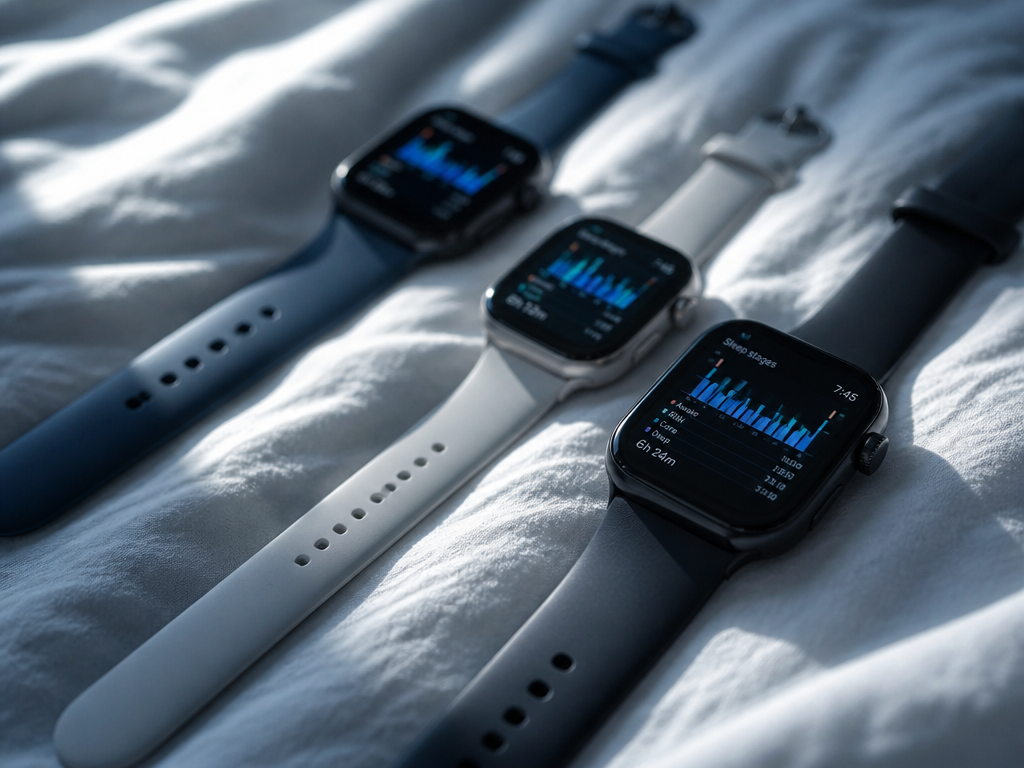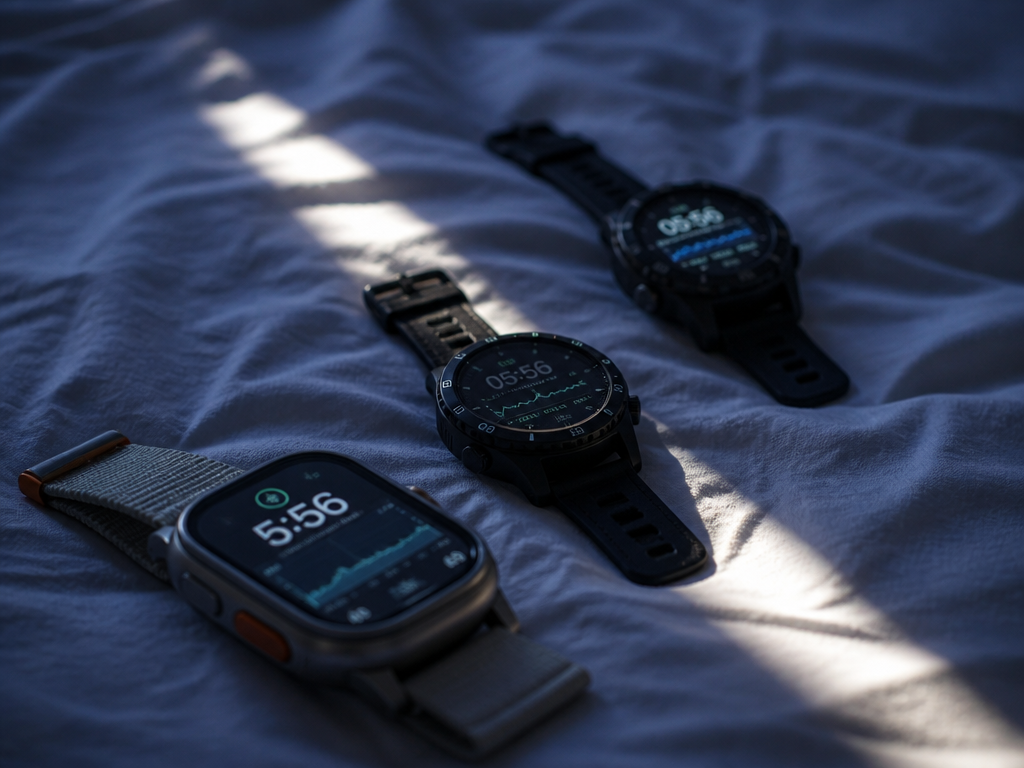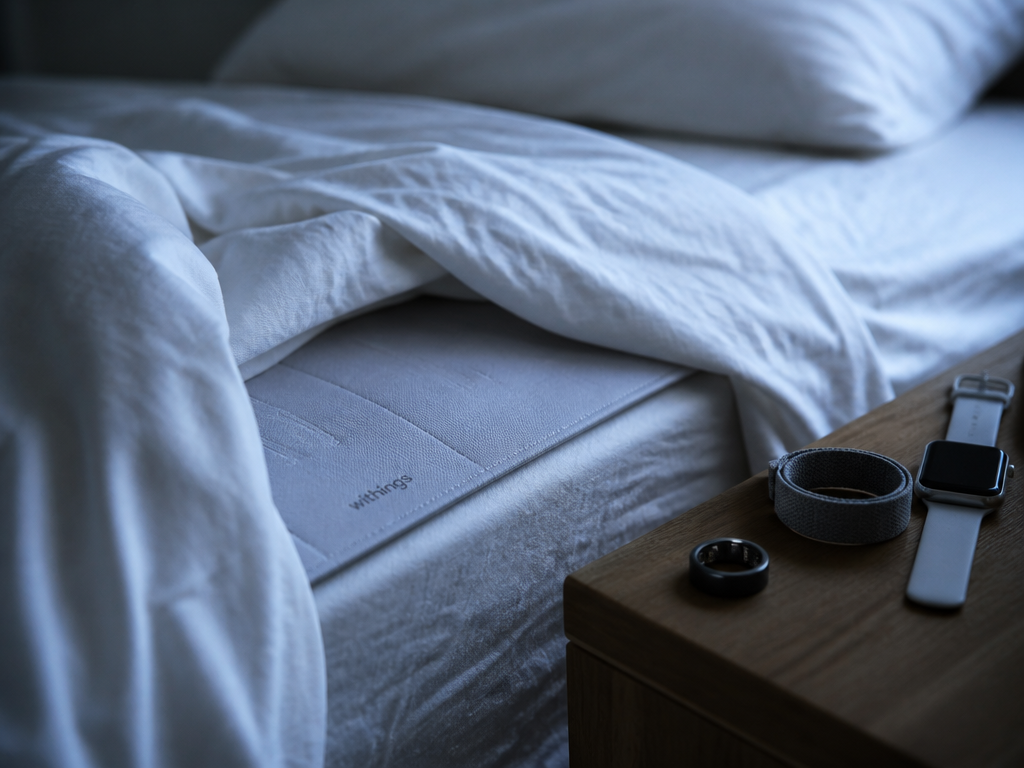
At 7:04 this morning, my ring had an opinion.
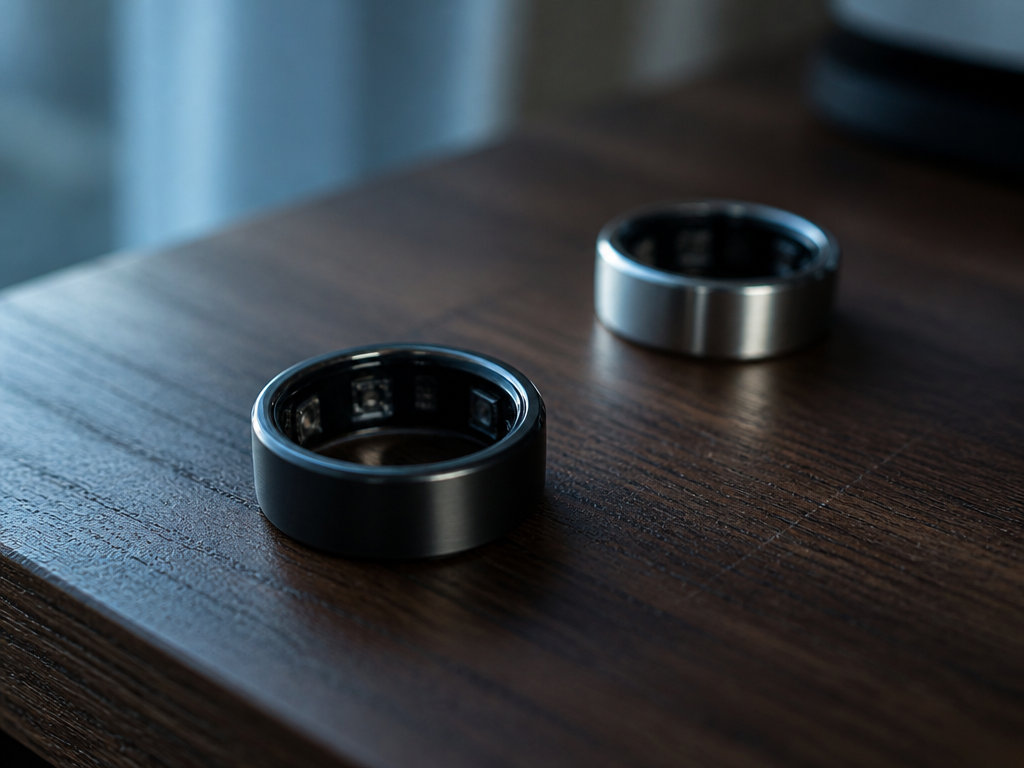
Sleep score 71, down eleven points, and beneath it a line of advice in the calm sans-serif of software that has never once been unsure of itself: consider limiting caffeine later in the day. I had, in fact, had an espresso at 4:40 p.m. But the Samsung Galaxy Ring did not know that. It knew my finger ran warm, my resting pulse sat four beats above baseline, and I moved more than usual between two and four. Everything past that was inference — a long chain of it, running from an accelerometer on my index finger, back through a decade of consumer sleep software, to a study with twelve people in it.
That chain is the actual product. The hardware in a smart ring is close to commodity now: a three-axis accelerometer, a couple of green and infrared LEDs doing photoplethysmography against the palmar arteries of your finger — a better optical site than the wrist, which is one of the honest engineering arguments for the form factor — and a skin temperature sensor. Oura, Samsung, Ultrahuman, and the RingConn-class newcomers are all reading roughly the same physics. What you are buying is the sentence at 7:04 a.m.
So it's worth asking where that sentence came from.
Where the "no coffee after 2 p.m." rule actually comes from
It comes, more or less, from one paper.
Drake and colleagues, 2013, in the Journal of Clinical Sleep Medicine: "Caffeine effects on sleep taken 0, 3, or 6 hours before going to bed." Twelve healthy normal sleepers. Double-blind. Each got 400 mg of caffeine — or placebo — at bedtime, three hours before bedtime, and six hours before bedtime. The headline result, the one that escaped the paper and became a rule the entire wellness internet now recites: even the six-hour dose measurably cut sleep, on the order of an hour of total sleep time, and the subjects mostly didn't notice it had happened.
That last part is the genuinely interesting finding and it gets quoted least. The self-report and the measurement disagreed. People slept worse and reported sleeping fine.
Now the parts that get quoted even less. Twelve subjects. A fixed 400 mg — that's roughly two to three mugs of drip coffee at once, not a 4:40 espresso, which is closer to 65 mg. And the sleep itself was measured with a Zeo, a consumer EEG headband, in participants' homes, not with full laboratory polysomnography. A study part-funded by a sleep-tracking company, run on that company's sleep tracker, is now the evidentiary spine under the advice your sleep tracker gives you. I don't think that's fraud. I think it's a loop, and loops are worth naming when you're standing inside one.
Six hours before an 11 p.m. bedtime is 5 p.m. The rule that actually circulates is 2 p.m., which is three extra hours nobody in the paper measured.
Can a smart ring tell whether caffeine hurt your sleep?
Not directly, and it's worth being precise about why. No ring on the market has a caffeine sensor. The closest thing to one is a tag you type in yourself. What the ring measures is movement, pulse rate and its beat-to-beat variability, blood oxygen, and skin temperature; from those it estimates when you fell asleep, when you woke, and which stage you were in. Then a model correlates last night's estimates against whatever you logged. That is an n-of-1 observational study with no control condition, no blinding, and a strong prior baked into the software about what caffeine does.
The estimates themselves are decent at the coarse question and shaky at the fine one. The lineage here runs back to wrist actigraphy — Cole and Kripke published the workhorse sleep/wake scoring algorithm in 1992, and its central weakness has never gone away: lying still is hard to distinguish from being asleep. de Zambotti and colleagues (2019, Behavioral Sleep Medicine) put an Oura ring against polysomnography in 41 adolescents and young adults and found sensitivity to sleep around 96 percent and specificity to wake near 48 percent. In plain terms: if you're asleep, it knows. If you're awake but still, it's near a coin flip. Chinoy et al. (2021, Sleep) ran seven consumer devices against PSG and found the same shape of error, with sleep staging the weakest link across the board.
So: total sleep time and sleep onset, useful. Your deep-sleep minutes, treat as a mood ring with a spreadsheet.
What actually happens between the cup and 3 a.m.
Walk it forward in order. You drink the coffee; caffeine crosses the gut wall almost completely and peaks in plasma somewhere around 30 to 60 minutes later. It's small and fat-soluble, so it crosses the blood-brain barrier without a transporter and without much delay.
Once there, it does one main thing: it sits in adenosine receptors — A1 and A2A — without activating them. Adenosine has been accumulating in your brain all day as a byproduct of ATP breakdown, and its binding is a large part of what sleep pressure is. Caffeine doesn't remove any of it. It occupies the doorway. The adenosine keeps piling up behind the blocked signal, which is why the crash when caffeine clears can feel so abrupt — that's not depletion, that's the backlog arriving at once.
Meanwhile your liver is working on it, mostly via the CYP1A2 enzyme. Population half-life is roughly four to six hours, but the individual spread is enormous — reported ranges run from under two hours to nine or ten. Oral contraceptives roughly double it. Smoking roughly halves it. Late pregnancy can stretch it past fifteen hours.
Whatever is left at lights-out does two measurable things: it suppresses slow-wave activity in the first sleep cycles, and it nudges your circadian clock. Burke and colleagues (2015, Science Translational Medicine) gave subjects 200 mg three hours before bed and found the evening melatonin rise pushed back by around forty minutes — a small, careful, in-lab study with a handful of participants in the double-blind arm, and one that has held up better than most.
How a small finding became a large belief
Trace the whole path: twelve people in 2013, one fixed 400 mg dose, measured on a consumer headband, produce a six-hour number. The six-hour number becomes a two-o'clock rule in a thousand blog posts. The two-o'clock rule becomes a heuristic inside an app. And the app delivers it back to you at 7:04 a.m. in the voice of a personalized measurement — as though your ring watched your espresso and traced its consequences through the night.
It didn't. It applied a prior, and the prior is real but thinner than the confidence it's stated with. Caffeine impairing sleep is well established. The specific hour of your personal cutoff is not; it's an extrapolation dressed as a reading.
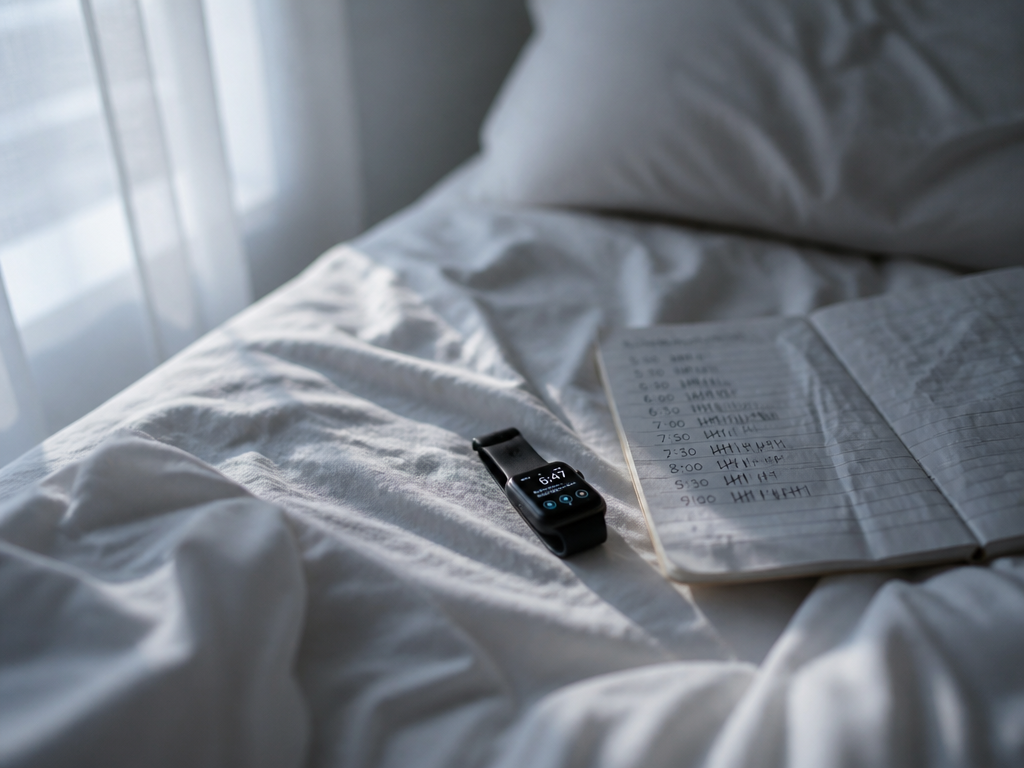
The cost isn't neutral, either. Baron and colleagues (2017, JCSM) named orthosomnia in a small case series — patients whose sleep got worse because they were pursuing a perfect score. The mechanism isn't mysterious. Anxiety about falling asleep is one of the few things that reliably prevents falling asleep.
An honest rule of thumb
Stop looking for a cutoff hour. There isn't a cliff; there's a slope. Assume a five-hour half-life and an 11 p.m. bedtime, and here's what one 12-ounce drip coffee (about 150 mg) leaves in you at lights-out:
| Last coffee | Hours before bed | Approx. mg still onboard |
|---|---|---|
| 8:00 a.m. | 15 | ~19 mg |
| 12:00 p.m. | 11 | ~33 mg |
| 2:00 p.m. | 9 | ~43 mg |
| 4:00 p.m. | 7 | ~57 mg |
| 6:00 p.m. | 5 | ~75 mg |
The directive, for tonight: pick the residual number you're willing to sleep on — 40 mg is a defensible place to start — and let that set your hour, rather than letting an hour you inherited from a blog post set your dose.1
My own practice, for whatever it's evidence of: I still wear the ring, and I've stopped reading the paragraph. I read one number, sleep onset latency, because it's the measurement the validation studies actually support. In April I moved my last coffee from 4:40 to 1:15 and then did nothing else for thirty nights, because one variable at a time is the only version of this experiment that means anything. Latency went from nineteen minutes to eleven. The score didn't move at all.
The ring is an excellent stopwatch wearing the costume of an oracle, and the trick is remembering which part you paid for.
-
The consumer genotyping angle — CYP1A2 rs762551 for "fast" versus "slow" metabolizers, ADORA2A rs5751876 for caffeine sensitivity, the latter usually traced to Rétey and colleagues (2007) — sits in the plausible-but-thin category. The receptor-variant work is real and the effect sizes in small EEG samples are striking, but the leap from a genotype chip to a recommended bedtime is longer than the marketing admits. ↩