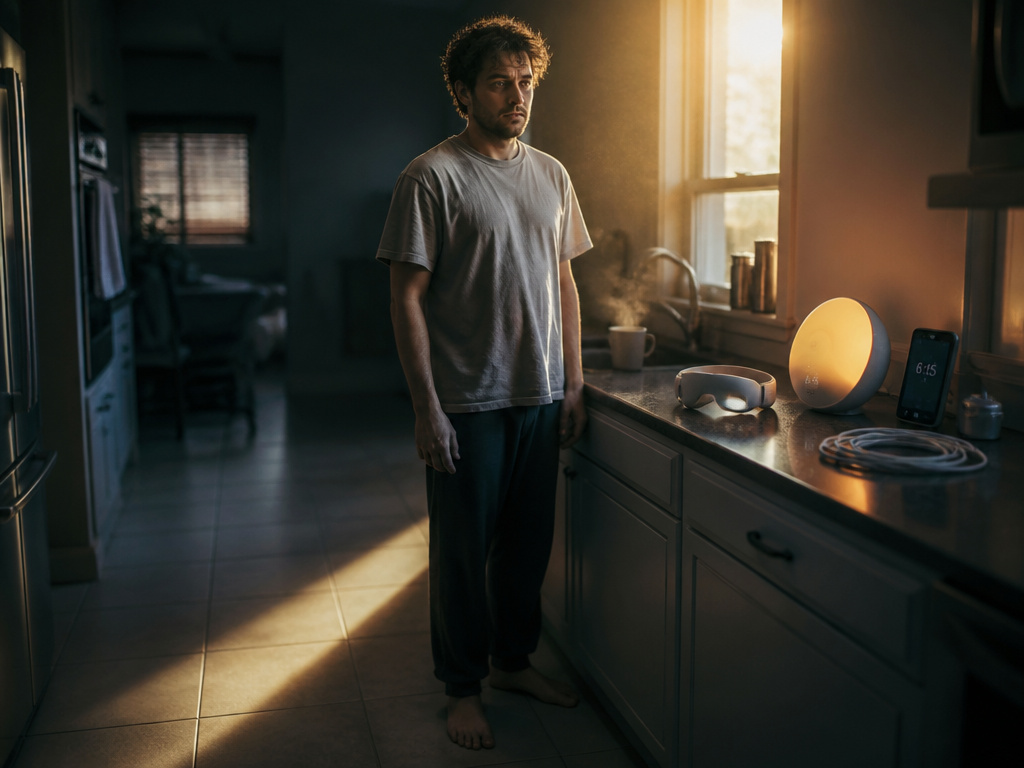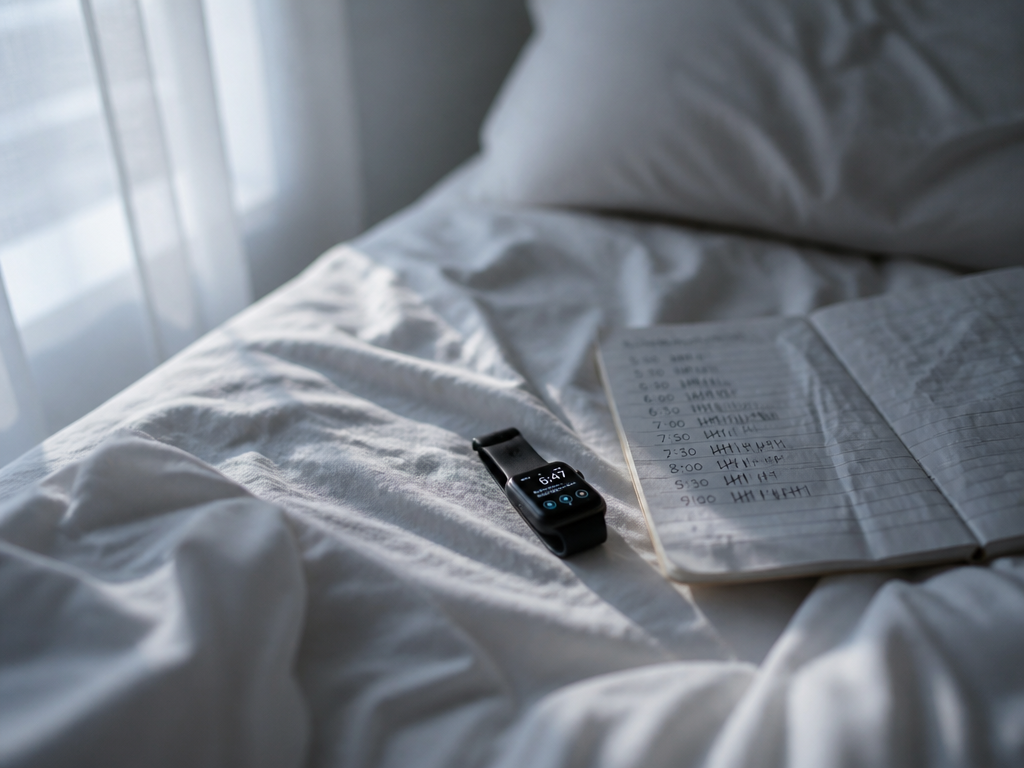
Forty-one minutes. That is the number this smartwatch review is built on — the gap in nightly deep sleep the Samsung Galaxy Watch Ultra 2 reported between the fifteen nights I drank coffee whenever I felt like it and the fifteen nights I cut caffeine off at noon. Fifty-two minutes of deep sleep on the open nights, ninety-three on the disciplined ones. If a health app showed you that chart, you would rearrange your afternoons around it.
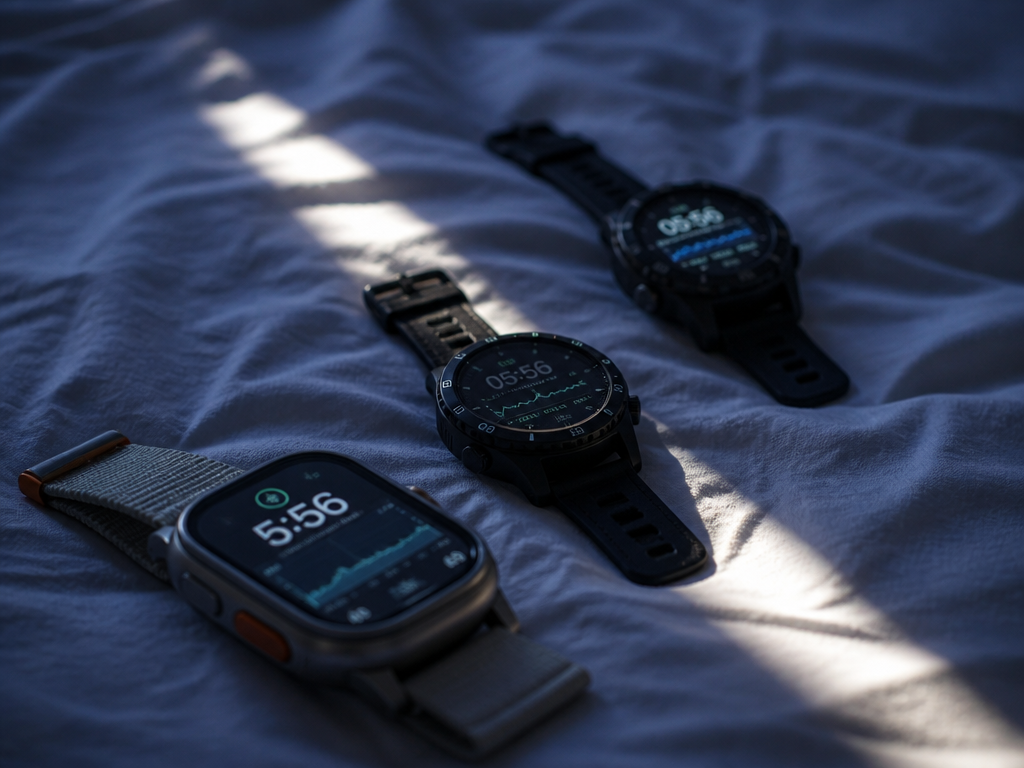
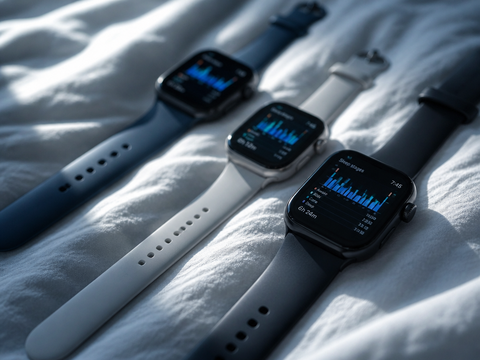
I wore two other watches on the same nights, on the same body, timing the same sleep. The Apple Watch Ultra 3 called the same experiment 27 minutes. A Garmin Fenix 8 called it 6.
That spread is the actual story here, and it is more useful than any of the three individual numbers. So this is a review of what the Galaxy Watch Ultra 2 is like to sleep in, and simultaneously a review of how much weight one specific figure on its screen can carry.
The verdict
The Galaxy Watch Ultra 2 is the one of the three I would actually choose to sleep in — lightest, thinnest, least intrusive on a wrist that is already trying to relax — and its deep-sleep minutes are the least trustworthy thing on its display; buy it for the wearability and the Samsung-phone integration, and read your caffeine habit off its sleep-onset and resting-heart-rate figures instead, which held up when I checked them against a chest strap.
What I did for thirty nights
Thirty consecutive nights, alternating in blocks of five: five nights caffeine ad lib, five nights nothing after 12:00, repeat. Twenty-six nights survived. I threw out two travel nights, one night where the Garmin's strap worked loose enough to break contact around 3 a.m., and one night I fell asleep reading on the sofa and only got to bed at two.
All three watches were worn simultaneously — two on the left forearm, one on the right, rotating position every five nights so that no device permanently owned the good spot. Wrist position matters more than most people assume; optical sensors want flat, still, well-perfused skin, and the slot nearest the wrist bone is the worst of the three. Rotating it does not eliminate the effect, but it stops it from being a constant bias in one device's favour.
For a heart-rate reference I wore a Polar H10 chest strap on eleven of the twenty-six nights — as many as I could stand, because sleeping in a chest strap is a genuinely unpleasant way to spend a week. The H10 is not a sleep stager. It cannot tell you anything about slow-wave sleep. What it can do is record beat-to-beat intervals well enough that if a wrist device's heart-rate curve disagrees with it, the wrist device is wrong.
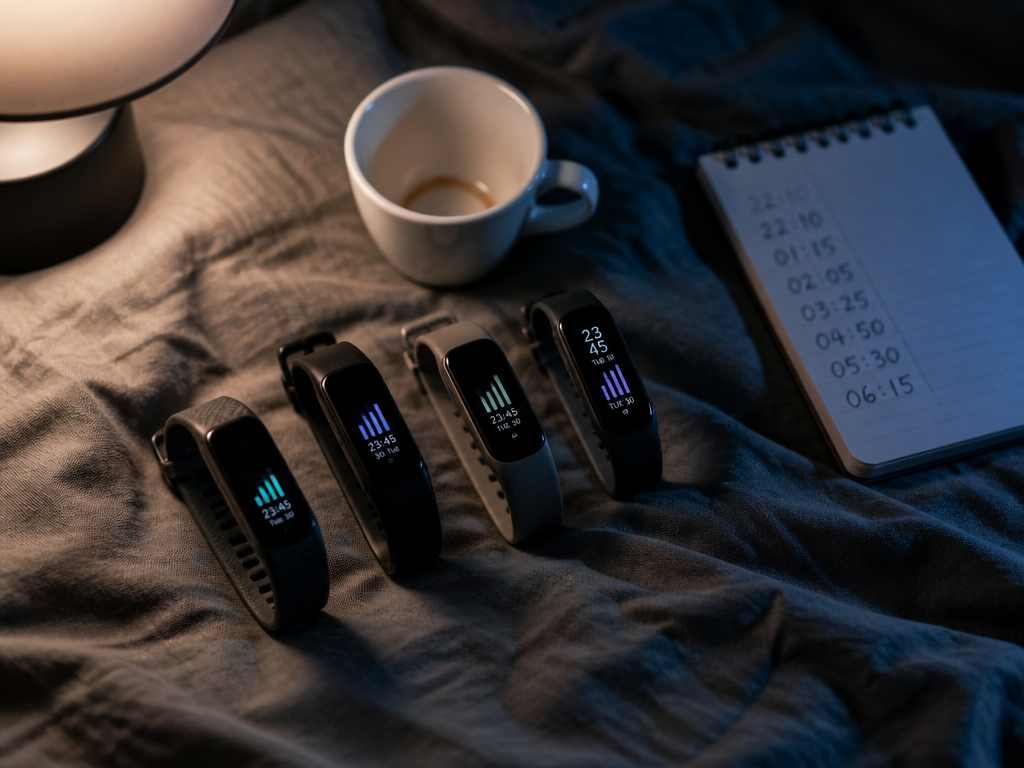
Caffeine I logged in grams of roasted coffee and clock time, not milligrams, because milligrams are a fiction unless you are running assays. I used a flat working conversion of 12 mg of caffeine per gram of roasted coffee — approximately right for a well-extracted filter brew, and probably off by twenty percent in either direction for anything else I drank. On the open block, my mean daily intake came to roughly 340 mg with a mean last dose at 15:41. On the cutoff block, roughly 290 mg, all of it before noon.
That 50 mg difference is the first thing wrong with this experiment, and I want it on the record early: I did not hold total dose constant. I changed timing and, without meaning to, changed quantity. Anything below is a test of "afternoon coffee versus no afternoon coffee," not a clean test of timing alone.
What "deep sleep" is, as far as a watch is concerned
None of these devices measures sleep. They measure movement, and they measure the way light bounces off the blood in your wrist, and from those two streams they derive heart rate, heart-rate variability, and an estimate of respiration. A model then chops the night into short epochs and assigns each one a label: awake, light, deep, REM.
The model is proprietary. Samsung will not tell you its epoch length, its feature set, or its decision boundaries, and neither will Apple or Garmin. What is publicly known — from the general run of independent validation work on consumer wearables — is the shape of the accuracy: these devices are quite good at telling sleep from wake, noticeably worse at picking REM out of light sleep, and worst of all at deep sleep, which is the stage with the least distinctive autonomic signature at the wrist. Slow-wave sleep is defined by cortical activity. A watch cannot see cortical activity. It is inferring a brain state from a pulse.
This is not a scandal, and I am not building to the conclusion that sleep tracking is worthless. It is a statement about which outputs on the screen are close to the sensor and which are three inferential steps away from it. Time in bed is close to the sensor. Heart rate is close to the sensor. Deep sleep minutes are a long way from it, and the further a number is from the sensor, the more of it is the manufacturer's opinion.
So when the Ultra 2 says caffeine cost me 41 minutes of deep sleep, the honest translation is: Samsung's classifier assigned 41 fewer minutes to its deep bucket on nights when I had drunk coffee after lunch.
Three watches, one body, one night

The cleanest way I can show you the problem is a single night. On night 19 — a cutoff night, in bed at 23:10, up at 07:02, no alcohol, nothing unusual — the three devices reported 38, 77, and 91 minutes of deep sleep respectively. Same body. Same night. A spread of 53 minutes on a quantity that only had about ninety minutes to play with in the first place.
Total sleep time, by contrast, agreed within 14 minutes across all three on that night, and within about twenty minutes on all but two nights of the study. The devices know roughly when I fell asleep and roughly when I got up. They do not agree about what happened in between.
Here is the whole experiment, per device, in minutes:
| Device | Deep sleep, coffee nights | Deep sleep, cutoff nights | Delta | Sleep-onset delta |
|---|---|---|---|---|
| Galaxy Watch Ultra 2 | 52 | 93 | 41 | 11 min slower |
| Apple Watch Ultra 3 | 61 | 88 | 27 | 7 min slower |
| Garmin Fenix 8 | 74 | 80 | 6 | 9 min slower |
Read across the deep-sleep column and you get three different studies. Read the last column and you get one.
The deep-sleep deltas do at least all point the same direction, which is worth something — no device claimed afternoon coffee improved my slow-wave sleep. But a finding that ranges from "life-altering" to "rounding error" depending on whose classifier you bought is not a finding you can act on. If I had only owned the Samsung, I would now believe something about my body that the Garmin would have told me was noise.
The number that survived
Sleep onset latency is the interesting column, and it is interesting for a structural reason: it sits much closer to the sensor. To estimate how long I took to fall asleep, a watch mostly needs to detect the moment sustained movement stops and heart rate settles into its nocturnal floor. That is a far more tractable problem than partitioning non-REM into stages.
All three watches said afternoon coffee delayed my sleep onset by between seven and eleven minutes, and the confidence intervals I could construct from twenty-six nights are wide enough that those three numbers are indistinguishable from each other. Call it nine minutes. That is a real, cross-validated, unglamorous result, and it is the only thing this experiment produced that I would repeat to someone else as fact.
The second survivor is resting heart rate in the first hour of sleep. The Ultra 2 put it 3.1 bpm higher on coffee nights, the Apple 2.8, the Garmin 3.4. The Polar H10, on its eleven overlapping nights, said 2.9 — which is the sentence in this entire piece that made me trust the wrist devices more, not less. When you ask these watches for something they can genuinely see, they see it, and they agree with a chest strap to within a fraction of a beat.
Nine minutes and three beats. That is what my afternoon coffee costs, as far as I can demonstrate. It is a much smaller and much duller result than forty-one minutes of vanished deep sleep, and it has the advantage of being defensible.
What forty-one minutes doesn't measure
It does not measure adenosine, or receptor occupancy, or anything else about caffeine's actual mechanism. It measures a classifier's output on nights that happened to differ in caffeine timing.
It does not isolate caffeine. My cutoff nights had less total caffeine, as noted. They also had, on inspection of my own log, earlier dinners — because a noon caffeine cutoff turns out to be correlated with the kind of day where I am organised enough to eat at seven. I did not control for that, I did not notice it until I was analysing the data, and it is exactly the sort of thing that turns a self-experiment into a story about lifestyle rather than a story about a drug.
It does not measure whether any of this matters. I ran no daytime performance test. I did not do reaction-time tasks, I did not track my afternoon mood on a scale, and I have no evidence that nine extra minutes to fall asleep changed a single thing about how I functioned. Subjectively — and subjectively is doing heavy lifting here — I could not tell the blocks apart. If you had woken me on a random morning and asked which block I was in, I would have been guessing.
And it does not measure my palate for its own error. Twenty-six nights, one person, one build, one sleep environment. I am a poor sleeper in general and I run a low resting heart rate; both of those could plausibly move how a classifier treats me.
Living with them
Measurements taken with a cheap digital caliper and a coffee scale, which is the equipment I own:
| Thickness (with sensor housing) | Weight, case + fitted strap | Overnight battery drain | |
|---|---|---|---|
| Galaxy Watch Ultra 2 | 12.2 mm | 47 g | ~9% |
| Apple Watch Ultra 3 | 14.6 mm | 62 g | ~17% |
| Garmin Fenix 8 (51 mm) | 13.9 mm | 74 g | ~4% |

Those numbers explain most of the sleeping experience. The Samsung is the only one of the three I stopped noticing. Two millimetres and fifteen grams sounds like nothing written down; on the inside of a wrist, under a duvet, at 2 a.m., it is the difference between a watch and an object. The Fenix, in the 51 mm case, is a thing I was aware of every time I rolled onto my side, and after about a week I started sleeping with my left arm outside the covers to give it room, which is not a behaviour a sleep tracker should be inducing.
The Apple's overnight drain is the practical problem. Seventeen percent a night means the watch has to be charged during the day, which means finding a ninety-minute window where you are not wearing it, which is the same window in which most people would like to be tracking a stress response or a workout. Samsung's nine percent means you charge every third day and can do it while showering. Garmin's four percent means you essentially stop thinking about charging, and that alone is why Garmin still owns the multi-day-in-the-field category.
Morning readability goes to Samsung by a clear margin. Its sleep summary opens on the numbers I wanted — time asleep, onset, resting heart rate — without making me swipe through a score first. Apple's presentation is cleaner-looking and tells me less. Garmin's app remains the densest and the most willing to show you raw curves, which I appreciate and most people won't.
Where each one wins
Samsung wins on wearability and on being the watch you forget. If you already carry a Galaxy phone, the integration is seamless in the boring way integration should be, and the case is now thin enough that overnight wear stops being a negotiation. It loses on deep-sleep credibility, and it loses on route handling — I still cannot build a route in the app the way I want to, and had to import one from elsewhere.
Apple wins on the interface and on the ambient stuff around sleep — the wind-down handling, the way the phone and watch coordinate a sleep schedule, the sheer polish of the hardware, which remains the best-made object of the three. It loses on battery, decisively, and its case depth makes it the second-best of the three to sleep in rather than the first.
Garmin wins on battery, on trail navigation, and on not overclaiming. Its deep-sleep delta of 6 minutes is the one I suspect is closest to honest, precisely because it is the least dramatic. Garmin's staging has always been more conservative about assigning deep sleep, and in this experiment that conservatism looks like a virtue. It loses on bulk, on app design for anyone who is not already fluent in Garmin, and on the fact that the 51 mm case is genuinely too much watch to sleep in.
Who this is for, and who it isn't
Buy the Galaxy Watch Ultra 2 if you carry a Samsung phone, want a capable dive-and-trail-rated watch that you will also wear to bed every night, and you want your sleep data as a trend line rather than a nightly verdict. It is the best all-day-and-all-night watch of the three.
Do not buy it if the thing you actually want is a defensible measurement of sleep architecture — no wrist device will give you that, and this one presents its staging with more confidence than the staging deserves. Do not buy it if you spend real time off-grid, where Garmin's battery and mapping are not a preference but a requirement. Do not buy it if you are on an iPhone; the integration gap is not worth the two millimetres.
And if you are buying a watch specifically to answer a caffeine question, buy the cheapest one that reports sleep onset and overnight resting heart rate, because those are the two numbers that survived contact with a chest strap.
The line you can screenshot
Of the three, the Galaxy Watch Ultra 2 is the best watch to sleep in and the worst one to argue with.
What I didn't answer
I never established ground truth. There is no EEG anywhere in this study — no lab polysomnography, not even a home headband — which means that when three devices disagree by 53 minutes on the same night, I cannot tell you which one is closest. I can only tell you they cannot all be right. That is the central hole in the piece and I am not going to paper over it.
I also did not separate dose from timing, did not measure a single thing about how I performed the next day, and did not test whether swapping the afternoon coffee for decaf preserves the nine minutes or eliminates them — which is the question I actually care about, since the ritual matters to me more than the drug.
The next run is already designed: same total caffeine every day, varied only by clock time, with a home EEG headband as a fourth device and a two-minute reaction-time test on waking. If someone has already done a decent version of that with a headband as reference, I would rather read it than repeat it.
In the meantime, the most productive thing anyone with one of these watches can do is go looking for the manufacturer's own validation documentation and read what agreement figures they quote for staging, and against what reference. Some of it is published, some of it is buried in regulatory filings, and the gap between what those documents claim and what the app shows you with two decimal places of confidence is the most interesting number in this whole category. It is not forty-one minutes. It is the one nobody puts on the screen.