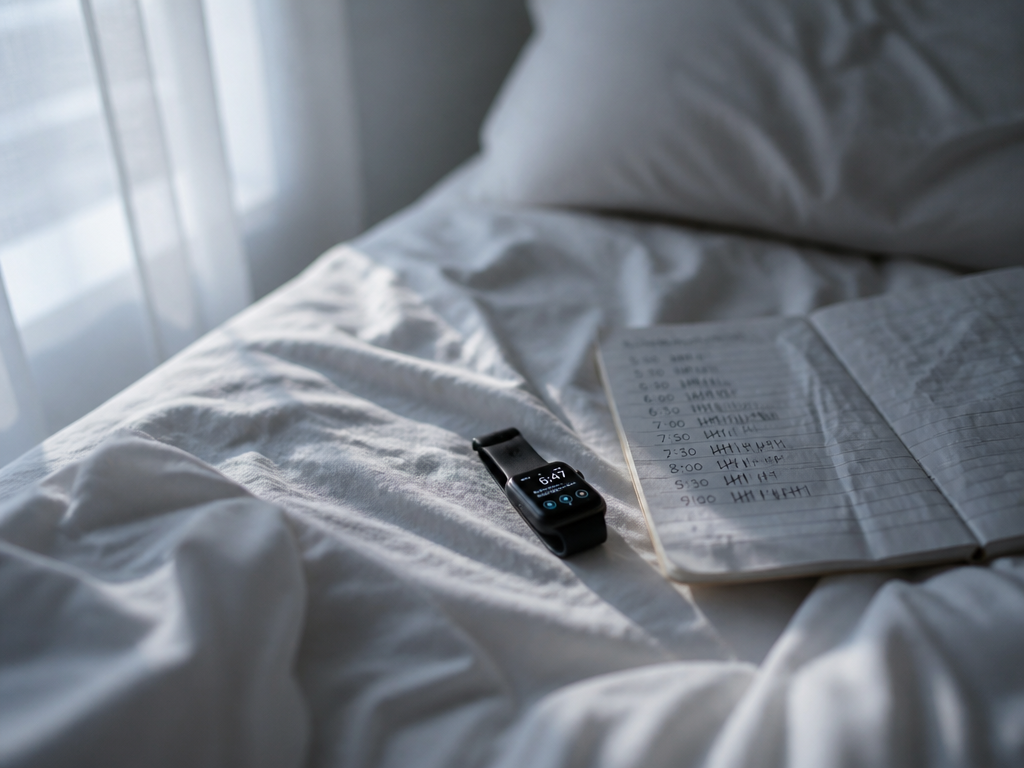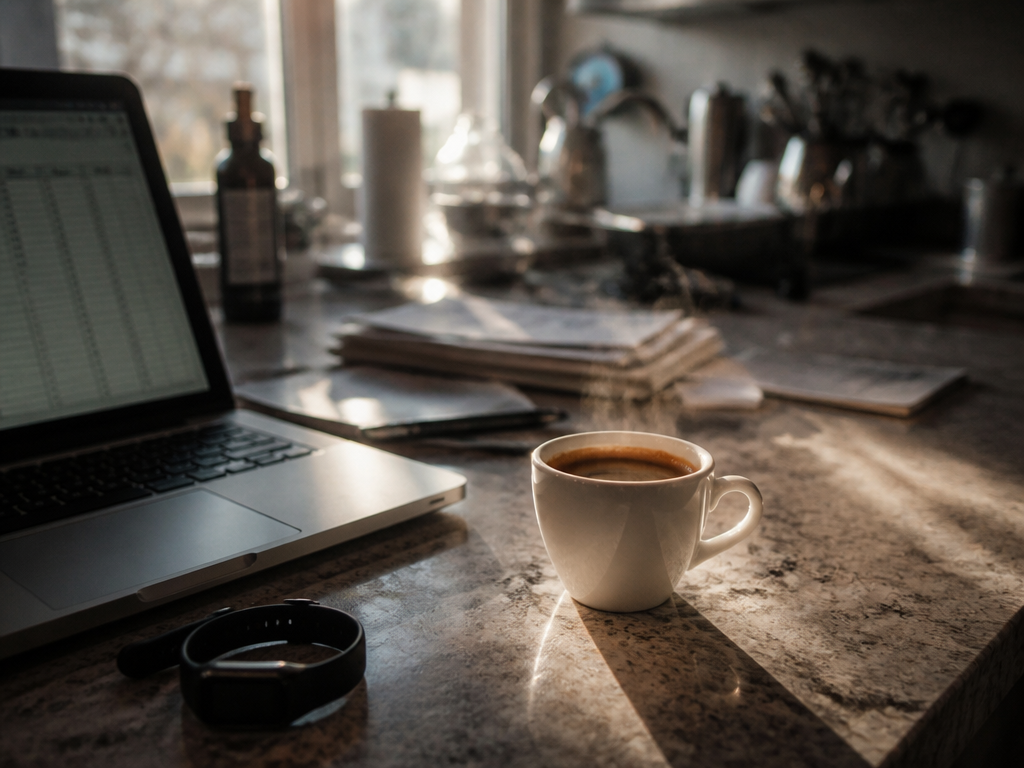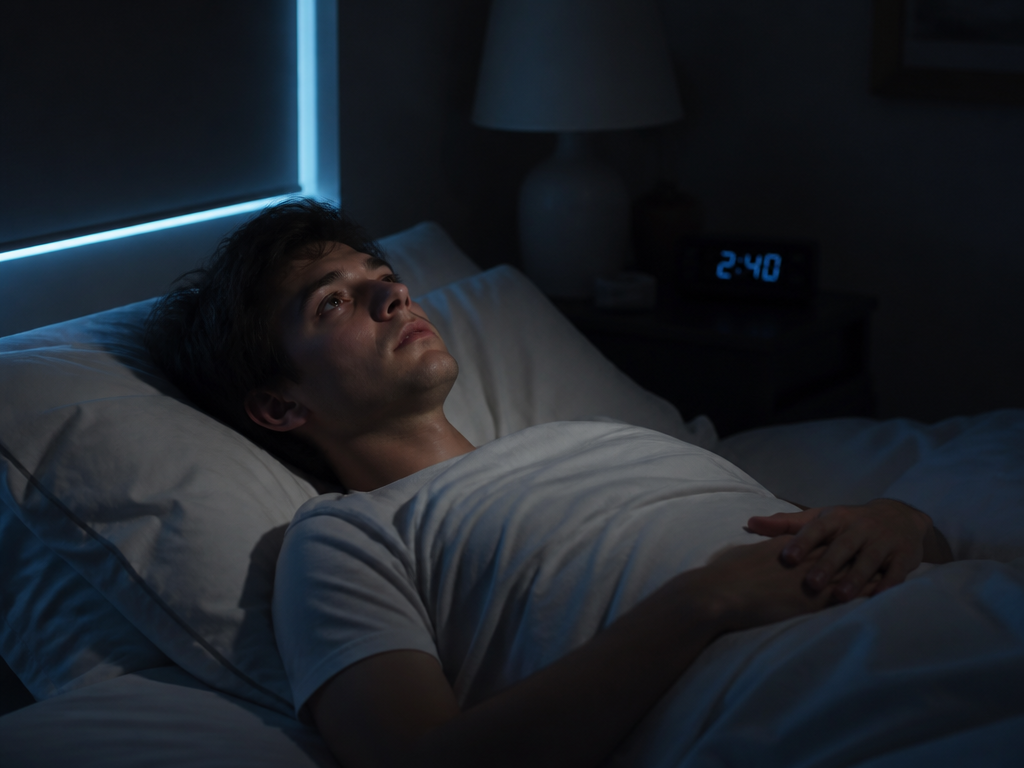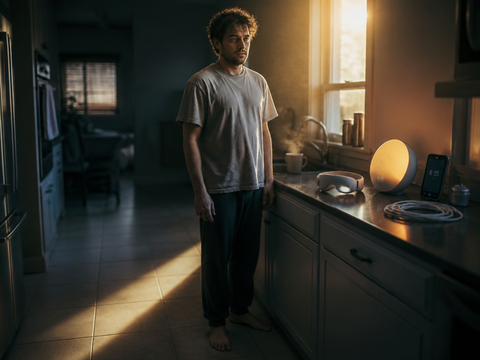
Here's the question, asked the way I actually asked it — 6:40 a.m., mug in hand, no memory of having filled it: can you buy your way out of sleep inertia? Not fix your sleep. Fix the hour after it. I have a four-year-old who treats 5:15 as a reasonable time to open negotiations, and the fog that follows a broken night costs me something close to a working hour, every day, whether or not I have one to spare. There is now an entire product category promising to shorten that hour. I bought $612 of it and ran it against my own mornings for nine weeks.
The verdict: the fog is genuinely shortenable, but the free intervention beat two of the three paid ones, and only one device is still on my nightstand. Total spend, $612. Amount I'd spend again, $189.
What I measured, and what I couldn't
Nine weeks, late April through late June, at about 44° north — which matters, and I'll come back to why.
Every morning at wake plus ten minutes I ran a three-minute psychomotor vigilance test on my phone, standing in the same spot in the kitchen. The PVT is the standard lab instrument for this: a dot appears at random intervals, you tap it, and the score that matters is lapses — responses slower than 500 milliseconds. It is boring and hard to game, which is the point. I also logged Karolinska Sleepiness Scale scores (a 1–9 self-rating) at wake plus ten and plus forty, and one homemade metric I trust more than I expected to: minutes until I wrote a sentence I kept. My drafts are timestamped, so that number is real even if it isn't scientific.
Baseline, established over eleven ordinary mornings: 4.2 lapses, KSS of 7 at ten minutes, and 52 minutes to a kept sentence.
Now the limits, because they're large. This is one person. I was not blinded — I knew which week was which, and morning-person optimism is exactly the kind of thing that shaves a tenth of a second off a tap test. I have no polysomnography, so I cannot tell you which sleep stage any alarm pulled me out of, which is probably the single biggest hidden variable in the whole exercise. My watch offered me sleep-stage estimates every morning; I recorded them and I am not reporting them, because consumer staging agrees with lab scoring poorly enough that publishing those numbers would be decoration, not evidence. And late-spring sunrise at this latitude does an enormous amount of free work. December is a different experiment. I have not run it.
The boring week that nearly ended the experiment
Before the hardware, I ran a control: a fixed wake time, 6:15 give or take ten minutes, seven days a week including both weekends, with no device and no other change. My son cooperated inconsistently.
Lapses fell from 4.2 to 3.1. Kept-sentence time fell to 44 minutes.
That's a quarter of the problem solved by a decision, and it made the rest of the experiment harder to interpret, because every device from that point on was competing against an already-improved baseline rather than my genuinely worst mornings. It's also the least marketable finding here, which is presumably why nobody sells it.
The comparison
| Intervention | Cost | PVT lapses (from 4.2) | Minutes to a kept sentence | Kept it? |
|---|---|---|---|---|
| Fixed wake time | $0 | 3.1 | 44 | Yes |
| Sunrise alarm | $189 | 2.4 | 38 | Yes |
| 470nm light glasses | $199 | 2.2 | 36 | No |
| Smart-wake alarm | $129 | 3.0 | 43 | No |
| 10 min outdoors | $0 | 2.3 | 31 | Yes |
The sunrise alarm ($189)
This is the one that stayed. Thirty-minute ramp, claimed 300 lux. I bought a $95 lux meter partly to check: 214 lux at 60 cm on the unit's face, and about 90 lux at pillow height with my head turned away from it, which is how anyone actually sleeps. So the real dose is a fraction of the number on the box.
It worked anyway, and I think the mechanism is more mundane than the marketing suggests. On nine of fourteen mornings I surfaced during the ramp rather than to the tone — waking up gradually, without a klaxon, instead of being extracted. Lapses 2.4. The complaint: the companion app is a liability, it lost my schedule twice, and the tap-anywhere snooze is far too easy to find at 6:15.
The light glasses ($199)
Best raw numbers of anything I tested: 2.2 lapses, twenty minutes of 470nm at wake, worn while doing the school-lunch shuffle. And I'm not keeping them.
I wore them on 11 of 14 mornings, which is a compliance failure I have to report honestly, because a 2.2 you achieve four days a week is worse than a 2.4 you achieve seven. Two of those mornings ended in a mild frontal headache. And there is a social cost that reviews tend to skip: my daughter asked, sincerely, whether I was sick. If you live alone and your mornings are quiet, the numbers say these are the most efficient dose of light per minute you can buy. Mine aren't.
The smart-wake alarm ($129 with subscription)
The premise is that a wearable can find a shallow moment inside a thirty-minute window and wake you there, sparing you the worst of the morning fog. Result: 3.0 lapses — indistinguishable, at my sample size, from simply having a fixed wake time and no subscription.
Worse, it cost me sleep. Across two weeks it fired an average of 17 minutes before the end of its window, nearly always in the first third. Whether it was detecting anything or just hedging toward early, I can't say from the outside. What I can say is that it reliably chose to wake me early and described that as optimization. Seventeen minutes is a lot to pay for a benefit I couldn't detect.
Going outside ($0)
Ten minutes outdoors, within fifteen minutes of waking. Coffee allowed, phone not. Lapses 2.3, and the best kept-sentence time of the whole experiment at 31 minutes.
The lux meter explains why. My kitchen with every light on: 180 lux. Outside on a flatly overcast morning: 8,400 lux. Clear sky, sun barely up: 24,000. The $189 device on my nightstand is delivering roughly one percent of what an ugly grey sky delivers for free. That comparison is the most useful thing I learned, and it reframes what the hardware is actually for. Indoor light boxes and sunrise lamps aren't competing with the sky. They're competing with the darkness you'd otherwise be sitting in — which, in a Midwestern January at 6 a.m., is the only competition that exists.
The coffee question
Because this is a caffeine magazine, I also tested the advice that gets repeated most often: delay your first cup ninety minutes.
Two weeks. Lapses at wake plus ten went to 4.0 — worse than the no-device control. KSS worse. Kept-sentence time 61 minutes, the worst number in my whole spreadsheet. I could not measure my night sleep well enough to say whether anything improved on the other end.
So, plainly: for someone already carrying real sleep debt, delaying morning caffeine bought me nothing I could detect and cost me the usable part of the morning. If your problem is falling asleep at night, the lever is your afternoon cutoff, not your morning delay. I moved my last cup to 1:30 p.m., and that single change did more for my nights than $612 of hardware did for my mornings.
Where the honest answer is "it depends"
If you're being woken at 3 a.m., none of this helps at 3:05. Light is a morning tool. Being hauled out of deep sleep in the middle of the night produces a heavier, longer fog than any device I tested can touch, and the only real fix is the one you already know and can't implement.
If you work nights, the logic inverts. Bright light on the commute home is the thing to avoid, not seek. Everything above is written for people whose schedule points the same direction as the sun.
If you're a night owl on a 7 a.m. contract, morning light is doing a different job — shifting your clock earlier — and that takes weeks, not mornings. Judge it in a month.
And severity varies wildly. Mine runs 40–60 minutes. I know people who are fine in ten and people who lose the morning entirely on identical schedules. If yours lasts hours, every day, and doesn't move regardless of what you try, that's not a hardware problem. Untreated apnea and several other genuinely treatable conditions present exactly this way. Go get it looked at.
Who this is for, and who it isn't
This is for you if your nights are unfixable for now — young kids, a rotating rota, a caregiving stretch — and your realistic goal is making the first hour less expensive. It's also for you if you wake in winter darkness, where a sunrise lamp genuinely has no free competitor.
This isn't for you if you're sleeping six hours by choice and shopping for a device that makes that fine. Nothing here touched my baseline on short nights; it only ever moved the shape of the recovery. And if you already wake to sunlight in a bedroom facing east, you have the good version already. Save the $189.
The winner is the ten minutes outside, and it costs nothing. The sunrise alarm is a legitimate second place and the only purchase I'd repeat — but buy it knowing you're buying a substitute for daylight, not an upgrade on it.
One thing to try this week
Five weekdays. Get outside within fifteen minutes of waking and stay there for ten — back step, sidewalk, car park, doesn't matter, and overcast counts for far more than you'd think. Take the coffee with you; leave the phone inside.
Before you start, write down one number: what time you finished the first thing you did that day that actually required a brain. Write it down again on Friday. That's the whole test, and it costs you nothing but the ten minutes you were going to spend standing in a 180-lux kitchen anyway.