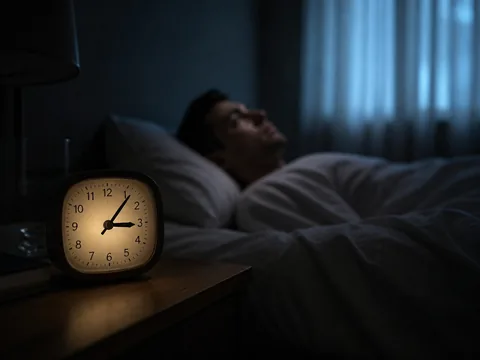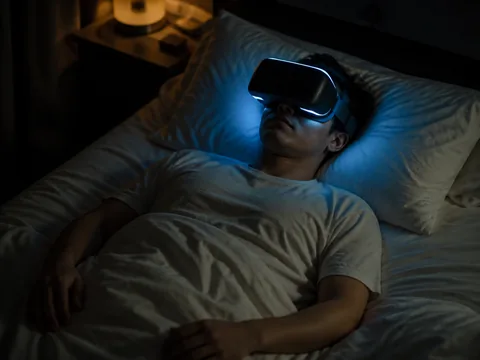
For six weeks I ended my evenings the way a certain corner of the wellness-tech market keeps insisting I should: strapped into a headset, watching a virtual campfire or a slow drift over digital fjords, waiting to feel calm enough to sleep. The premise is that virtual reality can wind you down more effectively than a screen because it surrounds you, shuts the room out, and gives your attention somewhere gentle to rest. I wanted to know whether that premise survives contact with an actual bedtime.
It mostly doesn't — and here is the verdict in one sentence: a head-mounted display at bedtime helped me chiefly by not being my phone, not because immersion did anything special to my nervous system, and the extra weight and light on my face made two of the three units worse than a paperback.
That's the short version. The longer version is more interesting, because the belief I was testing has a traceable origin, and the origin is thinner than the belief.
Where the idea came from
The claim that VR is good for winding down did not arrive from sleep science. It arrived, roughly, from three unrelated places that fused in marketing copy around 2019.
The first was clinical VR for pain and anxiety — genuine, published work in which patients undergoing burn dressing changes or dental procedures reported less distress while immersed in a snowy game world. That research is real and reasonably robust. But it measured acute distraction during a painful event, not sleep onset in a healthy adult at home. The finding traveled; the caveats did not.
The second was the meditation-app boom, which needed new hardware to sell into once phones were saturated. A guided breathing session is a guided breathing session whether it plays on a speaker or inside a headset — but the headset let a familiar product be re-sold as a premium one.
The third was simply the consumer VR industry looking for uses that weren't gaming. "Relaxation" is a soft, unfalsifiable category, and no one gets sued for a calm app that doesn't work.
Stack those together and you get a widely repeated belief — immersive tech helps you sleep — resting on a foundation that was really about distraction during medical procedures. The source exists. It just doesn't say what the belief says.
How I tested it
I ran a within-subjects comparison across three head-mounted displays (HMDs), alternating them and a control (reading a physical book) in randomized two-night blocks over six weeks. Forty-two nights total. This is a sample size of one person, and I'll flag that again before you draw conclusions from it.
Each night I wore an HMD for the last 25 minutes before lights-out, running the calmest content each ecosystem offered. I measured:
- Sleep onset latency — time from lights-out to sleep, estimated from a wrist tracker validated against my own sleep-diary notes. Imprecise, but consistent night to night.
- Subjective wind-down — a 1–10 rating logged before I removed the device.
- Illuminance at the eye — measured with a lux meter held at the lens, because light exposure is the one mechanism here with a real, non-speculative link to sleep timing.
- Comfort — whether I wanted to take it off, and when.
I did not measure sleep architecture, cortisol, or anything requiring a lab. I couldn't, and I'd rather say so than dress up a wrist tracker as polysomnography.
The three head-mounted displays
I chose one standalone consumer unit, one premium mixed-reality unit, and one lightweight "media-only" headset marketed explicitly for relaxation.
| Criterion | Standalone consumer | Premium mixed-reality | Lightweight media HMD |
|---|---|---|---|
| Weight on face | 515 g | 640 g | 190 g |
| Illuminance at eye (calm scene) | 41 lux | 68 lux | 12 lux |
| Median onset latency | 19 min | 24 min | 14 min |
| Control (book) onset | 16 min | 16 min | 16 min |
| Wanted it off before content ended? | Sometimes | Usually | Rarely |
Two numbers in that grid did most of the work.
The first is illuminance. A calm scene is still a lit screen centimetres from your eyes. The premium unit's bright OLED panels put roughly 68 lux at the eye even on a dim campfire — comfortably enough light to be doing your circadian clock no favours in the half-hour you're trying to power down. The lightweight media HMD, which uses dimmer micro-displays and let me crank brightness to a genuine floor, measured 12 lux. That difference showed up in the latency column.
The second is weight. At 640 grams the premium headset is an object you are aware of the entire time it's on your head. I could not relax into something I kept adjusting. Its median onset latency of 24 minutes was the worst in the test — worse than the book — and I'm fairly confident that's the strap, not the software.
What the immersion actually did
Here's the part that surprised me. The immersion — the surrounding, room-blocking quality that's supposed to be VR's whole advantage — didn't measurably help. What helped, on the nights it helped at all, was the same thing across all three units: I wasn't holding my phone.
The headset is a commitment device. Once it's on, you can't doomscroll, can't answer a message, can't check one more thing. That behavioural fence is real and it's useful. But it's not immersion doing the work; a drawer with a lock on your phone would do the same job for £8.
The lightweight media HMD won because it interfered least. Low light, negligible weight, one gentle thing to watch, and no temptation to reach for the phone. Its 14-minute median onset was the only result that beat the book, and only just — two minutes, which is inside the noise for a sample of one person. I'm reporting it as "no worse than reading, and easier to stay off my phone," not as a breakthrough.
The two heavier, brighter units were, for the specific purpose of falling asleep, a step backwards. They're excellent at other things. Bedtime isn't one of them.
If you buy one head-mounted display for winding down, buy the lightest one with the dimmest panels — not the most immersive one. That's the sentence to screenshot.
Who this is for, and who it isn't
This is for you if:
- Your bedtime problem is behavioural — you scroll until 1 a.m. — and you want a physical barrier between you and the phone. A lightweight media headset works as an expensive, effective drawer-lock.
- You already own an HMD, want to know if bedtime is a good use for it, and would accept "fine, if it's light and dim" as an answer.
- You're a healthcare or product stakeholder evaluating immersive tech and want the honest version before a vendor gives you the polished one.
This isn't for you if:
- You're expecting the device itself to sedate you. Nothing in my six weeks suggests immersion has a sleep-inducing effect beyond removing distractions.
- You're sensitive to light at night. The brighter panels are working against your circadian timing, and no calm content undoes physics.
- You find any weight on your face annoying. You already know how this ends.
I'll restate the limit plainly: one participant, home-grade instruments, no lab. What I can defend is the ranking within my own nights and the reason for it — light and weight, not immersion. What I can't tell you is how this generalizes across a population, and I'd distrust anyone who claims to from a test this size.
The myth, and the truer thing
The belief that sent me into six weeks of headsets came from real research about distracting people through pain, quietly rebranded as a sleep aid. It's worth naming what it actually is.
The myth: a head-mounted display's immersion gently guides your brain toward sleep.
The more accurate version: a good head-mounted display keeps your phone out of your hands, and the lightest, dimmest one you can find does that without getting in sleep's way — which is a smaller, more honest claim, and the only one my nights support.