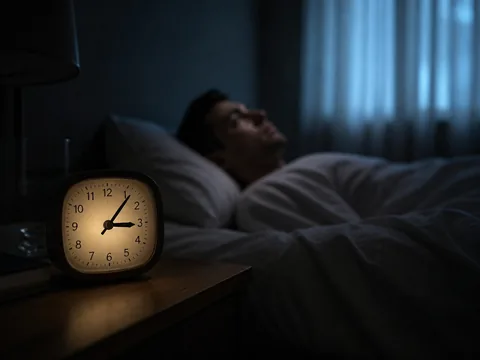
For fourteen nights I wrote down the time I woke in the dark. The most common entry was 3:07. It wasn't 3:00 or "around three." It was 3:07, give or take ten minutes, on eleven of the fourteen nights. If you've been reading about sleep disruption and nighttime wakeups on social media, you already know the usual explanation: cortisol, spiking at the wrong hour and dragging you awake. I wanted to know whether something more ordinary was responsible. So I tested three everyday habits one at a time and measured what each one did to the 3 a.m. problem.
The setup
My baseline was unremarkable. I had a 12-ounce drip coffee at 7:30 a.m. and a smaller cup at 2:30 p.m., about 190 mg of caffeine a day by standard estimates. Most nights I drank two glasses of red wine with dinner, ate around 8:30, and turned the lights out at 10:45.
I had three suspects. Each was changed on its own for ten nights while the other two stayed at baseline:
- Caffeine: last cup moved to noon.
- Alcohol: nothing after 5 p.m.
- Dinner: moved to 6:30, same food, same portions.
Between blocks I went back to baseline for four days. I wore a wrist tracker for wake times and overnight heart rate, and I kept a paper log that I filled in each morning before coffee. Consumer trackers are poor at telling quiet wakefulness from light sleep, so a wakeup only counted if I remembered it and the tracker showed it.
I decided on four criteria before starting:
- Nights with a wakeup longer than ten minutes between 2 and 5 a.m.
- Average minutes awake in that window
- A 1–5 morning rating, written before caffeine
- How hard the change was to keep up
There's a lot I couldn't do. I didn't measure cortisol. Nothing was blinded, since I always knew whether I'd had the wine. This is one person over one autumn. Read the numbers as a report from one sleeper, not a finding.
Why I didn't start with cortisol
Cortisol follows a daily curve. It is lowest around the start of the night, starts climbing in the early morning hours, and peaks shortly after you wake. That means it's rising at 3 a.m. in everyone, including the people who sleep straight through. A signal that every sleeper has can't, on its own, explain why some of us wake. Stress can raise the baseline and make it harder to fall back asleep, and I'm not dismissing that.
The second half of the night has a more mundane explanation: how sleep is structured. Deep sleep is packed into the first few hours. The later cycles are lighter and heavier on REM, and brief arousals between cycles are normal. Most of them are never remembered. So the useful question isn't why you surface around three, because nearly everyone does. It's what keeps you awake long enough to check the clock.
Suspect one: the 2:30 coffee
In healthy adults, caffeine's half-life is commonly given as about five hours, with wide individual variation. Some people clear it in half that time and others take twice as long. On the average estimate, a 2:30 cup leaves roughly a third of its caffeine in circulation at lights-out, and a smaller but real amount at 3 a.m.
Moving the cutoff to noon cut my qualifying wakeups from 11 of 14 baseline nights to 6 of 10. Time awake between 2 and 5 a.m. fell from an average of 26 minutes to 17. I didn't expect falling asleep to stay the same, but it did. What changed was falling back asleep. At baseline, lying awake at three felt alert and slightly wired. With the noon cutoff, I usually drifted off again within ten minutes.
This was the easiest change to keep. I switched the afternoon cup to half-caff and then to decaf. The ritual survived, and by day four I missed the caffeine less than I'd expected.
Suspect two: the wine

Alcohol sedates you at first; on drinking nights I fell asleep a few minutes faster. The body clears alcohol at roughly one standard drink per hour, and the rebound comes in the back half of the night, when sleep turns lighter and more broken even though most of the alcohol is gone. My two glasses, finished around 9:30, lined up closely with where my wakeups clustered.
The tracker agreed. On wine nights, my overnight heart rate ran 5 to 8 beats per minute higher through the first half of the night, and it never settled to the low I saw on dry nights. On dry nights it dropped earlier and stayed down.
The results were the largest in the experiment: qualifying wakeups on 2 of 10 nights, an average of 7 minutes awake in the 2–5 a.m. window, and a morning rating of 3.8 against a baseline of 2.6. There was a cost. Falling asleep took slightly longer for the first three dry nights. This was also the hardest change to keep, because two dinners out meant sparkling water and an explanation.
Suspect three: the late dinner
The case against eating late is reasonable. Digestion, a slightly raised core temperature, and reflux when you lie down all push against deep sleep. Moving dinner two hours earlier gave me qualifying wakeups on 8 of 10 nights and an average of 22 minutes awake. That difference is small enough that ten nights can't separate it from noise. I don't have reflux, though. If you do, expect this suspect to rank much higher for you. For me, the harder part was fitting a 6:30 dinner around work.
Head to head
| Criterion | Baseline | Coffee cutoff at noon | No evening alcohol | Dinner at 6:30 |
|---|---|---|---|---|
| Nights with a 2–5 a.m. wakeup | 11 of 14 | 6 of 10 | 2 of 10 | 8 of 10 |
| Average minutes awake, 2–5 a.m. | 26 | 17 | 7 | 22 |
| Morning rating (1–5) | 2.6 | 3.1 | 3.8 | 2.9 |
| Ease of keeping it up | — | Easy | Hard (social) | Moderate |
If you drink in the evening and wake at 3 a.m., drop the drink before you blame anything else, including cortisol.
Caffeine came a clear second. Dinner timing barely registered for me. In a final week I combined all three changes and had one qualifying wakeup in seven nights. That is better than any single change, but not by as much as adding up the individual improvements would suggest. Most of the gain had already come from the wine.
Who this is for, and who it isn't
This is for you if you fall asleep easily but wake in the small hours, you have a regular evening drink or an afternoon coffee, and you already track your sleep and want to use the data for something. The method carries over to other habits: change one thing at a time, give it ten nights, and pick your criteria before you start so you can't adjust them after the fact.
This isn't for you if your 3 a.m. wakings come with loud snoring or gasping, trips to the bathroom more than once a night, night sweats (perimenopause is a common and under-discussed cause in this age range), or early waking with low mood and no way back to sleep. Those need a clinician, not an experiment. If broken sleep has lasted for months, cognitive behavioral therapy for insomnia (CBT-I) is the first-line treatment and will do more than any change here. And if checking the tracker at 3 a.m. is keeping you awake, take the tracker off.
Back to 3:07
The number I started with looked like a signal: the same minute every night, as if something inside me had set an alarm. It turned out to be a meeting point. It was the hour my sleep naturally moved into its lighter cycles, the hour the wine's sedation wore off, and the hour the afternoon coffee still hadn't fully cleared. On dry nights I almost certainly still surfaced around 3:07. I just didn't stay up long enough to see it. The time was never what woke me. It was the moment I was always going to come up for air, and the only question was whether anything would keep me there.


