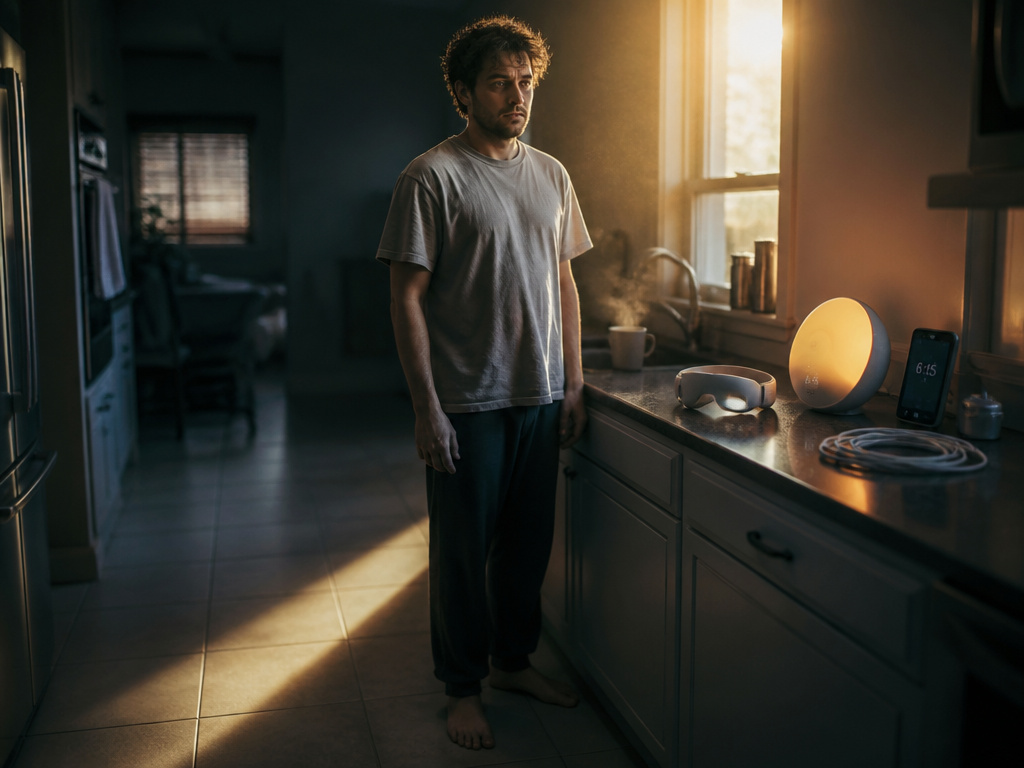
The Samsung Galaxy Watch 9 lists at $349 and lands near $130 if you have a dead watch in a drawer, which is how most people will end up buying it. I bought one for a narrower reason. I wanted to know whether a wrist sensor can detect a cup of coffee I drank seven hours earlier.
Verdict up front: it can, and it notices sooner than an Apple Watch Series 11 or the Galaxy Watch 7 it replaces. It is also confidently, repeatably wrong about the single number a late-coffee drinker most wants — how long it actually took to fall asleep.
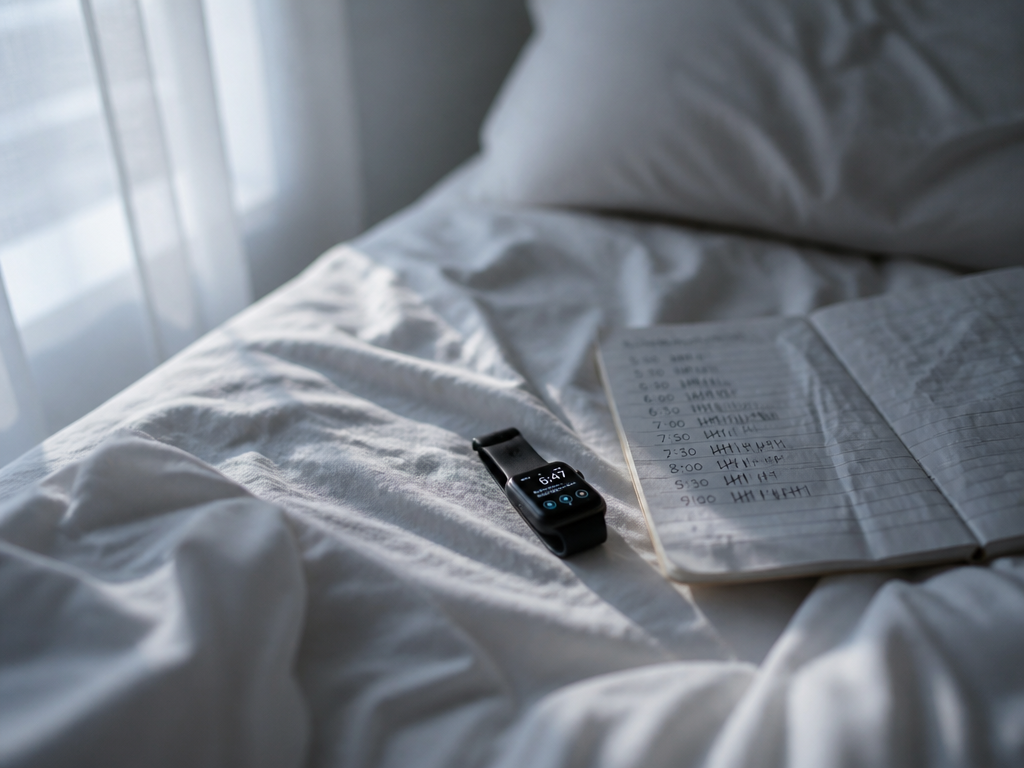
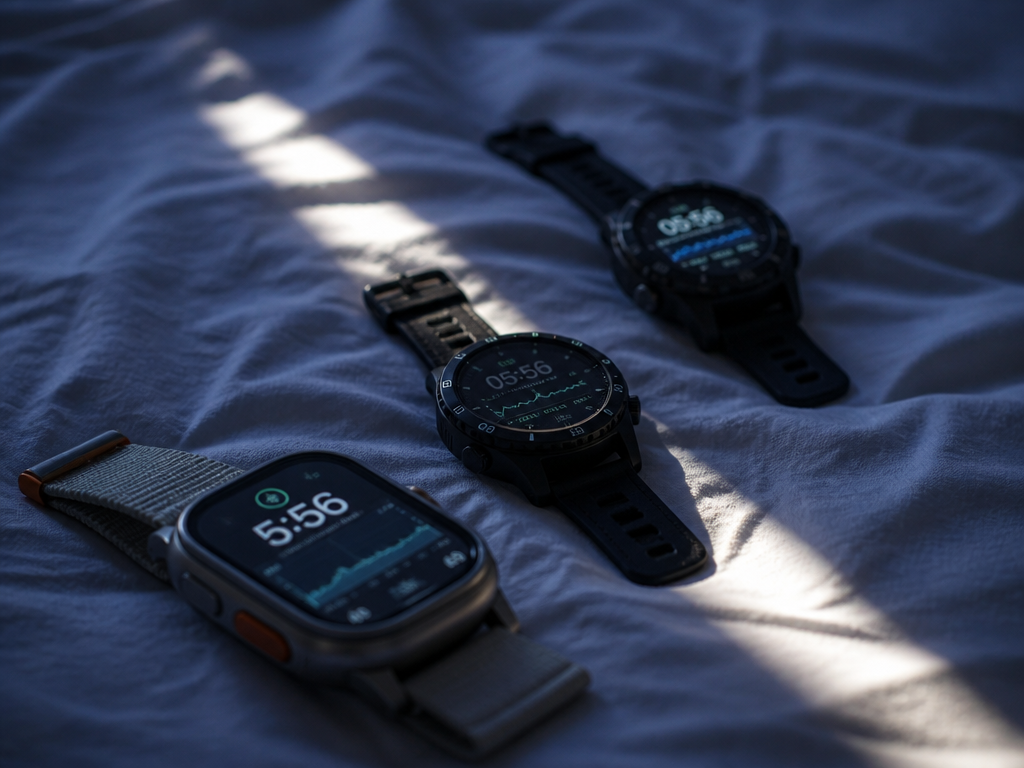
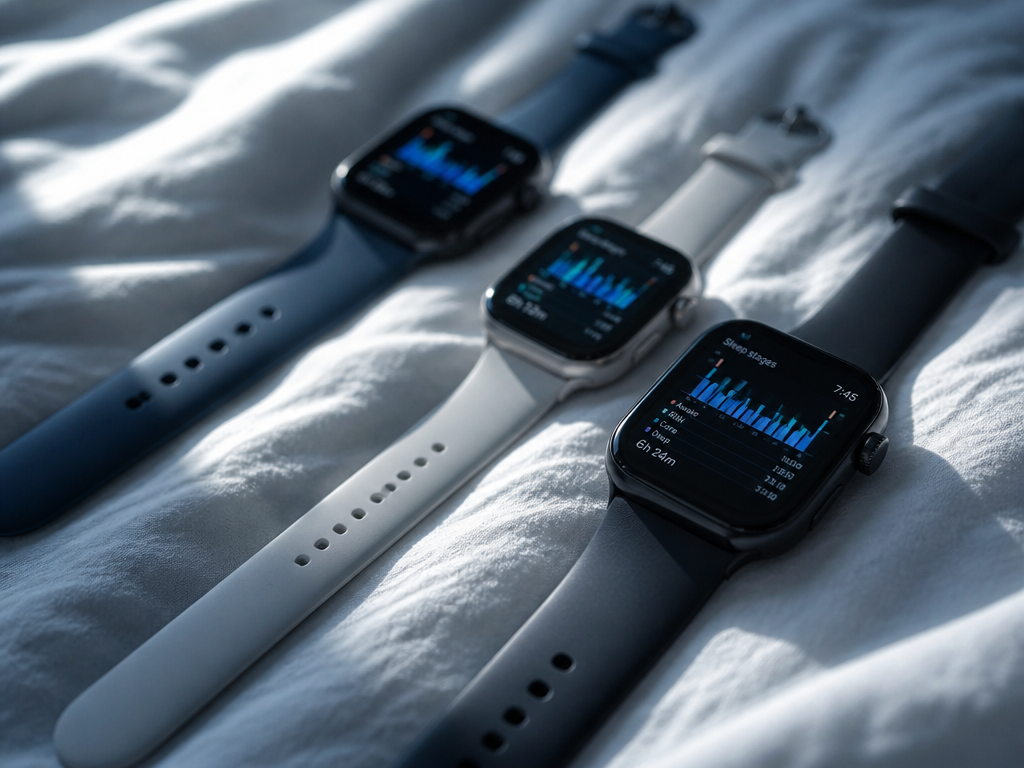
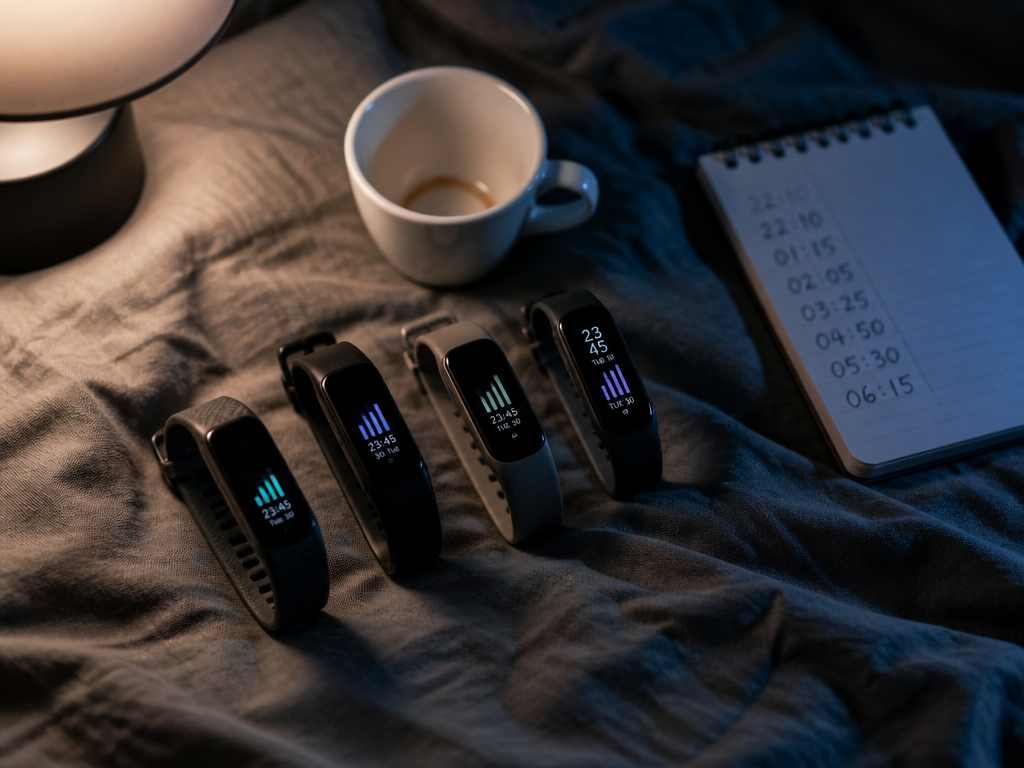
Twenty-one nights. Each morning I flipped a coin. At 4:00 p.m. I drank 12 oz of pour-over from a 22 g dose of the same Colombian — about 150 mg of caffeine by the roaster's lab number — or the identical coffee in decaf, about 6 mg. Ten caffeinated nights, eleven decaf. Three devices at once: the new Samsung on the left wrist, the Series 11 on the right, the Watch 7 above it on the same arm. Ground truth for sleep onset came from a phone tap test — a soft tone every two minutes, one tap to acknowledge, and the last tap stamps the moment I stopped responding to within two minutes.
One body, one liver, twenty-one nights. These are my numbers, not yours.
4:00 p.m. — the stomach, then the blood
Caffeine does not linger on the way in. It clears the stomach and small intestine almost completely inside 45 minutes, and blood levels are climbing well before anything feels different. That gap is the whole reason a wearable is interesting here: there is a window where the drug is in you and you cannot tell.
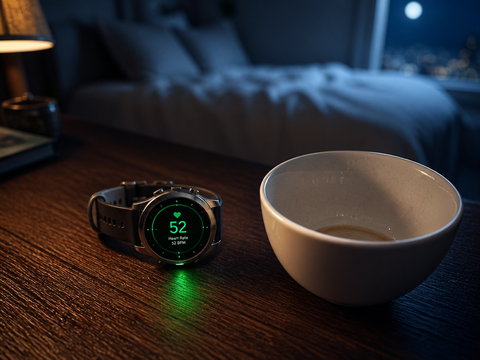
All three watches eventually registered it as a resting heart-rate lift of 3–5 bpm. What separated them was when. Averaged across the ten caffeinated evenings, the Galaxy Watch 9 flagged the rise at 4:38 p.m. The Series 11 got there at 5:10. The Watch 7, two generations back and sampling less often, waited until 5:52 — by which point I could feel it myself and the sensor was telling me nothing.
That's a genuine gain, and it comes from sampling rate rather than anything clever.
6:00 p.m. — the receptors nothing on your wrist can see
Here is where every sleep wearable hits a wall it doesn't advertise. Caffeine's actual mechanism is occupancy: adenosine builds up in the brain across the waking day and creates the pressure you experience as sleepiness, and caffeine parks itself in the same receptors so the pressure stops registering. The pressure is still there. You just lose the readout.
No consumer device measures any of that. What they measure is the autonomic wash downstream — mostly heart rate variability, the beat-to-beat wobble that shrinks when your sympathetic nervous system is doing more work.
This is the Watch 9's one defensible upgrade. It samples HRV continuously while you're awake, not only overnight. On caffeinated evenings my waking HRV dropped a median of 11 ms between 6 and 9 p.m. against the decaf baseline. The Series 11 doesn't track waking HRV in any usable density — it takes occasional readings and saves the real work for sleep, so on the same evenings it showed me nothing. The Watch 7 registered a 4 ms drop from sparse samples, which is inside its own noise.
If you want an evening signal rather than a morning post-mortem, this is the difference, and it's the only feature in the comparison I'd call decisive.
9:00 p.m. — the liver's slow arithmetic
Caffeine leaves through the liver, and it leaves slowly. Half-life sits around five hours for most adults — longer on hormonal birth control, shorter if you smoke. So the 150 mg from 4:00 p.m. is still about 75 mg at 9:00 and roughly 38 mg at 2:00 a.m. You go to bed with the equivalent of half an espresso in you and you go through the small hours with a quarter of one.
The body's tell at this stage is temperature. Core temperature has to fall for sleep to consolidate, and caffeinated nights ran warm: +0.28 °C skin deviation on the Samsung, +0.31 °C on the Watch 7, both consistent enough that I could guess the coin flip from the temperature graph alone about eight times in ten. The Apple watch has the sensor but reports only a nightly deviation figure, which arrives too late to act on.
11:20 p.m. — the number every device gets wrong
This is the failure, and it's not small.
By tap test, my median sleep onset was 26 minutes on caffeine nights and 12 on decaf. The devices reported: Galaxy Watch 9, 8 minutes versus 6. Series 11, 11 versus 9. Watch 7, 7 versus 5.
Every one of them compressed a 14-minute effect into two or three. The reason is structural. Wrist actigraphy infers sleep from stillness, and lying awake with caffeine on board is a very still activity — you are not tossing, you are staring at the ceiling with a low heart rate. The most sensitive behavioral marker of late caffeine is the one thing a motion-based sensor is built to miss.
The Samsung is the worst offender here precisely because its motion threshold is the most permissive. Its overall night is more accurate; its onset number is fiction.
1:00 a.m. to 4:00 a.m. — where the night actually breaks
The real damage isn't falling asleep. It's the back half. Deep sleep concentrates early and gets suppressed first, and fragmentation climbs as the drug thins out.
| Measure | Galaxy Watch 9 | Apple Watch Series 11 | Galaxy Watch 7 |
|---|---|---|---|
| Evening HR rise detected | 4:38 p.m. | 5:10 p.m. | 5:52 p.m. |
| Waking HRV drop, caffeine nights | −11 ms | not tracked | −4 ms (sparse) |
| Skin temp deviation | +0.28 °C | nightly only | +0.31 °C |
| Sleep onset (tap test: 26 min) | 8 min | 11 min | 7 min |
| Deep sleep, caffeine vs decaf | 68 vs 81 min | 74 vs 79 min | 71 vs 76 min |
The deep-sleep column is the one to read. A 13-minute gap is a signal you can act on. Apple's 5-minute gap and Samsung's older 5-minute gap both sit close enough to night-to-night variation that I wouldn't change a habit over them.
What the upgrade is worth
$349 outright. Samsung's trade-in credit runs $180–220 for a working Watch 6 or 7 in good condition, and it grades screens harshly — a scratched face knocked $60 off mine. Call it $130–170 realistically, which makes it the cheapest continuous-HRV wearable currently sold and undercuts the Series 11 by $230 before any Apple trade-in.
Coming from a Watch 7, the upgrade is one feature wide. Coming from a Watch 6 or older, it's a real jump.
Who this is for, and who it isn't
Buy it if you drink coffee after lunch, you want to see the effect while the evening is still salvageable, and you're already on Android. If that's you, the Galaxy Watch 9 is the one to get — as long as you ignore everything it says about how fast you fell asleep.
Skip it if you're on iPhone (the pairing compromises eat the advantage), if you only look at your data the next morning, or if you already wear a Watch 7. And skip it if what you want is an accurate onset number. Nothing on the market gives you that; a $6 tap-test app on the phone beside your bed does.
What I didn't answer
One dose, at one hour, in one person. I don't know whether 75 mg at 4:00 p.m. produces half this effect or none of it — the dose-response curve is the obvious next experiment and the one I'd want a threshold for. I don't know how much of my 26-minute onset is a fast or slow metabolism I've never had typed. And I have no idea whether seeing the HRV drop at 6 p.m. actually changes what anyone does at 7.
Next: the same protocol at 100 mg and 50 mg, and the same three devices against a home EEG headband, which at least scores wakefulness from the brain rather than from the wrist.