Every serious conversation about running world records now includes a dosing plan. Somewhere between the carbon plate and the sodium bicarbonate sits a number in milligrams per kilogram, and it has been settled long enough that nobody at the track argues about it. Caffeine is worth two to four percent. The figure shows up in umbrella reviews, federation nutrition guides, and the pinned post of every marathon forum.
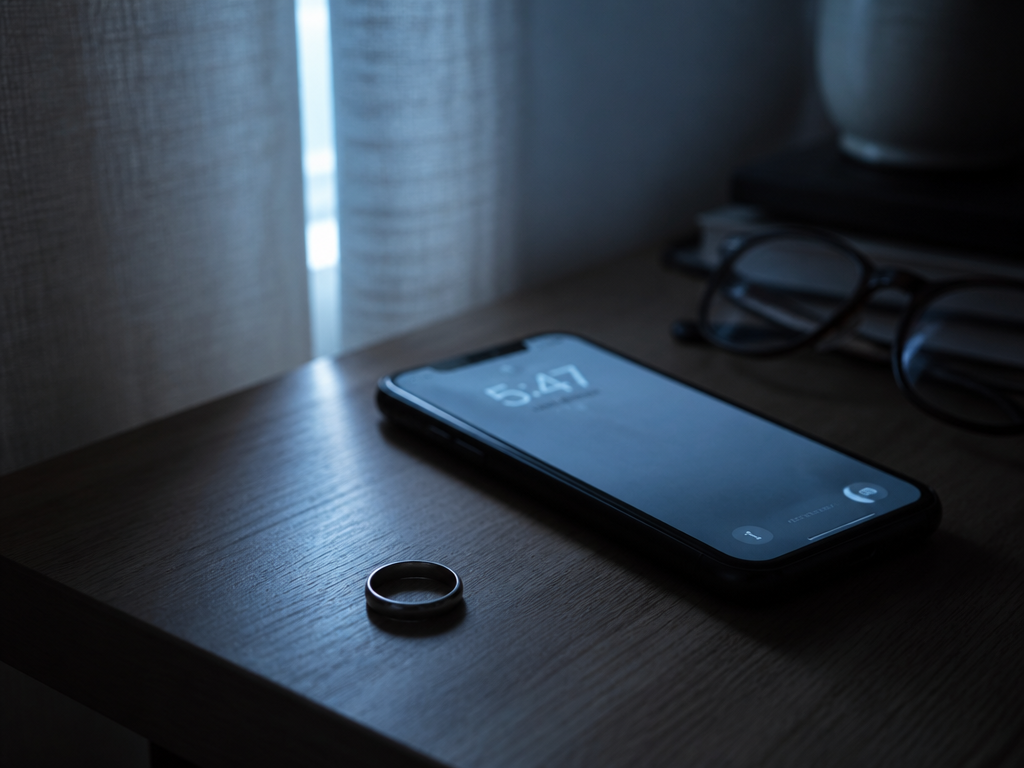
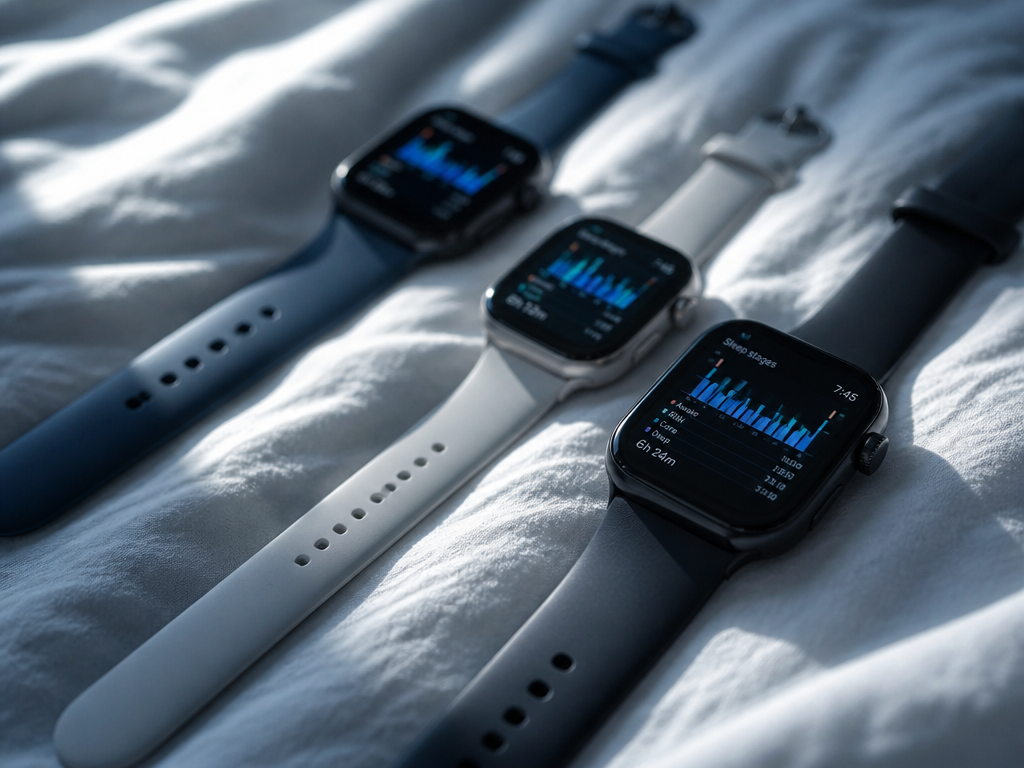
What almost nobody prices is the other column. So for six weeks I ran the same workouts on the same loop wearing a Garmin Forerunner 970 (about $750) and an Oura Ring 4 (about $350, plus the subscription), and moved exactly one variable: the clock time the caffeine went in.
The verdict: the gain is real and small — 14 seconds over 3 km — and on the evenings I chased it, my devices logged 38 fewer minutes of sleep. That is the whole trade, and no wearable I own will put both numbers on the same screen.
What I actually did
Forty-two days, three fourteen-day blocks, one subject: me, 71 kg, 41 years old, about 65 km a week, with a 3 km personal best from a decade ago that I no longer bring up.
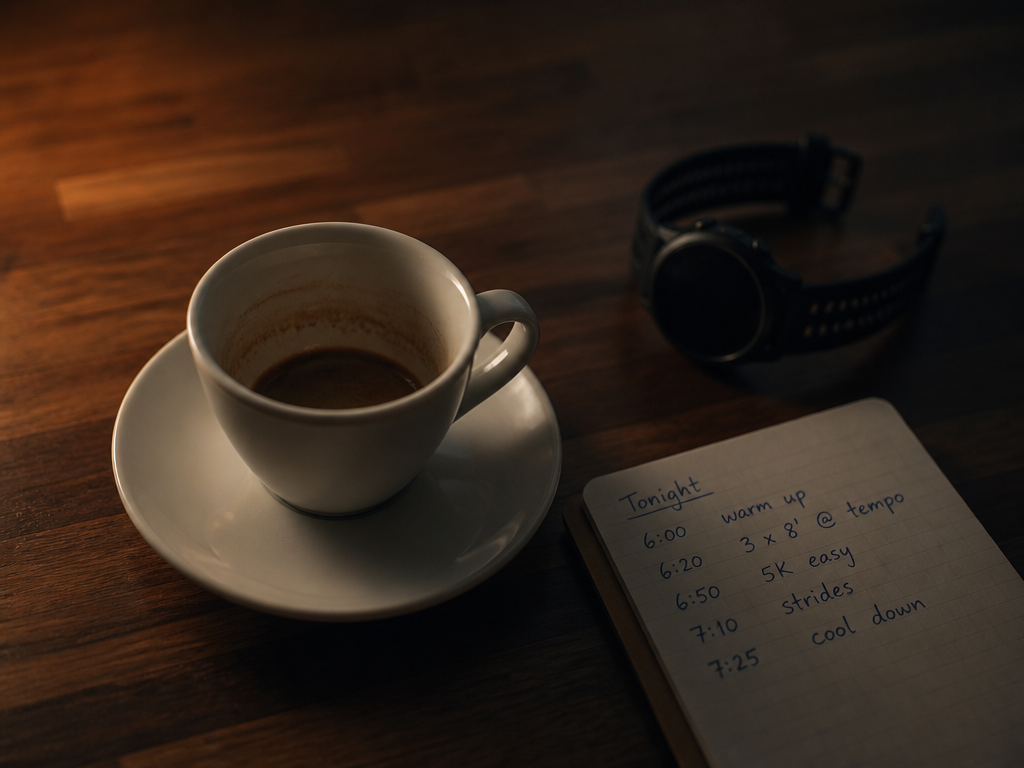
- Block A — habit. Two cups of filter coffee, last one around 14:30, roughly 250 mg total. Quality sessions Tuesday and Thursday at 17:30.
- Block B — race dose, evening. 213 mg of anhydrous caffeine (3 mg/kg) in tablet form, 60 minutes before those same 17:30 sessions, on top of the two morning cups.
- Block C — race dose, morning. Identical 213 mg, but the quality sessions moved to 06:30 and all caffeine stopped by 09:00.
Tablets rather than coffee, because I wanted the dose to the milligram instead of to the nearest café. The test was a 3 km track time trial on the last Saturday of each block, run under that block's own conditions — 60 minutes after the dose, at that block's hour.
That last detail is a confound and I can't remove it. Block C's time trial happened at dawn, and morning-versus-evening differences in core temperature and neuromuscular readiness are real and not small. I also did not blind myself. There was no placebo. I knew every single time which block I was in, and anyone who says that doesn't matter has never swallowed 213 mg of caffeine and then tried to be objective about how good they felt.
The numbers
| Metric (14-day median) | A: habit | B: 213 mg @ 16:30 | C: 213 mg @ 05:30 |
|---|---|---|---|
| Sleep onset latency | 14 min | 31 min | 12 min |
| Total sleep | 7h11 | 6h33 | 7h14 |
| Deep sleep | 62 min | 48 min | 64 min |
| Overnight HRV (rMSSD) | 58 ms | 49 ms | 60 ms |
| 3 km time trial | 11:38 | 11:24 | 11:27 |
Fourteen seconds off 11:38 is 2.0 percent, which lands almost embarrassingly close to the textbook figure. But six weeks of consistent training also makes you faster on its own, so I repeated a four-day version of Block A at the very end and ran one more time trial: 11:33. Five seconds of that gain was just fitness. The honest caffeine effect is closer to nine seconds — about 1.3 percent — and I only know that because I bothered to check for drift.
On the sleep side there was nothing subtle. Thirty-eight fewer minutes a night, sustained across fourteen nights, with the deep-sleep and HRV columns moving in the same direction. Nine milliseconds of rMSSD is the kind of drop my watch normally responds to by telling me to take it easy tomorrow. It never once connected that suggestion to the tablet I'd swallowed at 16:30.
Morning dosing kept 11 of the 14 seconds and cost nothing either device could find. If you take one line from this piece, take that one.
Where the two-to-four percent came from
The belief has a source, and the source is smaller than the belief.
In 1978, David Costill's lab at Ball State published a study in Medicine and Science in Sports on nine competitive cyclists. They abstained from caffeine for several days, then took 330 mg an hour before riding at 80 percent of VO2max until they couldn't continue. Time to exhaustion went from about 75 minutes to about 96. Free fatty acids in the blood rose. Costill's group proposed that caffeine spared muscle glycogen by shifting fuel use toward fat — a clean, mechanical, entirely satisfying explanation. Ivy and colleagues followed in 1979 with roughly seven percent more work over two hours of cycling.
That is the foundation. Nine caffeine-deprived cyclists and one elegant hypothesis.
The dosing table came later. Graham and Spriet's 1995 work compared 3, 6, and 9 mg/kg and found that the two lower doses improved endurance while the highest did not, despite producing the highest plasma caffeine. Every modern protocol that tells an athlete to take 3 to 6 mg/kg an hour before the gun is quoting that paper, usually without knowing it.
Meanwhile the IOC had put caffeine on the banned list with a urine threshold of 12 micrograms per millilitre — a number high enough that ordinary coffee drinkers were safe and only deliberate loading tripped it. The threshold did something odd to the culture: by drawing a line, it certified that there was something on the other side worth crossing. In 2004 WADA removed caffeine from the prohibited list entirely and moved it to the monitoring program, where samples across sports have consistently come back positive for it in the majority of tests ever since.

And the glycogen-sparing story? It didn't survive. Later muscle-biopsy work failed to reproduce it with any consistency. The metabolic explanation quietly fell away and was replaced by a neurological one: caffeine works mainly by blocking adenosine receptors in the brain, lowering perceived effort. The number stayed. The reason underneath it was swapped out mid-flight, and hardly anyone noticed.
The half of the sentence nobody measured
Here is the part that made me start logging.
Adenosine accumulates in the brain across your waking hours. In Borbély's two-process model of sleep regulation, that accumulation is sleep pressure — the thing that makes the bed feel good at 22:30. Caffeine's ergogenic mechanism, the one that replaced glycogen sparing, is antagonism of the receptors that molecule binds to.
So the sentence reads: caffeine improves endurance performance by blocking the signal that makes you sleepy. For forty-five years the field measured the first half of that sentence with beautiful precision and the second half barely at all — not out of negligence, but because in 1978 you could put a catheter in a cyclist's arm far more easily than you could measure what happened in his bedroom nine hours later.
The sleep side has its own thin foundation. The rule everyone repeats — no coffee after 2 p.m. — traces largely to a 2013 study by Drake and colleagues in the Journal of Clinical Sleep Medicine: twelve people, 400 mg in pill form, taken at 0, 3, or 6 hours before bed. Even the 6-hour dose measurably disturbed sleep. It is a good study. It is also twelve people, and it has been carrying a global habit on its back for over a decade. A 2023 meta-analysis in Sleep Medicine Reviews pushed the suggested cut-off closer to nine hours before bed for an ordinary dose, which for a 22:30 bedtime means your last coffee is at lunch. Almost nobody does this.
What's changed is not the science. It's that the second column is finally cheap to keep. A $350 ring will log your sleep latency every night for a year, which is more nights of data than the entire foundational caffeine-and-sleep literature combined.
Garmin vs Oura vs a paper notebook
If you're buying hardware for this, the device comparison matters more than the spec sheets suggest.
Oura Ring 4 reports sleep latency natively, as a number, every morning. That's the metric this experiment lives on, and having it handed to you rather than derived is worth real money.
Garmin Forerunner 970 does not surface latency directly, so I derived it: the gap between a manually logged lights-out and the watch's sleep-start timestamp. Workable, but it means my Garmin numbers are only as good as my discipline about noting the time I put the book down.
A paper notebook — my own guess, written before checking either device — was the least accurate and the most interesting. On Block B mornings I'd write "maybe 20 minutes" and Oura would say 31.
The three sources disagreed badly on absolute values. Median Block B latency: 31 minutes from Oura, 22 from the derived Garmin figure, roughly 20 from me. But on 13 of 14 nights all three moved in the same direction relative to my own baseline. That is the actual usable finding, and it applies to any wearable you own: the absolute number is close to worthless, the delta against your own history is not. Consumer devices are known to overestimate sleep and to handle the awake-but-still period poorly. Mine did. It didn't stop the signal from being obvious.
Who this is for, and who it isn't
This is for you if you race, if you already dose caffeine deliberately before hard efforts, and if you train in the evening because your job gives you no other option. That combination is where the trade is worst and where moving the clock — not the dose — costs you almost nothing.
It is not for you if you drink two coffees before 9 a.m. and nothing after. You have already solved this; the literature on running world records has nothing to sell you. It's also not for you if you're chasing the two percent in a season where you're sleeping badly anyway. Nine seconds over 3 km is a rounding error next to what a fortnight of 6h30 nights does to a training block, and no watch will draw that line for you.
And I should be plain about what I couldn't test: one runner, no placebo, no blinding, six weeks, two consumer devices with known validation limits, and a morning-versus-evening confound I could describe but not eliminate.
One thing to try this week
Don't change your caffeine. Don't change your training. For seven nights, write two numbers in the same note: the clock time of your last caffeine, and whatever your device calls sleep latency.
That's it. At the end of the week you'll have seven pairs — the second column that the founding studies never kept, for the specific body that has to run on it. If the pairs slope the way mine did, then next week move one quality session's dose to before 10 a.m. and keep logging. Same milligrams. Only the clock changes.