0.54.
That is the highest specificity any of seven consumer sleep trackers managed in Chinoy et al. (2021), published in Sleep, when 34 healthy adults slept in a lab wearing the devices while polysomnography recorded what was actually going on. Specificity, here, means exactly one thing: of all the minutes a person was genuinely awake, what fraction did the device correctly call awake. The best performer got a little over half. The weakest was down near 0.18.
Samsung Galaxy Unpacked 2026 was, as these events go, a strong one. Thinner foldables. A wearable line that keeps branching. Glasses that have finally stopped looking like a prototype someone lost a bet over. Sleep was on stage, because sleep is always on stage now — the ring, the watch, the score you get at 7 a.m. What was not on stage was a number shaped like 0.54.
That isn't a scandal. It's a category problem, and it's worth understanding before you buy a device whose whole promise is telling you how last night went.
What that study actually measured
Chinoy's team put people in a sleep lab and wired them for polysomnography — EEG for cortical activity, EOG for eye movement, EMG for muscle tone. A trained scorer then reads the record in 30-second epochs and calls each one sleep or wake, and if sleep, which stage. That's the reference standard. It is not perfect, but it's the only thing in the room that is actually looking at the brain.
Against that, they compared seven consumer devices — wrist trackers and bedside sensors, the 2017-to-2019 generation. None of them were Samsung's. That matters, and I'll come back to it.
The headline results were reassuring on the surface. Most devices estimated total sleep time within a reasonable margin. Sensitivity — correctly identifying sleep minutes as sleep — was high, generally north of 0.93.
Here's the trap in that number. A person lying in bed for eight hours is asleep for most of them. A device that simply guessed "asleep" for every single minute between lights-out and alarm would score a sensitivity of 1.0 and look magnificent. Sensitivity, on this base rate, is nearly free. Specificity is where the money is, because specificity is the part that requires the device to actually notice something happened.
And specificity is where the numbers fall apart.
Why wake is the structurally hard part
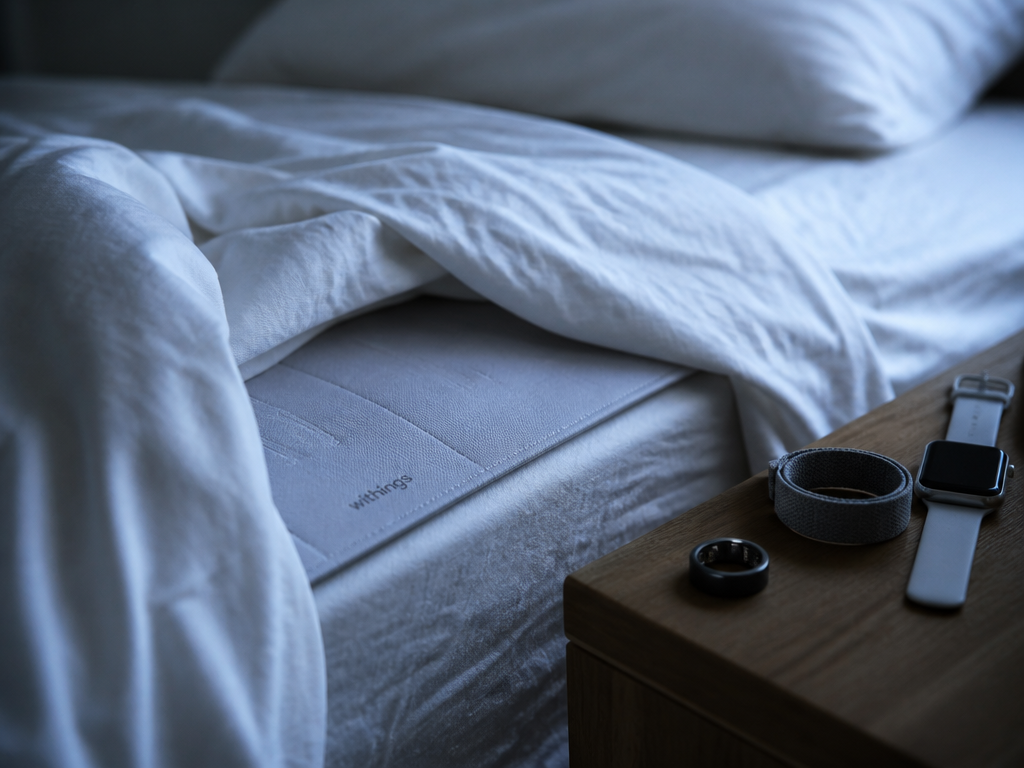
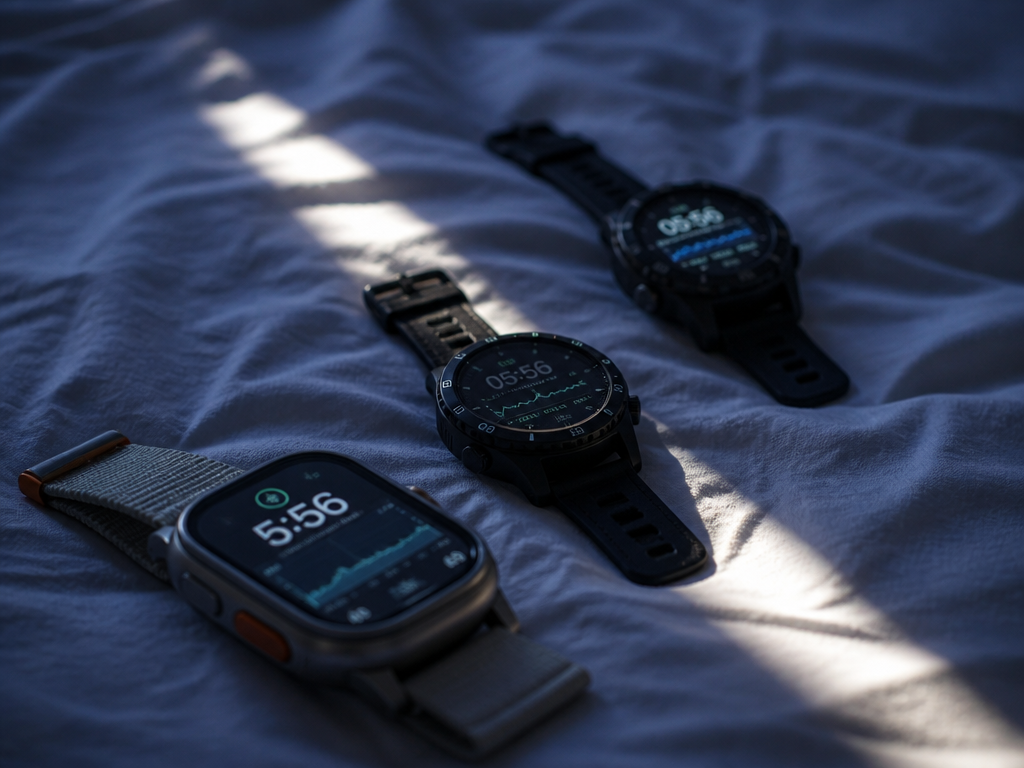
A wrist tracker infers sleep from two signals: motion, via an accelerometer, and cardiovascular data, via photoplethysmography — green LEDs measuring how much light your capillaries absorb as blood pulses through. From those, software derives heart rate, beat-to-beat variability, sometimes respiration rate. Everything else — stages, scores, "recovery" — is inference stacked on top of those inputs.
That pipeline is very good at detecting stillness plus a low, steady heart rate. It is much worse at detecting the specific kind of wake that caffeine produces.
From cup to wrist, in order
You drink the coffee. Caffeine is absorbed almost completely from the gut, with plasma concentration peaking somewhere around 30 to 60 minutes later. It crosses the blood-brain barrier easily, partly because it's structurally similar enough to adenosine to fit where adenosine fits.
Adenosine has been accumulating in your brain since you woke up — a byproduct of the day's metabolic activity, and one of the signals that builds sleep pressure. It docks at A1 and A2A receptors and dampens arousal-promoting systems. Caffeine occupies those receptors without activating them. The adenosine is still there. The message just doesn't get delivered.
Downstream, that shows up as longer sleep latency, reduced slow-wave sleep, and — critically — a more fragmented back half of the night. Fragmentation means brief cortical arousals: three to fifteen seconds of faster EEG activity, sometimes a heart rate bump, frequently no movement at all.
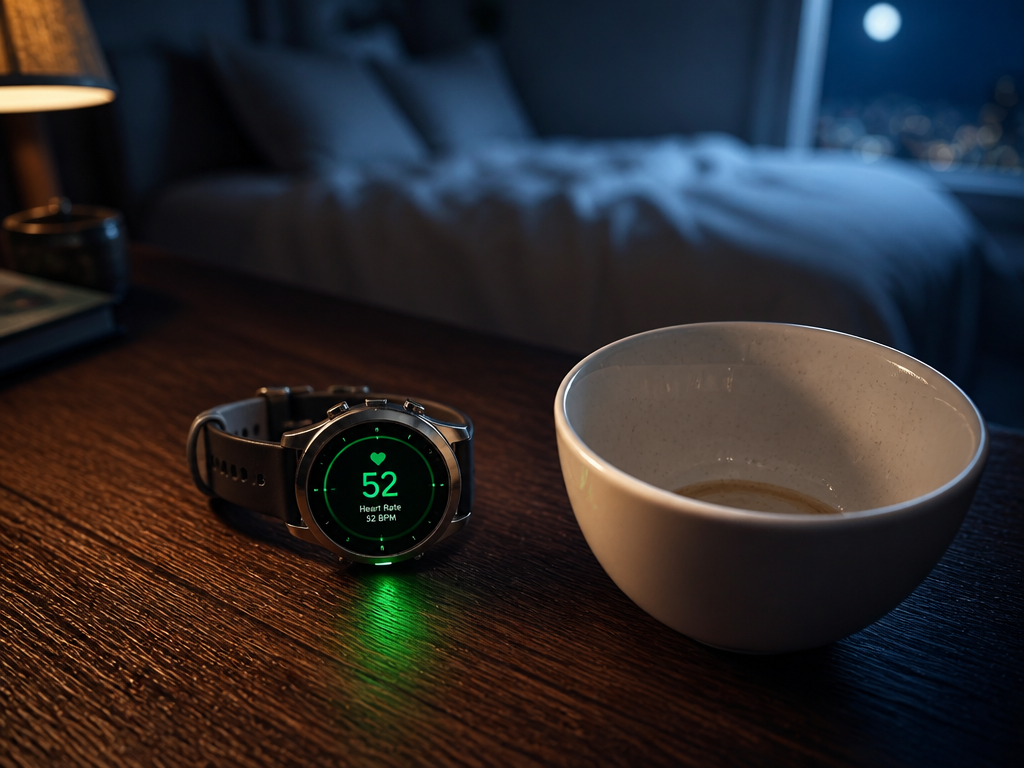
Now look at what's on your wrist. The arousal was electrical. The accelerometer registers nothing, because nothing moved. PPG might catch a transient heart rate change; it might average it away. The device's job at that moment is to detect a wake event that produced almost no peripheral signal, and its track record on that job is 0.54 on a good night, on the best device tested.
The pairing study here is Drake et al. (2013), in the Journal of Clinical Sleep Medicine, which gave 12 healthy adults 400 mg of caffeine at 0, 3, and 6 hours before bedtime. The 6-hour dose — a late-afternoon coffee, in normal-person terms — measurably degraded sleep. What made the study famous is that participants' own sense of their sleep didn't reliably track the damage. Sample of 12; treat the effect size loosely and the direction firmly.
So: your subjective report misses it, and your wearable is weakest at exactly the signal it produces. That's a real gap, and it's the gap wearables were supposed to close.
Does a Galaxy Watch or Galaxy Ring track sleep accurately?
Accurately enough to be useful across weeks. Not accurately enough to adjudicate a single night. If your ring says you got 6h 40m, the true figure is plausibly anywhere in a window tens of minutes wide, and the stage breakdown — the deep/REM/light pie chart — is the least validated layer of the display.
The nuance underneath: modern PPG-based devices have improved on the 2021 cohort, particularly on staging, where heart rate variability features carry genuine signal. Follow-up validation work on newer hardware is more flattering than Chinoy's original. But wake detection remains the laggard across manufacturers, and it is not a firmware problem anyone is one update away from solving. You cannot infer cortical arousal from a wrist with high confidence, because the information mostly isn't there.
The honest framing is that these devices are decent trend instruments and poor verdict instruments. Baron et al. (2017), also in JCSM, coined "orthosomnia" for patients whose sleep got worse from anxiously chasing their tracker's score. It's a small case series, not an epidemiological finding — but the mechanism is obvious enough that it hardly needs one.
What Unpacked actually improved, and what it didn't say
The ring form factor is a legitimate sensing upgrade, not just a styling choice. The finger has better perfusion than the wrist and far less motion artifact — no watch band shifting, no arm flung over a pillow. A cleaner PPG trace is a better foundation for every inference built on it.
The apnea feature is the most credible thing in Samsung's sleep stack, and specifically because of how narrow it is. The FDA's De Novo authorization in February 2024 covered detecting signs of moderate-to-severe obstructive sleep apnea in adults 22 and up, over two nights of monitoring, explicitly not as a diagnosis. That narrowness is the tell. Regulators made them define the claim, the population, and the protocol. Nothing else on the sleep screen has been through that.
Which brings us to the composite scores — energy, readiness, recovery, whatever this year's noun is. These are proprietary weightings of the same underlying sensor data. They may well be useful. They have not, as far as I can find, been externally validated against anything, and no spec sheet from any manufacturer lists a specificity figure. There's no rule requiring one. There's also no reason a company would volunteer it.
An honest rule of thumb
Tonight, don't ask your device whether the coffee hurt. Ask the arithmetic instead. Caffeine's half-life runs roughly 5 hours in a typical adult — with real variation from CYP1A2 genotype, and roughly doubled by oral contraceptives. A 200 mg dose at 4 p.m. leaves you around 100 mg at 9 p.m. and 50 mg at 2 a.m. Fifty milligrams is not nothing; it's a strong tea, circulating during the hours your sleep is most fragile.
Use the tracker for the seven-day average. Use the clock for the decision.
| What you want to know | What the hardware sees | How solid |
|---|---|---|
| How long I slept | Stillness + steady heart rate | Well established, within ~20–30 min |
| When I fell asleep | Motion stopping, HR drop | Reasonable |
| Deep vs. REM split | HRV features, inferred | Plausible but thin |
| Whether caffeine fragmented my night | Brief cortical arousals | Weak — this is the 0.54 |
| Signs of moderate-to-severe apnea | Blood oxygen desaturation patterns | Cleared for a narrow, defined claim |
Back to 0.54
That number isn't an indictment of Samsung, or of wearables generally. It's a measurement of where the boundary sits between what a sensor on your skin can observe and what's happening two inches into your skull.1
What changed at this year's Unpacked is real: better optics, better placement, one feature that survived a regulator asking hard questions. What didn't change is that the most interesting thing about your sleep — the quiet, motionless fraying that a late coffee causes — is the thing your wrist is worst at seeing.
So when the score appears tomorrow morning, read it as an estimate with a confidence interval nobody printed. The device isn't lying to you; it just can't see the part you actually wanted to know about.
-
Worth noting that PSG itself is scored by humans, and inter-rater agreement between trained technicians on stage-by-stage scoring is good but not unanimous — usually reported in the low-to-mid 80s percent. The ground truth has its own error bars. ↩