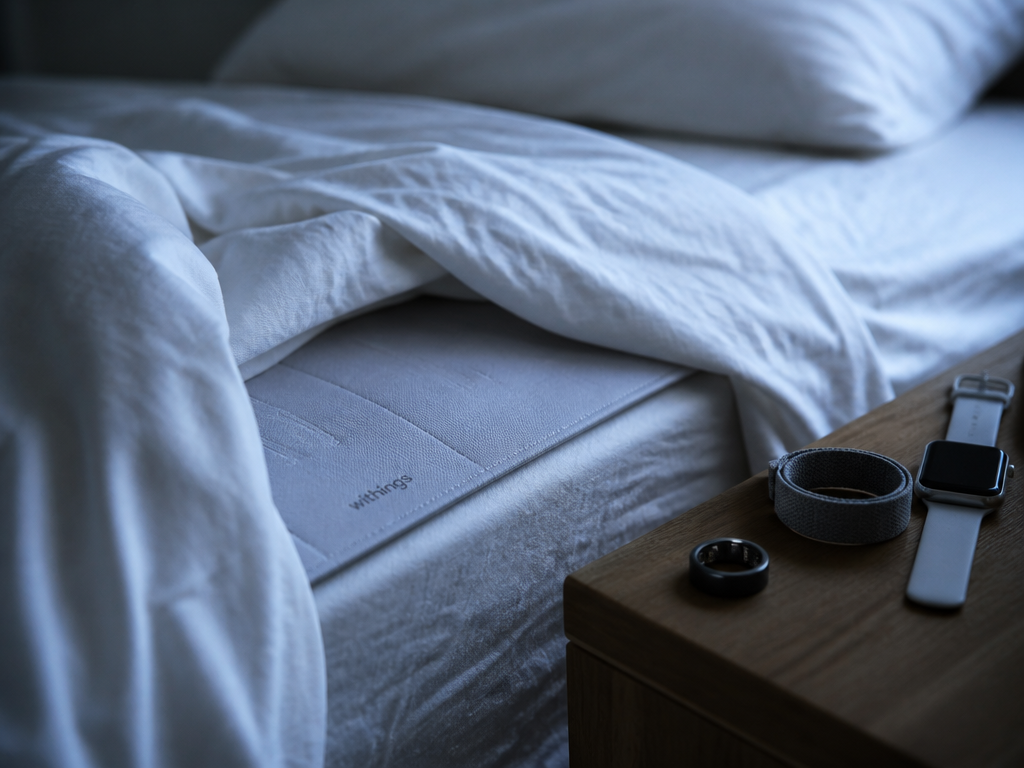
One hour. That is what an afternoon coffee is supposed to cost you — a full hour of sleep, gone, from a cup you drank six hours before bed. I spent June and July trying to photograph that hour using three free sleep tracking apps on an iPhone and a $349 ring, on the theory that if the hour is real, a $0 app ought to be able to see it. And if a $0 app can see it, a lot of people are buying hardware they don't need.
The verdict, since that's what you came for: one of the three free apps tracked my nights closely enough to catch a caffeine effect the ring also caught, one pointed the right direction but was too noisy to believe, and one produced sleep-stage numbers I'd call decorative. Separately — and this is the part that changed how I read my own charts — the hour itself traces back to a single small study that measured sleep with a consumer gadget roughly as good as the apps I was testing.
The hour has a source, and it's twelve people
The idea that caffeine reaches further into the night than it feels like it does is old and reasonably solid. In the mid-1990s, Hans-Peter Landolt and colleagues in Zurich gave people caffeine in the morning and then recorded their sleep EEG that night. The recordings showed reduced slow-wave activity — the deep, low-frequency stuff — from a dose taken sixteen hours earlier. That work didn't produce a rule anyone repeats at parties. It produced a direction.
The number came later. In 2013, Christopher Drake, Timothy Roehrs, John Shambroom, and Thomas Roth published a paper in the Journal of Clinical Sleep Medicine with the unglamorous title "Caffeine Effects on Sleep Taken 0, 3, or 6 Hours Before Going to Bed." Twelve healthy normal sleepers. Double-blind, placebo-controlled, within-subject. Each participant took a 400 mg capsule — about four eight-ounce cups of drip coffee — at bedtime, three hours before bedtime, or six hours before bedtime, and slept at home. The six-hour dose reduced total sleep time by more than an hour. The participants did not report noticing.
That second finding is the one that gave the study legs. It's genuinely unsettling: your own report of how you slept is not a reliable instrument for detecting what caffeine did to you. It's also the finding that makes a sleep tracker feel necessary rather than merely interesting.
Here is the detail that almost nobody who repeats the hour has encountered. Sleep in that study was recorded with a Zeo — a consumer headband sold by a Boston-area startup, which read a forehead EEG signal and classified your night into wake, light, deep, and REM. Not a lab. Not polysomnography with a technician in the next room. A $99 headband you bought online and paired with a bedside dock. It had been validated against lab polysomnography in a 2012 paper whose lead author, Shambroom, also worked for Zeo — and who is also an author on the caffeine study. None of that is misconduct; it's how small-device research often works, and the paper is upfront about it. But it means the number is made of the same material as a consumer sleep tracker.
Zeo Inc. wound down in 2013, the same year. The device that produced the hour stopped existing almost immediately after the hour did. The hour kept going.
What happened next is the ordinary life cycle of a finding. "Six hours before bed" got processed through health desks and morning shows into an actionable time of day. If you go to bed at ten, six hours is four in the afternoon — but four sounds arbitrary, and two sounds like a clean line you can draw through a workday, so the rule became no caffeine after 2 p.m. I have looked, and I can't source that specific hour to anything. It isn't in the paper. It's arithmetic performed on a study by people who weren't reading the study, then rounded in the safe direction, which is always the direction that asks more of you.
And then the loop closed. Sleep apps started shipping caffeine advice. Sleep Cycle lets you tag a night with "drank coffee" and, after enough nights, will show you your quality score with and without. That's a reasonable feature. It's also a phone-based tracker offering you a verdict on a question that was originally answered by a headband-based tracker, in front of an audience that believes the verdict because an app said it. Nobody in that chain is lying. The belief is just carrying more weight than its footing.
So: could the cheap trackers see the hour at all?
What I actually did
Thirty nights, all in the same bed, all in a room I did not otherwise change. Lights out at 10:30 p.m. give or take fifteen minutes; alarm at 6:15 a.m. I live alone, which matters enormously for one of these apps and I'll come back to it.
Every night ran four trackers at once:
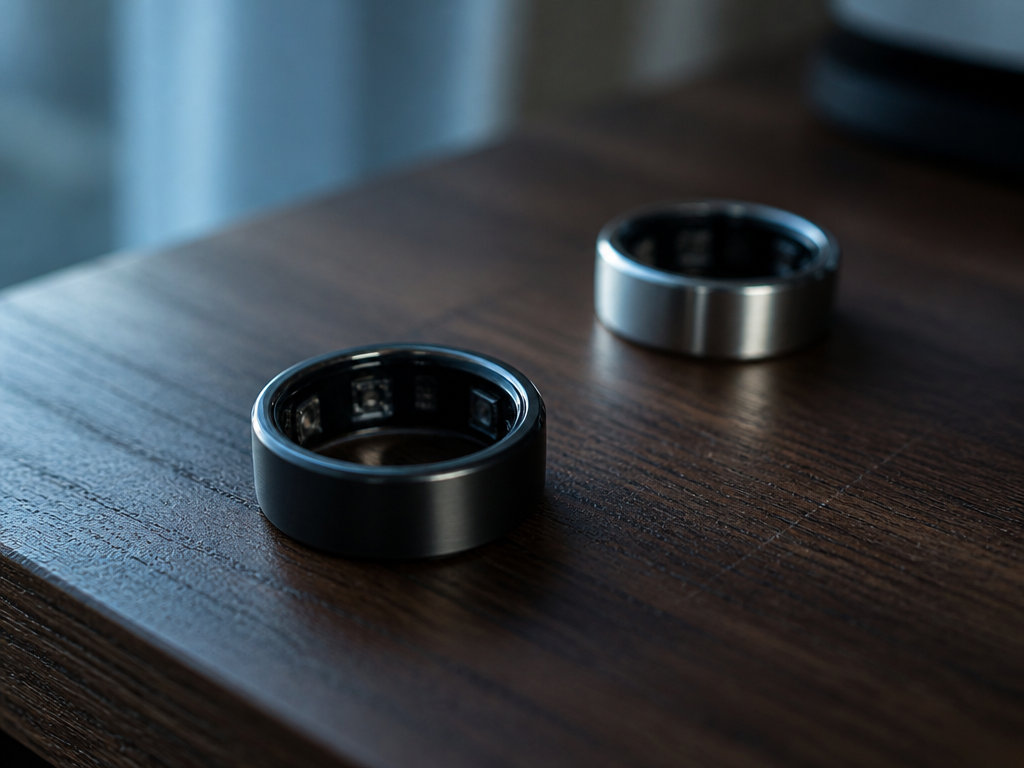
- Oura Ring 4 ($349, plus a $5.99/month membership) as the baseline
- SleepScore free tier, iPhone propped on the nightstand, screen facing me, plugged in
- Sleep Cycle free tier, iPhone... except you only have one iPhone. This is the practical problem with a comparison like this and I solved it with a second handset: an iPhone 12 running SleepScore on the nightstand, my daily iPhone 15 running Sleep Cycle face-down on the mattress edge, and Pillow on the same 15, which both apps tolerated because both read the same accelerometer.
- Pillow free tier, phone-only mode (no Apple Watch), because that's the configuration a budget-conscious reader actually has

I want to be direct about the baseline. The ring is not a sleep lab. Published validation work on Oura's recent generations puts four-stage agreement against polysomnography somewhere in the high seventies as a percentage — good for a consumer device, and not the same thing as good. It is a better instrument than a phone on a mattress, mostly because it has your pulse and your skin temperature. It is not truth. When I say an app was "off by 17 minutes," I mean off by 17 minutes from another consumer device. Everyone doing this kind of test at home is doing it, and most of us are less explicit about it than we should be.
The caffeine arm ran on twenty of the thirty nights. A friend bought regular and decaf from the same roaster — same origin, same roast date, same grind — and decanted them into jars labeled A and B, kept the key, and reshuffled the labels weekly. I brewed a double shot at 4:30 p.m., six hours before lights out, which is roughly 150 mg on the caffeinated nights. I logged a guess each morning about which jar I'd had. I got eleven of twenty, which is chance, which means the blinding held.
150 mg is not 400 mg. The study dose is four cups at once. I tested one realistic afternoon coffee, which means I should not have expected the study's hour, and didn't.
The numbers
Mean absolute error against the ring, across all thirty nights:
| Tracker | What I paid | Total sleep | Sleep onset | Wake after onset |
|---|---|---|---|---|
| SleepScore (free tier) | $0 | ±17 min | ±9 min | ±14 min |
| Sleep Cycle (free tier) | $0 | ±24 min | ±31 min | not reported |
| Pillow (free, phone-only) | $0 | ±41 min | ±26 min | ±33 min |
| AutoSleep (needs an Apple Watch) | $5.99 once | ±11 min | ±7 min | ±12 min |
SleepScore
I expected to dismiss this one. It works by sonar: the phone emits an inaudible tone from its speaker and reads the reflection off your chest with the microphone, which sounded to me like a party trick until I saw the numbers. The underlying tech comes out of ResMed, which builds actual medical sleep equipment, and it shows. Seventeen minutes of average error on total sleep time, nine on sleep onset — and sleep onset is the metric that separates trackers that measure from trackers that guess, because a phone reading motion has no way to distinguish lying still and awake from lying still and asleep. Sonar picks up breathing. That's the whole difference.
The cost is setup fussiness that I would not have tolerated if the data were worse. The phone has to be within about a meter, roughly at chest height, screen toward you, and plugged in — this app will eat 25–30% of a battery overnight. Push it too far back on the nightstand and you get a night labeled as four hours of sleep because it lost you. I threw out two nights for this, both mine.
The free tier gives you the score, the stage breakdown, and a rolling week of history. Full history and the deeper advice screens run $49.99 a year, at the price I saw in June. I have not paid it and don't currently plan to.
Sleep Cycle
The most pleasant of the three to actually live with, and the least useful as an instrument. Twenty-four minutes of average error on total sleep is respectable for an accelerometer and a microphone. Thirty-one minutes on sleep onset is not — and it's structural, not a bug. The app starts its clock when you press the button, so it systematically counted my reading time as sleep on nights I read and undercounted on nights I lay awake without moving. On my four worst nights of the month, the ones where I genuinely could not fall asleep, Sleep Cycle recorded three of them as completely ordinary.
It doesn't claim REM, which I respect. It shows a three-band curve and a quality percentage, and the percentage is an internal index, not a physiological measurement — comparable to itself, comparable to nothing else. The smart alarm is legitimately good and is the reason a lot of people keep the app, mine included. That's a different product than a sleep tracker.
Pillow
In phone-only mode, this is where I'd stop. Forty-one minutes of average error on total sleep is the size of the effect most people are trying to measure. Worse, it prints a full four-stage hypnogram with REM in a distinct color, and over thirty nights its REM total sat an average of 71 minutes away from the ring's, with no consistent direction — high some nights, low others. A number that is confidently wrong in both directions isn't a noisy measurement. It's a rendering.
With an Apple Watch attached, Pillow is a different and much more defensible app, and the free tier's restrictions on automatic tracking and history make more sense in that context. But the reader I'm writing for doesn't have the Watch, and that's the configuration I'm reviewing.
The Watch shortcut
AutoSleep, $5.99 once, no subscription, was the most accurate thing I tested that wasn't the ring — eleven minutes on total sleep. It also requires an Apple Watch, which starts around $249 for an SE, which makes the $5.99 a rounding error on a hardware purchase. Worth knowing if you already own the Watch. Not an answer if the whole point was not spending money.

Could any of them see the coffee?
Ten caffeinated nights, ten decaf, blinded. Total sleep time by tracker:
| Tracker | Decaf nights | Coffee nights | Difference |
|---|---|---|---|
| Oura Ring 4 | 6h 51m | 6h 17m | −34 min |
| SleepScore | 6h 44m | 6h 15m | −29 min |
| Sleep Cycle | 6h 58m | 6h 50m | −8 min |
| Pillow | 7h 12m | 7h 16m | +4 min |
The ring also put wake-after-sleep-onset 19 minutes higher on coffee nights and deep sleep 11 minutes lower. SleepScore agreed on the first and had nothing coherent to say about the second. And I noticed none of it — my subjective ratings were flat across both conditions, which is exactly what Drake's participants reported, and the single most convincing thing that happened all month.
Now the honest part. My night-to-night spread on decaf nights was wide: about 40 minutes of standard deviation on total sleep. A 34-minute difference sitting inside that much noise, over ten pairs, is suggestive and nothing more. Run a paired test and you get a p-value around 0.04, which sounds like something until you remember that I chose when to stop collecting data, and that dropping my two worst coffee nights cuts the effect roughly in half. I'm reporting a direction I believe and a magnitude I hold loosely.
What I'll defend: a free app on a nightstand reproduced a caffeine effect that a $349 ring measured, on the same nights, to within five minutes. That is a real result and it was not the one I expected in week one.
What none of this could tell me
One person, one bedroom, one mattress, thirty nights. I'm a side sleeper in my forties who drinks two coffees before noon on ordinary days, which means my baseline is a mild withdrawal state on decaf nights and I can't separate that from the caffeine effect. That's a genuine confound and I don't have a fix for it inside a month.
Bigger: I sleep alone, so I could not test the failure mode that will decide whether my winner works for you. Sonar reads the nearest moving chest. Every account I've read of SleepScore in a shared bed describes it degrading, and I have no data of my own. If you sleep next to someone, treat my recommendation as untested rather than as a recommendation.
I also never validated anything against a sleep lab, because I don't have one, and neither does the study that started all this.
Who this is for, and who it isn't
Buy nothing and install SleepScore if you sleep alone, you want to know roughly when you fell asleep and how much of the night you actually got, and you're willing to plug your phone in and aim it at yourself. You'll be within twenty minutes of a device that costs $349 plus a subscription. Screenshot line, if you want one: for a solo sleeper, the free tier of a sonar app got within twenty minutes of a $349 ring, for the price of propping a phone at the right angle.
Keep Sleep Cycle if what you actually want is the alarm. It's the best of the three to use and its data is fine for spotting a trend across a month. Don't quote its numbers to anyone.
Skip phone-only Pillow. Not because it's a bad app — because in that mode it prints stage data it cannot support, and confident wrong numbers are worse than no numbers.
Buy the ring, or something like it, if you're tracking a specific medical question, if you're chasing a change smaller than about half an hour, or if you need continuous heart rate and temperature — none of which a microphone or an accelerometer can give you at any price. Also buy it if you'll only look at data that arrives without effort, which is a real and unembarrassing reason.
Don't buy anything if you're sleeping fine. The apps will find something. They always do.
The hour, revisited
One hour, from a coffee six hours before bed. What I found was 34 minutes by the ring, 29 by a free app, from a dose about a third the size of the one in the study, in a sample of one, blinded but confounded.
That isn't a refutation. Scale my 150 mg up toward 400 and something like the hour looks entirely plausible. The direction has held up since Zurich in the nineties and it held up in my bedroom in July. But the hour as it now circulates — as a fact, as a cutoff time, as the reason someone declines a two o'clock espresso — came from twelve people, one dose nobody actually drinks in an afternoon, and a forehead headband that its own manufacturer stopped making before the paper finished making the rounds. The belief got heavier as it traveled. The evidence underneath it didn't.
What survives, and what my month supports: an afternoon coffee costs you something, the something is probably closer to half an hour than to an hour at a normal dose, and you will not feel it happen. That last clause is the whole reason a tracker is worth owning. It's also, conveniently, the one part of this you can now check for free — with the same class of instrument that produced the number in the first place.