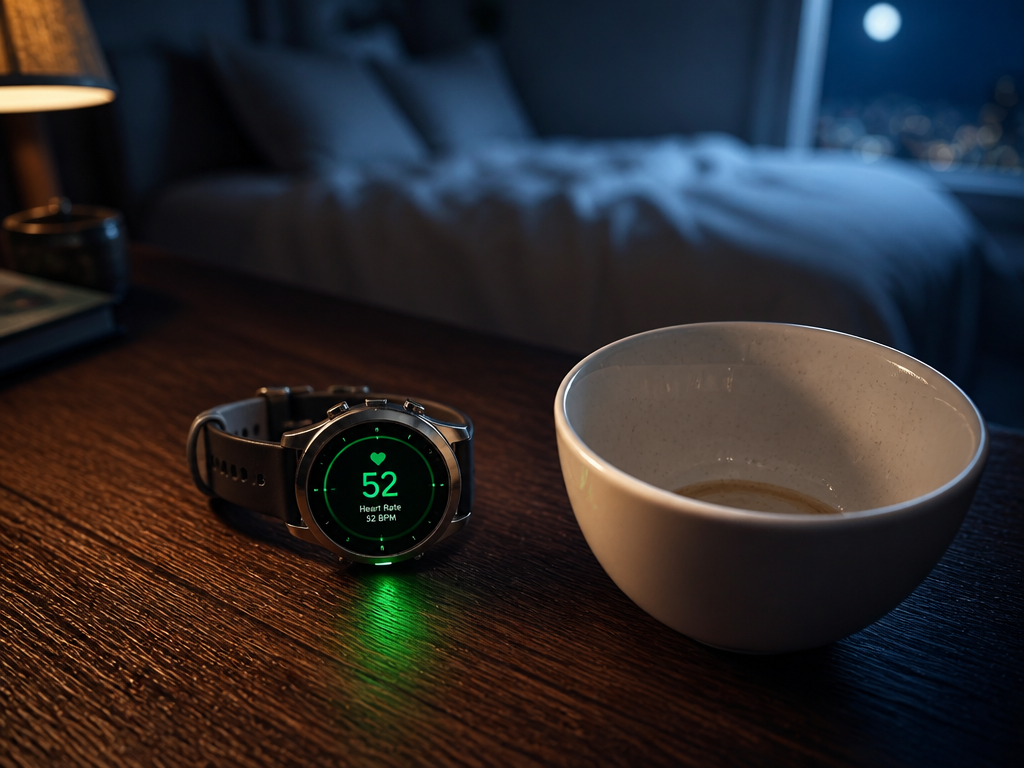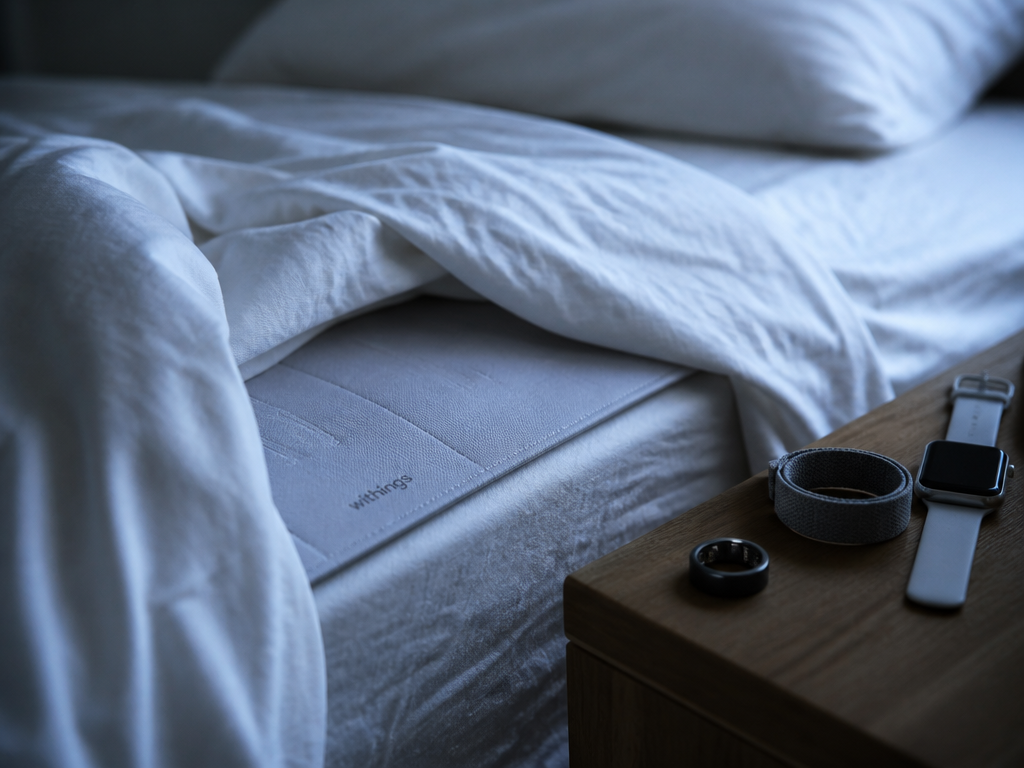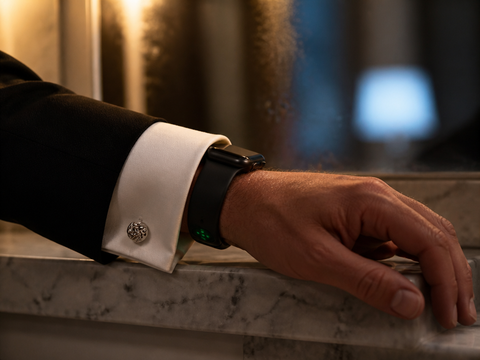
Most smartwatch reviews are written in daylight, on a treadmill, by someone in a hoodie. Mine started in a hotel bathroom at 11:15pm, in a rented dinner jacket, trying to work out whether the thing on my wrist was going to give me the one number I'd worn it all evening to collect — or whether I'd take it off, put it on the nightstand, and wake up with nothing.
That's the actual conflict. Formal dinners are where caffeine gets strange: a double espresso at 22:40 because the waiter is standing there, two glasses of wine already in, a room you can't leave for another hour. It is the single most interesting night of the month for anyone who tracks sleep onset. It is also the one night a lot of people take the watch off.
The verdict: the best formal-wear sleep tracker I tested is the thickest watch in the group, and the reason has nothing to do with millimetres.
What most people do
The standard advice is the swap. Wear the mechanical to the event, change into the tracker at bedtime. I did this for two years and it works exactly as well as any plan that depends on a tired person doing an extra step in an unfamiliar room.
My own failure rate on swap nights, before this test, was somewhere around half. Not because I forgot the watch — because the tracker was in the suitcase, the suitcase was across the room, and by the time I noticed I was already horizontal. The nights I lost were disproportionately the interesting ones: late food, late caffeine, unfamiliar bed, alcohol. The swap works best on the nights you don't need it and fails on the nights you do, which makes it worse than useless — it makes your dataset quietly optimistic.
The other move is the ring. Buy an Oura or a Galaxy Ring, wear it under everything, let the wrist go analog. I understand the appeal and I've worn one. My complaint isn't the data; the sleep staging held up fine against the watches. My complaint is that a ring gives you nothing at 22:40. You can't glance at it and see that your resting heart rate is still elevated forty minutes after the espresso. You get the story the next morning, fully formed, with no chance to have noticed anything while it was happening. For a magazine that mostly cares about the gap between what a stimulant does to you and what you think it's doing to you, that's a real loss.
So: one watch, worn from the ceremony through to the alarm. That was the brief.
What the evidence suggests
Eight weeks, four watches, two weeks each, then a final fortnight back on the winner. Five occasions in that window where a jacket wasn't optional: a wedding, a funeral, a black-tie awards dinner, two work dinners with a stated dress code. Shirts were mine — two with French cuffs, three with barrel cuffs, all off-the-peg, all with the cuff circumference that implies.
I measured every case with £14 calipers, so call it ±0.2mm.
| Watch | Measured thickness | Behaviour under a cuff | Onset error vs. paper notebook | Still on at 3am |
|---|---|---|---|---|
| Withings ScanWatch 2 (42mm) | 13.7mm | Snagged twice in 14 nights | ±9 min | 13/14 |
| Samsung Galaxy Watch Classic (46mm) | 10.6mm | Snagged most nights | ±6 min | 9/14 |
| Apple Watch (42mm) | 9.8mm | Cleared easily, every time | ±7 min | 7/14 |
| Garmin Venu 3 (45mm) | 12.0mm | Snagged, and the lugs flare | ±11 min | 11/14 |
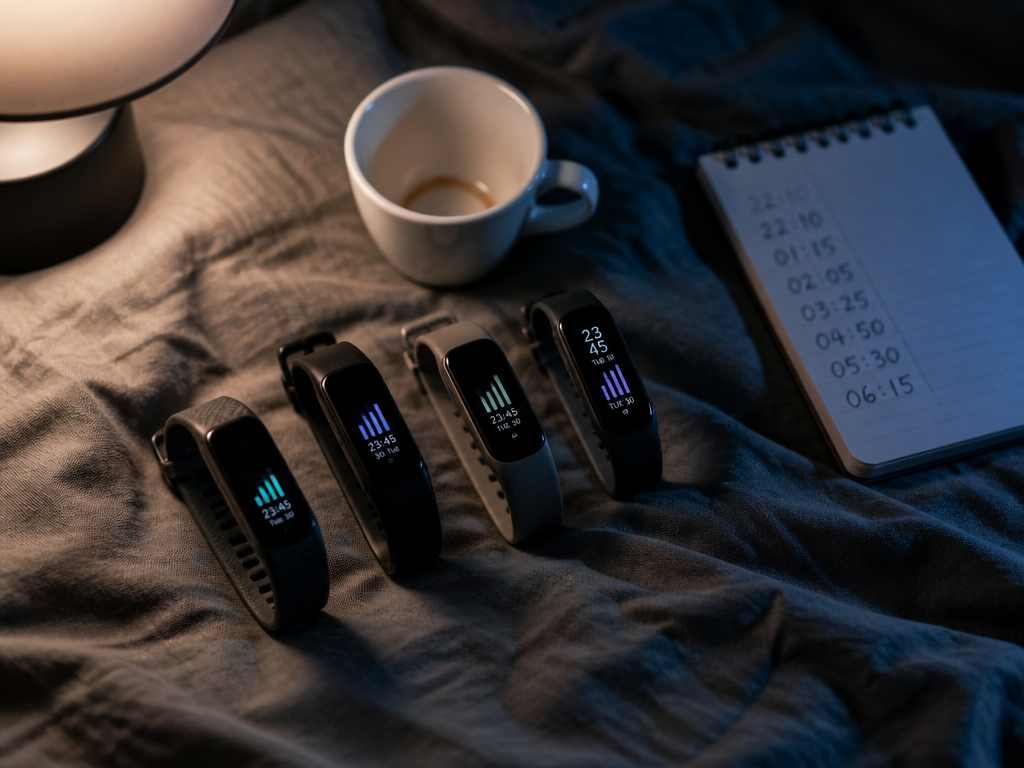
The onset column is the one I care about. Every night I wrote down the time I put the book face-down, in pen, and compared it the next morning to whatever the device claimed as sleep onset. Fourteen nights each is not a study and I'm not going to pretend it is — one person, one bed, one notebook, and the notebook itself is a guess. But the ordering was stable across the blocks, and the Galaxy's six-minute mean error was consistently the tightest. It is the better instrument. That is not in dispute.
It is also the watch I took off most often after the Apple, and here's why the thickness column is a trap.
What actually catches on a shirt cuff is not the tallest point of the case. It's the diameter, the lug flare, and the edge geometry where the glass meets the bezel. The ScanWatch is the thickest thing on the list by three full millimetres and it's the second-best behaved under a cuff, because it's 42mm across with a domed crystal that slides. The Garmin is thinner and worse, because the lugs push outward before they curve down. The Galaxy's rotating bezel — which I genuinely like, and which is the best physical control on any of these — is a knurled ring at the widest point of a 46mm case. It grabs cotton.
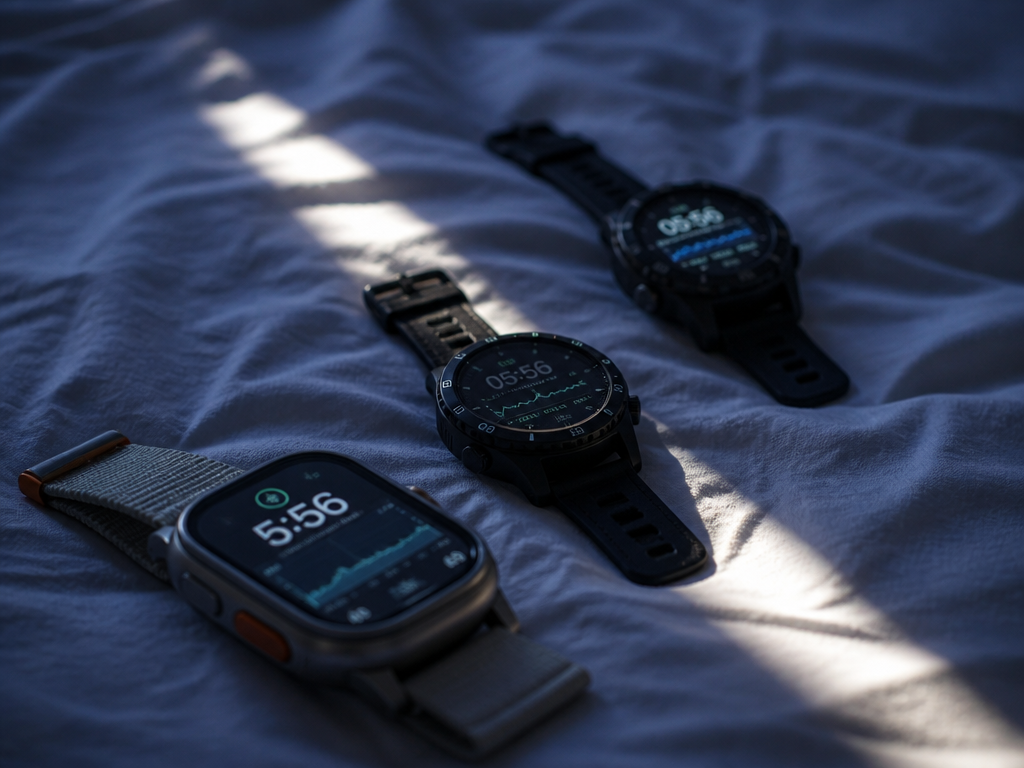
And then there's the thing no spec sheet lists. A dark rectangle on your wrist reads as a watch right up until it wakes. At a table with candles, the Apple and the Garmin lit up for gestures I didn't make, and the person across from me looked at my wrist twice. The ScanWatch has two real hands and a small monochrome window that does nothing unless asked. Nobody looked at it. During the funeral I forgot I was wearing a tracker at all, which is the highest compliment available.
That's the finding: at a formal event the failure mode isn't fit, it's attention. The watches that cleared my cuff most easily were the ones I most wanted to remove.
What I actually do
I wear the ScanWatch and I don't change anything at bedtime. That's the whole routine, and the boringness is the point — there is no step to skip in a hotel room at midnight.
What I gave up is real. Withings gives me onset, duration, interruptions, a breathing-disturbances score and a coarse stage breakdown. The Galaxy gives me finer staging and I trusted it more. Losing three minutes of onset precision was an acceptable trade; losing five nights a fortnight to the nightstand was not. Nine-out-of-fourteen data is not a slightly worse version of thirteen-out-of-fourteen data, because the missing nights are never random.
The espresso numbers, for what they're worth. Across nine nights with caffeine after 22:00 — most of them dinners, one a genuinely bad decision at a conference — my median onset was 34 minutes. On the nights without, 19. Nine and eleven nights respectively, one subject, no control over alcohol, food timing or how much I'd been dreading the room. I'd treat that gap as directionally true and nothing more. But I only have those nine nights because the watch was still on my wrist, and under the swap routine I'd have collected four of them.
Two small pleas. Withings: the hardware has earned a better sleep-stage engine, and I'd pay for it. Samsung: you already build the best-looking smart watch in the category and you're one software toggle away — a real dress mode that kills raise-to-wake and every ambient pixel until I press something — from owning this use case outright. Neither of these is a hardware problem.
If the watch has to survive a dinner jacket and still be on your wrist at 3am, buy the hybrid and accept coarser stages. Everything else is a watch you'll take off.
Who this is for, and who it isn't
This is for you if you dress formally more than a few times a year and you care about sleep onset specifically — the caffeine-curious, the people trying to work out where their personal cutoff actually sits rather than where the internet says it should. It's for you if you've already tried the swap and know how that goes.
It isn't for you if you train seriously. The ScanWatch's workout tracking is fine and the GPS is a phone-tether compromise; the Garmin and the Galaxy are in a different class and I'm not going to pretend otherwise. It isn't for you if you want notifications you can read — the ScanWatch's window shows enough to know something arrived and not enough to know what. And it isn't for you if you wear a watch you actually love, in which case the ring is the honest answer and you should stop reading gear pieces about this.
My sample is one wrist, one shirt drawer, one cuff size. If your cuffs are cut generously, the Galaxy stops snagging and the whole comparison shifts. Measure your own.
The myth is that a smartwatch is something you take off when you dress properly, and that's the price of tracking your sleep. The truth is narrower and more annoying: a smartwatch is something you take off when it announces itself — and the watch that stays quiet at a candlelit table is the one that's still on your wrist at 3am, which is the only place the data was ever going to come from.