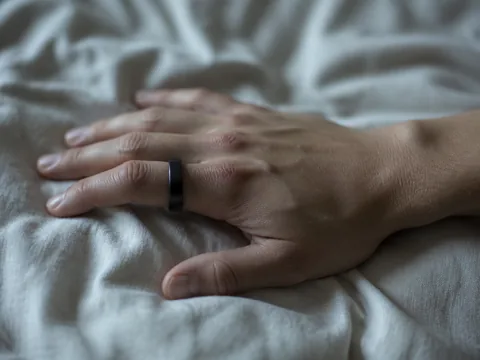
Forty-one minutes. That is the entire measurable return on five months with a sleep tracking wearable on my left index finger — forty-one additional minutes asleep per night, averaged across the final six weeks against the first four. Not a transformation, not a repaired circadian rhythm, and not the seven hours I said I was after. Forty-one minutes, for about $420 in year one and a nontrivial amount of attention I could have spent elsewhere.
The verdict, in one sentence: the ring did not improve my sleep — it timestamped my coffee, and the timestamps improved my sleep. The money bought evidence, not treatment. Whether that trade is worth $420 depends almost entirely on whether you are the kind of person who changes behavior when shown a number about yourself.
Here is what I did. I wore an Oura Ring 4 from the first week of January to mid-June: 154 nights of usable data after throwing out travel nights with a dead battery and one week when I wore it on the wrong hand out of laziness. Hardware was $349 when I bought it, plus $5.99 a month for the membership, plus a free sizing kit that costs you ten days of waiting. Alongside the ring I kept a stupidly simple log in a notes app: time of last caffeine, milligrams (estimated), alcohol, time of last meal, and lights-out. Once a month I exported the ring's CSV, pasted it next to the log in a spreadsheet, and computed group means. My statistics are group means and one t-test I don't entirely trust. That is the level of rigor on offer here, and I'd rather say so now than have it inferred later.
Baseline, the first 28 nights: 5 hours 32 minutes asleep, 6 hours 4 minutes in bed, sleep efficiency 91%, ring-estimated sleep onset latency 14 minutes, 26 minutes awake after sleep onset. Median time of last caffeine: 4:40 p.m. Average intake: around 380 mg — a double espresso at 7, a filter coffee at 10:30, and then whatever the afternoon demanded.
What most people do
They buy the device and then they read the score.
This is not a straw man; it was me for six weeks. The morning ritual is: wake, reach for phone, open app, receive a two-digit verdict on the previous night, feel briefly judged, close app. The score is a composite — it blends things you had some control over (when you went to bed) with things you had none over (a fever coming on, the ambient temperature of a hotel room, your resting heart rate's slow drift) into a single integer that conceals which was which. Optimizing an integer that hides its own inputs is not a strategy. It's a slot machine with a health-tech typeface.
Sleep clinicians noticed this early. A 2017 case series in the Journal of Clinical Sleep Medicine gave it a name — orthosomnia — describing patients whose pursuit of a perfect tracker readout was itself keeping them awake and, in some cases, surviving contradiction by an actual sleep study. The device had become the complaint.
The second common move is to take the absolute numbers seriously, and specifically the stage numbers. "I only got 43 minutes of deep sleep" is the sentence I hear most from people who own one of these, and it is built on the least reliable figure the device produces. More on that shortly.
The third move is quitting around week three, which I think is entirely rational given the first two. If the device tells you every morning that you slept badly, and offers no mechanism for why, it is a smoke alarm with no address attached. Most people are not short on the information that they're tired.
What almost nobody does — and this is the whole argument of this piece — is log a single input. The ring measures outputs: movement, heart rate, heart rate variability, skin temperature, respiratory rate. Every one of those is downstream. The things you actually control happen twelve to sixteen hours before the readout, in daylight, holding a cup. Without an input log, a consumer sleep tracker gives you a beautifully instrumented account of things that happened to you.
What the evidence suggests
Three findings shaped how I used the thing, and two of them argue against using it the way it's marketed.
These devices are decent at sleep versus wake and mediocre at staging. The 2021 comparison in Sleep by Chinoy and colleagues, which ran seven consumer devices against in-lab polysomnography, is the study worth knowing: the trackers were broadly comparable to research actigraphy at telling sleep from wake, noticeably weaker at classifying stages, and several tended to overestimate total sleep — with the error growing in exactly the fragmented sleepers most likely to buy one. So the REM and deep-sleep minutes on your screen are the faintest ink on the page. But — and this is the part that rescues the purchase — a device compared against itself, on the same finger, across a hundred nights, is a far better instrument than the same device compared against a lab. Systematic error mostly cancels in a difference. Trust the delta, not the level. Every useful number in this article is a difference between two groups of my own nights, never an absolute.

Caffeine timing has the best evidence-per-unit-effort ratio of any sleep behavior I know of. The 2013 trial by Drake and colleagues in the Journal of Clinical Sleep Medicine is the one that reorganized my afternoons: 400 mg of caffeine taken six hours before bed reduced objectively measured sleep by more than an hour. Six hours. And the participants in that condition did not reliably notice. That last clause is the hinge. If the damage were perceptible, none of us would need a $349 ring; we would simply feel the 4:40 p.m. coffee and stop drinking it. The whole case for a wearable rests on the existence of effects your subjective report cannot see.
The pharmacology is unglamorous and worth doing on the back of an envelope. Caffeine's half-life sits around five hours in a typical adult, with genuine variation in both directions, some of it genetic — CYP1A2 activity differs enough between people that identical cups produce non-identical nights. Take my old 4:40 p.m. cup at roughly 150 mg: about 75 mg still circulating at 9:40 p.m., roughly 38 mg at 2:40 a.m. Thirty-eight milligrams is not nothing. It's half a cup of black tea, administered during the hours your sleep is most fragile.
Self-monitoring changes behavior mainly when it closes a loop that is otherwise open. There is nothing mystical in this. Caffeine's consequence arrives eight hours after the decision, in a state where you cannot observe yourself, and is then attributed to stress, or the mattress, or being forty. The ring's contribution is not physiological. It is bookkeeping: it moves the consequence back into the same spreadsheet row as the cause. What the evidence does not support — I looked — is the idea that a sleep score improves sleep. No score has ever put anyone to bed.
What I actually do
Six rules, in descending order of what they were worth.
A hard caffeine cutoff at 1 p.m., with the dose left alone. This is the change, and I want to be exact about what it is not. I did not cut back. Daily intake went from about 380 mg to about 350 mg — inside the noise of my own estimation. I moved it: bigger morning, second cup at 11, nothing after one. The observational split across all 154 nights: on nights where my last caffeine was before 1 p.m. (76 nights) I averaged 6 hours 21 minutes asleep with a ring-estimated latency of 9 minutes; on nights following a post-4 p.m. cup (44 nights) I averaged 5 hours 47 minutes with a latency of 21 minutes. Time awake after sleep onset was the more brutal comparison: 19 minutes versus 34.
A three-week coin flip, because the observational split was confounded and I knew it. Early-cutoff days were disproportionately days I worked from home, slept in my own bed, and ate dinner at a sane hour. So for 21 nights I flipped a coin each morning: heads, cutoff at 1 p.m.; tails, business as usual with a cup permitted until 5. Eleven early nights averaged 6 hours 19 minutes; ten late nights averaged 5 hours 49 minutes. A 30-minute gap, which is close enough to the observational estimate that I believe the direction. It is eleven nights against ten. I would not publish it; I would act on it, which I did.
Corrected bedtime arithmetic. My assumption for a decade was that seven hours in bed produces seven hours of sleep, minus a rounding error. The ring's own numbers said I needed 7 hours 40 minutes in bed to bank 7 asleep — 14 minutes of latency plus 26 minutes of fragmentation, both of which I'd been treating as zero. Nobody told me this; I had simply never subtracted. Setting lights-out 35 minutes earlier was the single most boring change I made and it is worth about 12 minutes of the 41.
The app comes off the bedside phone. I check the data once, at breakfast, on a laptop. During the first six weeks I was opening it in bed, sometimes at 2 a.m. to see what the night was doing, which is roughly the mechanism the orthosomnia literature describes.
Thirty seconds of tagging, nightly. Last caffeine, alcohol, last meal, lights-out. Without this the ring is a diary of symptoms with the causes torn out.
Fourteen-night rolling medians, never single nights. Night-to-night variance in my data is enormous — the standard deviation of my nightly sleep is over an hour. Any single night can be made to argue for anything.
What each change was actually worth
| Change | Nights | Measured effect on time asleep | My confidence |
|---|---|---|---|
| Last caffeine before 1 p.m. | 76 vs 44 | +34 min vs post-4 p.m. nights (+30 in the randomized subset) | High |
| Lights out 35 minutes earlier | 154 | +12 min | Moderate |
| Two drinks with dinner | 19 | −4 min asleep, −18 min REM, +6 bpm resting HR | Moderate |
| Eating after 9 p.m. | 31 | No detectable effect | Low |
| Checking the score in bed | 28 | −9 min | Low |
The two effects don't add cleanly — earlier bedtimes clustered on early-cutoff days — so read the table as a ranking, not a budget. Roughly 25 of my 41 minutes track the coffee, about a dozen track the earlier lights-out, and the rest is noise I'm not going to dress up.

The alcohol row is the one that changed how I read the device. Two glasses of wine cost me essentially no sleep duration — four minutes, indistinguishable from nothing — while taking 18 minutes off REM and pushing resting heart rate up six beats. Given what I said about stage accuracy, I hold the REM figure loosely. The heart rate I believe, because it's the measurement the hardware is actually good at. If I'd been watching only the number I went in caring about, I'd have concluded wine was free.
If you're choosing hardware
Judge these on four things: what they measure well, how much friction they add, what they cost over three years, and whether they make input logging easy. A ring measures pulse-derived metrics well from the finger, adds near-zero friction once sized, and cost me roughly $565 over three years with membership — its logging is fine. A wrist strap on a subscription-only model runs $600–720 over the same period with no residual hardware value, and it's better if you want training load in the same dataset; it's worse if, like me, you find something on your wrist at night noticeable. An under-mattress mat is around $130 once, no subscription, invisible in use, genuinely accurate at bed-in and bed-out times — and useless the moment a partner or a cat is involved, with nothing to say about daytime physiology.
For the specific job of connecting an afternoon cup to a 3 a.m. wake-up, all three are adequate. The mat is the value pick by a distance. I chose the ring for the daytime data and I'm not sure I'd defend the premium to a stranger.
What I couldn't test
No polysomnography. Every "asleep" in this piece is the ring's opinion of asleep, and per the validation work, that opinion probably runs generous. My 41 minutes could be 30.
The study is n=1 and mostly unblinded. I knew which nights were cutoff nights, and expectation moves sleep onset latency — which is precisely the metric that moved most. The coin-flip weeks were randomized but not blinded, and there is no way to blind yourself to whether you drank coffee.
The experiment ran January to June in a city that gained about six hours of daylight over that window. Morning light is a plausible alternative explanation for some part of the improvement and I have no way to separate it from the caffeine.
I never ran the obvious next arm: afternoon decaf as a substitute rather than nothing. That would separate the pharmacology from the ritual — a real question, since half of what my 4:40 p.m. cup did was mark the end of the workday. That's the next experiment.
And I have no menstrual cycle data to offer, which is a genuine hole for a large share of readers; cyclical variation in temperature and sleep architecture is well documented and I can tell you nothing about it from my own wrist.
Who this is for — and who it isn't
Buy one if your sleep debt is behavioral, you suspect which behavior, and you've been unable to make yourself care in the absence of a number. That is a narrow but real description, and it was me. Buy one if you'll actually log inputs for a month — the hardware is the cheap half of this project; the expensive half is thirty seconds a night for thirty nights. Buy one if you find it motivating rather than accusatory to watch a fourteen-night median move.
Don't buy one if you want it to fix anything. It has no actuator. It cannot make you close the laptop.
Don't buy one if you're an anxious sleeper, or if you meet criteria for insomnia. The treatment with the evidence behind it is CBT-I, and it works partly by breaking the habit of monitoring your own sleep — which a wearable rebuilds nightly, in high definition. This is the group most likely to want one and most likely to be hurt.
And don't buy one if you already know the answer. If you're reading this thinking yes, the 4 p.m. coffee, obviously — you don't need $420 of instrumentation to confirm what you just said. Move the cup. If it works, you saved the money. If it doesn't, buy the ring and find out what else is going on, because then you have a real question and this device is quite good at real questions.
Forty-one minutes, again
I'm at 6 hours 13 minutes now. Still 47 minutes short of the seven I claimed to want, and I don't expect the ring to close that gap, because the remaining gap isn't made of caffeine — it's made of the two hours between the last email and the first honest attempt at bed, and no sensor has an opinion about that.
But the 41 minutes were never the wearable's to give. They were mine already, and had been for about a decade, sitting in the difference between a 4:40 p.m. coffee and a 12:40 p.m. one — a debt I'd been paying nightly, in installments too small to notice, which is exactly why I never noticed. The ring didn't produce those minutes. It itemized the bill. That happens to be the one thing I couldn't do for myself, and it turns out to be worth about what it cost.


