A friend asked me a question in a Carlton cafe in June that I could not answer honestly, which is the only reason this piece exists. She wanted to track her sleep. She had been reading about Apple Watch 11 pricing and deals — there is a lot of that reading available right now — and she had found a Series 11 at AU$427 down from an RRP of AU$649. Her question was not "is that a good price." It was better than that. How much watch do I actually need to track my sleep?
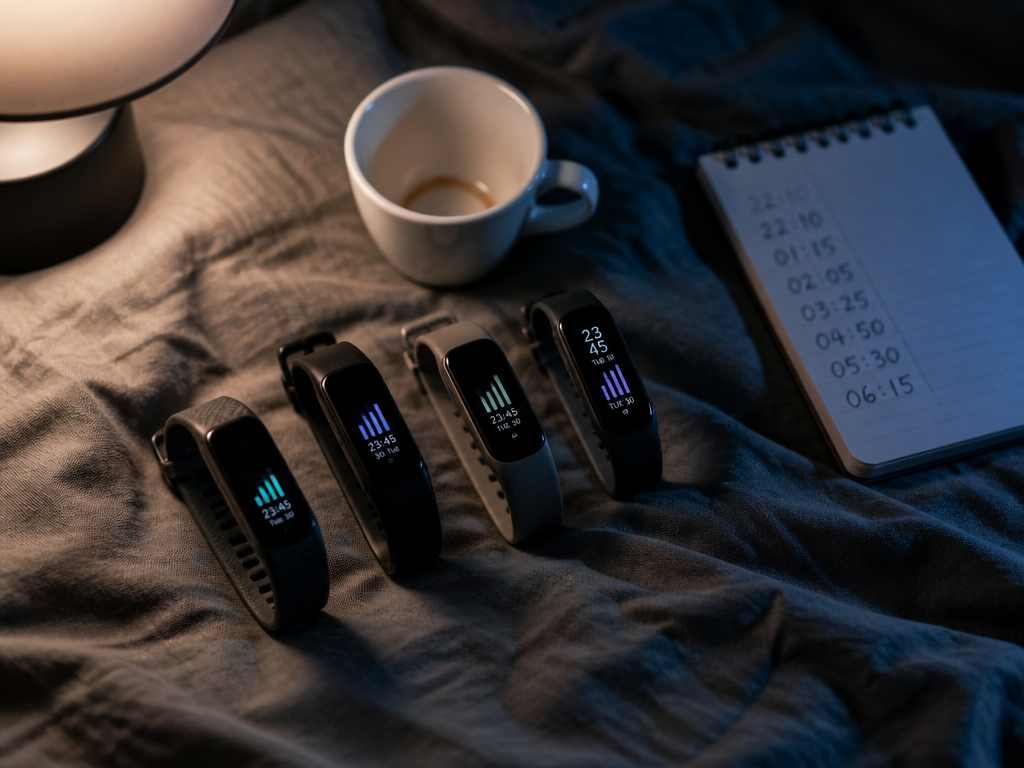
I said I'd find out. Then I spent four weeks with four Apple Watches, two of them on my wrists at once, most nights, with a coffee schedule I designed to break them.
What follows is not a review of the Series 11 as a watch. Other people have done that thoroughly and I have nothing to add about the 5G modem or the scratch resistance of the front crystal. This is a review of four Apple Watches as sleep instruments, priced in Australian dollars, by someone who wanted to know where the money stops buying anything.
The verdict, in one sentence
For sleep tracking specifically, the meaningful gap in Apple's current lineup is not between the Series 11 and the Series 10 — it is between the SE 3 and the Series 8, and the Series 11 at AU$427 wins on one measurement that has nothing to do with sensors: it is the only one of the four that survived a full night and a full day without me thinking about a charger.
How I ran it
Twenty-eight nights. Four watches: a Series 11 (42mm, GPS, bought at AU$427), a Series 10 (46mm, GPS, clearance stock, AU$479), an SE 3 (40mm, GPS, AU$339 on a sale that lasted about nine days), and a Series 8 (45mm, bought used off Marketplace for AU$205, seller-reported battery health 87%, which I verified in Settings before handing over cash).
Every night I wore two of them, one per wrist, rotating the pairings so each watch spent seven nights on the left and seven on the right. This matters more than it sounds like it should. I sleep on my left side with my left arm under the pillow, and across the whole set the left-wrist watch consistently logged more "awake" fragments than the right-wrist watch on the same night — a median of two more per night. That is a confound, not a finding, and it's why I rotated. If you read a sleep-tracker comparison where all the watches were worn on the same wrist on different nights, the person did not control for the night.
I logged lights-out manually, on paper, on a pad next to the bed, before the last device went face-down. That gives me a reference point for sleep onset latency that is independent of the watches — imperfect, because I am writing down a time and then trying to sleep, which is its own small intervention, but independent.
Here is what I could not do, and I want it stated before any numbers appear. I did not run polysomnography. I have no ground truth for sleep stages, so I cannot tell you which of these watches correctly identified REM. Nobody reviewing consumer wearables without a lab can tell you that, and when they do, be suspicious. What I can tell you is which watches agreed with each other, which disagreed and by how much, and which ones ran out of battery. Sample size is one person, one bedroom, one winter. Take the ratios seriously and the absolute numbers loosely.
The number that decides this: drain and charge time
Every serious sleep-tracking problem is a charging problem. A watch that measures nothing because it is on a puck at 11pm has an accuracy of zero. So I measured the boring thing.
Overnight drain is the battery percentage lost across a logged sleep window, measured at lights-out and at the first wake-check, averaged across the seven nights each watch spent on each wrist (fourteen nights per watch). Sleep windows averaged 7h 40m. Charge time is a stopwatch measurement from the low-battery warning to 80%, on the charger that shipped in each box, at a room temperature of 18-20°C.
| Watch | Price paid (AU) | Overnight drain, 7h40m | Low → 80% charge | Sleep apnea notifications |
|---|---|---|---|---|
| Series 11 (42mm) | $427 | 9% | 31 min | Yes |
| Series 10 (46mm) | $479 | 14% | 33 min | Yes |
| SE 3 (40mm) | $339 | 12% | 36 min | Yes |
| Series 8 (45mm, used) | $205 | 22% | 71 min | No |
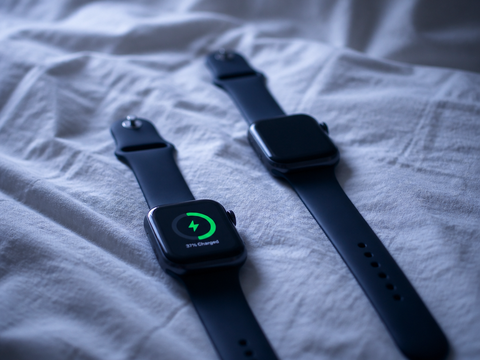
The Series 11's 9% overnight drain is the single most consequential number in this piece. It meant that across fourteen nights I never once put it on a charger with a plan. I'd drop it on the puck while showering, or while making coffee, and it stayed above 40% permanently. It never became a decision.

The Series 10 and the SE 3 both became decisions, but small ones. Twelve to fourteen percent overnight plus a normal day put both of them somewhere in the 20s by the following evening, which means a deliberate top-up — fifteen minutes in the shower does not quite do it, thirty-five minutes while cooking does. I missed two nights of data on the Series 10 in week two because I forgot, and I want that in the record: the failure mode of an 18-hour watch is not a dead watch, it's a missing night.
The Series 8 at 22% and 71 minutes is a different category of object. Some of that is age — 87% battery health on a used unit is honest wear, not a defect — but the slow charging is architectural, not degradation. Seventy-one minutes to 80% means the top-up has to be scheduled. On a used watch three years into its life, sleep tracking becomes a chore you perform, and chores get dropped.
Where the feature line actually falls
The marketing suggests the interesting boundary is Series 11 versus Series 10. For sleep, it is not. Those two produced nearly identical output: across the six nights they spent paired against each other, their sleep-stage summaries differed by a median of 11 minutes of total sleep time and 6 minutes of deep sleep. That is inside the noise of two devices on two different wrists. If you already own a Series 10 and you are looking at Series 11 deals for sleep reasons, you are buying nine percentage points of overnight battery. That's a real thing to buy — see above — but it is not a new instrument.
The boundary that matters sits underneath the SE 3. The SE 3 does sleep score, does sleep stages, does wrist temperature, and does sleep apnea notifications. Whatever else it gives up against the Series 11 — and it gives up plenty, in display, in materials, in the always-on refresh behaviour — it gives up almost nothing that happens between midnight and six.
The Series 8 is where the list gets short. It does sleep stages and it does wrist temperature, which was genuinely useful to me and which the older SE never had. But it does not get sleep apnea notifications, and it does not get the hypertension notifications that showed up on both the 11 and the 10 in my testing. That gap is not going to close. A used Series 8 at AU$205 is not a cheap sleep tracker; it is an expensive one that has stopped receiving the features people buy sleep trackers for.
One genuine caveat, and I'd rather flag it than pretend to a precision I don't have: Apple's health-feature availability moves with watchOS releases and it varies by region and by regulatory approval. I'm reporting what appeared on my four units, in Australia, in July 2026. Before you buy, open Apple's own feature comparison and check the exact model number against the exact feature you care about. Do not take my table — or anyone's — as a substitute for that.
The caffeine night
This is a magazine about coffee and sleep, so the interesting experiment was never going to be watch-against-watch. It was watch-against-coffee.
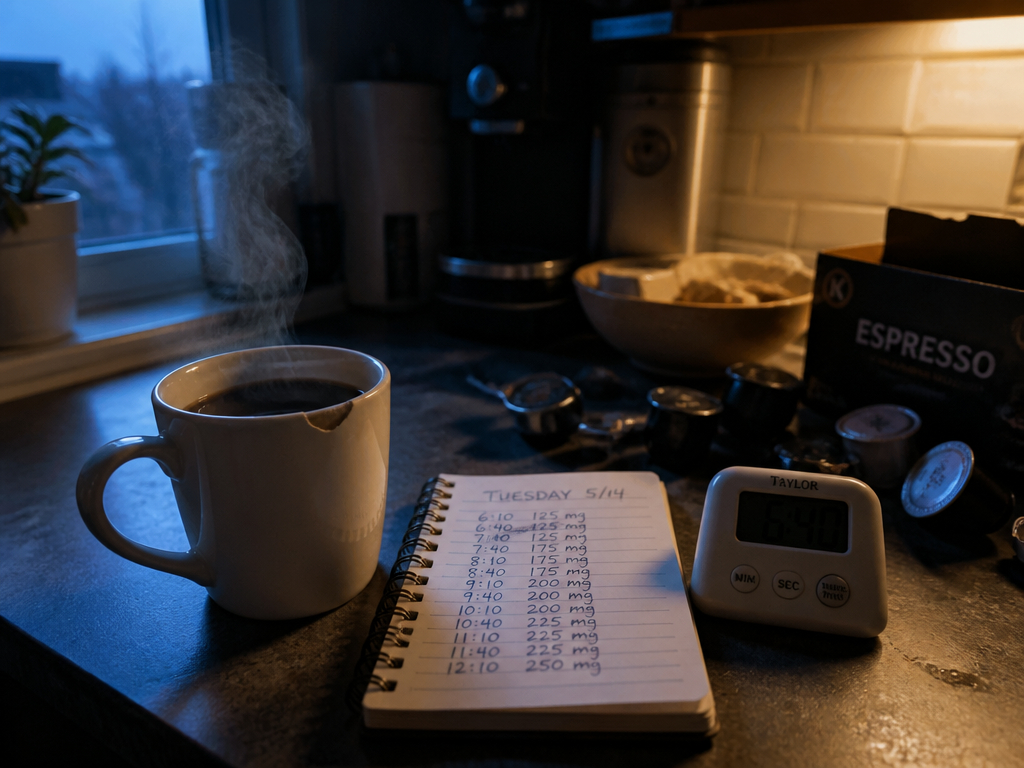
I split the twenty-eight nights into two conditions. Fourteen control nights: no caffeine after 11am. Fourteen loaded nights: one double shot at 2pm, same 18g dose, same grinder setting, same beans throughout — a washed Ethiopian I'd been drinking anyway — pulled at the same ratio. Call it 130mg, though I want to be clear that's an estimate from dose and roast, not a measurement. I have no way to assay caffeine content in my kitchen and neither does anyone else writing this kind of piece.
The result was not subtle. Against my paper-logged lights-out time, median sleep onset latency was 11 minutes on control nights and 24 minutes on loaded nights. Wake fragments after onset went from a median of 4 to a median of 7. Total sleep time dropped by a median of 41 minutes. All four watches saw it. Every single one. The Series 8, the cheapest and oldest and least capable device in the test, detected the 2pm double shot as clearly as the AU$427 Series 11 did.
And here is the number that reframed the whole exercise for me: the median disagreement between two watches on the same night was 11 minutes of total sleep time. The median difference between a control night and a loaded night was 41 minutes. The coffee moved the data roughly four times as far as the hardware did.
I'll add the honest asterisk. I knew which condition I was in each night, so this is unblinded, and expectancy could account for some of it. I could have had someone else prepare decaf and regular shots at random. I didn't, because I live alone and I can taste the difference, which is its own problem. Someone should run this properly. Until they do, treat 41 minutes as the shape of an effect rather than its size.
Where the answer is genuinely "it depends"
My friend's question has a clean answer in about three-quarters of cases and a messy one in the rest. The messy quarter:

If you already own a working Series 9 or 10. Then this whole comparison is theatre and you should keep your watch. You have the apnea notifications, you have the stages, you have wrist temperature. You are being sold nine percent of a battery.
If you have small wrists or you sleep badly with hardware on. The 40mm SE 3 was the only one of the four I stopped noticing. The 46mm Series 10 woke me up twice by pressing its own crown into my forearm. Case size is not a spec on a comparison chart, it is the difference between a watch you wear all night and a watch you take off at 3am and then write a review complaining about data gaps.
If you're buying used. Battery health under about 85% turns an 18-hour watch into a watch that can do a night or a day, not both. Ask the seller for a photo of Settings → Battery → Battery Health before you agree on a price, and treat a refusal as an answer.
If nobody has raised apnea with you and nobody in your house has mentioned your snoring. Then the feature that separates the SE 3 from the Series 8 may not be a feature you will ever use, and the calculus shifts back toward whatever is cheapest and charges fastest. Mine never fired a notification in 28 nights, which is the correct result for me and a completely uninformative one for you.
What AU$427 actually means
On the pricing question, some arithmetic, because "37% off!" is a claim and not a fact.
Series 11 42mm GPS carries an RRP of AU$649. The AU$427 I paid is a 34% discount — real, and the lowest I saw across the four weeks I was watching, across the major Australian retailers and Amazon AU. Across that window the same SKU sat at $549 for most of it, dipped to $479 twice, and touched $427 once, for about five days.
The verification step people skip: check the price history, not the strike-through. Australian retailers anchor against RRP even when the street price has not been RRP since launch month. A price tracker on the Amazon AU listing takes twenty seconds and tells you whether $479 is a discount or a Tuesday.
Two more things worth knowing about Australian Apple Watch pricing and deals specifically. First, grey imports. If the price is dramatically below everyone else's, look for the seller's ABN and an Australian warranty statement. An imported unit can arrive with a region-locked feature set on the health side, which is precisely the thing you are buying it for. Second, Apple's own refurbished store is chronically underrated here — refurbished units come with a new battery, a new outer shell, and the full Australian warranty, typically at 15% off, and unlike a Marketplace Series 8 you know exactly what the battery health is on day one.
Would I wait? No. The Series 11 has been on shelves long enough that the discount curve has flattened, and the next genuine step down comes when the successor lands, at which point you are buying last year's watch anyway. If $427 is in front of you and you want the battery, take it.
Who this is for, and who it isn't
Buy the Series 11 at AU$427 if you want to stop thinking about charging. That's the product. Nine percent overnight drain and a 31-minute top-up means the watch is on your wrist every night by default rather than by discipline, and consistency is the entire value of sleep data. Also buy it if you want the hypertension notifications, which the SE 3 did not offer me.
Buy the SE 3 at AU$339 if sleep is the actual reason you're buying a watch. It got stages, score, wrist temperature and apnea notifications; it was the most comfortable of the four to sleep in; and its 12% overnight drain was closer to the Series 11 than to the Series 10. You are giving up display quality and materials you will not be looking at while unconscious.
Do not buy a used Series 8, at any price, if sleep is the goal. Twenty-two percent overnight, 71 minutes to charge, no apnea notifications, and no path to getting them. AU$205 for a watch you will stop wearing at night within a month is worse value than AU$339 for one you won't.
Don't buy anything if you own a Series 9 or 10 already, or if you have not yet tried moving your last coffee to before midday. One of those interventions costs $427 and the other costs nothing, and in my four weeks the free one moved the numbers four times as far.
The winner
At AU$427, the Series 11 is the best sleep tracker Apple sells to people who are not buying an Ultra. At AU$339, the SE 3 is the one I told my friend to buy, and she did.
The best sleep tracker is the one still on your wrist at 2am. Everything above that line is a watch.