Most runners who have priced Peloton treadmills get the same advice: buy the treadmill for the belt and let your watch do the thinking. A treadmill is a motor and a deck. Your training data lives on your wrist, which goes with you outside, into races and into bed. Paying extra for a treadmill that collects data is paying twice for the same numbers.
Peloton disagrees, and its newest camera-equipped Tread is built on that disagreement. At launch the company argued that cameras watching your whole body can read running form more precisely than anything strapped to your arm. That claim is easy to test, so I tested it.
The short version: the cameras did beat my watch on form, clearly enough that the standard advice is wrong as stated. But they lost on everything that explains why form changes from one day to the next. The rule survives only if you rewrite it.
The advice, and the claim against it
The old advice rests on a reasonable assumption: a wearable sees your body and a treadmill sees only its own belt. A treadmill knows its speed and incline exactly. It knows nothing about the person on it. So the device that's attached to you should win.
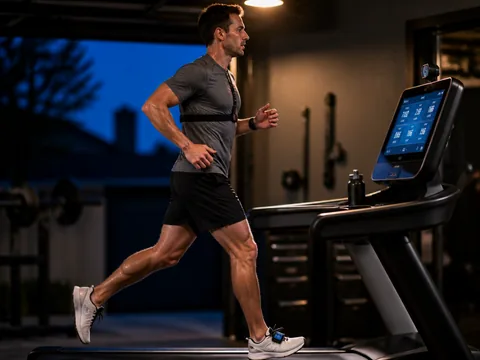
Cameras break that assumption, at least in part. A camera mounted on the console can see your shins, hips, trunk and arms all at once. A watch can't, however good its algorithms are. A wrist sensor infers what your legs are doing from how your arm swings. A footpod measures the foot it's clipped to. A chest strap measures your torso bouncing. Each is a good guess about one part of the body. A camera watches all of it.
That's the theory. In practice, the question is whether a consumer camera system at a home-gym price turns that view into numbers you can train with, or into a nice-looking dashboard that agrees with your watch.
How I tested
I ran 14 sessions on the camera-equipped Tread over three weeks: easy runs, two threshold sessions, one long-ish progression run and a few short shakeouts. I'm a 3:20 marathoner who logs about 55 km a week in a normal block. I know enough about my own stride to have opinions on it, but not enough to call myself a biomechanist.
On every run I also wore:
- a GPS watch on my left wrist, set to treadmill mode;
- a chest-strap heart rate monitor that also reports running dynamics (vertical oscillation and ground contact time, taken from torso movement);
- a footpod on my right shoe, calibrated against the belt on the first run.
For a check that didn't depend on any company's algorithm, I propped my phone on a tripod side-on to the deck. On six of the runs I filmed 30-second clips at 240 frames per second, then scored 20 consecutive right-foot strikes by hand: frames on the ground, shin angle at contact, and where the heel landed relative to the hip. At 240 fps each frame is about 4.2 milliseconds, which is fine enough to count ground contact to within a frame or two.
That is not a gait lab, and the limits matter. It's one runner, one treadmill unit, one camera angle for my reference video, and three weeks. Treat everything below as a careful anecdote. It isn't a study.
Where the advice holds: cadence and pace
Start with what's already solved, because this is the part of the pitch that adds the least.
Cadence. On a steady easy run at 5:30/km, the camera reported an average of 168 steps per minute. The footpod read 169 and the watch read 171. Counting steps by hand on my phone video gave 168 and 169 across two clips. All four sources are within three steps of each other, and the watch's slight overcount was consistent from run to run. For training purposes cadence is a solved number. You don't need a camera to get it, and you don't need a watch either, because a $40 footpod gets it.
Pace. The treadmill knows its belt speed exactly, which makes it the best pace source in the room. The watch, which has to estimate pace from arm swing when there's no GPS, was the worst. At 5:00/km it read between 3% and 6% fast, varying from run to run. That's the difference between a threshold session that looks right and one that's quietly too easy. The footpod, once calibrated, stayed within 1%.
This is the first crack in the standard advice. On a treadmill, the watch is the weakest data source you own. Any runner who does serious indoor sessions already knows this and either pairs a footpod or reads the console. Treadmill mode is a convenience, not an instrument.
The camera adds nothing to pace, because the belt already knows it. On cadence it adds nothing either, because everything agrees. If those were the only numbers that mattered, the old advice would hold: let the belt do pace, let a cheap sensor do cadence, and spend the difference on shoes.

Where it breaks: what a camera sees that a wrist guesses
The advice falls apart once you get to what form actually looks like.
Overstriding
This was the most useful thing the cameras did, and nothing else I wore could replicate it.
The system flags steps where your foot lands well ahead of your hips, with the shin angled forward instead of roughly vertical. I can't see the algorithm, so I checked it against my phone video. On a fresh-legged easy run, the camera flagged about 9% of steps across the session. In my hand-scored clip from the same run, 2 of 20 foot strikes had a shin angle I'd call a clear overstride. Those numbers line up.
What mattered was how the flags moved. On the back half of my progression run, as I pushed from 5:10 to 4:35 per km, the flagged share climbed to around 22%. My video from the last kilometre showed the same thing: my heel was landing visibly further forward, and I was reaching for pace instead of turning my legs over faster. My cadence barely moved, rising from 172 to 175, which is why the watch and footpod saw nothing wrong. Watched by cadence alone, my form looked fine. It wasn't.
A wrist sensor can't see this because it has no idea where your foot is. A footpod knows where its foot is but not where your hip is. Seeing overstriding means seeing both at once, and that is the camera's real advantage.
Vertical oscillation
This is the bounce of your body with each stride. It's where I expected the chest strap to win, since it physically rides on your torso. It didn't win, but it didn't lose either.
At easy pace the camera averaged 8.1 cm, the chest strap 8.4 cm and the watch 9.3 cm. Measuring my hip marker's rise and fall frame by frame on video gave me roughly 8 cm, though I'd put a centimetre of error on my own clicking. The camera and the strap track each other closely. The watch is estimating bounce from arm movement and runs high.
So the camera is better than the watch here and roughly equal to a chest strap you might already own. It's an advantage, but not the dramatic one in the pitch.
Ground contact time
This is the number I trusted the camera least on, and it surprised me. Across the 20 steps I scored by hand, contact averaged 248 ms. The camera reported 241 ms for the same stretch and the chest strap 262 ms. Both are within a reasonable margin, and the camera's figure was closer. But its readout jumped around more from second to second than the strap's. Over a whole run it averaged out, but the live number wasn't steady enough to adjust to during the run.
The comparison grid
| Metric | AI camera | Watch (treadmill mode) | Chest strap + footpod | My video check |
|---|---|---|---|---|
| Cadence (easy run) | 168 spm | 171 spm | 169 spm | 168–169 spm |
| Pace error at 5:00/km | n/a (belt is exact) | +3–6% | ~1% after calibration | — |
| Vertical oscillation | 8.1 cm | 9.3 cm | 8.4 cm | ~8 cm |
| Ground contact | 241 ms, noisy live | not reported | 262 ms | 248 ms |
| Overstride detection | Yes, matched video | No | No | 2 of 20 steps (fresh legs) |
| Heart rate, sleep, recovery | None | Yes | Heart rate only | — |
The camera is the most accurate form sensor I've used outside a lab. It is also the only device in this table that has no idea how you slept.
That last row is where the rest of this piece goes.
The bad-sleep runs
This is a magazine about caffeine and sleep, so I put the gap in the camera's view to work.
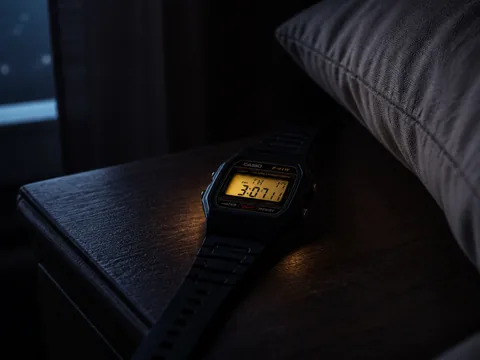
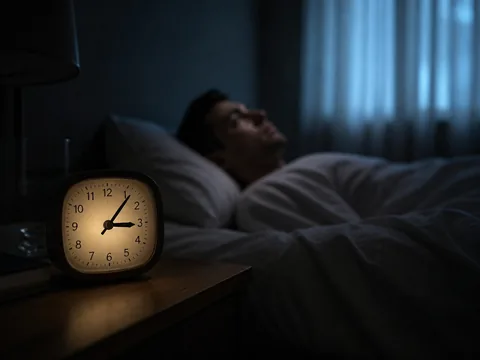
Four of my 14 runs came after short nights, between 4 h 50 min and 5 h 40 min by my watch's estimate. That's not deliberate deprivation, just a deadline week. All four were easy runs at the same pace and incline as my rested baseline runs. On two of them I drank my usual coffee, about 200 mg of caffeine, 45 minutes before running. On the other two I skipped it.
The camera saw something real on all four. Overstride flags at easy pace rose from my rested 8–10% to 14–17%. Vertical oscillation went up by about half a centimetre. Phone video from one of those mornings showed a lazier, more reaching stride, with my trunk slightly further back than on rested days. The camera was right that my form had slipped.

What it couldn't tell me was why. To the treadmill, these were four ordinary runs with slightly worse form. The watch, meanwhile, had the context: lower overnight heart rate variability, a resting heart rate about 5 beats higher, and the short sleep logged. Put the two together and the story is obvious: tired runner, sloppy stride. Look at the treadmill alone and you might decide your form needs drills, when what it needed was an early night.
Caffeine muddied it, as caffeine does. On the two coffee mornings, overstride flags were at the lower end of that 14–17% range, and my cadence was about 2 spm higher than on the no-coffee mornings. My heart rate at the same pace was also 4–6 beats higher. Did the coffee tidy up my stride, or just make me feel sharper and push a little harder at the same speed? With two runs on each side, I can't tell you. Anyone who claims they can from a sample that small is selling something.
One result was clearer, and it came from the watch, not the treadmill. On the one evening session I did, I'd had an afternoon coffee at 3 p.m. That night my sleep onset was about 25 minutes later than my three-week average, and I had less deep sleep by the watch's admittedly rough estimate. The camera recorded a nice clean run, and that was all it knew. What happened to me afterwards was on my wrist.
What I couldn't test
- Transfer to outdoor running. The main question is whether fixing overstriding on a belt carries over to the road. Three weeks isn't long enough to answer it, and I didn't have a matched outdoor reference.
- Long-term accuracy. I tested one unit with fixed lighting in a room with a pale wall behind me. I don't know how it copes with a dark room, baggy clothes or a cluttered background. I wore fitted kit throughout.
- Other body types and gaits. My stride is conventional. I can't speak for heavy heel strikers, very short or very tall runners, or anyone whose gait the system might not have been trained on.
- The coaching layer. Peloton pairs the form data with in-class cues and drills. I followed some and ignored others. I'm reporting on the measurements, not on whether the cues make anyone faster.
- Price, specifically. Prices on premium Peloton treadmills move often enough that any figure I print would be wrong by the time you read it. The camera model costs considerably more than the camera-less one. Check that difference against what the rest of this piece says the cameras actually do.
Who this is for, and who it isn't
It's for you if:
- you do most of your quality work indoors. Threshold and tempo sessions are exactly where form slips as you tire, and where a camera catches it.
- you've had injuries you or a physio have linked to overstriding or a reaching stride. Cadence won't show that, and seeing it during the run is worth a lot.
- you already own a decent watch and want to add to it, not replace it.
It isn't for you if:
- most of your running is outdoors. The camera stays in the room, and your form on a wet road in kilometre 30 of a marathon is the form that matters.
- you mainly want pace, heart rate and recovery data. A watch and a footpod give you almost all of that for a fraction of the cost.
- you're hoping the cameras will replace your wearable. They can't, because they don't know anything that happened before you stepped on the belt or after you stepped off.
A more honest version of the rule
The old advice, buy for the belt and let the wrist do the thinking, was right about pace and cadence. It was wrong about the watch, which is the weakest instrument you can bring to a treadmill. And it was wrong about form, where a camera that sees your whole body beats anything strapped to one part of it.
Peloton's version is wrong in the other direction. Cameras that see your stride clearly still don't know about the 3 p.m. coffee, the five-hour night or the resting heart rate that's five beats high. Those explain most of why my stride changed from one day to the next.
Here's the rule I'd give a friend: buy the cameras if you want to see your form, and keep the wearable for knowing why it changed. If you'd only use one, buy the watch, because the reasons matter more than the stride.
So is the camera more accurate than a wrist? On form, yes. My video agreed with it on overstriding and bounce, and the watch was simply guessing. But that claim only covers what happens during the run. My worst runs were caused by what happened the night before, and only the wearable could see that.