The Casio F-B100W reportedly sold out in Japan, then got hard to find in the UK, and is now reaching US shelves. That story has made a $20-looking digital watch with a Bluetooth chip into something people feel they need to grab. I wanted to know something narrower. Does a smartwatch that does almost nothing beat one that does everything, for someone trying to drink coffee and still sleep?
I don't think the scarcity matters much here. What I wanted to find out was whether a simpler watch on the wrist at night changes anything about how you sleep.
The setup: three watches, six weeks, one coffee rule
I wore three watches for two weeks each, in this order:
- Google Pixel Watch 2. It's the full-featured option, it was already in my drawer, and it launched at $349.
- Casio F-B100W. I paid $79 through an importer before the US release. Check current pricing before you trust my number.
- Casio F-91W. The resin original the F-B100W borrows its face from. I paid about $20.
One rule stayed the same the whole time: the last coffee by 1 p.m. That was a double shot most days, about 130 mg of caffeine by my usual estimate for my grinder and dose. On a few afternoons I had a cup of black tea before 1 p.m. instead. Each night I wrote down when the lights went out and roughly how long I thought it took to fall asleep. I also kept a tally of how many times I looked at my wrist after 10 p.m.
The obvious caveats come first. This is one person over six weeks, and the sleep-onset numbers come from a diary, not a lab. Order effects are real: by week five I was simply better at following my own coffee rule. I didn't wear any of the watches overnight at a sleep clinic, and I can't tell you what my brain was doing. What I can tell you is what each watch got me to do.
Criterion one: what the watch does at 11 p.m.
The Pixel Watch spent bedtime in its bedtime mode, with the screen dark, notifications muted and the vibration off. It still did plenty. I tilted my wrist to check the time and saw a sleep-tracking reminder. I tapped it away and then noticed a battery warning. Over two weeks I averaged 6.1 wrist checks after 10 p.m. Most were not about the time. I was checking whether anything had come in, even though I knew bedtime mode would have held it.
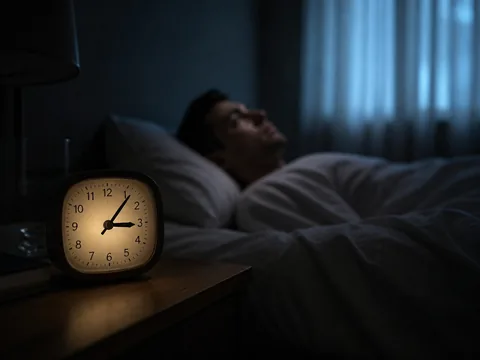
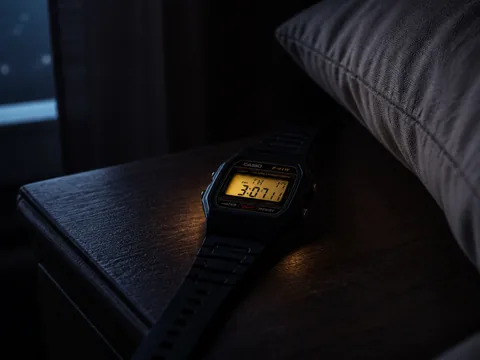
The F-B100W has a face that does nothing until you press a button. The backlight is a small, warm-ish LED that comes on only on demand. My average dropped to 2.3 checks a night, and nearly every one was to see the time after waking around 3 a.m. Nothing on the watch invites a second look. The step count sits on the display, but at midnight it's a number I've already read that day.
The F-91W came in at 2.0 checks a night. That's basically the same as the F-B100W, and the gap is within the noise of my own fidgeting.
The gap I care about here is the one between the Pixel and the two Casios, not between the two Casios.
Criterion two: enforcing the caffeine cutoff
This is where I expected the full smartwatch to win. On paper it should have.
On the Pixel I set a recurring 12:45 p.m. reminder that read "last coffee." It arrived on time and got lost among everything else that arrived. I dismissed it the way I dismiss calendar alerts, which means without reading it. Twice in two weeks I made an afternoon coffee "just this once" at 3 p.m. Both of those nights went into the diary with sleep-onset estimates above 35 minutes.
On the F-B100W I used the daily alarm, which I set from Casio's phone app because doing it on the four buttons is a small chore. It's a single beep with no text. Because it was the only thing the watch ever did unprompted, I noticed it every time, and it worked like a small bell. Over those two weeks I broke the cutoff zero times. I'd love to credit the hardware for that, but some of it is simply that it was weeks three and four and the habit was setting.
The F-91W has the same kind of alarm, set by hand. That's more fiddly but perfectly fine once it's done. I broke the rule once, at a friend's house, and no watch would have stopped me.
On this criterion the Pixel lost. It wasn't missing anything. Its one reminder had to compete with forty other buzzes.
Criterion three: charging and the bedside
This is the dull criterion, and it may matter most.
The Pixel needs charging roughly daily with the always-on display enabled. I did it at night, so the watch spent bedtime on a puck on my nightstand. The puck has a small light, and next to it sat a phone that was also charging. Charging set up a little station of glowing objects about 40 cm from my head. On the nights I charged in the morning instead, I had to remember to take the watch off and put it back on, and the sleep data had gaps.

The F-B100W runs on a coin cell that Casio rates in years rather than days. I never charged it, never thought about it, and never had a reason to take it off. The F-91W is the same.
What surprised me was that having nothing to charge freed up my evening routine more than any feature did. I didn't need a puck or a nightly trip to the nightstand. The phone could charge in the kitchen, and once the watch wasn't tied to it, I did that for all four weeks I wore the Casios. That one change probably did more for my sleep diary than either watch.
Criterion four: what it tells you in the morning
The Pixel gives you a sleep score, sleep stages, heart rate overnight and a readiness number. On the two late-coffee nights its score dropped, which matches what I felt. On a handful of other nights its score disagreed with how I felt, and I had no way to tell which of us was right. I'm not a skeptic about wearable sleep data in general. My problem was that I couldn't do much with it: I already knew to stop drinking coffee at 1 p.m.
The F-B100W tells you your step count and syncs the time. As far as I can tell it doesn't try to tell you anything about your sleep. In the morning you have your own sense of how the night went, plus whatever you write down. I found that was enough for this purpose, though I can see it being frustrating if sleep data is the reason you want a wrist computer at all.
The F-91W tells you the time. It still does that very well.
The grid
| Criterion | Pixel Watch 2 | Casio F-B100W | Casio F-91W |
|---|---|---|---|
| Avg. wrist checks after 10 p.m. | 6.1 | 2.3 | 2.0 |
| Coffee-cutoff breaks (2 weeks) | 2 | 0 | 1 |
| Avg. diary sleep onset | ~24 min | ~17 min | ~16 min |
| Charging | Roughly daily | Coin cell, years | Coin cell, years |
| Morning sleep data | Score, stages, HR | None | None |
| Price I paid | $349 (launch) | $79 (import) | ~$20 |
Read the sleep-onset row with suspicion. It's my estimate from a diary, and it improved as the experiment went on regardless of the watch.
The verdict
If the question is what to wear to bed when caffeine timing is the thing you're managing, the full smartwatch came last on the criteria that mattered to me. Its features didn't hurt my sleep directly. They cluttered the one reminder that mattered and made charging part of my bedtime.
Between the two Casios, the F-91W did nearly everything the F-B100W did for a quarter of the price. The connected Casio earns its premium in small ways. Setting the alarm from your phone is easier, the time keeps itself correct, and the step count is a modest daytime nudge. None of those helped my sleep. All of them made it a nicer watch to live with during the day.
For sleeping and keeping a coffee curfew, the F-B100W beats a full smartwatch, but the $20 F-91W gets you about 90% of the same benefit.
Who this is for, and who it isn't
The F-B100W makes sense for:
- People who want a connected watch but have noticed a full one makes them check their wrist too often.
- Anyone who likes the F-91W look and wants step counts and app-set alarms without adding a charger.
- Buyers who want a watch that can stay on the wrist through the night without becoming a data project.
It doesn't make sense for:
- People who use sleep stages, heart rate or readiness scores to make real decisions. This watch doesn't give you any of that.
- Anyone buying it mainly because it sold out somewhere else. Supply looks tight now, but it's a Casio, and Casio tends to keep making things people buy.
- Readers whose only goal is a caffeine cutoff. Use the F-91W's alarm and keep the $60.
What this didn't answer
Six weeks on one wrist can't separate the watch from the habit. The cutoff got easier every week, and I can't tell how much of the Casio fortnights' good numbers came from the Casios and how much from week three onward. A fair test would randomize the order across several people and use an actigraph or a sleep-lab night instead of my diary.
I also didn't test the harder case: someone who drinks coffee past 3 p.m. as a matter of course and wants the watch to show them the cost. For that you need overnight data, which means a full smartwatch, a ring or a dedicated sleep tracker. If that's you, look at published validation work comparing consumer wearables against polysomnography before you trust any one device's sleep score. That includes the one I took off for this experiment.