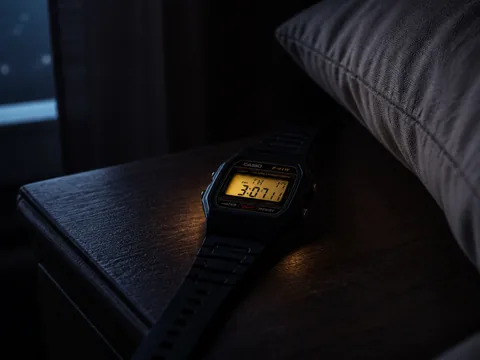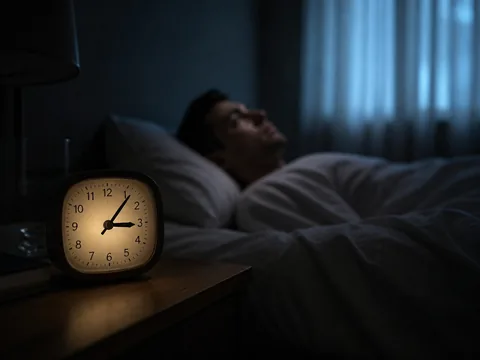
The advice is everywhere, and most of it is not wrong. Don't look at the clock. If you're still awake after twenty minutes, get out of bed. Write tomorrow's worries down before you get in, so they aren't waiting for you in the dark.
Every one of those lines traces back to real research. Every one was also validated on a problem slightly adjacent to the one you actually have — which is why sleep anxiety survives the entire protocol in so many people who follow it faithfully. The advice is roughly right. It's the roughly that keeps you up.
Because here's the part that usually gets skipped: waking at 3 a.m. is not the malfunction. It's the schedule.
What your body is doing at 3 a.m.
Sleep doesn't degrade evenly across the night. It runs in a sequence.
The first few hours belong to slow-wave sleep — the deep, hard-to-rouse kind that eats most of your homeostatic sleep pressure. By the second half of the night that's largely spent, and REM takes over in longer and longer runs. REM is not restful in the colloquial sense. Heart rate is variable, the brain is metabolically busy, the postural muscles are switched off. The back half of your night is structurally lighter than the front half. It is supposed to be.
Two other curves converge around the same hour. Core body temperature bottoms out roughly two hours before habitual wake time, which for a lot of people lands somewhere between 3 and 5 a.m. And cortisol, at its floor near midnight, starts climbing in the small hours — before you wake, not because you woke. By the time you're staring at the ceiling, your endocrine system has already begun assembling morning.
Then there's the ordinary churn. Healthy sleepers surface briefly many times a night: at the end of REM periods, at position changes, at the sound of a car door two streets over. Almost none of it is remembered. Encoding a waking episode into memory appears to require staying awake for something on the order of a minute or more. So the honest question isn't why did I wake up. It's why did this one stick.
The order it actually happens in
- A REM period ends and you surface. Unremarkable. It happens to people who sleep beautifully.
- Something holds you at the surface past the minute mark — a full bladder, a partner turning over, a thought with a hook in it.
- Memory switches on. Now you know you're awake, which the previous four arousals never told you.
- You appraise it. 3:14. Under four hours till the alarm. I'm going to be useless in the 9 a.m.
- The appraisal is the arousal. Heart rate up, sympathetic tone up, and an awakening that would have closed in ninety seconds is now self-sustaining.
Allison Harvey's cognitive model of insomnia (2002, Behaviour Research and Therapy) puts step four at the center of the whole thing: what maintains chronic insomnia is not the wakefulness but the excessively negative, self-monitoring thought that attaches to it. Step five is where that thought recruits your body as an ally.
Why do I wake up at 3 a.m. every night?
Most likely because you always have, and you've only recently started noticing. The clock-face consistency feels sinister — the same hour, night after night, as if something were scheduled — but that's exactly what it is. Your sleep architecture keeps a timetable, the light half of the night arrives on it, and your worry has learned when the room goes quiet.
There's a second, stranger possibility worth naming carefully. Wehr (1992, Journal of Sleep Research) put volunteers on 14-hour nights of enforced darkness for several weeks; their sleep split into two blocks separated by an hour or two of calm, non-anxious wakefulness. This is a small sample, not a population study, and it's often paired with the historian A. Roger Ekirch's documentation of "first sleep" and "second sleep" in pre-industrial Europe. Call that combination suggestive rather than settled. What it does justify is a lower baseline alarm: a wakeful gap in the middle of the night is not, on its face, evidence that something has broken.
Why the same thought is worse at 3 a.m. than at 9 a.m.
Because the equipment you'd normally use to evaluate it isn't fully on yet.
Balkin et al. (2002, Brain) tracked cerebral blood flow through the transition out of sleep using PET. Brainstem and thalamic regions came back quickly. The prefrontal cortex — the part that does proportion, context, and is this actually a catastrophe — lagged behind by a stretch of minutes. That's the neural correlate of sleep inertia, and it means the 3 a.m. version of you is running threat detection at full volume with the appraisal circuitry still booting.
The tempting next step is to invoke amygdala hyperreactivity, and there is real work there (Yoo et al., 2007, Current Biology, found roughly 60% greater amygdala response to negative images after total sleep deprivation). But that was deprivation, not a normal mid-night arousal. Treating it as an explanation for your 3 a.m. dread is plausible and thin — a reasonable extrapolation that nobody has tested at 3 a.m. in your bed.
Where the standard advice earns its keep
Pre-bed writing has the best evidence, and it's better than you'd guess. Scullin et al. (2018, Journal of Experimental Psychology: General) had 57 young adults spend five minutes before bed writing either a to-do list for tomorrow or a list of what they'd already finished, with sleep measured by polysomnography rather than self-report. The to-do writers fell asleep about nine minutes faster, and the more specific the list, the faster the onset. Carney and Waters (2006, Behavioral Sleep Medicine) tested a structured "constructive worry" procedure — name the concern, name the next concrete step — in a small student sample and found reduced pre-sleep cognitive arousal.
Getting out of bed is real too, just slower than advertised. Stimulus control (Bootzin, 1972) is a conditioning protocol. You leave the bed so the bed stops predicting wakefulness. It works over weeks. It is not a technique for tonight.
Where it breaks down
Here's the seam. Scullin measured sleep onset. Carney measured pre-sleep arousal. Both interventions happen before you're unconscious, and both were validated against the problem of not falling asleep at 11 p.m. The 3 a.m. wakeup is a different animal with different neurochemistry — cortisol rising instead of falling, prefrontal function degraded instead of merely tired. Applying onset data to it is a defensible guess, not a finding.
The practical failures follow from that:
Journaling at 3 a.m. can become rumination with a pen. With the prefrontal cortex still half-offline, "process the worry" turns into circling it in better handwriting. The pre-bed version works partly because you're awake enough to actually finish a thought.
Trying harder makes it worse, mechanistically. Espie et al. (2006, Sleep Medicine Reviews) described the attention–intention–effort pathway: sleep is an automatic process, and deliberately recruiting effort toward it inhibits it. So the moment you deploy the quarter-hour rule in order to get back to sleep, you've converted a conditioning protocol into a performance, and performance is arousal.
And not looking at the clock doesn't stop the arithmetic. Tang, Schmidt and Harvey (2007) is the usual citation for clock-monitoring maintaining nighttime anxiety, and turning the display away genuinely helps some people. But most of us just estimate instead, and estimates run pessimistic in the dark.
The caffeine footnote nobody wants
Caffeine's half-life runs about five hours in a typical adult, with a real range of roughly three to seven.1 A 200 mg coffee at 3 p.m. leaves something in the neighborhood of 35–40 mg circulating at 3 a.m. — not enough to wake you, easily enough to matter at the margin. Drake et al. (2013, Journal of Clinical Sleep Medicine) gave 12 subjects 400 mg at 0, 3, and 6 hours before bed; even the 6-hour dose cost over an hour of objectively measured sleep.
The honest version: caffeine does not schedule your 3 a.m. wakeup. What it plausibly does is lighten sleep enough that a routine arousal crosses the threshold into one you remember. That specific claim — arousals converted from forgotten to encoded — is a mechanism I'd call reasonable and untested.
An honest rule of thumb
| At 3 a.m. you are… | Do this |
|---|---|
| Awake with a specific, solvable worry | Write one line. Not a paragraph. The next physical action, nothing else |
| Awake and looping with no solvable content | Stop trying to sleep. Aim for bored, not unconscious |
| Awake, calm, not distressed | Stay put. This may just be the night's architecture |
| Awake past ~25 minutes and escalating | Leave the bed. Dim light, dull book, no screen, no email |
The rule, more honestly stated than the version you've read: do the writing at 9 p.m., not 3 a.m. — and at 3 a.m., leave the bed only once you're bored, not the moment you're anxious. Boredom is the signal that the arousal has peaked. Anxiety is the signal that it hasn't.
One concrete thing, for tonight: put a piece of paper and a pencil where you'd have to sit up to reach them, and write your one line before you get in bed.
I keep index cards on the floor beside mine — pencil, not pen, because pens fail when you write lying down. The card from two nights ago says, in handwriting I could barely decode at six the next morning, call the insurance people. The call took four minutes. It had been running in my head for three hours.