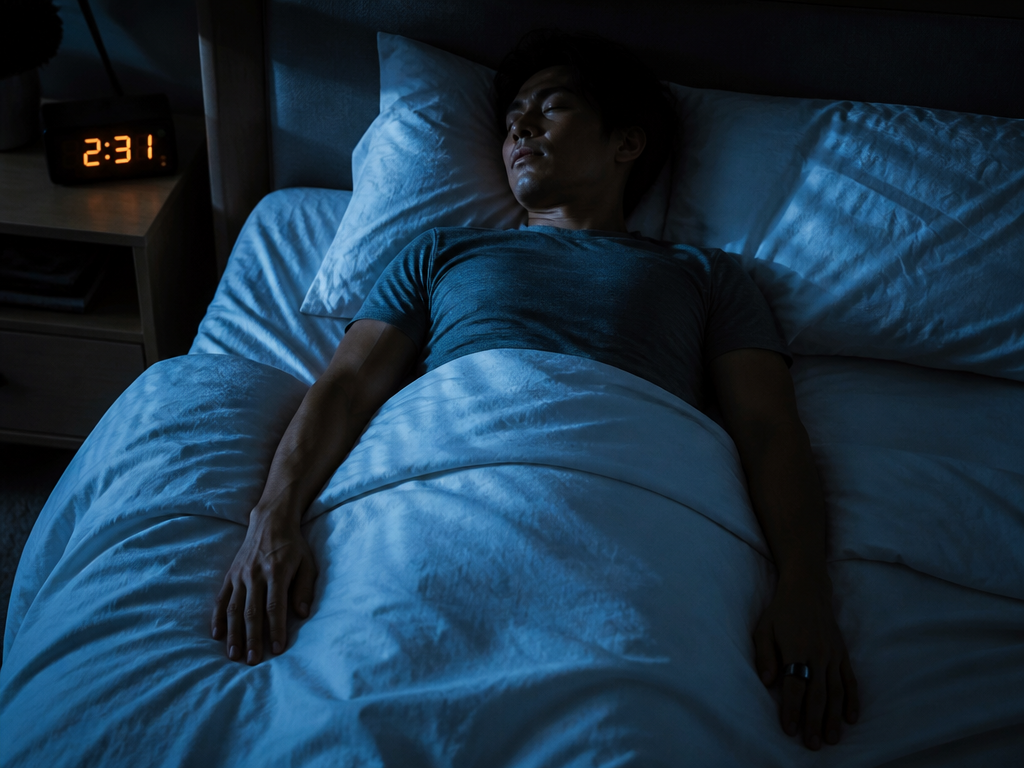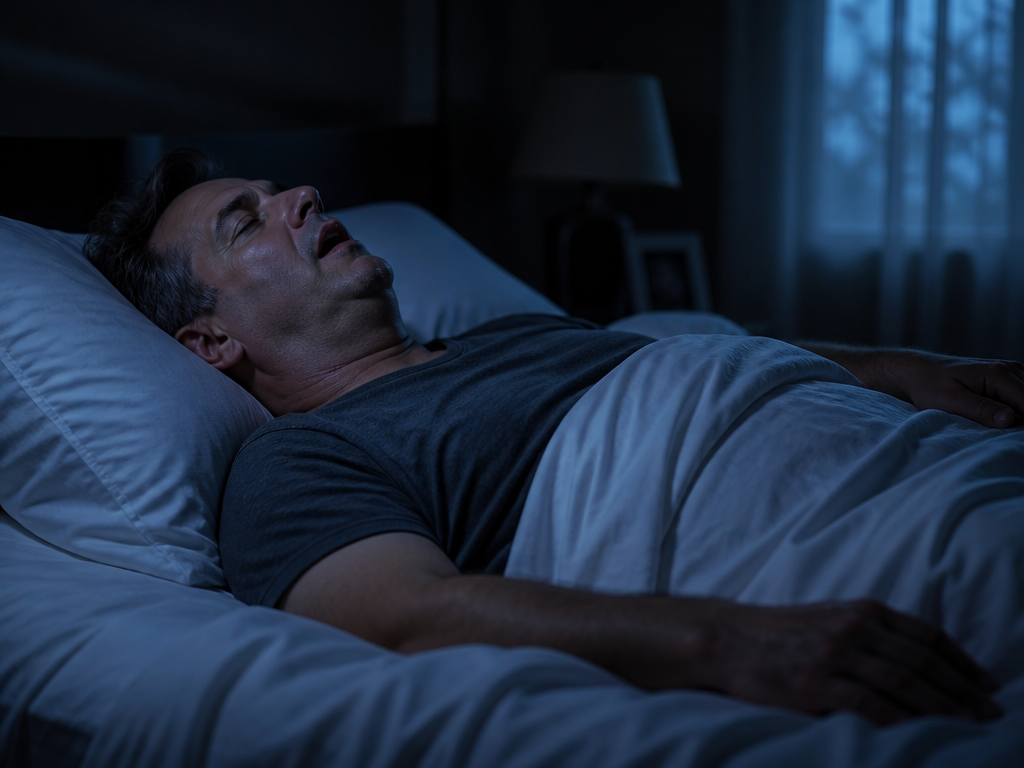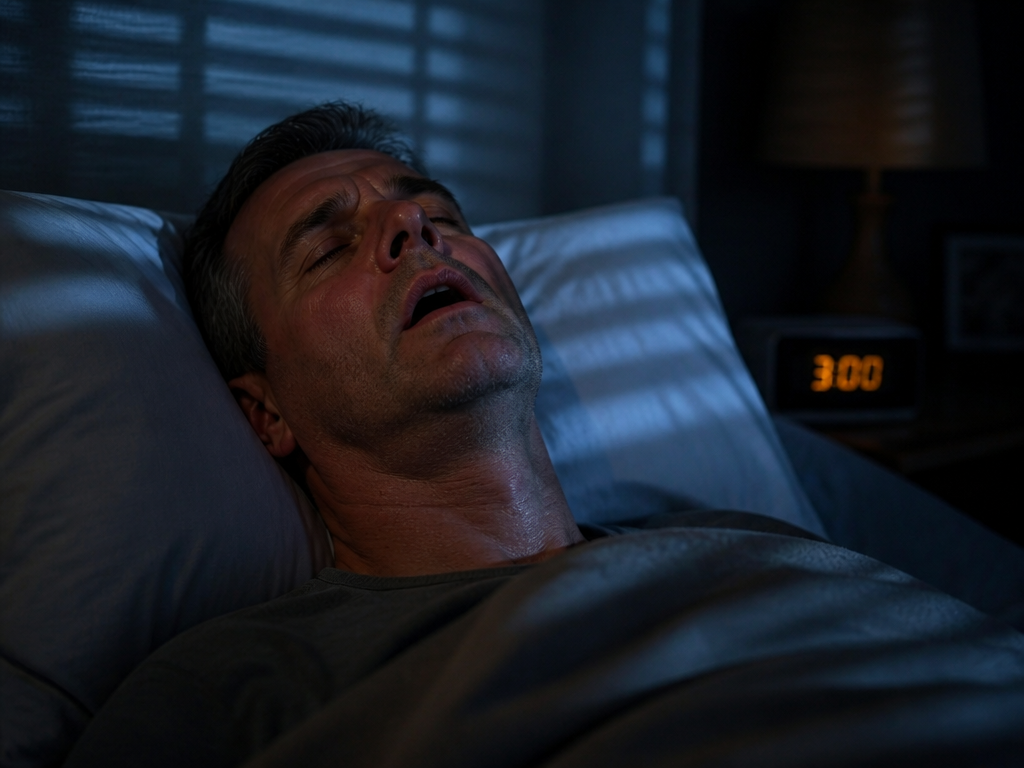
There is a number sitting underneath the diagnosis of sleep apnea, and most people who get the diagnosis never hear it. The number is five. To qualify, your breathing has to stall at least five times an hour while you sleep — five pauses or shallow stretches, each lasting ten seconds or more. Four times an hour and the textbook says you are fine. Five and you have a disorder.
That cutoff sounds like physics. It is closer to a committee decision.
Sleep apnea is, in the plainest terms, a breathing disorder in which airflow repeatedly stops or drops during sleep, fragmenting rest and starving the blood of oxygen for seconds at a time. The definition is real, the harm is real, and the condition is genuinely underdiagnosed. But the boundary line — the moment a noisy sleeper becomes a patient — was drawn by people, in specific years, using the measuring tools they happened to have. Knowing where the line came from tells you more about your own risk than any single number can.
What is actually happening in the airway
Start with the body, in the order events occur.
You fall asleep. The muscles that hold your upper airway open — chiefly the genioglossus, the muscle that anchors the tongue — lose tone, the way every muscle does as you drift off. In most people this is harmless slack. In someone with obstructive sleep apnea, the airway is already narrow, whether because of a thick neck, a small or set-back jaw, large tonsils, or simply the anatomy you were born with. The slack tips it over the edge. The soft tissue at the back of the throat falls inward and seals the tube.
Now air can't move. Your chest and diaphragm keep trying — they pull harder against a closed door — but no oxygen reaches the lungs. Blood oxygen falls. Carbon dioxide climbs. After ten, twenty, sometimes forty seconds, chemoreceptors in your carotid arteries and brainstem register the danger and trigger a brief arousal: a flash of wakefulness, often too short to remember. Muscle tone snaps back, the airway reopens, and you take a few recovering breaths, sometimes with a gasp or a snort.
Then you fall back asleep, the muscles relax again, and the cycle repeats. In severe cases this happens sixty or more times an hour. You are technically in bed for eight hours and never spending much of it in the deep, consolidated sleep your brain needs. You wake up tired without knowing why, because the part of you that kept surfacing all night doesn't file a report.
That repetition is the disease. A single pause is meaningless — everyone has them. The pathology is in the count and the consequence.
How we decided five was the number
The word "apnea" is old — from the Greek for "without breath" — but the idea that breathing pauses in sleep could constitute a disease is surprisingly recent. For most of medical history, the loud snorer who fell asleep at the dinner table was a comic figure, not a patient. Dickens gave us the type in The Pickwick Papers: Joe, the fat boy who snores and dozes mid-sentence. For a century, daytime sleepiness with obesity was filed under "Pickwickian syndrome," named after a literary joke.
The modern understanding begins in the mid-1960s. In 1965, two groups working independently — Henri Gastaut's team in France and Richard Jung and Wolfgang Kuhlo in Germany — put Pickwickian patients on overnight recordings and saw what no one had documented before: the breathing wasn't just shallow, it was stopping, over and over, each pause ending in an arousal. The sleepiness wasn't laziness. It was the cost of a night spent suffocating in installments.
The term obstructive sleep apnea came a little later, from Christian Guilleminault and colleagues at Stanford in the early 1970s. Guilleminault did something that shaped everything after: he started counting. If breathing pauses were the problem, you needed a way to quantify them, and a quantity needs a threshold. How many pauses per hour separates a sick person from a normal one?
This is where the number five enters, and it is worth being honest about how it arrived. Early researchers needed a cutoff to study the condition at all, and five events per hour was a reasonable round figure that seemed to separate symptomatic patients from controls in small samples. It was a working definition, not a discovered constant. Over the following decades it hardened into the official one.
The American Academy of Sleep Medicine has revised the scoring rules repeatedly — notably in 1999, then again in 2007 and 2012 — and each revision quietly moved the goalposts. The biggest fight was not over apneas, which are easy to define (airflow essentially ceases), but over hypopneas — the partial reductions in airflow. How much does breathing have to drop, and for how long, and does it count only if oxygen falls? The 1999 "Chicago criteria" used one rule; the 2012 update used another. The practical effect is jarring: the same night of sleep, scored under two different rule sets, can yield two different diagnoses. A 2014 analysis by Richard Bonsignore and others, and a much-cited 2009 study by Ruehland and colleagues in Sleep, both showed that switching the desaturation threshold from a 4 percent drop in oxygen to a 3 percent drop roughly doubled the number of people who met criteria.
So the threshold is real and useful. It is also, at the edges, an artifact of which version of the rulebook your lab happens to use.
The three kinds, and what separates them
The condition isn't one thing. It splits cleanly along a single question: is the airway blocked, or is the brain not sending the breathe signal?
Obstructive sleep apnea (OSA) is the airway problem described above and accounts for the large majority of cases. The drive to breathe is intact — your chest is heaving against a closed throat. The machinery for the command works; the pipe is shut.
Central sleep apnea (CSA) is the opposite. The airway is open, but for a stretch of seconds the brainstem simply stops issuing the command to breathe. There is no effort, no struggle, no chest movement — just a quiet absence. CSA is much rarer and tends to travel with other conditions: heart failure, stroke, opioid use, or high altitude. It is a signaling failure, not a plumbing one.
Mixed (or complex) sleep apnea is what it sounds like — events that start central and end obstructive, or patients who develop central events once their obstruction is treated. This last group is genuinely puzzling. Some people put on a CPAP machine that clears their obstruction and then start showing central pauses that weren't there before. Why this happens isn't fully settled; the leading explanation involves the breathing control system overshooting and becoming unstable once the airway resistance is suddenly removed.
The distinction matters because the treatments diverge. Open a blocked airway and OSA improves. But you can't pry open an airway that was never closed — central apnea needs a different approach entirely, sometimes aimed at the underlying heart or neurological cause.
How do I know if I have sleep apnea?

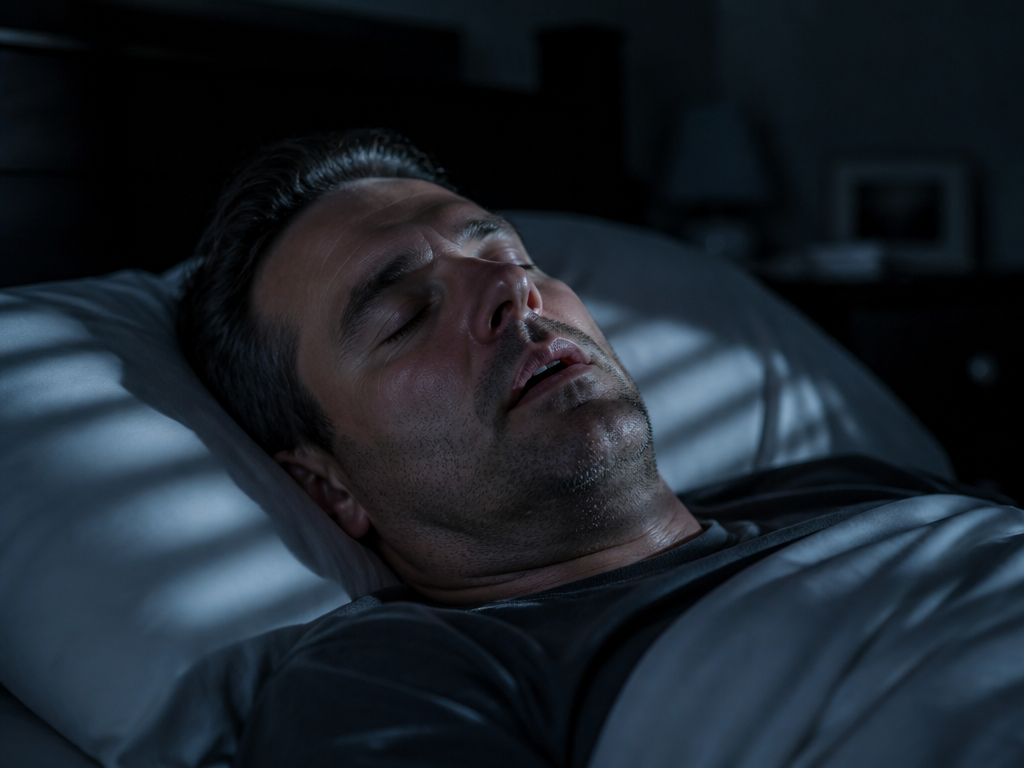
You probably can't diagnose it yourself, and that is the honest answer, but there are specific signals worth taking to a doctor. The most reliable single tip-off is something someone else notices: loud, chronic snoring punctuated by silent pauses, often ending in a gasp or choke. Sleepers rarely catch their own arousals, which is exactly why the condition hides — the person doing the suffocating is asleep for the evidence.
The daytime signs are less specific but add up. Waking unrefreshed after a full night. A dull, persistent fatigue that caffeine papers over but never fixes. Morning headaches, from the carbon dioxide that built up overnight. Trouble concentrating. Irritability. A 2017 review in The Lancet by Jean-Louis Pépin and colleagues emphasized how unreliable any one symptom is on its own — plenty of people with significant apnea don't feel sleepy at all, and plenty of tired people don't have apnea.
Screening questionnaires exist — the STOP-BANG is the common one, built around snoring, tiredness, observed pauses, blood pressure, body mass index over 35, age over 50, neck circumference over 17 inches, and male sex. It is a decent net for catching who should be tested, not a diagnosis. The actual answer comes from a sleep study: either an in-lab polysomnography, wired up overnight, or increasingly a home sleep apnea test, which is cheaper and good enough for clear-cut obstructive cases but misses central apnea and tends to undercount mild disease.
If a partner has watched you stop breathing, that observation alone is worth a referral. It outperforms most of the rest.
The risk factors, weighted honestly
Excess weight is the dominant modifiable risk factor for obstructive apnea, and the relationship is mechanical, not moral — fat deposited around the neck and tongue narrows an already tight airway. The landmark Wisconsin Sleep Cohort, run by Terry Young and colleagues since 1988, found that a 10 percent weight gain predicted roughly a sixfold increase in the odds of developing moderate-to-severe disease. That said, plenty of lean people have severe apnea, usually driven by jaw and airway anatomy, so weight is a strong lever, not the whole story.
The rest of the list is more modest in effect. Male sex roughly doubles risk, though the gap narrows sharply after menopause, which points to a protective hormonal role we don't fully understand. Age increases prevalence. Alcohol in the evening relaxes the airway muscles and worsens events that night. Smoking inflames the upper airway. Sedatives can deepen the suppression of breathing drive. And anatomy you can't change — a recessed chin, a narrow palate, large tonsils, nasal obstruction — sets the baseline everything else acts on.
What you'll notice is that the strongest factors are either fixed (anatomy, age, sex) or slow (weight). The fast levers — alcohol, sleep position, sedatives — make a given night worse but rarely cause or cure the underlying disorder. That's worth keeping straight, because the wellness internet sells the fast levers as solutions and stays quiet about the slow ones.
Where the definition still argues with itself
Here is the part the patient-education pamphlets skip. The apnea-hypopnea index — the AHI, that count of events per hour — is a famously crude summary of a complicated night. It treats a 10-second pause and a 40-second pause as identical. It counts an event whether your oxygen dropped to 90 percent or to 70 percent. It says nothing about when in the night events cluster, or how badly each one fragmented your sleep.
Two people can share an AHI of 20 and have entirely different diseases — one with brief, mild events and minimal oxygen loss, another with long, deep desaturations that hammer the cardiovascular system. The single number can't tell them apart, yet that number determines the diagnosis, the severity grade, and often whether insurance will pay for treatment.
Researchers know this. There's active work on better metrics — "hypoxic burden," developed by Ali Azarbarzin and colleagues in a 2019 European Heart Journal paper, which measures the total area under the oxygen-desaturation curve and predicts cardiovascular death better than the AHI does. There's interest in the arousal intensity and in how much each event disrupts the autonomic nervous system. None of these has replaced the event count, because the event count is simple, decades-deep in the literature, and built into every machine and billing code. The definition persists partly because it's entrenched, not because it's the best description of the harm.
This is not a reason to distrust the diagnosis. It is a reason to treat the number as a starting point rather than a verdict — to ask your doctor not just how many events but how low your oxygen went and how it affected your heart rate, because those are often the parts that matter.
An honest rule of thumb
If you want one usable directive tonight: stop relying on how you feel in the morning to tell you whether you slept well. The hallmark of sleep apnea is that the damage happens during arousals you will never remember. Your felt sense of the night is exactly the instrument the disease defeats.
So borrow an outside observer. If you sleep next to someone, ask them — directly, once — whether you snore, and whether they have ever heard you stop breathing and then gasp. If you sleep alone, a phone app that records audio overnight is imperfect but will catch the pattern of snore-silence-gasp if it's there. Either of those, plus daytime fatigue that good sleep hygiene doesn't fix, is enough to justify asking a physician for a sleep study. You are not diagnosing yourself. You are gathering the evidence your own consciousness can't.
Here's how the severity grades map, under the standard scoring most labs still use:
| Events per hour (AHI) | Standard label | What it usually means |
|---|---|---|
| Under 5 | Normal | Everyone has occasional pauses |
| 5 to 14 | Mild | Often symptomatic; treatment is a judgment call |
| 15 to 29 | Moderate | Treatment typically recommended |
| 30 and above | Severe | Treatment strongly recommended |
The line between the first two rows is the committee decision we started with. Treat it as a doorway, not a wall — a 14 and a 5 are both "mild," and a person at either end can feel terrible or fine.
What this looks like lived out
I'll tell you the small thing the logic of this article changed in my own house. I used to treat my morning grogginess as data — a bad night meant I'd slept badly, a good morning meant I'd slept well. After reading enough of the apnea literature, I stopped trusting that reading entirely, because the whole point of the disorder is that the worst nights feel like nothing from the inside.
So now, once or twice a year, I leave a voice recorder running on the nightstand and listen back to ten minutes of it the next day. It's a strange, slightly embarrassing thing to do. What I'm listening for isn't the snoring — it's the silences, and whether they end with a gasp. They don't, so far. But the habit reframed something: the only honest witness to your sleep is the one that's awake while you aren't.