For a condition defined by something as basic as breathing, the sleep apnea definition is oddly hard to pin to a felt experience. The clinical version is precise: obstructive sleep apnea is the repeated narrowing or collapse of the upper airway during sleep, each event lasting at least ten seconds, scored by how many times per hour it happens. The lived version is vaguer — you wake up tired, your partner elbows you, and you have no memory of the 200 small suffocations in between.
I spent a month trying to close that gap. I wore a pulse-oximeter ring every night, then ran a physician-ordered home sleep test, then compared both against what the literature actually says the numbers mean.
The verdict: a consumer device can tell you whether to get tested, but it cannot tell you whether you have sleep apnea — and the gap between those two things is wider than the marketing suggests.
What most people do
Most people do nothing for years, because the symptoms are easy to file under "modern life." Loud snoring gets blamed on a glass of wine. Morning headaches get blamed on screens. Daytime exhaustion gets blamed on the job. The events themselves happen during sleep, so the person experiencing them is, by definition, the worst-positioned witness.
When something finally prompts action, it's usually one of three moves:
- A partner reports gasping or silence, and the snorer buys a mouth strip or a wedge pillow.
- A smartwatch flags "low SpO2 during sleep" and the person panics or, more often, dismisses it.
- A new diagnosis of high blood pressure sends a doctor asking pointed questions about snoring.
The first move treats a symptom without knowing the mechanism. The second relies on a sensor that was never validated for the job. The third is the one that actually works — but it usually arrives years late, after the condition has had time to do quiet cardiovascular damage.
The common thread is that none of these answers the only question that matters clinically: how many times an hour does your airway actually obstruct? Everything before that number is guessing.
What the evidence suggests
That number has a name. The Apnea-Hypopnea Index (AHI) counts breathing events per hour of sleep. An apnea is a near-complete airflow stop for ten seconds or more; a hypopnea is a partial reduction with an associated oxygen drop or arousal. The thresholds are standardized:
- AHI under 5 — normal.
- 5 to 15 — mild.
- 15 to 30 — moderate.
- 30 and above — severe.
These cutoffs are clinical conventions, not laws of physics, and that matters later. But they're what every diagnosis and treatment decision hangs on.
What the evidence is clear about: untreated moderate-to-severe OSA is not a snoring nuisance. The repeated drops in blood oxygen and the surges of arousal drive sustained increases in blood pressure, and the association with hypertension, atrial fibrillation, stroke, and type 2 diabetes is well established and dose-dependent — more events, more risk. The daytime sleepiness is downstream of fragmented sleep architecture; you may spend eight hours in bed and almost none of it in restorative deep stages.
What the evidence is less clear about: the symptoms map poorly onto severity. Plenty of people with an AHI of 40 feel fine. Plenty with an AHI of 8 feel destroyed. Neck circumference (over roughly 17 inches in men, 16 in women), obesity, male sex, and age all raise risk, but none of them confirm or rule out the condition. You cannot reason your way to a diagnosis from symptoms. You have to count the events.
There's also a category most people don't know exists: central sleep apnea, where the airway is open but the brain briefly stops sending the signal to breathe. It's far less common than the obstructive kind, but it changes treatment entirely — which is one more reason a home gadget that only watches oxygen is a starting point, not an answer.
What I actually do
I ran two tools side by side for the same nights.
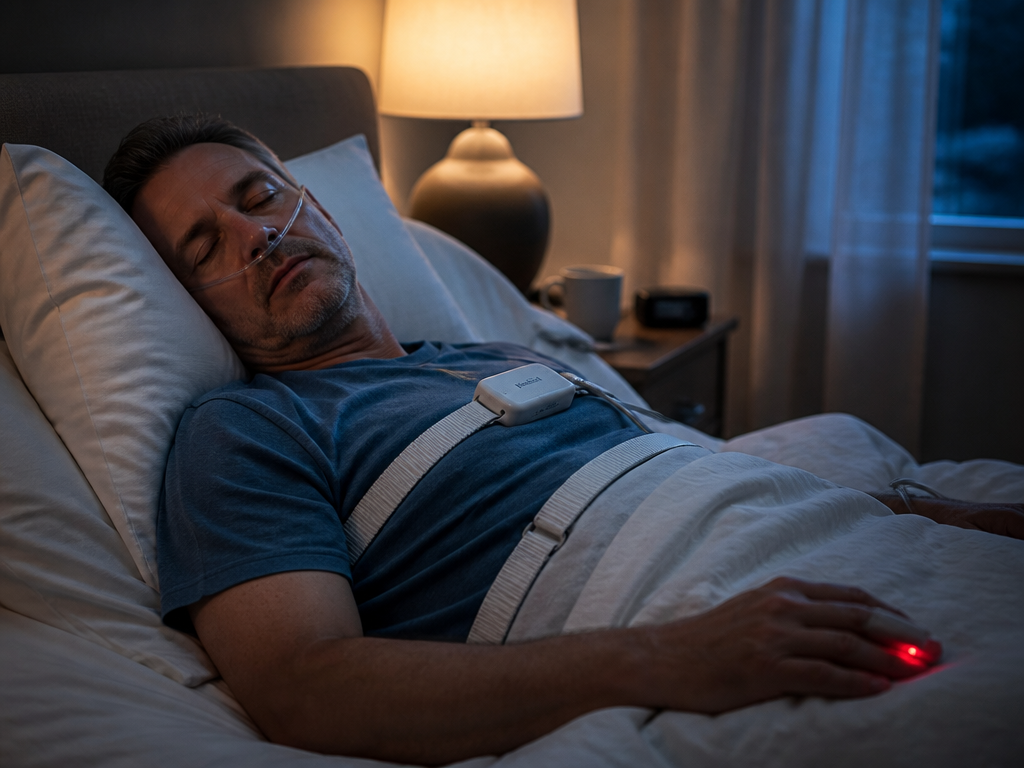
The first was a consumer pulse-oximeter ring (retail around $300, no subscription) that logs blood oxygen and heart rate. The second was a Type III home sleep apnea test ordered through a doctor — a chest band, a nasal cannula measuring airflow, and a finger oximeter — the kind insurers will reimburse and a sleep physician will actually score.
Here's how the three measurement approaches compared:
| Approach | What it measures | Gives you an AHI? | Cost | Best use |
|---|---|---|---|---|
| Smartwatch / O2 ring | SpO2, heart rate, movement | No (estimates only) | $0–300 | Deciding whether to test |
| Type III home test | Airflow, effort, SpO2 | Yes (scored) | ~$150–400 | Confirming most OSA |
| In-lab polysomnography | All of the above + EEG, stages | Yes (gold standard) | $1,000–3,000 | Complex or central cases |
The ring told me my oxygen dipped below 90% "several times" most nights and gave me a vague "lower than typical" sleep-quality flag. Useful as a nudge. But it never produced a number a doctor could act on, and on one night it logged a dramatic desaturation that turned out to be the sensor sliding off my finger.
The home test was a different instrument entirely. It recorded airflow and breathing effort, which is what separates an obstructive event (effort continues, airflow stops — your body is trying to breathe through a closed door) from a central one (effort and airflow stop together). My scored result came back at an AHI of 11 — mild, obstructive, with most events clustered when I slept on my back. The oxygen nadir was 88%.
What I actually changed: I stopped trusting the ring's number as anything but a tripwire, and I tested positional therapy first, since my events were posture-dependent. A firm pillow arrangement that kept me off my back dropped my self-reported morning grogginess noticeably within two weeks. I want to be honest about the limits here: that's an n of one, measured by how I felt, not a repeat sleep study. I haven't re-tested to confirm the AHI actually moved. It may not have.
The ring still has a job. It's the cheapest possible reason to call a doctor. It is not a diagnosis, and treating it like one is how people either scare themselves or falsely reassure themselves.
Who this is for — and who it isn't
This approach is for you if you snore loudly, wake unrefreshed, have witnessed pauses in your breathing, or carry the risk factors and want a low-friction first step before booking a sleep study. A consumer oximeter is a reasonable $0–300 nudge to take the next step seriously.
It isn't for you if you already have a witnessed-gasping report plus high blood pressure or a heart rhythm problem — skip the gadget and go straight to a physician-ordered test. And if you have heart failure, opioid use, or stroke history, the chance of central apnea is high enough that you likely need the full in-lab study, not a home one.
The screenshot line: a smartwatch can tell you to get tested; only a scored test can tell you what you have. Don't let the first one substitute for the second.
The question I can't answer
Here's where I have to stop being confident. My AHI was 11 — mild. The treatment case for moderate-to-severe apnea is overwhelming. But for mild OSA in someone without major daytime sleepiness, the evidence on whether aggressive treatment actually reduces long-term cardiovascular risk is genuinely unsettled. Some trials show improved sleepiness and quality of life; the hard-outcome data on hearts and strokes at the mild end remains thin.
So I'm left with a real question, not a tidy ending: at an AHI of 11, am I treating a disease, or am I treating a number that happens to sit just over a line someone drew?
I don't know yet. Neither, honestly, does the field.