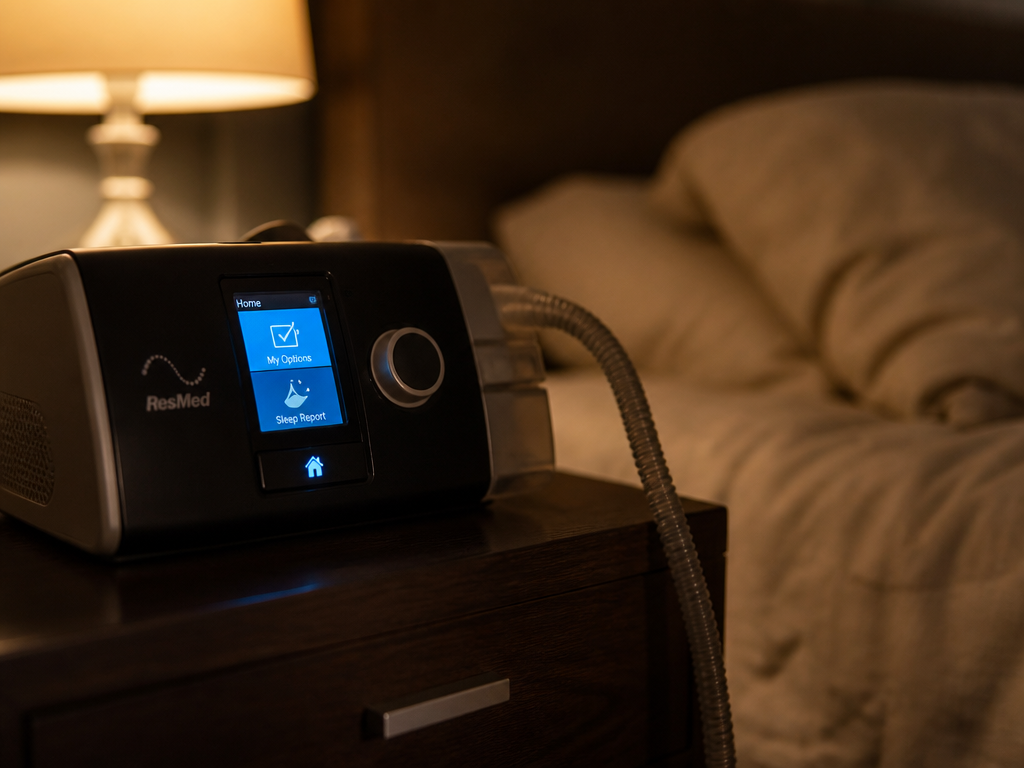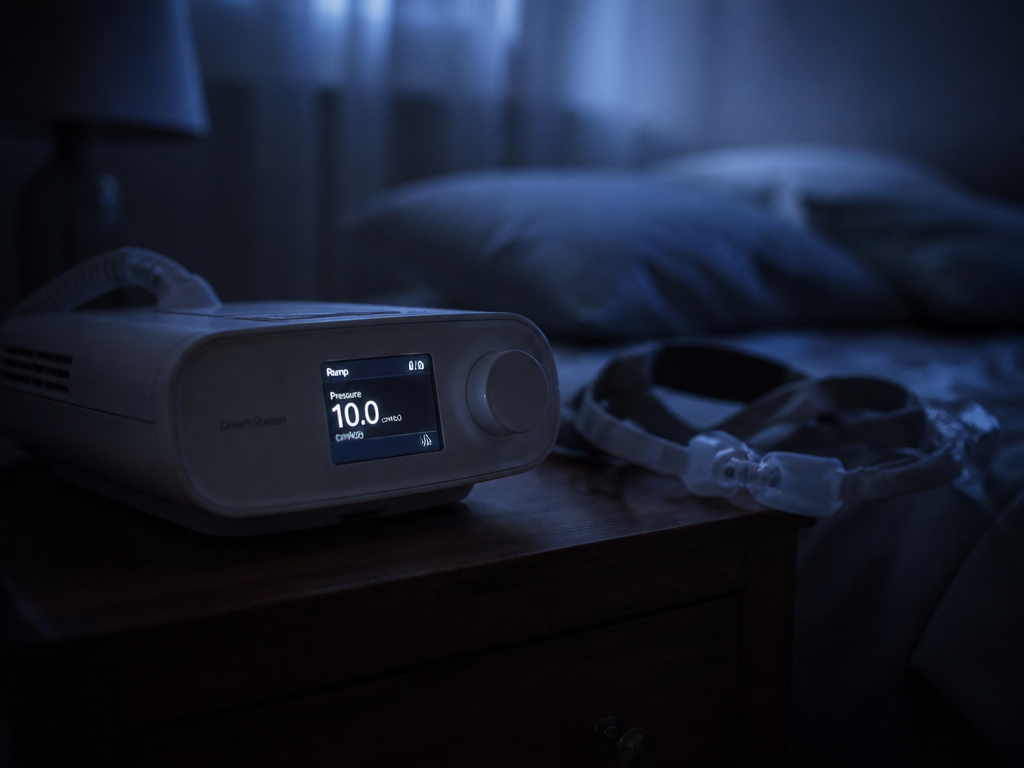
Every quarter ResMed reports, the stock moves, and the market reaches for the same explanation. Last week's print was a clean version of the ritual: an earnings beat, a soft top-line outlook, and about six percent off the shares in a session. Within an hour the selling had a name attached to it — Zepbound. But the ResMed financial guidance that actually triggered it named something else, and that something was not a drug.
The fiscal 2027 revenue range landed at $5.75 to $5.85 billion. Management tied roughly $75 million of the gap to a single product line — Astral, the company's life-support ventilator platform — after an FDA correction led it to stop selling new units so components could be routed to servicing devices already with patients. Most of the remaining pressure sat in gross margin: input costs, freight, tariffs. The CFO's framing was that productivity gains no longer cover input inflation. Those are supply sentences and cost sentences. Neither is a demand sentence.
The myth a smart investor has actually heard
The thesis runs like this: obstructive sleep apnea is a disease of body weight, GLP-1 receptor agonists remove body weight, therefore the addressable market for positive airway pressure shrinks a little more every year the prescriptions compound.
This is not a fringe position. It has been the cleanest liquid expression of the GLP-1 disruption trade since the summer of 2023, when ResMed shed roughly a third of its market value in a matter of weeks on trial results that had nothing to do with sleep. In December 2024 the FDA approved tirzepatide — Zepbound — for moderate-to-severe OSA in adults with obesity, the first drug ever indicated for the condition. The myth acquired a catalyst. Twenty months later it remains the default lens through which soft ResMed financial guidance gets read, including this one. What it still lacks is arithmetic.
Do GLP-1 drugs replace CPAP?
For most patients in the trial that won the indication, no. They reduce the disease substantially without ending it.
SURMOUNT-OSA (Malhotra et al., 2024, New England Journal of Medicine) enrolled 469 adults with obesity and moderate-to-severe apnea across two 52-week trials — one in patients using PAP, one in patients who weren't. Tirzepatide cut the apnea-hypopnea index by roughly 25 events per hour in the non-PAP arm and about 29 in the PAP arm, against roughly 5 on placebo. By the standards of sleep medicine those are very large effects.
Here is the part that tends to fall out of the summary. Baseline AHI in those trials was around 50 events per hour. Subtract 25 and the average patient finishes the year at 25 — the middle of the moderate range, still a treatment candidate under every major guideline. Depending on the arm, something like 40 to 50 percent met a prespecified endpoint approximating remission. The rest did not. That describes a co-prescription market, not a substitution market.
Then there is persistence. PAP adherence is the industry's oldest embarrassment: somewhere between half and two-thirds of patients still using the device at twelve months, depending on how you define use, with ResMed's connected-care cohort at the better end. GLP-1 persistence so far looks worse. The figure most often cited is a 2024 Blue Health Intelligence claims analysis finding that roughly 30 percent of patients prescribed a GLP-1 for weight management stopped within four weeks and around 58 percent before twelve. Apnea comes back when the weight does. A drug you stop taking is not a substitute for a device you stop using.
What actually closes an airway
Worth walking through in the order it happens, because the order is where the investment case lives.
You fall asleep. Within seconds, tone drops in the genioglossus and the other pharyngeal dilator muscles, which hold the upper airway open by active effort rather than by structure. The diaphragm descends and generates negative pressure inside what is, mechanically, a collapsible tube. If that tube's critical closing pressure sits near atmospheric — because of fat in the tongue and lateral pharyngeal walls, a recessed mandible, large tonsils — the airway narrows at the soft palate or tongue base, then seals. Flow stops. CO2 climbs, oxygen saturation falls, and inspiratory effort ramps against a closed door for ten, twenty, forty seconds. Eventually the brain issues a cortical arousal. Dilator tone snaps back, the airway opens, usually with a gasp. Sleep resumes. The loop runs again, twenty to sixty times an hour, all night.
Four separate traits govern that loop. Eckert et al. (2013), American Journal of Respiratory and Critical Care Medicine, phenotyped 75 subjects and found non-anatomical traits contributing in roughly 56 percent of apnea patients.
| Trait | What it governs | Moved by fat loss? | Addressed by PAP? |
|---|---|---|---|
| Airway collapsibility (Pcrit) | How easily the tube seals | Yes, directly | Yes — pneumatic splint |
| Muscle responsiveness | Dilator recruitment during sleep | No | Bypassed |
| Arousal threshold | How easily a disturbance wakes you | No | Partially |
| Loop gain | Stability of ventilatory feedback | Minimally | Partially |
Tirzepatide acts on row one. Wang et al. (2020), same journal, 67 participants, found that reduction in tongue fat was the leading mediator of AHI improvement after weight loss — an elegant result, and a narrow one. Peppard et al. (2000), JAMA, following 690 people in the Wisconsin Sleep Cohort, put the dose-response at roughly a 26 percent AHI reduction per 10 percent of body weight lost. Take 26 percent off an AHI of 45 and you get 33. Better. Still severe. Still a mask.
The counterweight nobody has modeled
The binding constraint on this market has never been demand. It has been the diagnostic funnel: symptoms, a physician who thinks to ask, a sleep study, a titration, a purchase. Peppard et al. (2013), American Journal of Epidemiology, estimated that about 26 percent of U.S. adults aged 30 to 70 have an AHI of 5 or higher. The share carrying a diagnosis is commonly put at one in five — a number repeated often enough that its provenance has gone soft, though no serious estimate puts it above half.
In September 2024 the FDA cleared sleep apnea notifications on the Apple Watch. That diagnoses nobody. What it does is insert a first-stage prompt onto tens of millions of wrists that previously had none, at precisely the stage where this market is starved. Morningstar's analysts have argued the net effect favors ResMed. The reasoning is sound; the magnitude is unmeasured. Nobody has published conversion rates from wrist notification to titrated device, because two years is not long enough to have them. Plausible, and thin.
An honest rule of thumb for the next print
When ResMed guides below consensus, reconcile the line items before you accept the narrative. The narrative and the disclosure have repeatedly pointed in different directions.
- Split device revenue from masks and resupply. Resupply is the annuity and the truest read on the installed base; device revenue is lumpy and exposed to one-off supply events.
- Read the gross margin bridge, not the gross margin. Tariffs and freight can be recovered through price. Structural mix erosion cannot.
- Check whether the dollar amount management attributes to a cause reconciles to the guidance gap. In this case, most of it does.
- Watch new patient setups, not tirzepatide scripts. Substitution would surface first as decelerating new starts. It hasn't yet.
None of this makes the stock cheap, and none of it says the drugs are irrelevant. A decade out, the severe-apnea population may well be structurally smaller, and that is a legitimate terminal-value question. It is simply not what happened last week.
The myth: GLP-1 drugs are eating ResMed's market, and the guidance cut is the market finally pricing it in. The more accurate version: the guidance cut priced in a suspended ventilator line and an inflation problem, while the drug that was supposed to end sleep apnea leaves the average patient still in it. A footnote for this magazine's usual readership: untreated apnea is a caffeine story too. The daytime dose escalates to cover the sleep debt, the caffeine pushes bedtime later, and the shortened night can worsen AHI through arousal-threshold effects in some patients. The mechanism is coherent. The longitudinal evidence is folk wisdom in a lab coat, and we would like it to be better.