For sixty nights I logged how stressed I was at bedtime and let my machine count how many times my airway closed. I expected the two columns to rise and fall together. They didn't. On my five most stressful nights, my apnea-hypopnea index averaged 4.1 events per hour — below my sixty-night average of 6.8, and well under the threshold that got me diagnosed in the first place.
That is the counterintuitive claim, stated plainly so I can spend the rest of this piece earning the right to have made it: stress did not drive my obstructive sleep apnea events, and the nights I felt most wound up were frequently my mechanically quietest. Stress changed my sleep in real, measurable, miserable ways — just not the way I assumed it would, and not by the mechanism most people fear.
What I had to work with
I am not a sleep lab. I want to be honest about the equipment before anyone treats the numbers as gospel.
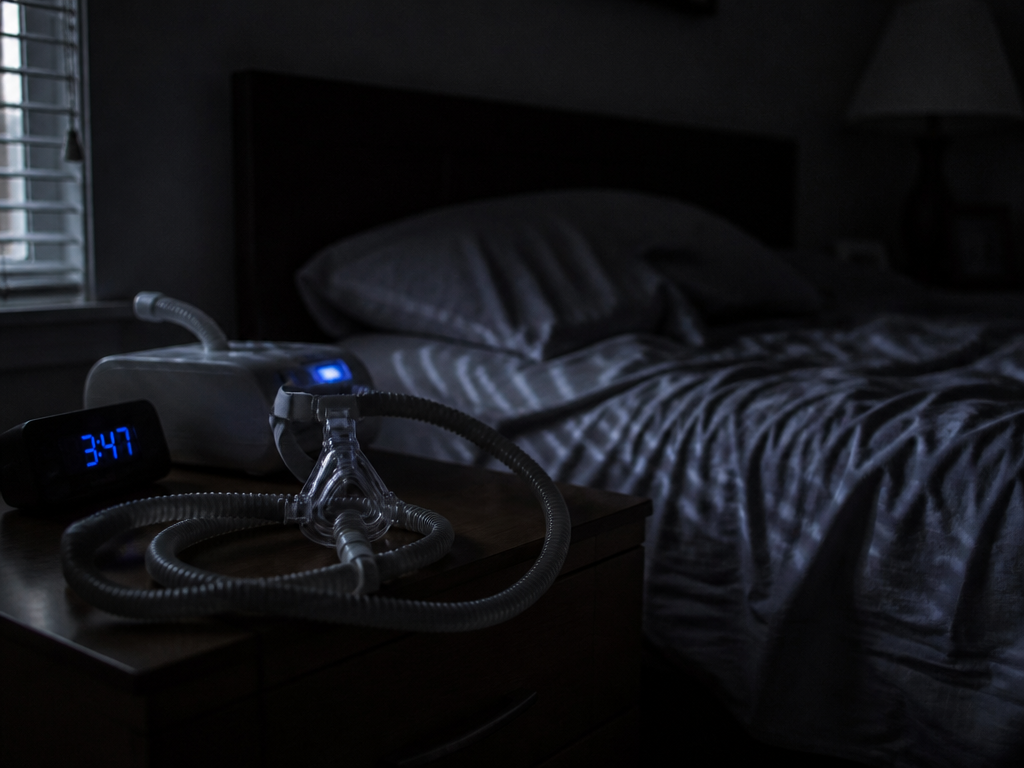
I was diagnosed with moderate obstructive sleep apnea last year — an in-lab study put my untreated AHI at 24 events per hour, which is to say I stopped breathing properly roughly once every two and a half minutes and had no idea. I now sleep on a CPAP machine that exports a nightly report: residual AHI, mask leak rate, total usage hours, and a breakdown of obstructive versus central events. That export is the most trustworthy thing in this experiment. It's a medical device doing flow-based event detection, not a wristband guessing.
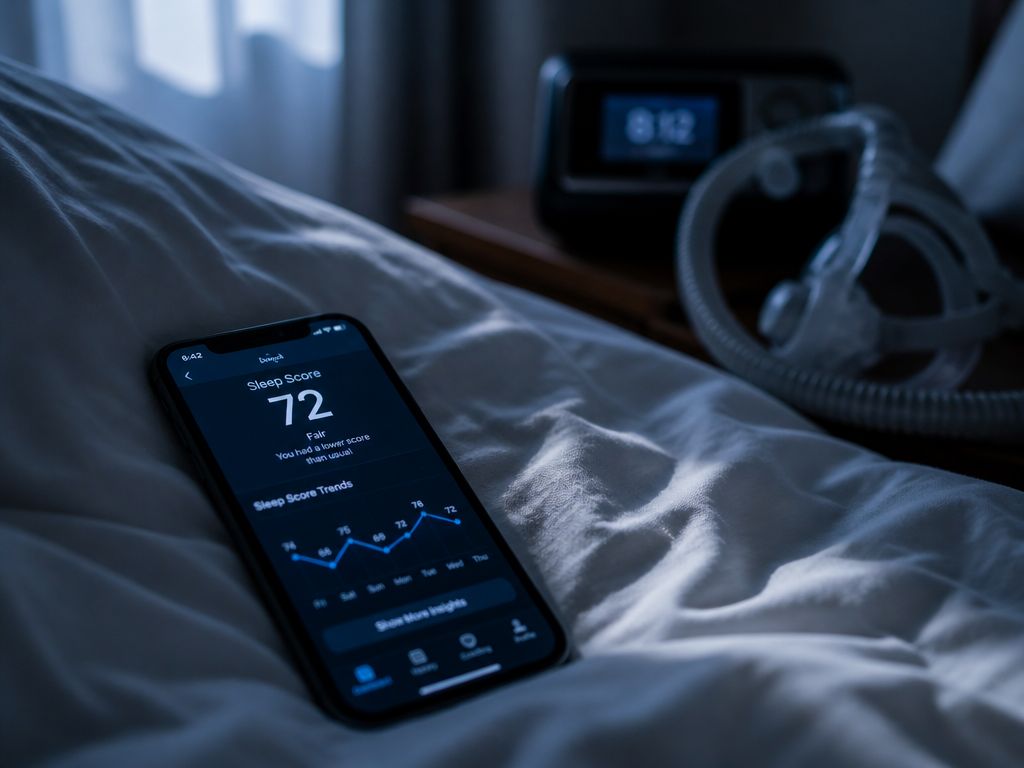
Everything else was scrappier. For stress I used two inputs. The first was a 0–10 self-rating I wrote down within ten minutes of lying down — how keyed-up I felt, gut-level, before I could talk myself into or out of it. The second was overnight heart rate variability from a finger ring, reported as RMSSD in milliseconds, where lower generally tracks with higher physiological stress and poorer recovery. I treated the ring as a supporting witness, not a verdict. Consumer HRV is noisy, sensitive to placement, and I'm not going to pretend otherwise.
So: one good instrument, one decent self-report, one shaky biometric. Sixty consecutive nights. One person, one airway. This is an n of 1 with a sample size you could fit in a shoebox. Read it as a careful anecdote with receipts, not a study.
The protocol, such as it was
Every night the same five columns went into a spreadsheet:
- Bedtime stress (0–10) — written before lights out
- Residual AHI — from the machine, the next morning
- Sleep onset latency — how long until I fell asleep, estimated, generously rounded
- RMSSD — the ring's overnight average
- Notes — alcohol, late meals, sleeping position, anything unusual
I didn't change my behavior to chase clean data. That would have made the numbers prettier and the conclusion useless. I drank when I'd normally drink, traveled twice, worked through two genuinely brutal weeks, and had one fight that I rated a 9 and stand by.
Then I sorted the sixty nights into the top quartile and bottom quartile by bedtime stress score — my fifteen most stressful nights against my fifteen calmest — and looked at what the other columns did.
What the data said
Here is the comparison that surprised me. These are averages across the two quartiles.
| Metric | 15 calmest nights | 15 most stressful nights |
|---|---|---|
| Bedtime stress (0–10) | 1.9 | 7.6 |
| Residual AHI (events/hr) | 7.1 | 5.4 |
| Sleep onset latency (min) | 14 | 41 |
| Overnight RMSSD (ms) | 48 | 31 |
| Times I woke and noticed | 1.2 | 3.4 |
Read the apnea row first, because it's the one everyone expects to tell a story. It doesn't tell the story you'd assume. My residual AHI was, if anything, slightly lower on high-stress nights. I don't think the difference is real in either direction — both numbers sit comfortably inside well-controlled territory and the night-to-night scatter was larger than the gap between the columns. The honest reading isn't "stress lowered my apnea." It's "stress did essentially nothing to the count of obstructive events."

Now read the other three rows, because that's where the experiment actually found something. On stressful nights I took nearly three times as long to fall asleep — 41 minutes versus 14. My HRV cratered, exactly as you'd predict from a stressed nervous system. And I woke and consciously noticed it almost three times as often. I felt wrecked on those mornings. The machine, meanwhile, reported a perfectly ordinary night of breathing.
That gap — between how destroyed I felt and how unremarkable my apnea data looked — is the whole point.
Why the intuition is wrong
The reason this surprised me, and probably surprises you, is that "stress is keeping me up" and "stress is causing my apnea" feel like the same sentence. They are not, and the difference is anatomical.
Obstructive sleep apnea is, at its core, a plumbing problem. When you fall asleep, the muscles holding your upper airway open relax. In some of us — because of throat anatomy, tongue position, neck circumference, jaw structure, fat distribution around the airway, age — that relaxation lets the airway narrow or collapse. Air can't get through. Oxygen drops, the brain panics you partway awake to reopen the airway, and the cycle repeats. The machine in my bedroom exists to splint that airway open with a column of pressurized air. It is treating a mechanical failure with a mechanical fix.
Stress doesn't change the shape of your throat. A stressful day does not narrow your airway or alter how your soft palate collapses. So when I went to bed at a 9, the physical preconditions for an obstructive event were exactly what they'd been at a 2. The pressure from the machine did the same job either way. That's why the AHI column barely moved.
What stress does touch is upstream of all that: the work of getting to sleep and staying there. A wired nervous system fights sleep onset, which is why my latency tripled. It fragments sleep, which is why I woke more. It tanks HRV, which is the body announcing it never got to downshift. None of that is apnea. It's the rest of sleep — the architecture, the depth, the continuity — and stress wrecks it freely.
There's a second wrinkle worth naming honestly. Not all sleep apnea is obstructive. A smaller share is central sleep apnea, where the problem isn't a blocked airway but the brain intermittently failing to send the signal to breathe. Central events are a nervous-system story, and a nervous system under chronic load is at least a more plausible place to look for a stress connection. I can't test that here. My events were overwhelmingly scored as obstructive, and I have no central-apnea data worth interpreting. So I'll say clearly what I can't say: this experiment is about obstructive events in one person, and it has nothing useful to tell you about central apnea.
The thing that actually got worse: tolerating the machine
The data table doesn't capture the most practical finding, so I'll add it as prose. On high-stress nights I was far worse at using the treatment. My notes are full of it: ripped the mask off at 3 a.m., couldn't settle with air blowing at me, lay there resenting the hose. My usage hours dipped on stressful nights even though my breathing, when I was actually wearing it, was fine.
This matters more than it sounds. CPAP only works for the hours it's on your face. If stress makes you yank the mask at 3 a.m. and finish the night untreated, then stress has absolutely worsened your apnea — not by changing your airway, but by sabotaging the thing keeping your airway open. The mechanism is behavioral, not physiological, and that distinction isn't academic. It tells you where to aim. You don't fix 3 a.m. mask removal with a different pressure setting. You fix it by being less wound up at midnight.
The confound I couldn't escape
Here's where I have to be careful, because this is exactly the place a tidy experiment lies to you.
Stress doesn't travel alone. On my high-stress nights I was also more likely to have a drink, eat late, and sleep badly positioned because I went to bed restless. Alcohol is a known airway-relaxant and a reliable AHI-raiser; a late heavy meal pushes things around; sleeping on your back tends to worsen obstructive events. Any of those could have nudged my AHI up on stressful nights — which means my "stress did nothing to AHI" finding might partly be stress raising AHI through alcohol while something else lowered it, and the two cancelling out where I can't see them.

I went back through the notes to check. My five lowest-AHI nights included two with alcohol and three without; my five highest-AHI nights, the same mix. I couldn't find a clean stress signal hiding inside the booze. But I also can't rule it out with fifteen-night quartiles and a notes column instead of a controlled diet. If I ran this again I'd cut alcohol entirely for the duration, hold sleeping position with a positional device, and standardize my last meal — and I suspect the AHI line would get even flatter, not steeper.
The point survives the confound, though. Even granting that alcohol and position muddy the apnea column, nothing muddies the latency and HRV columns. Those moved with stress, hard and consistently, and those columns are about sleep quality, not airway collapse.
Who this is for, and who it isn't
This is for you if you've been recently diagnosed with obstructive sleep apnea, you're already on treatment or about to start, and you've been quietly blaming your stress levels for the diagnosis. The blame is mostly misplaced. Your airway anatomy got you here; your stress did not build it. That should be a small relief, because it means managing stress isn't a way to cure your apnea — it's a way to sleep better around an apnea that's being treated by other means.
This is also for you if you're treated but still feel terrible in the mornings and can't understand why, because your machine says your AHI is fine. The mismatch I lived through for sixty nights may be yours too: controlled breathing, wrecked sleep. If that's the case, your problem to solve is probably onset, fragmentation, and mask tolerance — and stress is squarely in that fight.
This is not for you if you have central sleep apnea, or a mixed picture with a meaningful central component. My experiment says nothing about your situation, and the nervous-system mechanism there genuinely might respond to physiological stress in ways obstructive events don't. Ask the clinician who read your study.
It's also not for you if you're using "I'm too stressed" as a reason to delay getting evaluated. Daytime stress is a terrible diagnostic instrument. I felt fine the year my airway was closing 24 times an hour. The felt sense of how you're sleeping is exactly the thing apnea corrupts. Get the study.
If I had to hand you one line
Stress won't reshape your airway, but it will keep you from sleeping and keep you from tolerating the only thing that holds the airway open — so treat the apnea mechanically and treat the stress separately, and stop expecting one to fix the other.
That's the screenshot. Everything else is the receipts.
Back to the number
I opened with this: on my five most stressful nights, my AHI averaged 4.1 — below my own baseline. For a while that number felt like a paradox, almost a refutation of common sense. How could the worst nights of my month also be the calmest, breathing-wise?
It isn't a paradox once you stop asking the airway to carry feelings it can't hold. That 4.1 is the machine reporting on a mechanical system that doesn't know or care what my Tuesday was like. The pressure splinted my airway open whether I was serene or furious, because that's the only job it has. The number is low because the treatment works, full stop.
The stress went somewhere — it just went into the columns I almost didn't bother tracking. Forty-one minutes of staring at the ceiling. An HRV that read like a body that never clocked out. Three-thirty in the morning, mask in my hand, deciding whether to put it back on. That's where stress lives in a sleep-apnea life: not in the count of obstructive events, but in everything wrapped around them.
So I'll revise the opening claim one last time, now that it's been earned. Stress wasn't the villain in my apnea. It was the villain in my sleep. Those turned out to be two different stories, and the most useful night of the sixty was the one where I finally stopped confusing them.