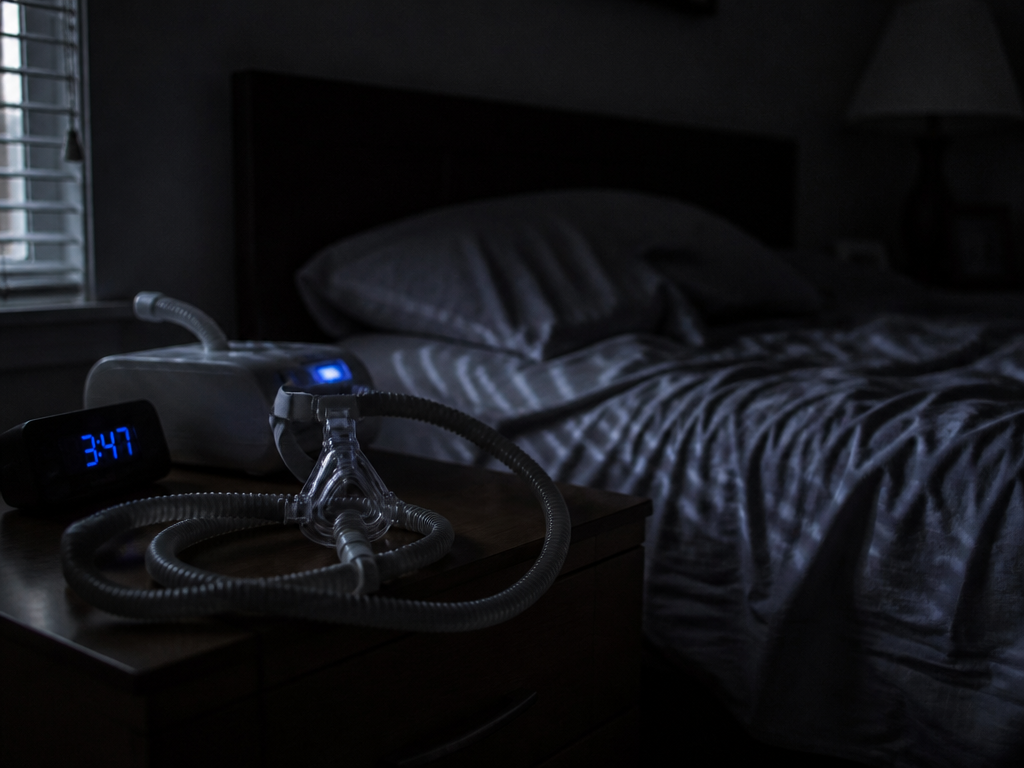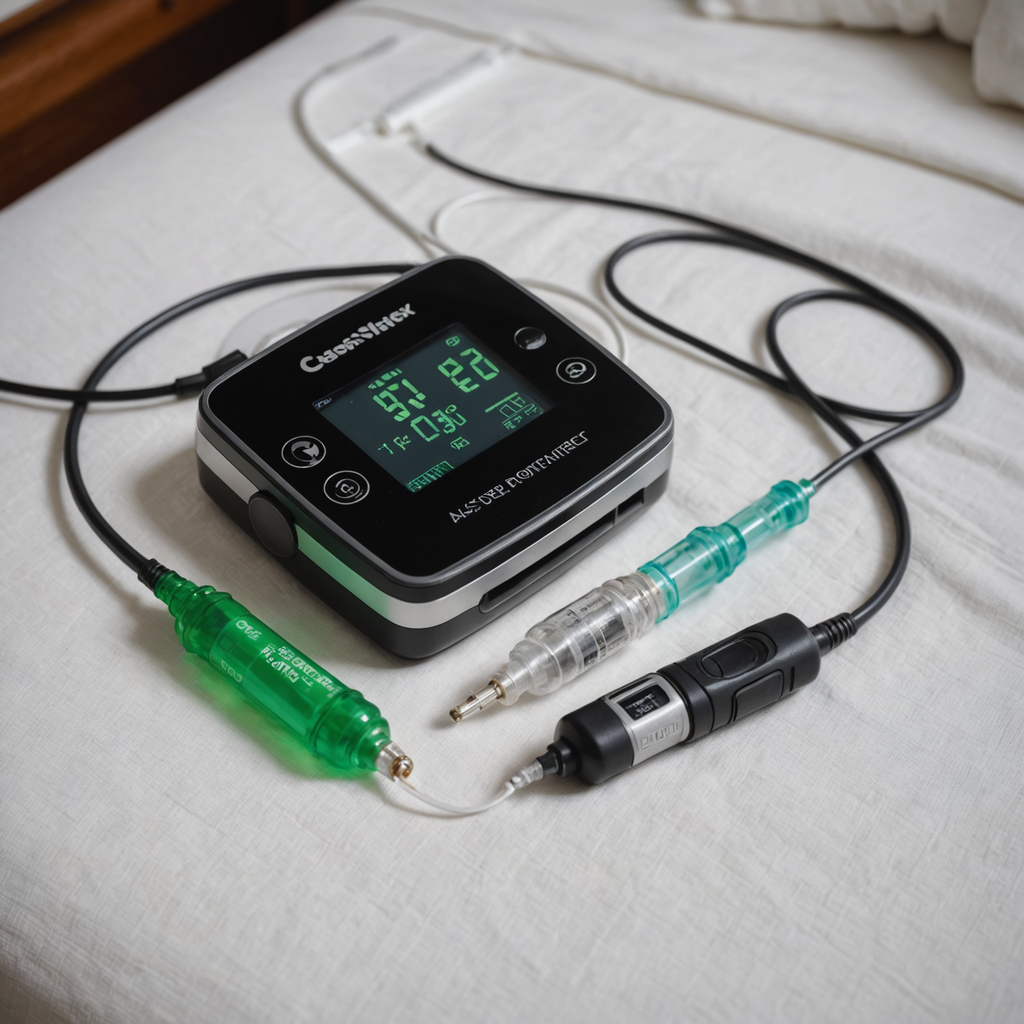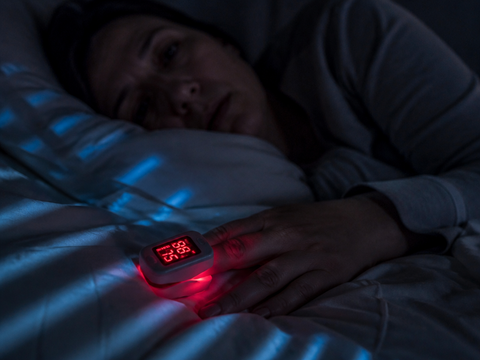
The first night I wore a fingertip pulse oximeter to bed — the thirty-dollar kind, the kind that clips on like a clothespin and glows red through the dark — it told me my blood oxygen had dropped to 84 percent at 3:11 a.m. I lay there the next morning reading the little sawtooth graph on my phone and felt the specific dread of someone who has just bought a problem they didn't ask for.
That number is why I eventually agreed to a real sleep apnea diagnosis. It's also, as it turns out, exactly the kind of number you should not try to interpret alone. A clip on one finger, sampling once a second, jostled loose by a pillow, is not a diagnosis. It's a rumor. But it was a loud enough rumor to get me into a lab, and the gap between what my gadget claimed and what the actual testing measured is the whole story I want to tell here.
What is a sleep apnea diagnosis actually measuring?
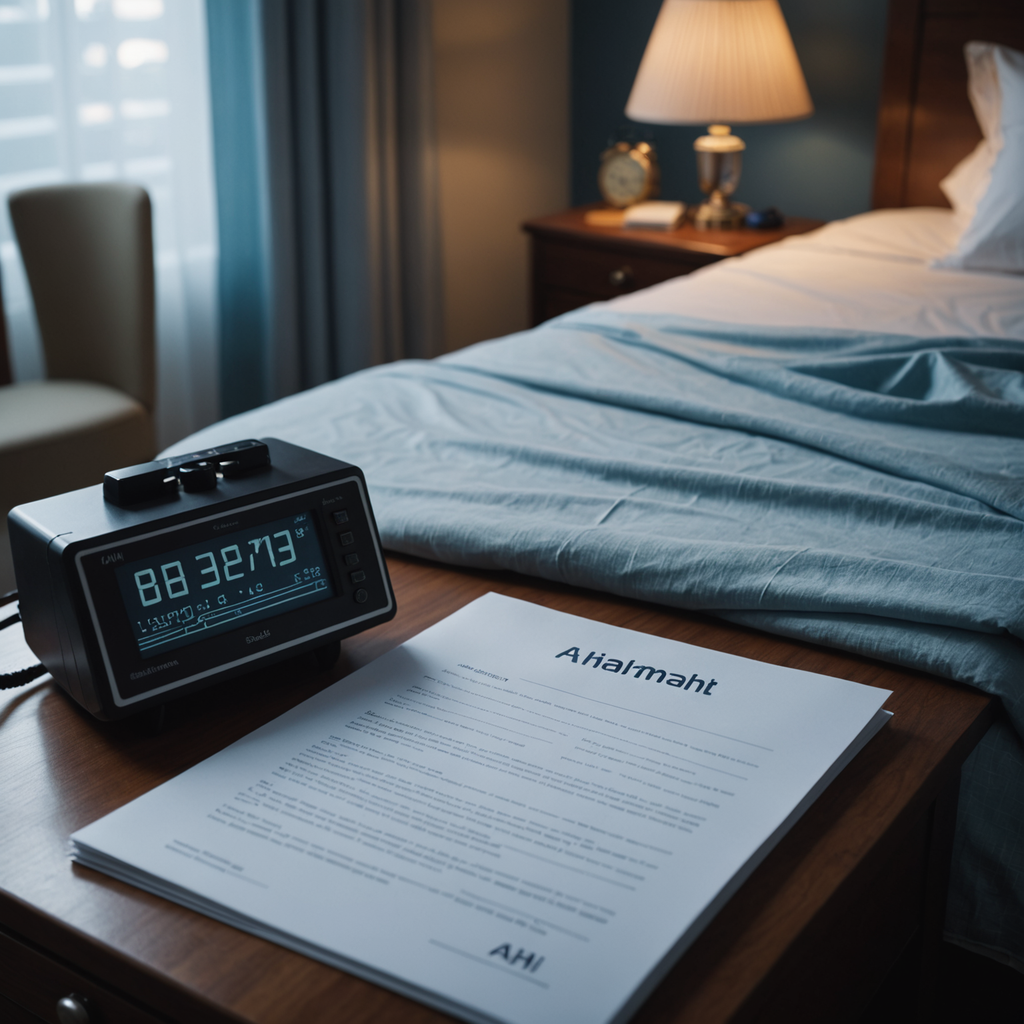
A sleep apnea diagnosis measures how often, and how severely, your breathing stalls during sleep — not just whether your oxygen dips. The headline number is the apnea-hypopnea index, or AHI: the count of breathing events per hour of sleep. An apnea is a near-total airflow stop lasting at least ten seconds. A hypopnea is a partial collapse, usually defined as a meaningful drop in airflow paired with either a 3 percent oxygen desaturation or a brief brain arousal.
The thresholds are blunt but agreed upon. Fewer than 5 events an hour is normal. Five to 15 is mild, 15 to 30 is moderate, and above 30 is severe. My pulse oximeter could see the oxygen consequence — that scary 84 — but it couldn't see the event that caused it, couldn't tell an apnea from me rolling onto the sensor, and couldn't count anything per hour of sleep because it had no idea when I was actually asleep.
That last point matters more than it sounds. The denominator in AHI is sleep time, not time in bed. To get it right, you have to know when the brain is asleep. That requires watching the brain.
What's happening in your body during one event
Walk through a single obstructive event in the order it unfolds, because this is what every sensor in the room is built to catch.
You're asleep. The muscles of the throat — the tongue, the soft palate, the walls of the pharynx — relax, as they're supposed to. In an apnea-prone airway, they relax too far and the tube narrows or closes. Your diaphragm keeps pulling. Your chest and belly heave against a shut door, which is why a polysomnogram straps elastic bands around both: they detect effort with no airflow, the signature of obstruction.
Airflow drops. Over the next ten, twenty, sometimes forty seconds, oxygen in the blood falls and carbon dioxide climbs. Chemoreceptors in your brainstem notice. They trigger a cortical arousal — a brief surfacing toward wakefulness, often too short to remember. The throat muscles snap back to tone, the airway reopens, and you take a few recovery breaths, sometimes with a gasp or snort. Then you sink back down and the cycle resets.
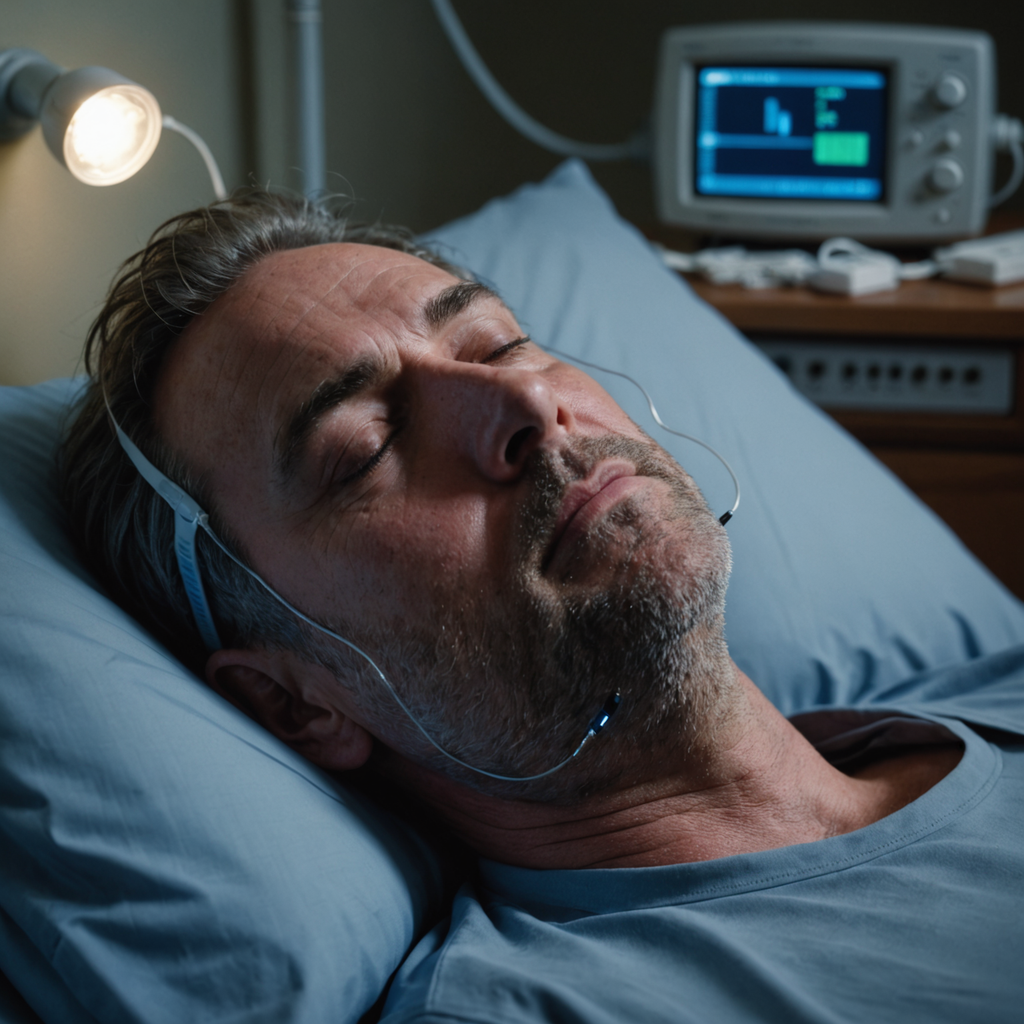
You can run this loop thirty times an hour and have no memory of any of it. What you remember is being tired. The EEG electrodes catch the arousals, the bands catch the effort, the oximeter catches the desaturation, and a nasal sensor catches the airflow itself. The diagnosis is the pattern across all of them, lined up in time.
The two tests, and which one you'll probably get
There are two legitimate paths, and they trade off precision against comfort.
| In-lab polysomnography | Home sleep apnea test | |
|---|---|---|
| Where | Sleep lab, one night | Your own bed |
| Sensors | EEG, EOG, EMG, ECG, airflow, effort bands, oximeter, mic, sometimes video | Airflow, effort, oximeter, position; no brain monitoring |
| Measures sleep stages? | Yes | No — estimates from time in bed |
| Best for | Complex cases, central apnea, other suspected disorders | Otherwise-healthy adults with clear OSA signs |
| Tends to | Slightly overcall severity | Underestimate AHI, since it can't subtract awake time |
If your primary care doctor suspects straightforward obstructive sleep apnea and you're otherwise healthy, you'll likely be sent home with a small kit. The American Academy of Sleep Medicine endorsed home testing for exactly this population in its 2017 guideline (Kapur et al.). It's less precise — without EEG it can't tell sleep from lying awake, so it dilutes the events across the whole night and tends to read low. A normal home test in a person with strong symptoms is often followed by a lab night, not a clean bill of health.
About the part you're actually dreading
The fear is rarely the diagnosis. It's the night. People picture being mummified in wires inside a windowless room and asked, absurdly, to fall asleep.
Here is the honest version. You will have roughly two dozen sensors attached, most with paste or tape, none of them needles and none of them painful. You can roll over; the leads gather at a single box you can unclip to use the bathroom. The room is a bedroom, not a hospital bay. A technician watches from elsewhere and will not be in the room while you sleep.
And yes — you will sleep worse than usual. Sleep scientists named this the first-night effect decades ago (Agnew, Webb, and Williams, 1966): in an unfamiliar monitored setting, people show more fragmented sleep on night one. Labs know this. The scoring thresholds account for imperfect sleep, and a severe airway doesn't politely behave just because you're nervous — the events still show up. If claustrophobia is the real obstacle, say so when you book; home testing exists in large part for you.
An honest rule of thumb
If a consumer wearable hands you a frightening oxygen number, do this: don't diagnose yourself, and don't dismiss it either. Screenshot the trend, note whether you snore or wake gasping or feel unrefreshed after a full night, and bring all of it to a doctor within a week or two. Treat the gadget as a reason to ask, never as the answer.
Back to my 84
I did the lab night. I slept badly, exactly as advertised. My AHI came back at 11 — mild, real, treatable, and nowhere near the catastrophe my fingertip had implied at 3 a.m. The wearable hadn't lied, exactly. It had just told me one true thing loudly and left out the context that made it meaningful.
The myth: a bad night and a scary number from your watch mean you already know what's wrong.
The more accurate version: those are the reasons to get measured properly — the diagnosis is the part that turns a frightening rumor into something you can actually fix.