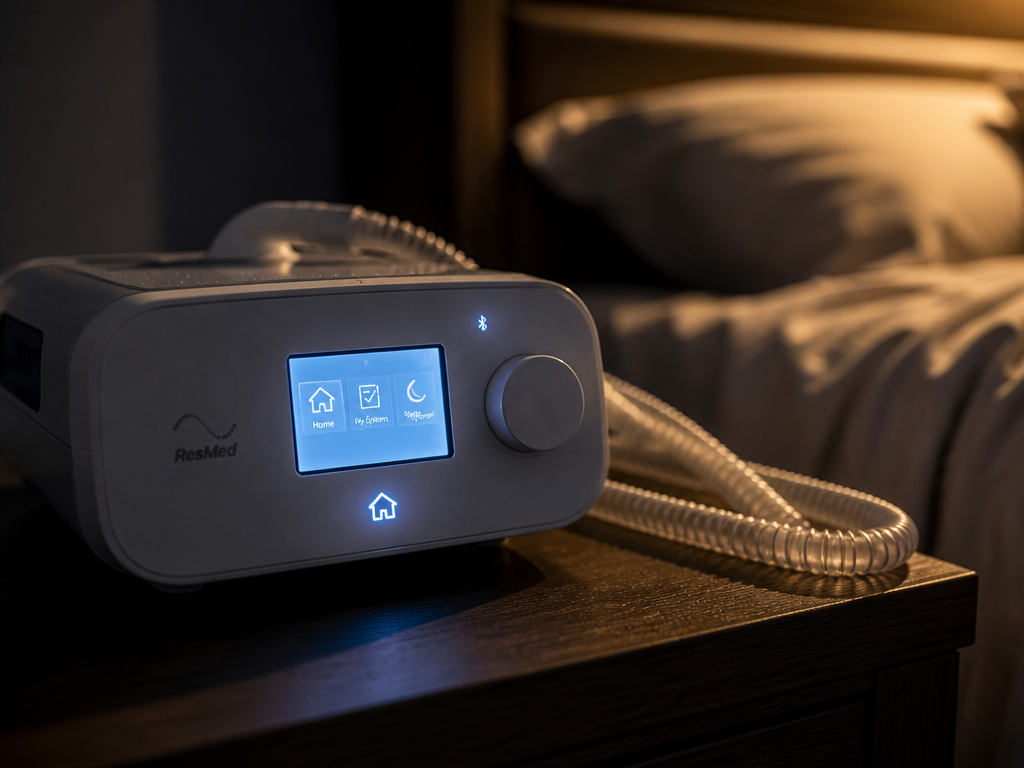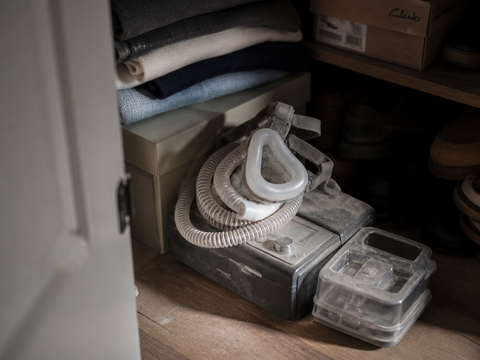
There is a machine in a closet somewhere in your house. Hose coiled, mask still faintly smelling of silicone, humidifier chamber gone dry. You used it for maybe eleven nights. This is one of the most common outcomes in sleep medicine, and it is why most people looking for sleep apnea treatment alternatives arrive at the question through defeat rather than curiosity: you were told the therapy was excellent, you believed it, you tried, and you could not do it.
The scale of that failure is worse documented than you'd hope. Weaver and Grunstein's widely cited 2008 review in Proceedings of the American Thoracic Society placed CPAP non-adherence — using the conventional threshold of four hours a night on 70 percent of nights — somewhere between 29 and 83 percent, depending on which study you pick. The width of that range is itself the finding. The field cannot hand you one honest number. What it can tell you is that abandonment happens early: the first week sets the trajectory and the first month usually decides it.
So here is the question this piece is actually about, the one you have already put to a dentist, a spouse, or a search box at one in the morning:
Is a mouthpiece actual treatment, or am I settling for the thing I can stand?
You are settling. Settling may also be the better clinical decision. Both of those are true at once, and the reason is arithmetic.
What the appliance actually does, in the order it happens
Start with the collapse, because the device only makes sense against it.
When you fall asleep, the tonic drive to your pharyngeal dilator muscles drops. The genioglossus — the large fan-shaped muscle that forms most of your tongue and anchors to the inner surface of your chin — loses a substantial share of its waking activity within seconds of sleep onset. The airway between your soft palate and your epiglottis has no bone or cartilage holding it open. It is a collapsible tube maintained by muscle tone alone.
Then you inhale. Inspiration lowers the pressure inside that tube. In an airway already narrowed — by a low-hanging soft palate, a bulky tongue, a set-back mandible, fat deposited in the lateral pharyngeal walls — the negative pressure wins and the walls meet. Airflow stops. Oxygen falls, carbon dioxide climbs, sympathetic tone spikes, and after ten to sixty seconds the brainstem issues an arousal. Muscle tone snaps back, the airway opens, you take a breath you will not remember, and the cycle restarts. Thirty times an hour. Two hundred times a night.
A mandibular advancement device intervenes precisely at the geometry step. It holds the lower jaw forward — usually 5 to 10 mm, titrated over weeks toward roughly 60 to 75 percent of your maximum voluntary protrusion. Because the genioglossus originates on the mandible, advancing the jaw carries the tongue base forward with it. Because the palatoglossal arches tether tongue to soft palate, the velopharynx above is pulled taut as well. Imaging consistently finds the largest gain is lateral: the airway widens side to side more than front to back, which is not the picture most patients have in their heads. The tube gets wider and stiffer. It now takes more negative pressure to close it.
That is the whole mechanism. It is passive and purely mechanical, and it works or fails according to why your particular airway collapses — which is the source of every "it depends" that follows.
Does a mouthguard really work for sleep apnea?
For most people, partially — and "partially" is doing real work in that sentence. A custom, titratable mandibular advancement device typically cuts the apnea–hypopnea index by roughly half. Something like a third to 40 percent of patients get all the way to an AHI under 5, the threshold usually called normal; a majority reach at least a 50 percent reduction or an AHI under 10. CPAP, worn correctly, normalizes AHI in the overwhelming majority. Per hour of use, CPAP is the more powerful therapy. Nobody serious disputes that.
The dispute is about hours.
Phillips et al. (2013), in the American Journal of Respiratory and Critical Care Medicine, ran the trial that reframed the question: 126 patients with moderate-to-severe OSA, randomized crossover, one month of CPAP and one month of a custom titratable appliance. CPAP cut AHI from about 25.6 to 4.5. The appliance got it to about 11.1 — meaningfully worse. And yet across 24-hour ambulatory blood pressure, Epworth sleepiness scores, quality of life, and neurobehavioral testing, the two treatments came out statistically indistinguishable. Nightly use ran about 6.5 hours for the appliance against 5.2 for CPAP.
One caveat that trial could not escape, and neither should you: CPAP use was machine-recorded while appliance use was self-reported, and self-report flatters. Vanderveken et al. (2013), in Thorax, later embedded temperature microsensors inside appliances for 51 patients and measured about 6.5 hours a night objectively at three months. Close enough to the self-reports that the comparison held up better than it had any right to.
The arithmetic nobody puts on the brochure

The concept is mean disease alleviation: efficacy multiplied by the fraction of your sleep the therapy actually covers. It was proposed because "reduces AHI by 90 percent" means very little if the mask is on the nightstand by two in the morning.
| CPAP | Custom titratable appliance | |
|---|---|---|
| AHI while the therapy is in place | 25 → ~4 | 25 → ~11 |
| Efficacy when worn | ~85% | ~55% |
| Objectively measured nightly use | 3.3–5.2 h | ~6.5 h |
| Share of a 7-hour night covered | 47–74% | ~93% |
| Mean disease alleviation | ~40–63% | ~51% |
The 3.3-hour figure is not a straw man. It is the mean nightly use in the SAVE trial (McEvoy et al., 2016, New England Journal of Medicine), 2,717 patients, the largest cardiovascular endpoint trial CPAP has — and it did not show a reduction in cardiovascular events. Whether that is because CPAP doesn't prevent them, or because 3.3 hours isn't a dose, remains genuinely unsettled. Anyone who tells you which is overreading the data.
Where "it depends" actually lives
Response is not random, but our ability to predict it is mediocre. The signals that show up consistently: supine-dependent apnea, in which events cluster when you're on your back; lower BMI; smaller neck circumference; milder baseline AHI; younger age; female sex; and a retrognathic jaw. Patients with complete concentric collapse at the soft palate do worse. Patients whose apnea is driven less by anatomy than by a low arousal threshold or unstable ventilatory control may not respond at all.
None of that yields a reliable yes or no in the chair. The best-validated prediction tool is a remotely controlled mandibular positioner used during an overnight study, which advances the jaw in steps and watches the airway respond — Remmers and colleagues published the foundational work in Sleep in 2013. It performs well. It is also unavailable in most cities and rarely covered. So in practice most patients find out by trying: fit, titrate over six to ten weeks, then repeat the sleep study with the appliance in the mouth. That last step is the one that gets skipped, and skipping it converts treatment into a hopeful guess.
What it costs your mouth
Short term: morning jaw soreness, excess salivation or dry mouth, and a bite that feels wrong for the first half hour after waking. Most of that fades within weeks, and a morning repositioner helps.
Long term is the part that gets soft-pedaled. Pliska et al. (2014), in the Journal of Clinical Sleep Medicine, followed 77 appliance patients for a mean of about eleven years and found progressive reductions in overbite and overjet — the front teeth drift — with no plateau over time. Most of those changes were not clinically troublesome. Some were. This is a genuine tradeoff rather than a disclaimer, and the fair way to hold it is against the alternative: untreated moderate apnea is a worse bargain than a millimeter of overjet.
The other doors
Two more sleep apnea treatment alternatives deserve naming, because appliances are not the end of the list.
Hypoglossal nerve stimulation implants a device that fires the nerve driving tongue protrusion in time with inspiration. Strollo et al. (2014), NEJM, followed 126 patients: median AHI fell from 29.3 to 9.0 at twelve months. Eligibility is narrow — a BMI ceiling, moderate-to-severe AHI, and no complete concentric palatal collapse on drug-induced sleep endoscopy — and it is surgery.
Weight-directed treatment has changed. Malhotra et al. (2024), NEJM, tested tirzepatide in 469 adults with obesity and moderate-to-severe OSA and saw AHI fall by roughly 20 to 30 events per hour; the FDA approved it for that indication in December 2024. It is slow, and it treats a subset.
Positional therapy is the cheapest item on the list and the most under-tried. If your study shows supine AHI three or more times your non-supine AHI, staying off your back does real work — usually alongside an appliance rather than instead of one.
The honest rule of thumb
If you have stopped using CPAP, stop treating that as a decision and start treating it as a referral. Ask for a dentist with board certification from the American Academy of Dental Sleep Medicine or equivalent training. Insist on a custom titratable device rather than anything purchasable without a prescription.1 Expect six to ten weeks of gradual advancement, not a single fitting. And require a repeat sleep study with the appliance in your mouth before anyone calls you treated. The 2015 AASM and AADSM practice guideline (Ramar et al., Journal of Clinical Sleep Medicine) already recommends this pathway for adults who cannot tolerate CPAP, at any severity — you are not asking for a favor.
Tonight, sleep on your side on purpose and pay attention to how the morning feels, because the airway that behaves better off its back is the airway a mouthpiece is most likely to fix.
-
Over-the-counter boil-and-bite trays are the most common way people conclude that oral appliance therapy doesn't work for them. They are not titratable, they seat poorly, and the 2015 guideline explicitly recommends custom devices over them — a distinction that matters more than the price gap suggests. ↩