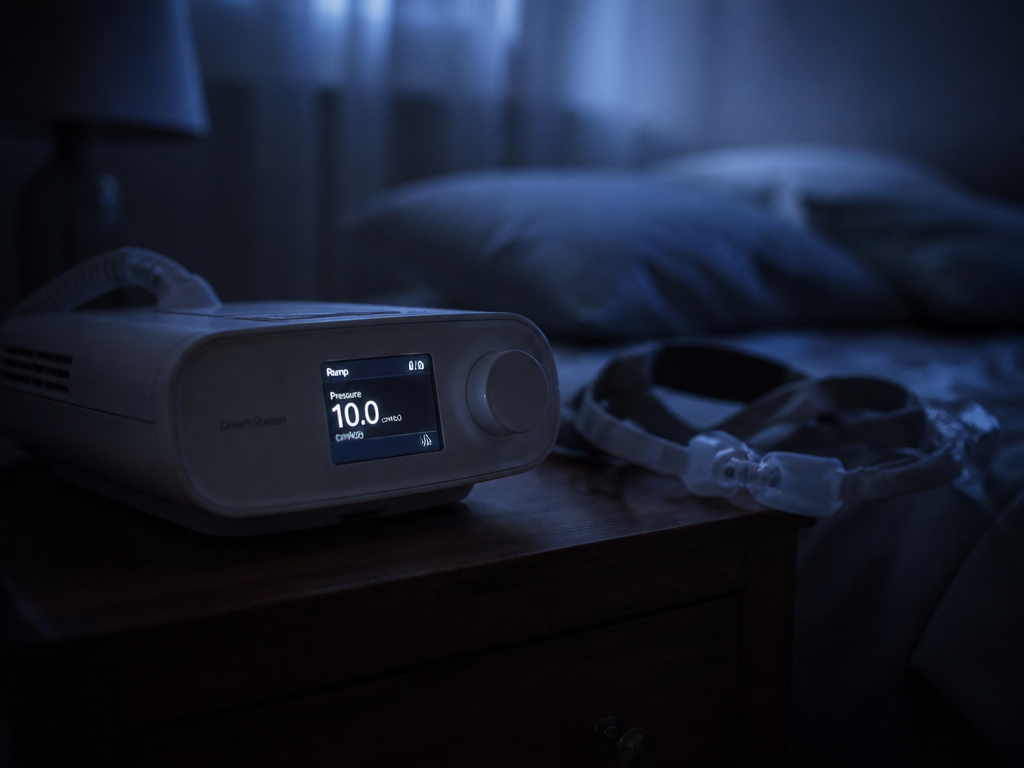
A medical device maker posts the best quarter in its history — revenue up roughly ten percent, gross margin near sixty percent, free cash flow ample, buyback running, dividend raised — and the stock opens down five percent. The reflex is to hunt for a scandal. There usually isn't one. Reading ResMed earnings over the past two years has mostly been an exercise in watching a compounding business get marked down for reasons the income statement doesn't contain. The interesting question isn't whether the CPAP market is growing. It plainly is. The question is which of three competing explanations for the selloff actually survives contact with the disclosures.
ResMed closed fiscal 2025 with revenue just over $5 billion, the first time it has cleared that line. Masks and accessories — the recurring, higher-margin side of the model — kept pace with devices. The installed base of cloud-connected machines runs into the tens of millions, and Philips Respironics has been operating under a January 2024 FDA consent decree that kept it from selling new sleep devices in the US. None of that is in dispute. What's in dispute is the terminal value.
Three explanations, three tests
The candidates are familiar to anyone who has sat through a ResMed earnings call: GLP-1 drugs are shrinking the future patient pool; gross margin is being squeezed by costs the company doesn't fully control; and the multiple, not the business, is what's deflating.
Judge them against three things. Timing — does the explanation account for why the stock moved on the day of the print rather than gradually? Traceability — does it show up in a line item the company actually discloses, or only in commentary? Durability — would it still be the right explanation four quarters later?
The substitution thesis
The strongest version of the GLP-1 argument isn't that these drugs make CPAP obsolete tomorrow. It's that a drug which reliably strips 15 to 20 percent of body weight pushes a large cohort of mild and moderate patients below the threshold where anyone bothers prescribing a machine, and that the diagnosed population therefore grows more slowly than the epidemiology implies.
The clinical anchor is real. Malhotra et al. (2024), New England Journal of Medicine, reported the SURMOUNT-OSA trials: 469 adults with obesity and moderate-to-severe obstructive sleep apnea, randomized to tirzepatide or placebo for 52 weeks, split into a PAP-using arm and a non-PAP arm. Mean apnea-hypopnea index fell by roughly 25 to 29 events per hour on the drug, against about five on placebo. The FDA approved tirzepatide for OSA in adults with obesity in December 2024 on that basis.
Read the endpoint carefully, though. Baseline AHI in those trials sat near 50 events per hour. A 27-event reduction lands a patient around 20 — still moderate apnea by the standard cutoffs, still symptomatic for plenty of people. A minority reached anything resembling remission. The trials measured a large improvement in a severe population, not the elimination of a disease.
ResMed's counter is that GLP-1 users show up as better PAP patients, not fewer of them. The company has repeatedly cited its own retrospective analysis of de-identified US prescription and claims data — a cohort it has described in the hundreds of thousands — showing higher therapy initiation and higher resupply persistence among patients also filling GLP-1 prescriptions. Take the direction seriously and the magnitude with salt. It is company-run, retrospective, and not peer-reviewed, and the population that fills two prescriptions is self-selected for being the kind of person who fills prescriptions.
The margin thesis
The quieter explanation is that the market wasn't repricing sleep apnea at all. It was repricing sixty basis points.
Gross margin is the one number in a ResMed quarter that is both disclosed to the decimal and genuinely uncertain quarter to quarter. It absorbs freight, component costs, tariffs, currency, and — above all — mix. Devices carry lower margin than masks. A quarter where device growth outruns mask growth prints a slightly worse margin while telling you new patient starts were strong, which is the opposite of bad news. A quarter with the reverse mix prints better and means less.
That asymmetry is why the margin thesis usually wins on timing. Sell-side models carry gross margin to a tenth of a point. Nobody's model carries "percentage of the 2032 addressable market captured by incretin drugs." When the print lands a hair short, the algorithms don't need a thesis. They need a delta.
The multiple thesis
Then there's the arithmetic that has nothing to do with airways. A company priced as a durable compounder carries a premium earnings multiple, and premium multiples are unstable in one specific way: they price certainty, not growth. A small margin miss doesn't dent earnings. It dents the belief that earnings are predictable. Compress the multiple a few turns and a quarter that grew revenue ten percent produces a double-digit drawdown.
This thesis has a tell. If the stock falls while forward EPS estimates hold steady or drift up, the market didn't cut the business — it cut what it will pay for the business. That's checkable within a week of any print.
Will GLP-1 drugs replace CPAP machines?
For most diagnosed patients, no — not on the evidence available now. Tirzepatide and drugs like it substantially reduce apnea severity in people whose apnea is driven by obesity, but the average trial patient finished treatment still meeting criteria for moderate sleep apnea. The likelier near-term outcome is a treatment ladder: drugs for weight-driven disease, positive airway pressure for the residual, surgery or hypoglossal nerve stimulation for the anatomically obstructed. Whether the drugs eventually shrink device volumes is a genuinely open question. Anyone who states the answer confidently is guessing with a spreadsheet.
What happens in the airway, in order
The reason substitution is partial rather than total is anatomical, and it's worth walking through in sequence.
You fall asleep. Within minutes, tone in the pharyngeal dilator muscles — the genioglossus chief among them — drops, because postural muscle tone drops broadly at sleep onset. You inhale, which creates negative pressure inside a soft-walled tube. If that tube is already crowded, the negative pressure pulls the soft palate and the base of the tongue back against the pharyngeal wall. Airflow stops. Over the next ten to thirty seconds, oxygen saturation falls and carbon dioxide rises. Chemoreceptors register it, the sympathetic nervous system fires, blood pressure spikes, and the cortex produces a brief arousal — usually too short to remember. Muscle tone returns, the airway snaps open, you gasp, and it starts again. Thirty times an hour. Several hundred times a night.
Weight loss intervenes at the crowding step. Fat in the tongue and in the parapharyngeal pads narrows the tube; Wang et al. (2020), American Journal of Respiratory and Critical Care Medicine, used MRI in 67 participants after weight loss and found that reduction in tongue fat was the strongest mediator of AHI improvement. Lose the fat, widen the tube.
CPAP intervenes somewhere else entirely. It doesn't change the anatomy; it changes the pressure gradient, splinting the airway open pneumatically so the collapse never happens in the first place. That is why the two are not clean substitutes. A patient with a recessed mandible and a crowded airway at a BMI of 26 has very little load to shed, and the drug has very little to work with.
Scoring the three
| Thesis | Explains the day's move | Visible in disclosures | Still right in four quarters |
|---|---|---|---|
| GLP-1 substitution | Weak — a decade-long thesis rarely moves on a Thursday | No — commentary only | Unresolved |
| Margin compression | Strong — modeled to a tenth of a point | Yes — reported quarterly | Partly; mix normalizes |
| Multiple compression | Strong | Indirectly, via estimate revisions | Yes, while certainty stays priced |
Two of the three turn out to describe the same event from opposite sides: a small, disclosed, mix-driven margin variance hitting a valuation built on predictability. The substitution story takes the headlines and explains almost none of the trading.
An honest rule of thumb
When the next set of ResMed earnings lands, before you read a word of commentary, do this: pull device revenue growth and mask revenue growth separately, then read gross margin next to them. If margin missed and devices outgrew masks, you are looking at new patients entering the funnel at lower unit margin — a good quarter wearing a bad number.1 If margin missed and masks outgrew devices, that's a genuine cost problem, and the tariff commentary deserves your attention.
Separately, over years rather than quarters, watch diagnosis rates. Benjafield et al. (2019), Lancet Respiratory Medicine, estimated the global mild-to-severe OSA population at roughly 936 million adults aged 30 to 69, with about 425 million moderate-to-severe. Against that, the treated population is small. Undiagnosed prevalence is the largest number on either side of this argument, and it moves slower than any drug launch.
The myth: GLP-1 drugs are dismantling the CPAP market, and no amount of record revenue can hide it.
The more accurate version: the market is still overwhelmingly undiagnosed, the drugs so far reduce apnea severity rather than eliminate it, and what actually moved the stock was sixty basis points of gross margin colliding with a valuation that had priced perfection.
-
Mix is also why comparing a quarter's margin to guidance is more informative than comparing it to the year-ago quarter. Guidance was set with a mix assumption baked in. The year-ago comparison wasn't. ↩