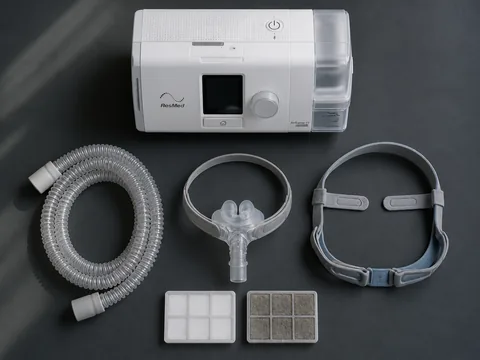
The CPAP machine is the most durable thing in the whole setup. It is also the part everyone worries about, budgets for, and researches before buying. That is backwards. In a year of tracking my own equipment, the motor never faltered. What failed — quietly, on a schedule I hadn't respected — were the twelve-dollar parts I treated as disposable and then forgot to dispose of.
The verdict: good CPAP maintenance is almost entirely about the consumables, not the machine, and the single most consequential part is the mask cushion. Get the cushion cadence right and most of the other problems people blame on their therapy simply don't happen.
What I tracked, and how
I run a nasal pillow mask on a fixed-pressure machine, 10.4 cm H₂O, roughly 7 hours a night. Starting last January I logged three things: a monthly note on how each component looked and felt, my machine's own leak data (the report it emails is more honest than I am), and every dollar I spent or my insurer spent on replacements.
One caveat up front: this is one person, one mask style, one climate. A full-face mask user in a dry high-altitude house will see silicone stiffen faster than I did. Treat my intervals as a starting reference, not a decree.
The cushion goes first, and it lies about it
Silicone doesn't crack or tear on any timeline you'd notice. It slackens. By month two my nasal pillows had lost enough spring that they no longer sealed without me overtightening the headgear — which is exactly the move that leaves a red bridge on your face and doesn't fix the leak anyway.
The tell was in the data. My machine's reported leak rate sat around 4 L/min when the cushion was new. By week six it drifted to 11. By week ten it spiked past 24 on nights I slept on my side. A fresh cushion dropped it back under 5 the first night. That's the whole argument for monthly cushion replacement in one number: the part looks fine and performs badly, and only the leak report catches the gap.
Filters, tubing, and the parts that fail visibly
Filters were the honest ones — they show you. The disposable intake filter went from white to grey-brown by the end of each month; a house with a cat, which mine has, is not gentle on them. The tubing lasted longer than I expected. No cracks at three months, a slight cloudiness inside by five that cleaning didn't fully clear, which is when I swapped it.
Headgear was the surprise. The straps hold up mechanically for a long time, but the elastic loses its recoil around the four-month mark, and slack headgear quietly recreates the leak problem you thought you'd solved with a new cushion. I now replace it twice a year whether it looks tired or not.
The schedule I landed on
| Component | Replace every | What I actually measured | Rough cost each |
|---|---|---|---|
| Mask cushion / pillows | 1 month | Leak crept from 4 to 24+ L/min by week 10 | $18–30 |
| Disposable filter | 1 month | Visibly grey by 30 days (cat household) | $2–4 |
| Tubing | 3 months | Interior cloudiness by month 5 | $15–25 |
| Full mask frame | 3–6 months | Frame fine; clip tension fading by month 6 | $40–70 |
| Headgear | 6 months | Elastic recoil gone by month 4–5 | $20–35 |
| Water chamber | 6 months | Mineral scaling despite distilled water | $15–30 |
The pattern worth internalizing: the parts that touch your face and move air degrade on the monthly-to-quarterly end; the structural parts stretch to twice a year. The machine itself isn't on this table because in twelve months it didn't need to be.
What insurance actually covered
Here's the part that changes the math. Medicare and most private plans reimburse replacement supplies on a published cadence that maps almost exactly onto the wear intervals above — cushions monthly, filters twice monthly for some, tubing quarterly, headgear and full masks less often. I didn't have to argue for any of it. My supplier's system knew my eligibility dates and prompted me.
What I learned the hard way: the coverage is use-it-or-lose-it. Skip a month's cushion and you don't bank it — the clock just resets. For most of the year I was leaving free, prescribed parts on the table simply because nothing prompted me and the old cushion still looked fine. Set a reminder tied to your eligibility dates, not to how the part looks.
Who needs this discipline — and who can relax
You should track intervals closely if: you fight morning leaks, wake with a dry mouth, use a full-face mask, or run high pressure. Leak-driven problems are almost always a consumables problem in disguise, and the cushion is the first suspect.
You can be more relaxed if: you're a stable back-sleeper on low pressure with clean leak reports. You'll still hit the cushion cadence, but the frame and tubing can ride to the far end of their windows without penalty.
Nobody should be replacing the machine on a schedule. If therapy feels worse over time, the machine is the last thing to suspect, not the first.
If you fix only one habit: swap the cushion monthly and read your leak number the next morning. That single loop catches most of what goes wrong.
What this looks like at my house
I keep three cushions in the nightstand drawer now, not one. The first of the month, the old one comes out before I've fully woken up, and I check the leak figure with coffee. Last month it read 3.8 the morning after the swap and I felt, honestly, a little smug about a number no one else will ever see. That's what the whole argument reduces to: a cheap part, a fixed date, and a report that tells the truth when the silicone won't.