You have been handed a prescription for a sleep study, and somewhere between the parking lot and the front door a worry has installed itself: What if I can't fall asleep with all that stuff on me? If you already sleep badly, or you get keyed up in medical settings, that worry compounds. You start to believe the whole point of sleep testing is to sleep well — and that you, specifically, are going to fail it.
That belief is the myth. It is also the single most common reason people dread the night, and it is wrong in a way worth understanding before you go.
The myth: "If I don't sleep well, the test won't work"
Here is the version most people carry in: the technician needs a full, restful night, so if I toss and turn, or only manage three hours, or lie there wired to the ceiling until 4 a.m., they'll get nothing and I'll have to do it again.
It's a reasonable fear. It's built on a false premise — that the test is grading your sleep the way you grade it. It isn't. The test is measuring what your body does while you sleep, however little and however roughly. A bad night for you is often a perfectly adequate night of data for them.
What happens if you can't sleep during a sleep test?
The short answer: usually, enough. Diagnostic sleep studies don't require you to sleep soundly or for a full eight hours. For in-lab polysomnography, most labs want somewhere in the range of two to four hours of recorded sleep to score the study reliably, and many diagnoses — obstructive sleep apnea in particular — reveal themselves in far less. The American Academy of Sleep Medicine's scoring guidelines are built around events per hour of sleep (the apnea-hypopnea index, or AHI), not around a total-sleep quota. Fragmented, anxious, light sleep still contains breathing pauses, oxygen dips, and leg movements. Those are the things the sensors are hunting.
If you genuinely can't sleep at all — which is rare — the lab has fallbacks. A tech may offer a low dose of a sleep aid partway through the night (this is planned for and doesn't invalidate most apnea findings), or the study gets flagged as inconclusive and repeated. That's the worst case. It is not a moral failure and it is not common.
The number that gets quoted a lot: studies of the first-night effect — the well-documented tendency to sleep worse in an unfamiliar recording setup — go back to Agnew, Webb, and Williams (1966) and have been replicated many times. Your first lab night is expected to be worse than home. The people scoring it know this. They are not surprised by your bad night; they planned for it.
What your body is actually doing — in order
Walk through the night as it happens, because the mechanism explains why "barely slept" still yields answers.
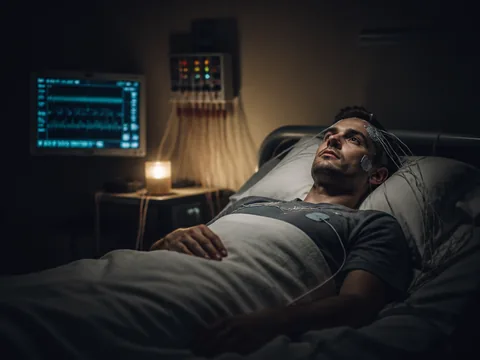
You lie down. Your nervous system, sensing an unfamiliar room and a stranger who just glued electrodes to your scalp, keeps sympathetic tone up — heart rate a little fast, muscles not fully released. This is the arousal that makes falling asleep hard. Meanwhile, adenosine, the byproduct that's been accumulating in your brain all day and creating sleep pressure, is still pushing the other direction. Sleep is a tug-of-war between that pressure and your alertness. Anxiety loads the alertness side, but adenosine doesn't quit. Eventually, most people lose the tug-of-war at least a few times a night, even if it doesn't feel like "real" sleep.

The moment you drift into stage N1 and N2, the recording starts earning its keep. If your airway is prone to collapse, it collapses in light sleep too — arguably more visibly, because you cycle in and out of it repeatedly. Each collapse shows up as a drop in airflow at the nasal sensor, a dip in blood oxygen at the pulse oximeter on your finger, and often a micro-arousal on the EEG as your brain yanks you toward wakefulness to reopen the airway. That pattern — pause, desaturation, arousal, repeat — is the signature of obstructive sleep apnea, and it doesn't need deep sleep to appear. It frequently gets worse in REM, when your muscles go slack, but the diagnosis rarely hinges on catching a pristine REM cycle.
So the fragmented, resentful, half-awake night you're dreading is, mechanically, a night full of the exact events the study exists to count.
The practical part
You are not there to perform sleep. You're there to be observed doing whatever your body does. Lower the stakes and you'll sleep more, which is the one lever you actually control.
A few grounded expectations:
- Bring your own pillow if you use one, and wear what you normally sleep in. Familiar smell and texture blunt the first-night effect more than people expect.
- Skip the "I'll tire myself out" plan. Don't skip sleep the night before, over-caffeinate to stay up, or exercise hard at night. A normal, slightly under-rested state is fine; an artificially exhausted, cortisol-flooded one is not.
- You can move. The wires are long and taped to allow rolling over, getting up to use the bathroom (the tech unhooks a central connector), and shifting positions. You are not pinned.
- Ask the tech your questions before lights-out. Knowing where the camera is, how you call for help, and what the microphone does removes the low hum of not-knowing that keeps anxious sleepers scanning the room.
How the two formats compare:
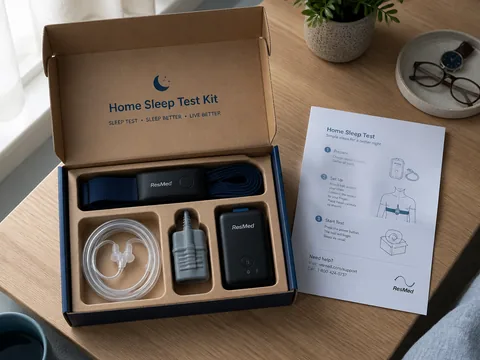
| In-lab polysomnography | Home sleep apnea test | |
|---|---|---|
| What it records | EEG, eye/muscle activity, airflow, oxygen, heart, leg movement | Mostly airflow, oxygen, effort, heart rate |
| Detects sleep stages? | Yes | No — estimates time in bed |
| Best for | Complex or uncertain cases | Suspected moderate–severe OSA |
| Anxiety footprint | Higher (strange room, tech present) | Lower (your own bed) |
| Risk if you sleep poorly | Repeat if too little data | Can underestimate severity |
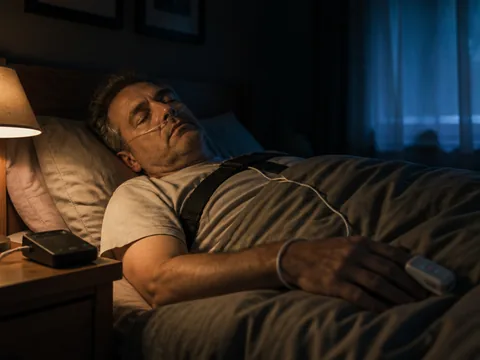
That last cell matters. Home tests generally can't tell sleep from wakefulness, so they divide breathing events across your total time in bed, not your actual sleep time. If you lay awake half the night, a home test can dilute your real numbers and read milder than the truth. That's the honest weakness — and it cuts opposite to the myth. With a home test, sleeping more helps accuracy.
The honest takeaway
Two things are true at once. A bad night usually still produces a usable study — the mechanism guarantees the events show up whether or not you feel rested. And the first-night effect is real, so your data may not capture your average night perfectly. The lab has ways around this; the home test's blind spot is worth knowing so you don't downplay a borderline result.
What isn't settled is how often mild cases get missed on a single rough night, especially at home. The data there is thinner than the confidence with which "one test and you're done" is usually stated. If your symptoms are loud and your test comes back quiet, say so — a second study or an in-lab confirmation is a normal next step, not a defeat.
An honest rule of thumb for tonight: treat the study like a night you're allowed to sleep badly. Bring your pillow, ask your questions, and give up on performing. The less you try to sleep well, the more you will.
You don't have to ace the test. You just have to show up and let your body be itself.