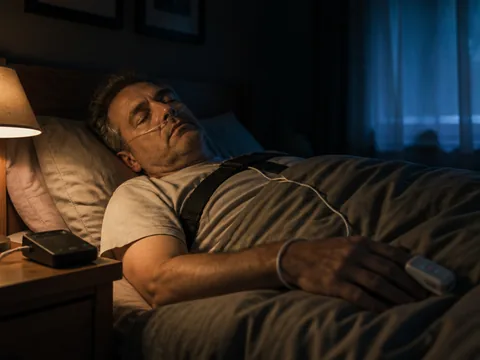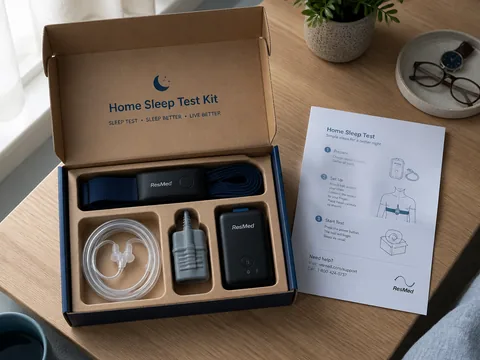
The kit came in a box the size of a hardback novel. Inside were a chest belt, a nasal cannula, a finger probe, and a recorder about as heavy as a deck of cards. The instructions fit on one folded sheet. I wore it on a Tuesday night in March after my usual three coffees, and in the morning I mailed it back in the same box. Nine days later a sleep physician went through the report with me on a video call. That one night became my sleep apnea diagnosis. More precisely, it became the first half of one.
The short version: if your symptoms point toward obstructive sleep apnea and you don't have a serious heart, lung or neuromuscular illness, a home test read by a physician is a sound place to start. A normal result from one does not clear you. The number you get also depends on which scoring rule the reader applies, and nobody warns you about that ahead of time.
This is what that night measured, what it couldn't measure, and what happened afterward. That includes nine nights in hotels with a travel machine, because a diagnosis that works only in your own bedroom is half a diagnosis.
Why I finally did it
Three things piled up. My partner started timing the silences between my snores, and some of them passed ten seconds. My score on the Epworth Sleepiness Scale, an eight-question form about how likely you are to doze off in ordinary situations, came out at 13. Anything above 10 counts as excessive daytime sleepiness. The third one is the embarrassing one for a writer at this magazine: I had built a caffeine schedule around a problem I hadn't named.
The schedule was one cup at 7:00, one at 10:30, and one at 2:15. The last cup wasn't pleasure. It was upkeep. Without it I would nod off at my desk around 3:30, in a way that felt less like tiredness and more like a power cut. By my own rough estimate from brew ratios I was taking in about 290 mg of caffeine a day. That's well within what most adults tolerate, and that was exactly the problem. Nothing about the habit looked unusual, so nothing about the fatigue got a second look.
Caffeine doesn't cause apnea. What it does very well is hide apnea's main daytime symptom. I suspect many readers of this magazine are in the same position: sleepy enough to reach for a cup, not so sleepy that they call a doctor.
The night itself
Setup took eleven minutes. The belt goes around the chest to measure breathing effort. The cannula sits under the nose to measure airflow. The finger probe reads blood oxygen and pulse. The recorder also logs body position, which turned out to matter more than anything else on the report.
I didn't sleep well, and I'd be surprised if anyone does. The cannula tickled. I woke twice to check that the finger probe was still on. The recorder ran for 7 hours 22 minutes and flagged 6 hours 51 minutes as usable signal. By my own guess I fell asleep about 45 minutes later than usual. Researchers call this the first-night effect, and it applies to lab studies too. A strange room, or even strange equipment in your own room, makes sleep lighter.
The bad sleep isn't just a complaint. It changes the result, for reasons that come up in the next section.
What the report said
These were the headline figures:
- Respiratory event index (3% rule): 11.4 events per hour
- Respiratory event index (4% rule): 6.8 events per hour
- On my back: 22.3 events per hour
- On my side: 4.1 events per hour
- Lowest oxygen saturation: 84%
- Time below 90% saturation: 9 minutes
Two things on that list need explaining, and neither was explained on the paperwork.
The first is the term REI rather than AHI. The apnea-hypopnea index, the figure most people have heard of, counts breathing events per hour of sleep. A home device can't tell whether you're asleep, because it doesn't record brain waves. So it divides by hours of recording. Those 45 minutes I spent lying awake in the dark went into the denominator. The real per-hour figure for my sleep was almost certainly higher than the report showed. Home tests tend to understate the problem, not overstate it.
The second is the two sets of numbers. An apnea is a near-total stop in airflow. A hypopnea is a partial reduction, and whether it counts depends on how far your oxygen drops with it. Under one widely used rule, a 3% dip is enough. Under another, which some insurers require, the dip has to reach 4%. The standard cutoffs are 5 events per hour for mild, 15 for moderate and 30 for severe. By those, my night came out as solidly mild under one rule and barely mild under the other. Same chest, same night, same machine. If your report shows only one number, ask which rule produced it.
My physician wasn't very interested in the headline number. She cared about the position split. Twenty-two events an hour on my back and four on my side is a pattern with a name, positional obstructive sleep apnea, and it gave us options that a flat 11 wouldn't have.

What a home test is, and what it isn't
Obstructive sleep apnea is mechanical. When you fall asleep, the muscles holding your upper airway open relax. In some people the airway narrows or collapses. Breathing continues to push against the blockage, oxygen falls, and eventually the brain partly wakes you to reopen the airway. These wake-ups usually last a few seconds, and you almost never remember them. That's why someone can spend eight hours in bed, recall none of it, and still feel as if they slept for four. Their sleep has been broken up dozens of times an hour.
A full overnight study in a sleep lab, called polysomnography, records all of this. Scalp electrodes track brain activity, so the scorer knows when you're asleep and in which stage. Other sensors track eye movement, chin muscle tone, leg movements, heart rhythm, airflow, breathing effort and oxygen, and there's usually video as well. A technician stays up all night watching the signals and fixes sensors that slip.
A home test keeps the breathing channels and drops most of the rest. A standard kit like mine records airflow, effort, oxygen, pulse and position. Some newer devices skip the belt and cannula. They infer breathing events from changes in blood vessel tone at the fingertip, plus movement and oxygen. Both kinds are validated for one specific job: confirming obstructive apnea in adults who very likely have it, especially at moderate or severe levels.
The gaps follow from that design. Without brain-wave data, a home test can't see a breathing event that ends in an arousal without a big oxygen drop. That pattern is more common in younger, leaner people, and some sleep physicians say it's especially easy to miss in women. A home test also can't see other disorders that cause the same daytime fatigue, such as periodic limb movements, narcolepsy or fragmented sleep from insomnia. And it isn't built to judge central sleep apnea, where the brain briefly stops sending the signal to breathe even though the airway is open.
So home testing is good at confirming apnea and weak at ruling it out.
Home test vs lab study vs wearable vs questionnaire
| Method | What it measures | Where | Cost I was quoted or paid | What it misses |
|---|---|---|---|---|
| Home sleep apnea test | Airflow, breathing effort, oxygen, pulse, position | Your bed, one to three nights | $189 cash, including the physician's read | Actual sleep time, arousals without oxygen drops, non-breathing sleep disorders |
| In-lab polysomnography | All of the above plus brain waves, eye and leg movement, heart rhythm, video | Hospital or clinic sleep lab | A little over $2,000 cash, before insurance | Your normal sleeping conditions; the first-night effect is stronger |
| Smartwatch or ring oxygen alerts | Wrist or finger oxygen trend, movement, sometimes breathing rate | Anywhere | The price of a device you may already own | Too much to serve as a diagnosis; useful only as a nudge |
| STOP-Bang or Epworth questionnaire | Your answers about snoring, tiredness, blood pressure, neck size, age | A form, five minutes | Free | Everything physical; it screens for risk and measures nothing |
I haven't slept in a lab, so I can't describe a lab night firsthand. The lab column reflects what the lab told me on the phone and nothing more. The wearable row is based on four months of wearing a ring that sent me three low-oxygen notifications. I don't think any wearable should settle the question either way. It got me to fill in a questionnaire, and the questionnaire got me to call a doctor. That's roughly the right job for both.
The cost, and the thing underneath the cost
I told myself money was what had held me back. That wasn't honest. Once I had both quotes, the difference was large but not decisive. My insurance would have covered a good share of the lab night, and if my home result had come back ambiguous, the physician would have referred me to the lab anyway.
What actually held me back was the picture in my head: wires glued to my scalp, a stranger behind a window, and the pressure to fall asleep on command. The home test got rid of most of that. It didn't get rid of the discomfort. It just moved it into my own bed, where it was easier to put up with.
The practical side is worth describing, since it's where people give up. A physician or a telehealth service has to order the test. A sleep physician reads the raw data, not only the device's automatic scoring. The results come as a PDF, and with most services you can request a copy. Ask for yours. The position breakdown and both scoring rules were on page three of mine, and neither appeared in the one-paragraph summary the service emailed first.
What the physician did with it

For mild, positional apnea she gave me three options, in no particular order. The first was positional therapy: a device or garment that makes sleeping on your back uncomfortable. The second was an oral appliance fitted by a dentist, which holds the lower jaw slightly forward. The third was a 30-day trial of auto-adjusting positive airway pressure, or APAP, a CPAP machine that raises and lowers its pressure through the night as needed.
I picked the APAP trial. I wanted to find out quickly whether treating the breathing would change the afternoons. Position training can take weeks to show anything, and a dental appliance takes weeks just to fit. That was my reasoning, not a recommendation. Plenty of people with a report like mine do well with the other two.
The first two nights, with a full-face mask, were miserable. Air leaked around the bridge of my nose and hissed in my ear. On night three I switched to nasal pillows, small silicone cushions that sit at the nostrils, and the problem mostly went away. Over the 30 days I used the machine an average of 6 hours 41 minutes a night. The machine's own estimate of my remaining events was 1.8 per hour. That figure is a rough guide rather than a test result, because the machine infers events from airflow alone. At six weeks my Epworth score was 7.
I'm not calling that a cure, and a single patient isn't a study. It's one data point, and it went in the expected direction.
Travelling with it
This section is for readers who already have a machine and dread packing it.
My home unit is about the size of a toaster and needs a water chamber. The travel unit I rented and then bought weighs roughly 300 grams. It has no water tank and uses a disposable moisture-exchange cartridge instead. Here's what I learned over nine hotel nights on three trips:
- Carry it on. Never check it. On US airlines a CPAP machine is a medical device and doesn't count toward your carry-on allowance. At security it goes in its own bin, out of the bag. Mine was swabbed twice and questioned once.
- Power is easier than you'd think. Almost every CPAP power supply accepts 100 to 240 volts, so abroad you need a plug adapter, not a voltage converter. Hotel outlets are often behind the bed, so I pack a three-metre extension cord.
- Batteries have limits. Lithium batteries under 100 watt-hours can go in the cabin. Batteries between 100 and 160 need airline approval. Spare batteries never go in checked luggage. Check your battery's rating before you book, not at the gate.
- Humidification is the weak point. In a dry hotel room the moisture-exchange cartridge did less than my home machine's heated water chamber. I woke with a dry mouth on two of the nine nights.
- Check the mask first. Many travel units accept only certain masks. My nasal pillows came in a compatible version from the same maker, but I had to buy it separately.
Across those nine nights the travel unit's event estimate averaged 2.6 per hour, against 1.8 at home. I suspect the mask seal and the dry air more than the machine, but I can't separate the two. I've used only one travel machine and can't rank it against others I haven't slept with. If you're away fewer than about six nights a month, I'd pack the home machine and accept the extra bulk. Above that, a dedicated travel unit starts paying for itself in shoulder strain.
Who this is for, and who it isn't
A home test is a reasonable first move if:
- You snore loudly, someone has seen you stop breathing, or you wake up gasping
- You're persistently sleepy during the day, and caffeine is doing more work than it used to
- You're otherwise fairly healthy and want an answer within weeks, not months
Ask your physician about a lab study instead if:
- You have heart failure, significant lung disease such as COPD, a neuromuscular condition, or a history of stroke
- You take opioid medication regularly, which raises the risk of central apnea
- Your fatigue might have another cause: sudden muscle weakness, kicking legs, acting out dreams, or long stretches lying awake
- A home test came back normal and you still feel as though you haven't slept
If you already use CPAP and travel, a travel unit is a comfort purchase, not a medical necessity. Decide by how often you're away, and check mask compatibility before anything else.
If you snore, stop breathing at night and wake up tired, start with a home test read by a physician. If it comes back normal, that's the start of a conversation, not the end of one.
One more point on diagnosing sleep apnea, because I nearly didn't bother. I thought mild meant it could wait. Mild meant that on my back I was having an event every three minutes, all night, for years, while I kept adding coffee to cope.
Back in the kitchen
The 2:15 coffee went away without my deciding anything. Around week five I noticed I hadn't walked to the grinder after lunch in several days, and I couldn't remember choosing not to. I still own three mugs. Most days only two of them are dirty by dinner.