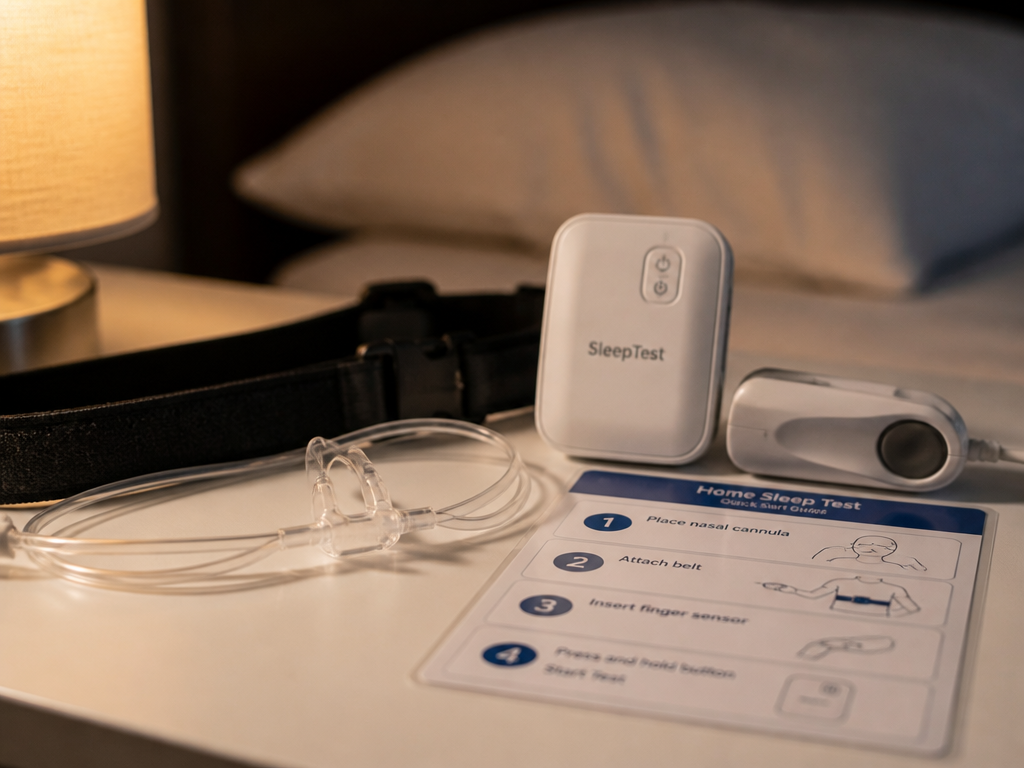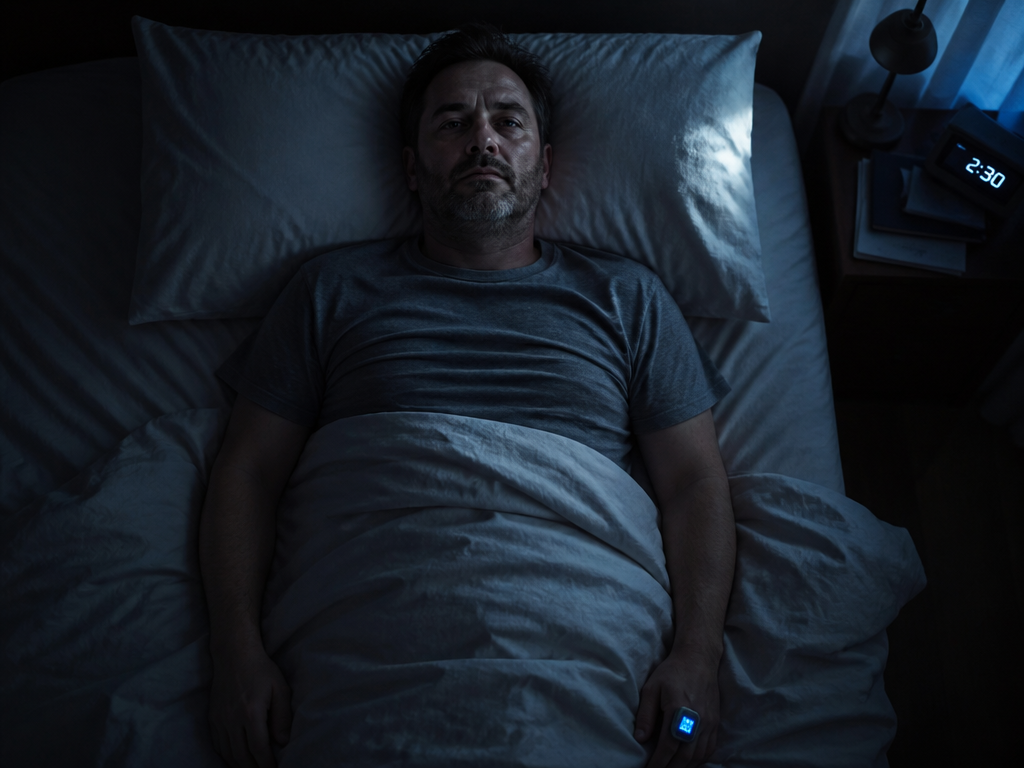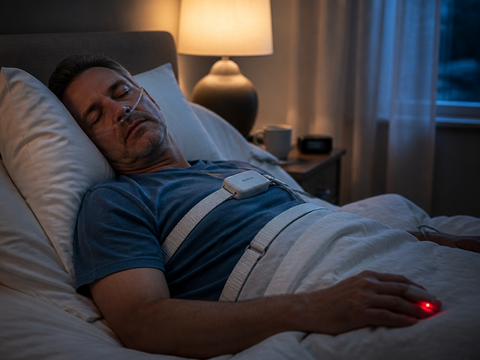
My wife has told me for years that I stop breathing in my sleep. I assumed she was exaggerating, the way you do when someone interrupts an argument with your own snoring. Then I borrowed a prescribed home sleep apnea test — a finger oximeter, a chest belt, and a small nasal cannula — and wore it for three consecutive nights. The chart settled the argument.
The verdict: A home sleep test will not formally diagnose obstructive sleep apnea, but it will show you, in your own data, the exact sequence of events that turns ordinary snoring into a breathing disorder — and that sequence is hard to argue with once you've seen it on a graph.
What follows is organized the way a single breath travels: in through the nose, down the throat, into the blood, up to the brain, and out into the next morning. Each stage is where one part of the device was listening.
Stage one: air enters
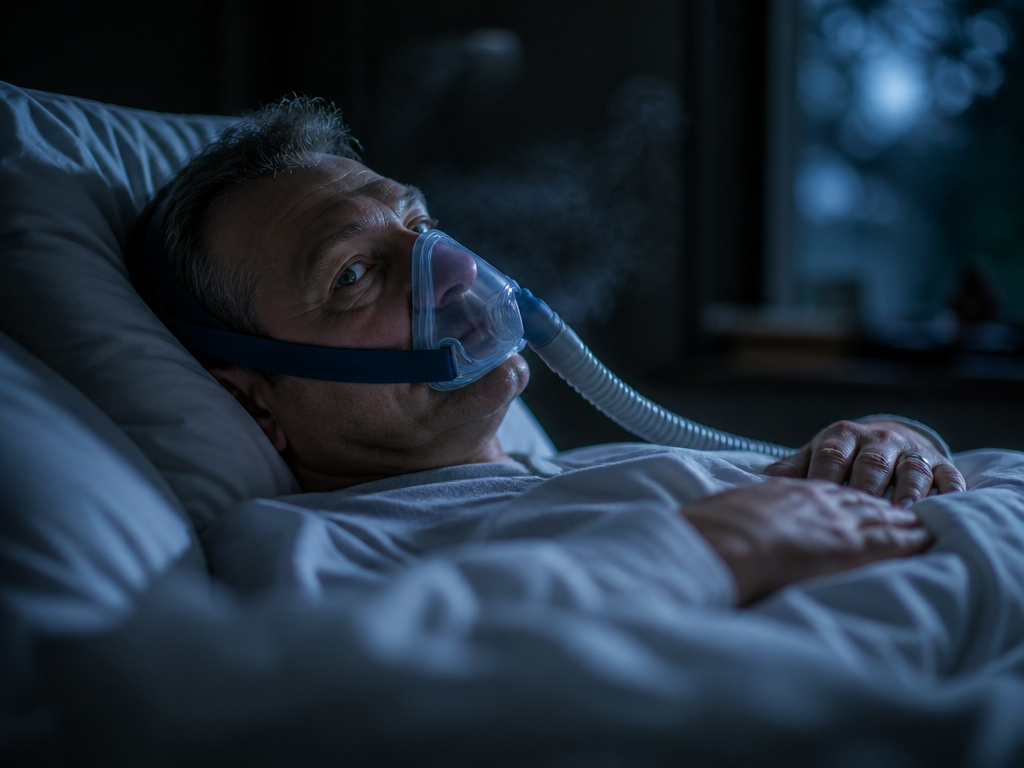
The nasal cannula sits under your nostrils and measures airflow — pressure changes as you inhale and exhale. On a healthy night, that signal looks like a steady picket fence: even peaks, even troughs, breath after breath.
My fence had gaps. The software flagged stretches where the airflow signal flattened or dropped to near zero for ten seconds or longer. A flattening that doesn't fully stop is scored as a hypopnea (a partial reduction). A near-total stop is an apnea. The cannula can't tell you why the air stopped — it only knows that it did. For that, you need the next sensor down the line.
Across three nights my device logged 142, 168, and 119 of these events. That averages out to roughly 18 per hour of recorded sleep — which, if a clinician confirmed it, would land in the moderate range. I want to be careful here: a consumer-adjacent home test tends to underestimate event counts, because it estimates total sleep time rather than measuring brain activity. So the real number may be higher, not lower.
Stage two: the throat closes
Here is the part the airflow data implies but the chest belt confirms. The belt — an elastic band measuring how your ribcage expands — kept moving during my flagged events. My chest was still heaving, trying to pull air in. The air just wasn't arriving.
That gap between effort and airflow is the signature of the obstructive kind. The muscles surrounding your upper airway relax during sleep, the soft tissue at the back of the throat sags inward, and the channel narrows or seals. You keep trying to breathe against a closed door. (In the central type, by contrast, the brain briefly stops sending the signal to breathe at all — so both the airflow and the chest effort go quiet together. My belt never went quiet, which is consistent with the obstructive pattern, though only a full study could rule out a mix of both.)
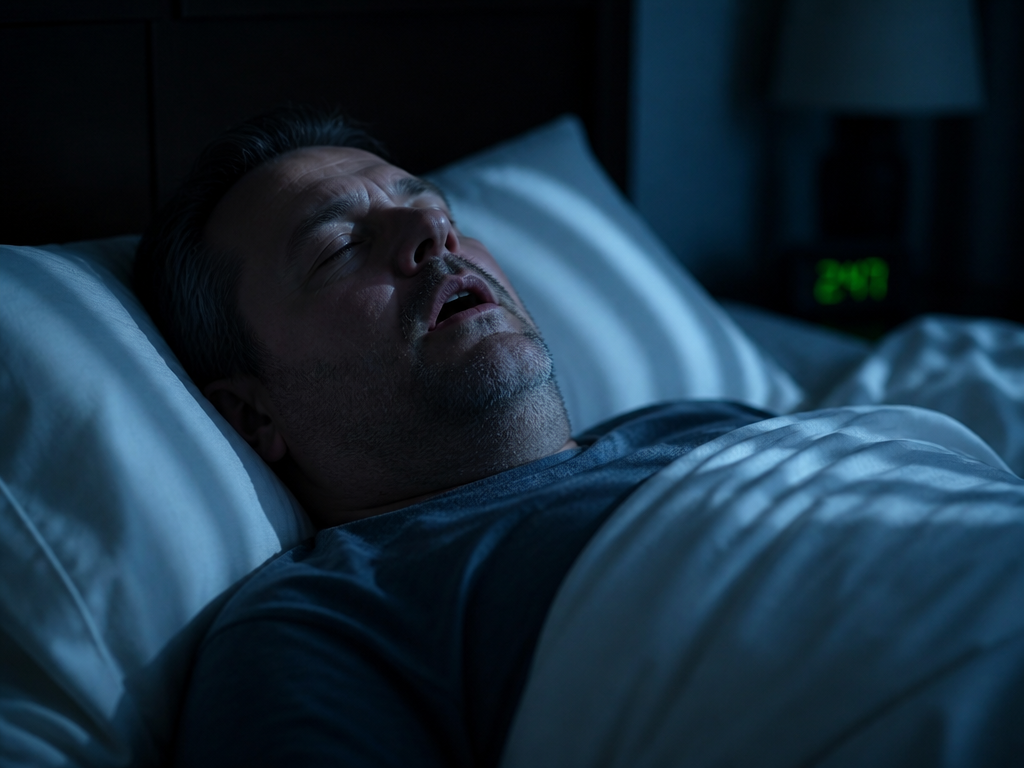
This is also where the snoring comes from. Snoring is the sound of air forcing its way through a passage that has already started to collapse. It is not separate from the breathing problem; it is the early, audible stage of the same mechanical event.
Stage three: oxygen falls
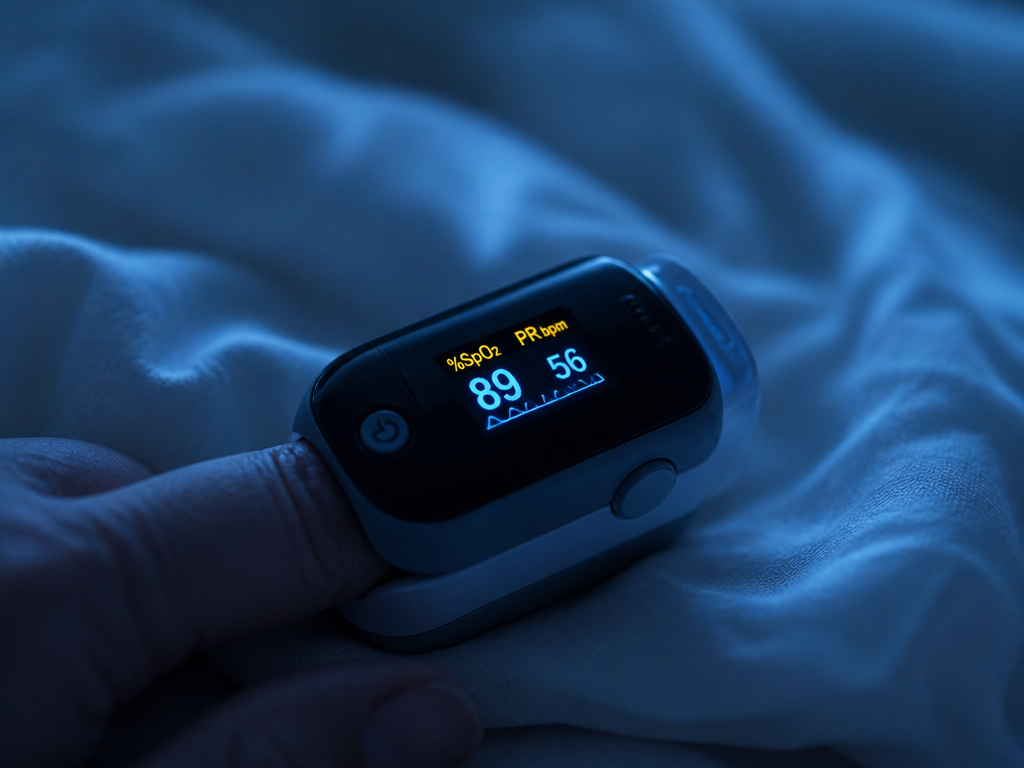
The pulse oximeter on my finger tracked blood oxygen saturation. A rested, healthy sleeper holds steady around 95–98 percent all night.
Mine sawtoothed. Each time the airflow flatlined for fifteen or twenty seconds, the oxygen line began to sink — sometimes to 91, on the worst night down to 84. Then it would shoot back up. Down, recover, down, recover, hundreds of times. The clinical term for those dips is desaturation, and the depth and frequency of them is a large part of why apnea is treated as a cardiovascular concern and not just a sleep nuisance. Your heart and blood vessels are absorbing those swings all night, every night, for years.
I should note what the oximeter can't see: it samples and averages, so brief dips can be smoothed over or lagged by a few seconds. The shape of the pattern is trustworthy; the precise depth of any single dip, less so.
Stage four: the brain intervenes
The home test I used had no EEG — no electrodes reading brain waves — so this stage I'm inferring rather than measuring, and I'll say so plainly. In a lab, this is the stage they capture directly.
When oxygen drops far enough, the brain rouses you just enough to stiffen the airway muscles and reopen the passage. You gasp, the air rushes in, the oxygen climbs back, and you sink under again — usually without ever knowing you surfaced. These micro-arousals are why someone can spend eight hours in bed and accumulate almost no consolidated deep sleep. The architecture keeps getting interrupted before it can build.
On my charts I could see the consequence of these arousals — the abrupt oxygen recoveries, a jump in heart rate logged by the oximeter — without seeing the arousal itself. That is precisely the gap a real sleep study fills.
Stage five: the morning
This stage needs no sensor. The morning headaches I'd blamed on screens make more sense alongside a night of oxygen swings. The fog that I'd been treating with a third coffee tracks with sleep that never consolidated. None of this is proof — plenty of things cause morning headaches — but the data reframed symptoms I'd been explaining away one at a time.
Three ways to find out, compared
| Method | What it measures | Catches the "why" | Cost / effort |
|---|---|---|---|
| Noticing it yourself | Snoring, fatigue, a partner's reports | No | Free, but easy to dismiss |
| Home sleep test | Airflow, chest effort, blood oxygen | Mostly — distinguishes obstructive from central by effort | Lower cost, your own bed, no EEG |
| In-lab polysomnography | All of the above plus brain waves, leg movement, sleep stages | Fully | Highest cost, a night in a clinic, the gold standard |
The line you can screenshot: A home test is the best tool for deciding whether to get a real test — and a poor substitute for getting one.
Who this experiment is for
- People whose partner reports gasping or silences, not just volume. The pauses matter more than the noise.
- People with the daytime half — unrefreshing sleep, morning headaches, the sense that rest isn't landing — who want something more concrete than a symptom checklist before booking an appointment.
- Family members trying to understand a relative's diagnosis. Watching the airflow line and the oxygen line move together makes the mechanism click in a way that no explanation did for me.
Who it isn't for
- Anyone hoping to avoid a clinic. This is a doorway, not a destination. The device printed "consult a physician" on its own report, and it was right.
- People with heart, lung, or neuromuscular conditions, where the central type and other complications are more likely and a lab study's full sensor array genuinely matters.
- Anyone who'll use a borderline result to talk themselves out of it. If the numbers are ambiguous and the symptoms are real, the symptoms win.
I did one thing, with one device, on one body, for three nights, and I am not a clinician. What I can say is that the experiment converted a vague worry into a specific question I could bring to a sleep specialist — which is exactly the question I'm now waiting on a real study to answer.
The myth I arrived with was that snoring is just noise, and a loud sleeper is simply an inconvenient one. The more accurate version, written across three nights of my own charts, is that snoring is the sound of a throat beginning to close, and the silences that follow it are the part worth measuring.