The advice usually comes as one package. Skip the sleep lab. Order a home test online, sleep in your own bed with a few sensors attached, and you can have a sleep apnea diagnosis within a week, often for less than a car repair and with no referral or wait. If you already use CPAP and you travel, buy a travel machine and stop carrying the big one through airport security.
I followed that advice this summer. Then, eleven days later, I did the thing it tells you to skip: a full night in a hospital sleep lab. Once I was on treatment, I bought a travel CPAP and used it for eleven nights across three trips over the next two months. I paid for all of it myself. No testing service, clinic, or manufacturer knew I was writing about them.
The short version: a home test is the right first step for most adults who snore loudly and wake up tired, but if it comes back mild or normal and you still feel wrecked, stop trusting the advice there, because that is exactly where the lab is worth its price.
This is one person's experience, a sample size of one, and I'll point out where that limits what I can tell you. But the gap between my two results was large, and it had a clear explanation, so it's worth walking through.
What I actually did
Some background. I'm in my mid-forties, I snore according to everyone who has shared a room with me, and for about two years I blamed afternoon coffee for waking up unrefreshed. Cutting back to one cup before 10 a.m. changed nothing I could measure about how I felt at 3 p.m. For a magazine about caffeine and sleep, that's worth saying on its own: when cutting coffee doesn't fix the tiredness, the coffee probably wasn't the cause.
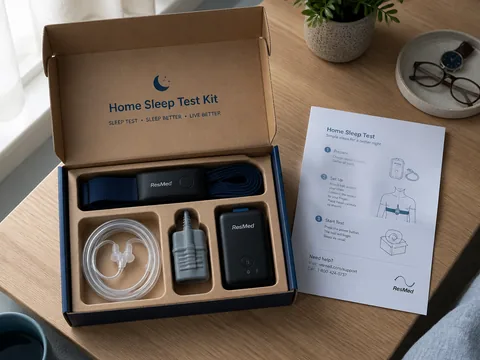
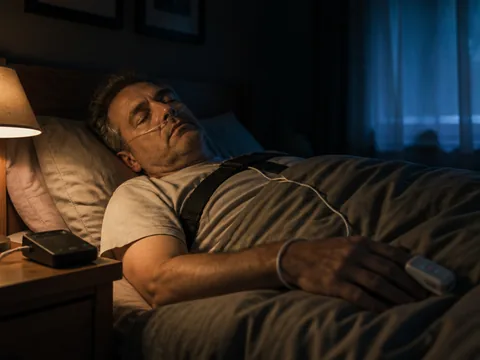
The home test. I ordered it from an online service that bundles a short video consultation with a physician, the device, and a physician's reading of the results. The cash price was $189, and nothing was billed to insurance. The device was what clinicians call a Type III recorder: a nasal cannula to measure airflow, an elastic belt around the chest to measure breathing effort, and a fingertip pulse oximeter, all wired to a recorder about the size of a deck of cards. It arrived three business days after the consultation. I wore it for one night and mailed it back in a prepaid box, and the report appeared in my patient portal five days later.
The lab. Because my symptoms didn't match my home result (more on that below), the physician who read it recommended an in-lab study, called polysomnography. I went to a hospital-affiliated sleep center twenty minutes from home. Check-in was at 8:30 p.m., followed by about forty-five minutes of wiring: electrodes on the scalp for brain waves, beside the eyes and on the chin, on both shins, and on the chest for heart rhythm, plus the same airflow belt and oximeter the home kit used. An infrared camera recorded the room. The center billed my insurer $2,840, and my share after the deductible was $612. The next open slot was sixteen days out, which the scheduler told me was short. A physician went over the results with me at a follow-up visit twelve days after the study.
I tried to keep the two nights comparable. I had no coffee after 9 a.m. on either day, drank no alcohol, and went to bed within twenty minutes of the same time.
Where the home-test advice is right
It is cheaper and faster, by a wide margin
My out-of-pocket cost was $189 for the home test and $612 for the lab. From first contact to written report, the home route took about ten days. The lab took nearly a month, counting the wait for a slot and the follow-up appointment. If your deductible is high or you have no insurance, the gap is bigger: cash prices for in-lab studies commonly run well over $1,000, while cash-pay home tests generally fall between about $150 and $500.
Your own bed is your own bed
The lab report put my sleep onset latency (the time it took to fall asleep) at 38 minutes. At home I'm usually asleep within fifteen. A lab bedroom is comfortable enough, but you're wearing about twenty sensors, a technician is watching, and there's a camera in the corner. The home kit was far less intrusive. The nasal cannula was the most annoying part, and I stopped noticing it once I fell asleep.
I should admit a limit here. The home device can't measure sleep, so I have no home-night latency to compare with the lab's 38 minutes. I only remember falling asleep quickly.
For the classic case, the home result is good enough

The American Academy of Sleep Medicine's guidance says home testing is appropriate for uncomplicated adults with a high likelihood of moderate-to-severe obstructive sleep apnea. Think of someone whose partner hears them stop breathing and then gasp, who falls asleep at red lights, and whose home test shows 35 events an hour. For that person the home test answers the question. Many people in that situation start auto-adjusting CPAP straight from the home result and never see a lab. That's the reader the common advice is really written for, and for that reader it's good advice.
Where the advice breaks down
What a home test can't see
A home kit like mine records breathing and oxygen. It doesn't record brain waves, which has two consequences.
The first is the denominator. A lab counts breathing events per hour of sleep, which gives the apnea-hypopnea index, or AHI. A home test can't tell whether you're asleep, so it counts events per hour of recording, which gives the respiratory event index, or REI. If you lie awake for ninety minutes, those minutes still count as hours in the calculation, and they dilute the result.
The second is the one that mattered for me. Under the standard scoring rules, a hypopnea (a partial blockage of breathing) counts as an event if it lowers blood oxygen by 3 percent or causes a brief arousal in the brain. A home test can't see arousals, so it counts only the events that drop oxygen enough. Many home-test reports, and Medicare's coverage rules, use a stricter 4 percent oxygen threshold. So a narrowed airway that jolts your brain briefly awake without lowering your oxygen much goes uncounted at home, even though it breaks up your sleep all the same.
My two nights, side by side
| Measure | Home test | Sleep lab |
|---|---|---|
| Time counted | 7 h 12 min of recording | 5 h 41 min of sleep |
| Index, 4% oxygen rule | REI 8.4 | AHI 9.1 |
| Index, 3% or arousal rule | Not measurable | AHI 21.6 |
| Lowest oxygen | 88% | 87% |
| Severity category | Mild | Moderate |
On the stricter rule, the two nights nearly agreed, which is reassuring about the home device. The difference came almost entirely from events that ended in an arousal and dropped my oxygen only a little. The home test couldn't score those. In the lab they more than doubled my count and moved me from mild (5 to 15 events an hour) to moderate (15 to 30).
The practical difference was smaller than the numbers suggest, but it was real. The physician told me a mild result combined with my symptoms could still have justified a trial of CPAP. The lab result turned that from a judgment call into a clear recommendation, and it was the number my insurer used to approve the machine.
One more thing I can't tell you. A lab can also find problems a home test isn't designed to look for: central sleep apnea, where the brain doesn't send the signal to breathe, periodic limb movements, and others. I had none of them. In my case the lab's wider view didn't turn up a second problem, so I can't describe what it's like when it does.
Who the home test isn't built for
Clinical guidance steers these people toward the lab from the start:
- Significant heart or lung disease, including heart failure and COPD
- Neuromuscular conditions, or a history of stroke
- Regular opioid use, which raises the risk of central apnea
- A suspected second sleep disorder, such as narcolepsy, restless or kicking legs, or severe insomnia
- A normal or mild home result while the symptoms continue
The last item is the one the common advice most often leaves out, and it applies to the most people. Clinicians describe the pattern I had, frequent brief arousals with little oxygen drop, more often in women and in younger, leaner patients. Those are also the people most likely to be told they don't look like someone with sleep apnea. A home result of "no significant apnea" in someone who is still exhausted doesn't rule anything out. It means the test didn't find enough of what it can see.
Home test vs. lab: the comparison
| Online cash-pay home test | Home test ordered by your own doctor | In-lab polysomnography | |
|---|---|---|---|
| Typical out-of-pocket | About $150 to $500 | Copay or deductible; varies | Often over $1,000 before insurance (my share: $612) |
| Referral and insurance | Prescription included in the telehealth fee; no claim filed | Usually needs an office visit; billed to insurance | Usually needs a referral and prior authorization |
| What it records | Airflow, breathing effort, oxygen, pulse | Same | All of that plus brain waves, eye and leg movement, heart rhythm, video |
| Measures actual sleep and arousals | No | No | Yes |
| Best fit | Clear, uncomplicated cases; people avoiding insurance delays | Same cases, when you want insurance to cover the equipment later | Mild or negative home result with ongoing symptoms; complex health history |

One thing to check before paying cash: some insurers want the diagnosis to come from an in-network provider before they'll cover a CPAP machine, and a report from a cash-pay service doesn't always carry over cleanly. It cost me nothing to call my insurer first. Not calling could have cost me the lab bill as well as the home test.
The travel CPAP half of the advice
My home machine is a ResMed AirSense 11 with a heated humidifier. For travel I bought a ResMed AirMini. It cost $899 cash, and my insurer wouldn't cover it, since most plans pay for one machine every five years. It also needed a prescription, which the sleep center sent to the supplier. My pressure is set on auto, between 6 and 12 cm H2O, on both machines.
Over eleven nights on three trips, this is how the two compared.
Weight and bulk. On my kitchen scale, the home setup (machine, water tub, power supply, and hose) weighed 1.9 kg. The AirMini with its power supply and hose weighed 0.9 kg, and it fit in a toiletry-bag-sized case. Much of what's left is the hose and the power brick, not the machine itself.
How well it treated me. The machines' own estimates of leftover events averaged 1.9 per hour over thirty nights at home and 3.2 per hour over the eleven AirMini nights. Both are well under 5, the usual target. These are the machines' estimates, not lab scoring, and eleven nights is a small sample.
Dryness. The AirMini skips the water tank and uses a disposable moisture-exchange cartridge instead. I woke with a dry mouth on four of the eleven nights, all of them in hotel rooms with forced-air heating. At home, with the heated humidifier, it happens maybe once a month.
Noise. The AirMini is higher-pitched. A sound-meter app on my phone read about 4 to 5 decibels louder at pillow height. Phone meters aren't calibrated instruments, so take that as a direction rather than a measurement. My partner noticed the difference on the first night and not after that.
Masks. The AirMini works only with a short list of ResMed masks and needs a specific connector. I had to buy a compatible version of my nasal mask for $110, which the headline price doesn't include.
Flights. I carried the AirMini onto six flights without trouble. Under U.S. Department of Transportation rules, a CPAP is a medical device and doesn't count toward your carry-on allowance, and at security it gets screened separately. I didn't test in-flight use or battery packs, so I can't speak to either.
My verdict: the travel machine is the right call if you're away from home several nights a month. If you travel a few times a year, pack your home machine. It flies free in the cabin too, and you keep your humidifier.
Who this is for, and who it isn't
Start with a home test if you snore loudly, someone has seen you stop breathing, you're sleepy in the daytime, and you don't have the heart, lung, neurological, or opioid factors listed above. That's the fastest, cheapest honest route, and a clearly abnormal result is reliable.
Go to the lab if your home result is normal or mild and you're still exhausted, if another sleep disorder seems possible, or if your health history appears on the list above. Book it as the next step, not as an admission that the home test failed.
Buy a travel CPAP if you already do well on CPAP, travel often, and can live with a limited choice of masks and a drier night.
Skip the travel machine if you rely on heated humidification, travel only occasionally, or your mask isn't on its compatibility list.
The line to screenshot: a home test can confirm sleep apnea, but it can't rule it out.
A more honest version of the rule
The common advice isn't wrong about the barriers. The lab is slower and costs more, and it's harder to sleep there. For most people with the classic symptoms, a home test gives a trustworthy answer, and treatment can start from it. But the advice treats the home test as a replacement for the lab when it's really a filter. It catches the obvious cases well and lets the subtle ones through. A good sleep apnea diagnosis depends on the test that can see your particular kind of broken sleep, and for some people only the lab can.
The myth: skip the sleep lab, because a home test is all anyone needs for a sleep apnea diagnosis.
The more accurate version: start with the home test, and if it comes back mild or normal while you still feel wrecked, the lab is your next step, not the one you get to skip.