I spent four months carrying the same list of complaints — unrefreshing sleep, 3 a.m. wake-ups, a fatigue that coffee dented but never fixed — through three different doors: a primary care office, a consumer sleep-tracking ring, and eventually a home sleep test that a specialist upgraded to an overnight lab study. I wanted to know which route actually catches obstructive sleep apnea in women, and which one sends you home with a shrug and a prescription for better sleep hygiene.
The short version: the wearable flagged something real but couldn't name it, the standard questionnaire nearly missed me entirely, and only the sleep study — read by someone who knew what to look for — produced a diagnosis. The route matters as much as the symptoms.
The complaints I brought, and the ones nobody asked about
Here is what I actually experienced, logged over six weeks before I sought help:
- Morning headaches, roughly 4 days out of 7
- Waking with a dry mouth and a racing heart
- Daytime fatigue that felt like a weight, not sleepiness — I rarely dozed off
- Low mood and a shortening fuse that I'd chalked up to work
- A bed partner who reported "little pauses," not the freight-train snoring of cliché
Notice what's missing: loud, habitual snoring and witnessed gasping — the two symptoms most screening tools were built around. Those tools were validated largely on middle-aged men, whose apnea tends to present as dramatic airway collapse. Women more often present with fragmented sleep, insomnia-like waking, fatigue, anxiety, and headache. The plumbing is similar; the surface signs are not.
That mismatch is the whole reason this condition goes unnamed in so many women for so long. I went in wanting to see exactly where each screening route broke on it.
Route 1: The primary care questionnaire (STOP-BANG)
My GP visit lasted eleven minutes. The screening ran on STOP-BANG, an eight-point checklist: Snoring, Tiredness, Observed apnea, Pressure (hypertension), BMI over 35, Age over 50, Neck circumference over 40 cm, and male Gender.
Read those last four again. Three of the eight points — high BMI, large neck, male sex — are weighted toward a specific male phenotype. I scored one point on the "BANG" half (age) and two on "STOP" (tiredness, and a maybe on observed pauses). A score of 3 lands in "intermediate risk," which in a busy practice often means "watch and wait."
What it got right: it's free, fast, and it did register my fatigue.
What it got wrong: it treats snoring and neck size as near-prerequisites. A woman with textbook fragmented-sleep apnea and a 34 cm neck can score below the referral threshold. My GP, to her credit, referred me anyway — but on the strength of the questionnaire alone, I'd have been told to cut back on caffeine and come back in six months.
Route 2: The consumer wearable
I wore a sleep-tracking ring for 30 nights. It doesn't diagnose apnea and doesn't claim to. What it measures is downstream: blood-oxygen dips, heart-rate variability, movement, and "sleep stages" inferred from those signals.
The data was genuinely useful as a flag. Across 30 nights it logged an average of 14 to 22 "restless" episodes per night and repeated small overnight SpO2 dips into the low 90s. My resting heart rate ran 6–8 bpm higher on nights the app scored as poor. None of that is a diagnosis, but it turned "I feel tired" into a pattern I could put on a table in front of a doctor.
What it got right: it made an invisible problem visible and gave me language and numbers.
What it got wrong: it can't distinguish an apnea event from a bad dream or a cat on the bed. Consumer pulse oximetry is not medical-grade, and the "restless" metric is proprietary and unvalidated for this purpose. Bringing it to my specialist, I was told plainly: useful for motivation, useless as evidence.
Route 3: Home sleep test vs. in-lab study

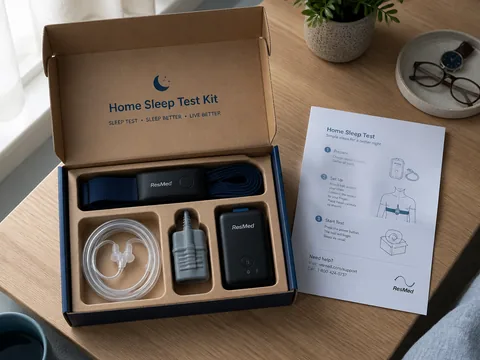
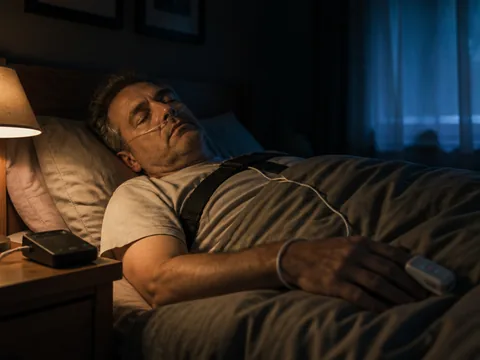
The home sleep test (a chest belt, a finger oximeter, a nasal cannula) came back with an apnea-hypopnea index of 6 — events per hour of sleep. Under the conventional adult cutoff, 5 is the floor for "mild," so 6 is a diagnosis by a hair. Home tests, though, tend to underestimate, because they assume you slept the whole time they were recording, and they're less sensitive to the subtler, arousal-based events — the ones that end in a brief wake-up rather than a full oxygen crash. Those subtler events are disproportionately the kind women have.
The in-lab polysomnography, which measures brain waves, told a different story. Scored against actual sleep time and including arousal-based hypopneas, my AHI came back at 11 — squarely moderate. The lab caught events the home kit had slept through.
The comparison
| Criterion | STOP-BANG questionnaire | Consumer wearable | Home test vs. lab study |
|---|---|---|---|
| Cost to me | Free | ~$300 device | $150 home / $600+ lab (pre-insurance) |
| Caught my case? | Barely (intermediate) | Flagged, didn't diagnose | Home: mild; Lab: moderate |
| Sensitive to female presentation | Poor | Moderate | Home: fair; Lab: good |
| Produces a diagnosis | No | No | Yes |
| Time investment | 11 minutes | 30 nights | 1–2 nights |
Why the standard criteria keep missing women
The gap isn't bad luck; it's built in. Three mechanisms:
Hormones. Progesterone helps keep the upper airway toned, which is part of why apnea rates in women climb sharply after menopause. A screener that ignores menopausal status ignores one of the largest risk shifts a woman experiences.
The event definition. Apnea scoring rewards long pauses with big oxygen drops. Women more often have shorter events that end in a cortical arousal — a micro-awakening — before oxygen craters. Score only the crashes and you undercount the arousals, and the AHI comes out artificially low, as mine did at home.
The symptom script. Fatigue, insomnia, and low mood are read as depression, stress, perimenopause, or "just life" long before anyone suspects breathing. Each of those may also be true. But they are frequently the presentation of apnea, not the alternative to it.
Who each route is for — and isn't
Start with a wearable if you can't get a doctor to take the fatigue seriously and you need data to make your case. Don't mistake its numbers for a diagnosis.
Rely on the questionnaire alone only if you happen to fit the classic profile — loud snoring, witnessed pauses, higher BMI. If you don't, know that a low score does not clear you, and say so out loud in the appointment.
Push for the lab study if a home test comes back borderline but your symptoms don't, or if you're post-menopausal with fragmented sleep. The extra sensitivity is the entire point, and it's what changed my result from "mild, maybe watch it" to "moderate, treat it."
This route isn't for you if your sleep genuinely refreshes you and your fatigue has a clearer cause you haven't yet explored — apnea is common, not universal.
I'll admit the limits here: this is one person's path, one body, one set of numbers. I can't tell you an AHI of 11 will show up for you, or that your GP will refer as mine did.
If you take one line from this: a normal questionnaire and a mild home test do not rule out obstructive sleep apnea in a woman — a full study read by someone expecting the female pattern does.
The old story says sleep apnea is a heavy man's snoring problem, loud enough that everyone in the house already knows.
The more accurate story is that it's often a quiet, fragmented, hormone-shifted condition that the standard tests were never built to hear — and the woman who's exhausted for reasons no one can name may simply not have been tested by anything that was listening.