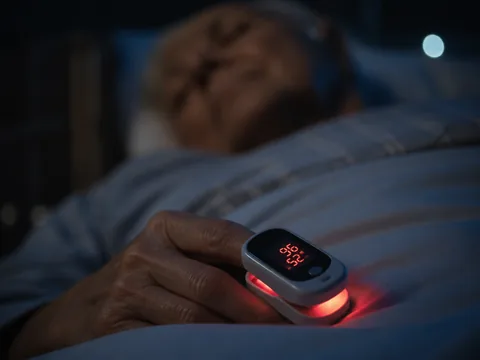
The pulse oximeter clipped to my father's finger glowed a soft red all night, and around 2 a.m. I finally understood what the sleep clinic had tried to describe. His breathing climbed — deeper, deeper, deeper — then tapered, went shallow, and stopped. For maybe fifteen seconds, nothing. Then it started again, quiet at first, building back toward that same peak. The oxygen number on the screen tracked it like a tide: 96, 94, 91, 88, then back up. This is Cheyne-Stokes respiration, and once you've watched it happen, the clinical name stops sounding abstract. It is a rhythm — a waxing and waning of breath, punctuated by pauses — and it belongs to a family of conditions many people first meet through the word apnea.
If you or someone you love has recently been told about this pattern, you are probably trying to reconcile two things: it looks alarming, and the doctor's tone was measured. Both are correct. Let me explain why.
What Cheyne-Stokes respiration actually is
Cheyne-Stokes respiration is a specific breathing pattern in which the depth of each breath gradually increases to a peak, then gradually decreases, until breathing stops entirely for a short period — a central apnea — before the cycle repeats. The whole loop typically lasts between 30 seconds and two minutes. The defining feature is its shape: a smooth crescendo followed by a smooth decrescendo, then silence. Not gasping, not choking. A tide going out and coming in.
It is named for John Cheyne and William Stokes, two nineteenth-century physicians who described it independently in patients with heart disease. That association still holds. The pattern shows up most often in people with heart failure, and also after strokes and at high altitude.
Crucially, the pauses here are central apneas. The airway is open. The problem is upstream — in the brain's command to breathe, not in the throat's ability to let air through. That single distinction changes almost everything about how the condition behaves.
The loop, in the order it happens
To see why the breathing waxes and wanes, follow the control system in real time.
Your brainstem regulates breathing mainly by watching carbon dioxide. When CO2 in the blood rises, chemoreceptors sense it and tell you to breathe harder to blow it off. When CO2 falls too low, the drive to breathe eases, and you can pause. In a healthy sleeper, this thermostat runs smoothly and quietly.
Now introduce two problems, both common in heart failure.
First, the feedback is delayed. In a failing heart, blood moves more slowly from the lungs to the brain's sensors. So the chemoreceptors are always reading old news — the CO2 level from several seconds ago, not now.
Second, the system is too twitchy. The chemoreceptors overreact, so a small rise in CO2 triggers a large burst of breathing. That burst blows off too much CO2, driving the level below the threshold that keeps you breathing. So breathing stops. CO2 climbs back up. The delayed, oversensitive sensors eventually notice, and overreact again — a big burst of breathing.
Delay plus overcorrection is the recipe for an oscillation. Engineers see the same math in a thermostat that turns the heat on too hard and too late: the room swings from cold to hot and back. Your breathing is doing the same thing, and the crescendo-decrescendo shape is what that instability looks like from a chair at 2 a.m.

How it differs from obstructive sleep apnea
Many readers arrive here already fluent in obstructive sleep apnea (OSA), where the throat collapses during sleep. The two conditions can look similar on a monitor and can even coexist, but the underlying failure is different.
| Obstructive apnea | Cheyne-Stokes respiration | |
|---|---|---|
| Where it fails | Collapsed upper airway | Brain's breathing drive |
| Effort during pause | You try to breathe; airway is blocked | No effort; no signal sent |
| Breath shape | Abrupt stops and gasps | Smooth waxing and waning |
| Common setting | Overweight, narrow airway | Heart failure, stroke, altitude |
| First-line device | CPAP | Treat the heart; sometimes ASV |
The practical upshot: a CPAP machine, which splints the airway open, is the workhorse for obstructive apnea but is not the automatic answer here, because the airway was never the problem.
What the research actually measured
Here is where honesty matters more than reassurance.
Cheyne-Stokes breathing in heart failure is a genuine marker of severity. In a frequently cited analysis by Lanfranchi et al. (1999, Circulation), central apneas were associated with worse survival in patients with left-ventricular dysfunction — though as with much of this literature, it's hard to fully separate the breathing pattern from the sickness of the heart producing it.
Treatment is where the story gets complicated. Adaptive servo-ventilation (ASV) is a device that senses the waxing and waning and delivers counter-pressure to smooth it out — more support during the shallow phase, less during the peak. It works, mechanically. But the SERVE-HF trial (Cowie et al., 2015, New England Journal of Medicine), which enrolled over 1,300 patients with heart failure and reduced ejection fraction, found higher cardiovascular mortality in the ASV group. The finding surprised the field, and it stands as a caution: fixing the number on the screen is not the same as helping the patient. For that specific group — reduced ejection fraction — ASV is now generally avoided.
So the plausible-but-thin conclusion is this: the breathing pattern is often a symptom of the heart, and the most reliable lever is treating the heart itself — optimizing heart-failure medications, sometimes oxygen. The device question is unsettled, and anyone who states it with confidence is ahead of the evidence.
An honest rule of thumb
If you're the one watching, resist the urge to diagnose from the couch. The pattern is real and worth reporting, but its meaning depends entirely on the person's heart, brain, and history — which is a clinic's job, not a nightstand's.
What you can do tonight: note the shape (smooth rise-and-fall versus abrupt gasping), roughly how long the pauses last, and whether the person seems to be straining to breathe or simply not breathing. Bring that to the doctor. It is genuinely useful information, and it costs nothing.
And if there's chest pain, blue lips, or breathing that doesn't restart, that's not a note for the morning — that's a call for emergency help now.
My father's cardiologist adjusted his medications over the following weeks, and the tide in his breathing grew shallower. It never fully vanished, and I've stopped expecting it to.
If the breathing rises and falls like a tide, watch the heart, not just the lungs.