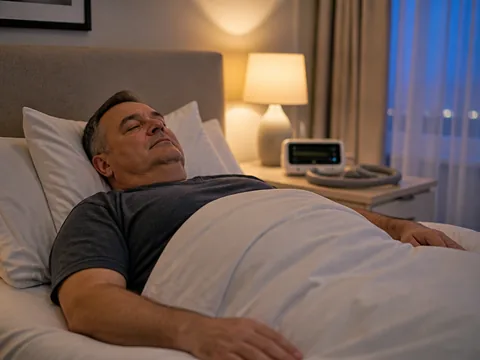
My partner's recording is forty-one seconds long. Thirty of those seconds are snoring. Then there are eleven seconds of nothing, no breath at all, and then a noise like a garbage disposal trying to restart. For three years I'd been told about this, and every time I said I'd look into it. The recording wasn't what finally got me to book a test. It was hearing Jack Black, in an interview that made the rounds, cheerfully describe his CPAP mask, and realizing that a funny, famous man could talk about sleep apnea treatment the way you'd talk about a mouthguard. For some reason that made it easier for me to talk about it too.
So I ran the experiment I'd been dodging: a home sleep test, a diagnosis, then thirty nights on a CPAP machine, logging everything the machine logged, plus one thing it didn't track, which was how much coffee I drank.
The short version: in thirty nights, CPAP took my breathing interruptions from 23 an hour to under 2 and my coffee from four cups a day to two. The machine was never the hard part. The mask was, and it took me three tries to find one I could sleep in.
The night I measured
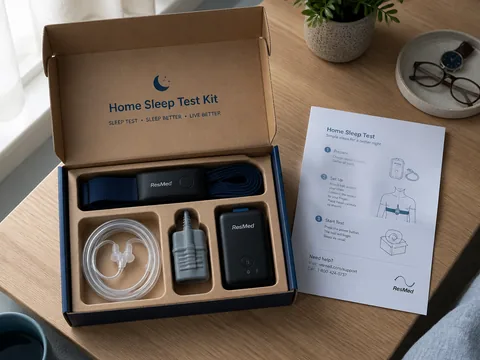
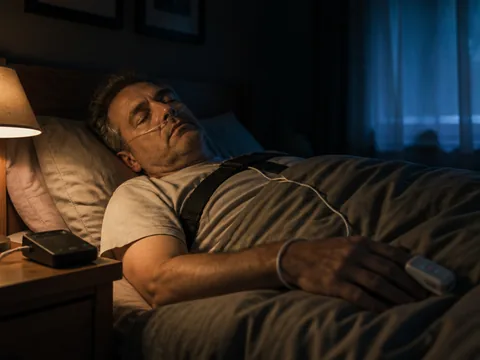
The home sleep apnea test came in a box about the size of a hardback novel. It had a chest belt, a nasal cannula that hooked over my ears, and a fingertip oximeter on a cable. My sleep physician's office mailed it on a Tuesday and I wore it on Wednesday night. It was not comfortable. I slept on my back more than usual because I was afraid of pulling the cannula out, and I mention that because back-sleeping makes apnea worse for most people. My result may be slightly inflated by the test itself. I'm saying so because that's the kind of thing a review should admit.
The report came back eight days later:
- Apnea-hypopnea index (AHI): 23.4 events per hour
- Lowest blood oxygen: 84%
- Time below 90% saturation: about 31 minutes
- Classification: moderate obstructive sleep apnea
For scale, fewer than 5 events an hour counts as normal for adults. Five to 15 is mild, 15 to 30 is moderate, and above 30 is severe. At 23 events an hour, my airway was partly or fully closing roughly once every two and a half minutes, all night, and I had no memory of any of it. I just remembered waking up tired.
My Epworth Sleepiness Scale score, a short questionnaire about how likely you are to doze off while reading, watching TV, or sitting in traffic, was 13. Anything above 10 suggests excessive daytime sleepiness. I had filled it out honestly and was still surprised. I had always thought of myself as someone who just liked coffee.
Why a famous person's mask matters more than it should
No celebrity has ever told me anything medically useful about sleep apnea, and that isn't their job. What they can do is narrower and, for people like me, possibly more important: they can make the device look ordinary.
Jack Black's version was mostly comedy. He played up how absurd the mask looks, said plainly that he sleeps much better with it, and treated the whole thing as a slightly ridiculous fact of middle age. Years earlier, Shaquille O'Neal let a camera follow him through an overnight sleep study and then talked publicly about using CPAP. He's seven feet tall and a four-time NBA champion, and he was showing millions of people a man with a hose on his face. The heavier example is Carrie Fisher. When she died in 2016, the Los Angeles County coroner listed sleep apnea among the conditions that contributed to her death. That wasn't a confession, but it reached a lot of people who had never connected snoring with anything serious.
All three work through permission. Most people who put off getting tested already know something is wrong; their partner has been telling them for years. What stops them is embarrassment: picturing yourself in a mask, the sense that it means you're old, unhealthy, unattractive, or just not someone who needs a machine to sleep. When someone famous wears the mask in public and stays funny and likeable, it gets harder to keep that image of yourself going.
That's why the American Academy of Sleep Medicine's estimate stays with me. Roughly 30 million American adults have obstructive sleep apnea, and around 80% of them haven't been diagnosed. Most of those people aren't uninformed. Plenty of them have heard of CPAP. They just haven't found a version of themselves they're willing to picture wearing one.
What is actually happening in your throat
When you fall asleep, the muscles that hold your upper airway open relax. In most people the airway stays open anyway. In people with obstructive sleep apnea, the soft tissue at the back of the throat (the soft palate, the tongue, sometimes the tonsils) collapses enough to narrow the airway (a hypopnea) or close it completely (an apnea). Snoring is the sound of air forced through a partly closed passage. The silence on my partner's recording was the airway fully shut.
Your body doesn't wait for that to resolve itself. Blood oxygen drops, carbon dioxide rises, and the brain fires a brief arousal, usually too short to remember, that tightens the throat muscles and reopens the airway. You gasp, breathe, and fall back asleep. Then it happens again. With moderate apnea that's 15 to 30 times an hour, and each arousal comes with a spike in heart rate and blood pressure.
Those repeated spikes are why untreated apnea is associated with high blood pressure, atrial fibrillation, stroke, type 2 diabetes, and car crashes caused by drowsy driving. The links are well established. Whether treatment reverses all of them is less certain, and I'll get to that at the end.
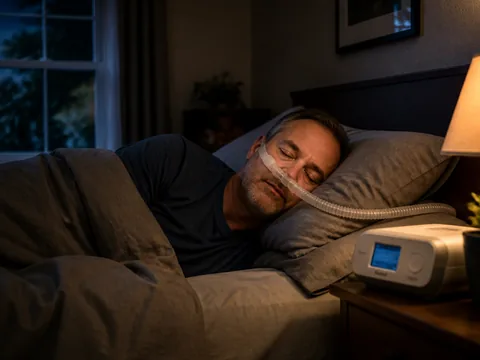
CPAP (continuous positive airway pressure) does something mechanically simple. A small bedside pump pushes room air through a hose and mask at a pressure just high enough to hold the airway open, like air holding open a wind sock. It doesn't breathe for you or add oxygen. It just keeps the soft tissue from collapsing. Mine was an auto-adjusting machine, set to work between 6 and 14 centimeters of water pressure and adjust within that range through the night. It settled at an average of about 9.
The coffee problem
This is a magazine about caffeine and sleep, so here's the part I hadn't told anyone.

Before the test, I drank four cups of coffee a day, about 12 ounces each, brewed at home. At a rough 95 milligrams per 8 ounces, that's somewhere around 550 to 600 milligrams of caffeine a day, well past the 400 milligrams the FDA cites as a level generally not linked to negative effects in healthy adults. I would have told you I drank it for the taste. I was drinking it to get through mornings that started with a dull headache and a mouth as dry as felt, which are two of the most common morning symptoms of untreated apnea. My fourth cup was at about 2 p.m., which is late enough to cut into deep sleep on its own. So I was using caffeine to cover for bad sleep, and the caffeine was making the sleep a little worse.
That's why I decided to track coffee alongside the machine data. I didn't try to cut back. I just counted. I wanted to know whether the urge would change once I was getting real sleep.
Thirty nights: what the machine reported
CPAP machines log almost everything: hours of use, mask leak, pressure, and a residual AHI, meaning the events that still get through while you're on therapy. I copied the numbers into a notebook every morning and recorded my coffee count each evening.
| Period | Avg AHI | Avg hours on CPAP | Avg cups of coffee/day | Epworth score |
|---|---|---|---|---|
| Baseline (home test) | 23.4 | — | 4.1 | 13 |
| Week 1 | 4.8 | 4.6 | 3.9 | — |
| Week 2 | 2.6 | 6.2 | 3.0 | — |
| Weeks 3–4 | 1.9 | 6.9 | 2.1 | 6 |
A few notes on these numbers, because they look neater than the month felt.
First, the week-one AHI of 4.8 is partly a mask problem, not a pressure problem. When a mask leaks badly the machine has trouble holding pressure, and some events get through. Most of my week one was spent in a mask that leaked (see below).
Second, I wasn't trying to cut back on coffee. Around day ten, the fourth cup just stopped appealing to me. I made it out of habit and left half of it in the mug. By week three, the second morning cup was the last one most days. I'd love to call that a direct effect of better sleep, and it probably mostly is, but I knew I was tracking it, and a person who knows he's counting cups drinks differently. It's a sample of one with no control.
Third, the morning headaches stopped within the first week. They were the first thing that changed, and the easiest to notice.
Three masks, compared
If CPAP fails, the mask is usually why. I tried three types, in the order my supplier handed them over, and they were not equally livable.
| Mask type | Nights tried | Avg hours worn | Median leak (L/min) | Nights I pulled it off asleep |
|---|---|---|---|---|
| Full face (nose and mouth) | 7 | 4.1 | 18 | 4 of 7 |
| Nasal cushion (over the nose) | 9 | 5.6 | 9 | 2 of 9 |
| Nasal pillows (in the nostrils) | 14 | 6.9 | 6 | 1 of 14 |
Full face. This is the one people picture: a triangle covering nose and mouth. It's often the first one handed out, because it works for mouth breathers. On me, the seal broke whenever I turned on my side, the bottom edge pushed against my pillow, and the leak blew air across my eyes hard enough to wake me. Four out of seven nights I woke at 3 a.m. with the mask on the floor and no memory of taking it off. I can't sleep on my back for long, so this one was finished.
Nasal cushion. A smaller triangle over the nose only. It was much quieter, and leaks dropped by half. The trouble was a red pressure line across the bridge of my nose that was still visible at 10 a.m. That's minor, but it's the kind of minor thing that eventually stops you wearing it. On two nights I also woke with a dry mouth, which meant my mouth was falling open and air was escaping that way.
Nasal pillows. Two soft silicone tips that sit at the opening of each nostril, held on by a thin headgear strap. They feel the most intrusive in theory and turned out to be the least intrusive in practice. Nothing touched the bridge of my nose, I could sleep on either side, and there was almost nothing on my face. I wore a chin strap for the first two nights to keep my mouth closed and then stopped needing it. The heated humidifier, set to 4, took care of the dryness.
If you want one line from this section: nasal pillows beat the full face mask on every measure I tracked, and I nearly quit CPAP because I was handed the full face one first.
That's my face and my sleeping position, though. People who breathe through their mouths, have chronic congestion, or need high pressures often do better in a full face mask. What I'd generalize is that if you tried CPAP once and hated it, you may have hated that particular mask. Ask your supplier for a different style. Most will let you swap within the first 30 days.
The embarrassing parts, plainly
I said I'd be honest, so here are the things I was actually worried about.
How it looks. It looks like a thin hose attached to your face. My partner's first reaction was a long, assessing look and then: you look like you're about to go scuba diving in a very shallow pool. We both laughed, and that turned out to be the end of it. Having it named out loud helped more than having it politely ignored would have.
Intimacy. You take the mask off first. It's a strap and a clip and takes about four seconds. Of everything on this list, it was the worry that turned out to matter least.
Noise. The machine itself is quieter than a bedroom fan. A leaking mask is the loud part, a hiss or a little whistle. A well-fitted mask is almost silent. My partner described the first silent night as the best sleep they'd had in years, and they weren't the one wearing anything.

Travel. The machine plus hose fits in a bag about the size of a hardcover dictionary. Under FAA rules, CPAP machines are medical devices and generally don't count against your carry-on allowance. I haven't flown with mine yet, so that's from the rules, not from experience.
Someone is watching. Of everything, this is what bothered me most. My machine has a cellular modem that sends usage data to the supplier, and that data goes to my insurer. Many US insurers, following Medicare's standard, cover the machine long-term only if you use it at least four hours a night on 70% of nights during a 30-day stretch within your first 90 days. That isn't a conspiracy; it's how they decide whether to keep paying. But some nights I put the mask back on at 4 a.m. partly because of that data, and it's worth knowing before you start.
If CPAP doesn't work for you
CPAP is the most studied option for moderate and severe apnea, but it isn't the only one, and a lot of people can't tolerate it even after trying different masks. The alternatives:
- Mandibular advancement devices. These are custom mouthguards from a dentist that hold the lower jaw slightly forward, which keeps the tongue from falling back. They're best studied in mild to moderate apnea. They're less effective than CPAP at lowering AHI, but people tend to wear them more consistently, so the real-world benefit can come out about the same.
- Positional therapy. Some people's apnea happens mostly when they're on their back. A wearable device that buzzes when you roll onto your back can help. My home test suggested I'm partly positional, but not enough to rely on this alone.
- Hypoglossal nerve stimulation. This is an implanted device that stimulates the nerve controlling the tongue so it doesn't fall back during sleep. It's for people with moderate to severe apnea who can't use CPAP, and it requires surgery and an airway evaluation first.
- Weight loss, including medication. Excess weight around the neck and abdomen makes the airway more likely to collapse. In late 2024 the FDA approved tirzepatide for moderate to severe obstructive sleep apnea in adults with obesity, the first drug approved for the condition. It isn't a fit for everyone. Some people with apnea aren't overweight, and narrow jaws and large tonsils are causes too.
- Surgery. For specific anatomy, such as large tonsils (especially in children), a deviated septum, or jaw structure, surgery can help. Results vary a lot, so it's worth getting more than one opinion.
Which of these makes sense depends on your AHI, your anatomy, and what you'll actually keep using, and that's a conversation for a sleep physician. My point is that if a mask isn't for you, that doesn't mean nothing is.
Who this is for, and who it isn't
This is for you if someone who shares your bed has described your snoring as having gaps in it. Or you wake with headaches or a parched mouth, you rely on coffee in a way that seems like more than enjoyment, you've nodded off while driving, or you've been told to get tested and have quietly not done it because you can't picture yourself in a mask. That last group is who I was. A home sleep test is a single uncomfortable night, it's often covered by insurance, and the result is just a number you can then decide what to do with.
It isn't a substitute for a diagnosis. If you have significant heart or lung disease, a neuromuscular condition, or symptoms that suggest something other than obstructive apnea, such as central apnea, insomnia, or restless legs, a home test may not be enough. You may need an overnight study in a lab. And if you snore loudly but feel rested, have no pauses in your breathing, and score low on the Epworth scale, you might simply be someone who snores. That's worth checking, but it isn't worth panicking over.
What I couldn't test: I tried one machine brand, three masks, and one month. I didn't have an in-lab study. My coffee numbers are self-reported and not blinded. My Epworth score of 6 at the end came from the same person who badly wanted it to go down. And I don't know yet how this holds up over a year, through a head cold, or in a hotel room.
What I still don't know
This is the part I keep thinking about.
The reason my doctor gave for treating my apnea wasn't the snoring or the coffee. It was my heart. Untreated obstructive sleep apnea is strongly associated with cardiovascular disease, and it's reasonable to assume that stopping the nightly oxygen drops and blood pressure spikes would protect against it.
But when researchers tested that, the results were disappointing. The SAVE trial, published in the New England Journal of Medicine in 2016, followed more than 2,700 people with moderate to severe apnea and existing cardiovascular disease. CPAP improved their daytime sleepiness, mood and quality of life. It did not significantly reduce heart attacks, strokes, or cardiovascular deaths compared with usual care. Later trials mostly found the same.
There's a well-known catch. People in SAVE used their machines an average of about three hours a night. That's less than half the night, and the second half is when REM sleep is longest and apnea is often at its worst. Analyses that looked only at people who used CPAP for four hours or more found hints of benefit, but people who stick with any treatment tend to differ from those who don't in all sorts of other ways. Nobody has settled whether CPAP worn all night, every night, for years protects the heart, or whether its real benefits stop at feeling awake, avoiding drowsy crashes, and letting the person next to you sleep. Those benefits are real, and for me they were enough. But they aren't what I was told I was treating.
My machine says I averaged 6.9 hours a night over the last two weeks. That's well above what most SAVE participants managed and still short of a full night. I'm drinking two cups of coffee instead of four. My partner has deleted the forty-one-second recording. I don't know whether my heart is any better off. Does keeping my airway open protect my heart over the next twenty years, or does the evidence only show that it lets me get up in the morning without a headache?