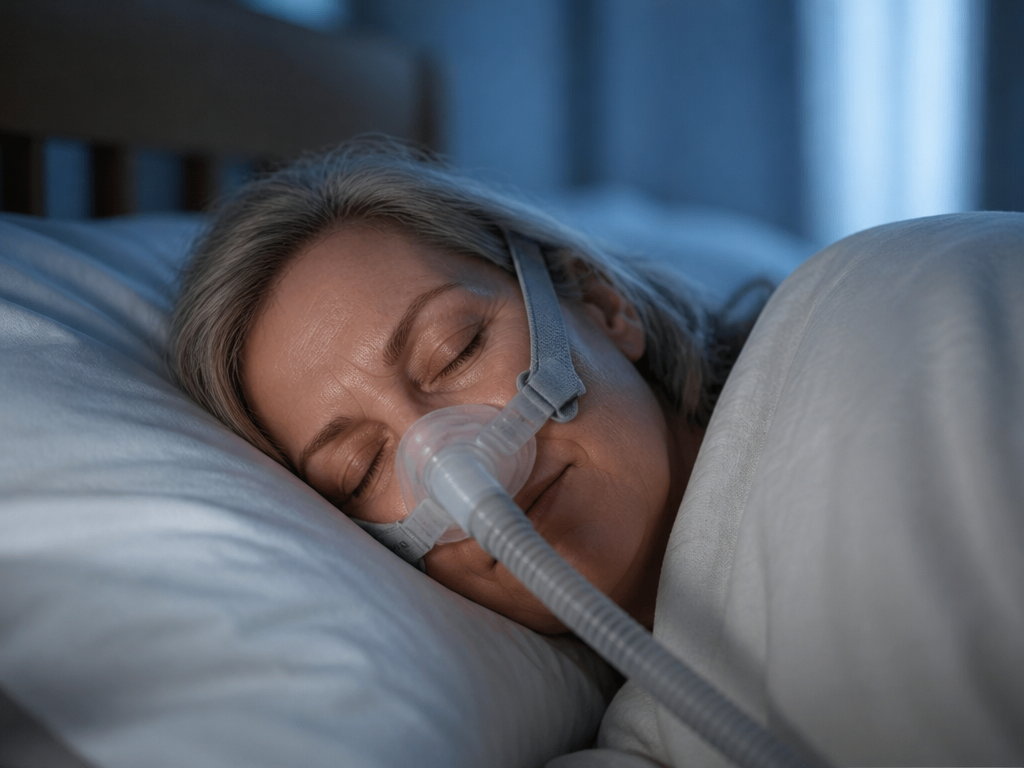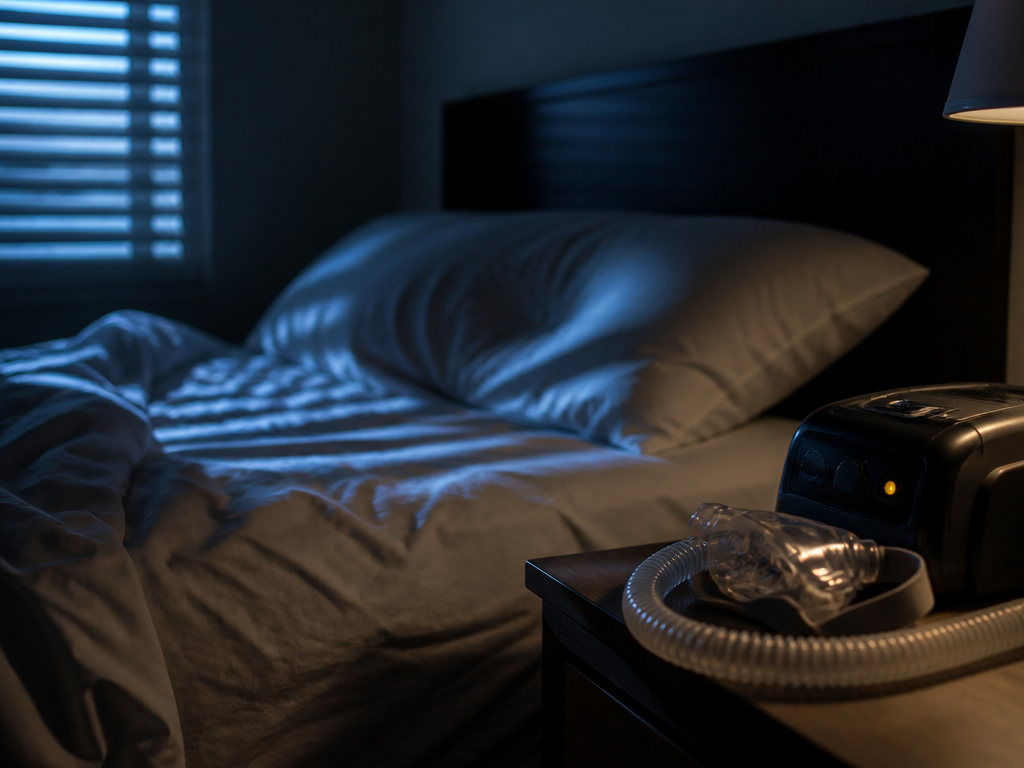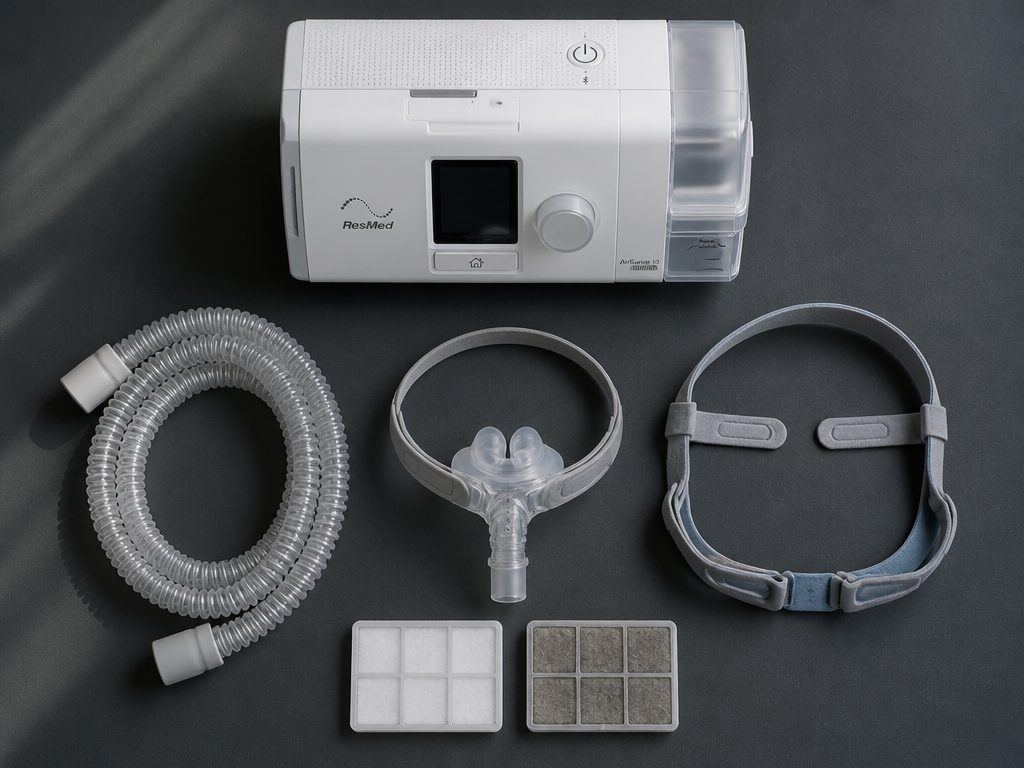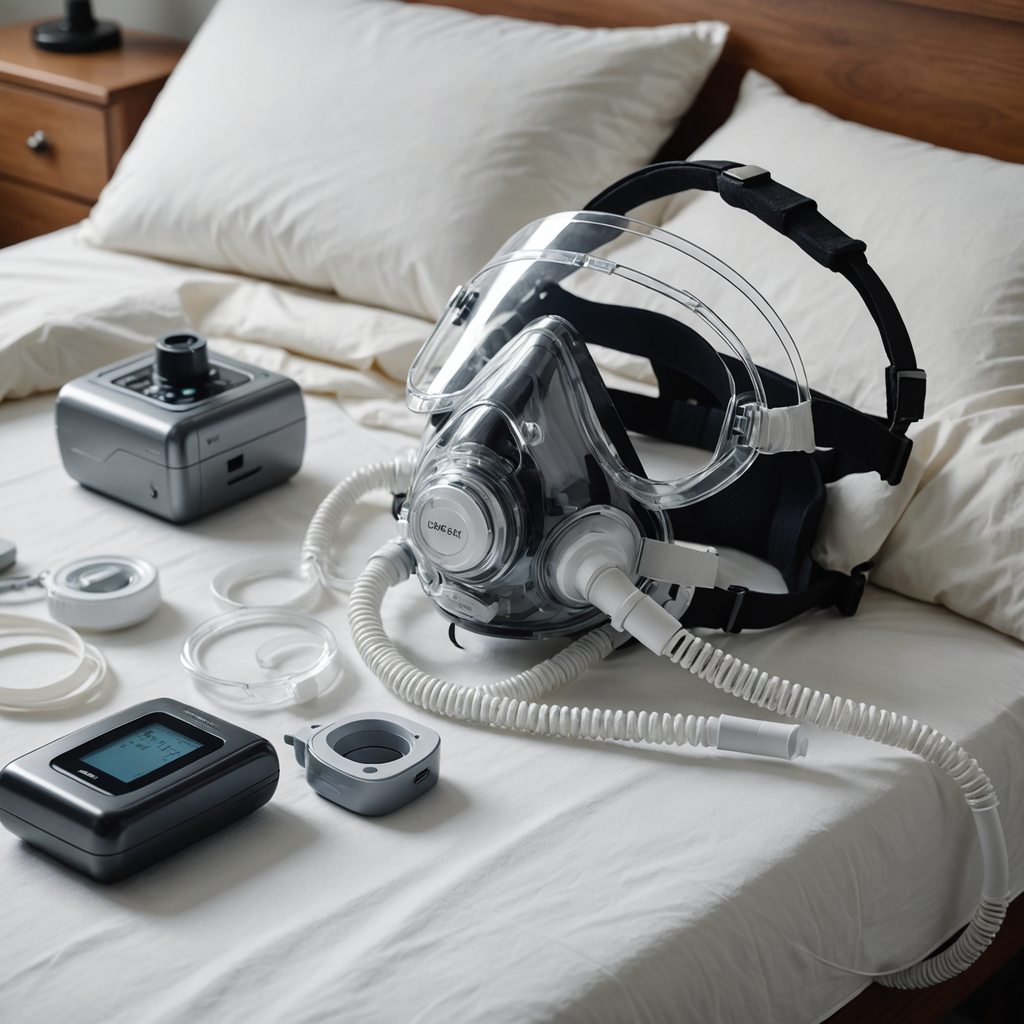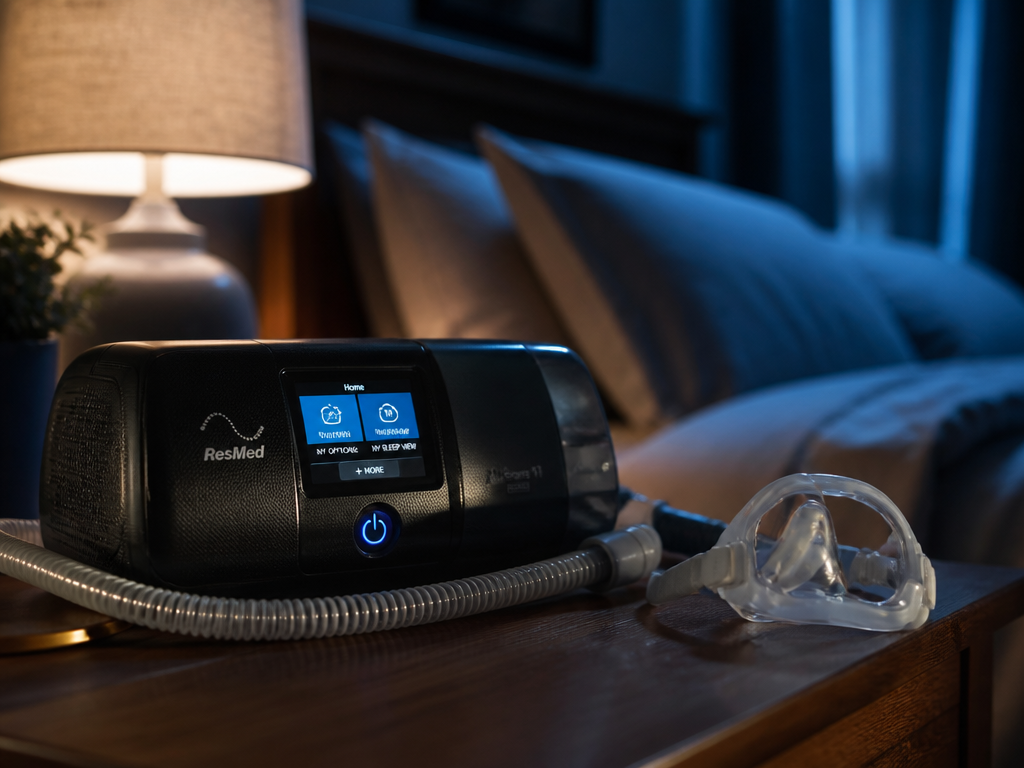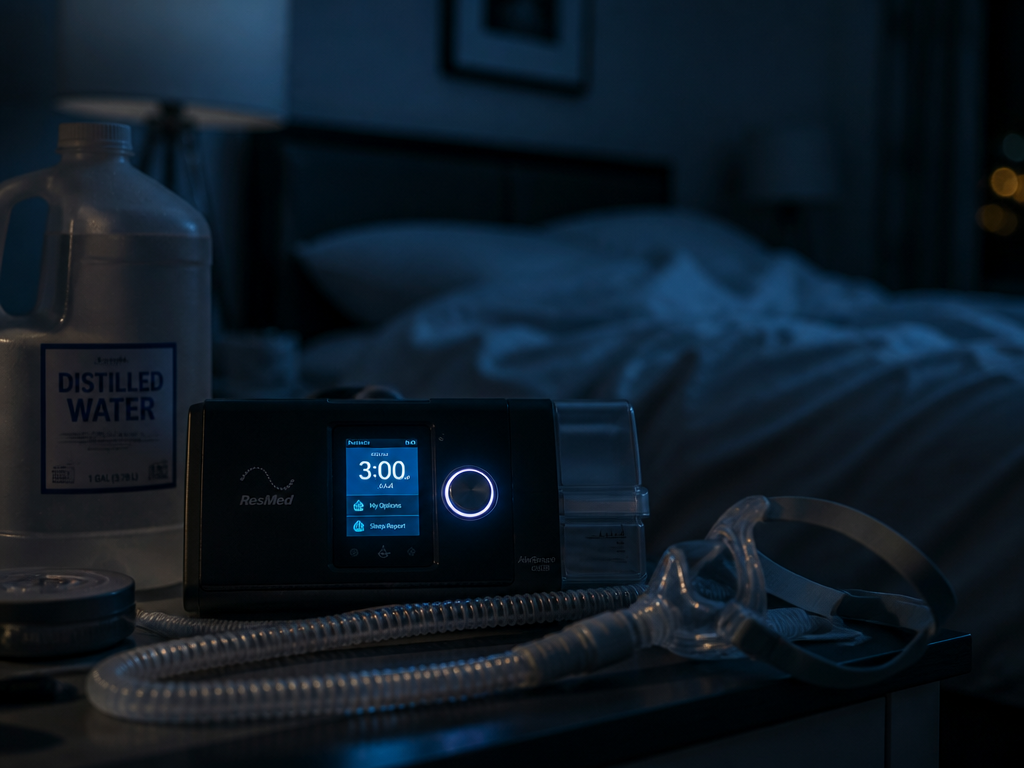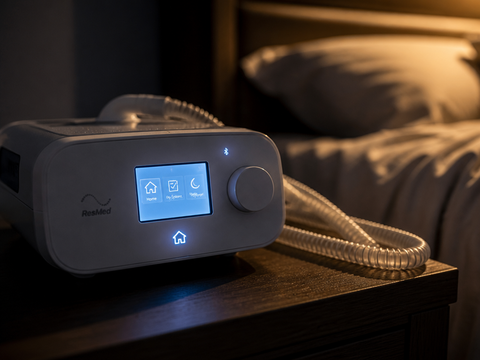
You already know the drill on the soft parts. The mask cushion goes brittle and starts leaking around month three. The tubing clouds and the headgear loses its grip. You swap them on a schedule, maybe prompted by a resupply text, maybe by the cold whistle of air escaping at 2 a.m. against your cheek.
The harder question is the box itself — the part that hums on the nightstand and almost never asks for anything. CPAP machine replacement is the decision nobody schedules, because the device rarely fails outright. It just gets quietly worse, and "quietly worse" is a difficult thing to act on when you're asleep for the entire performance.
This is a piece about how to tell, with actual criteria, whether the durable part of your therapy is still doing its job.
How long does a CPAP machine last?
Most continuous positive airway pressure devices are built and warrantied for roughly five years of nightly use, and that number is the one to start from. It's not a biological limit on the machine; it's an engineering and reimbursement convention. The motor — a high-speed centrifugal blower — is rated for thousands of hours, and at six to eight hours a night you accumulate those hours fast. A device run nightly logs around 2,000 to 2,900 hours a year. By year five you're well past 10,000 hours on a part that spins continuously, pulls in household dust, and lives in a warm, humidified airstream.
So five years is a reasonable planning horizon, not a cliff. Plenty of machines run cleanly past it. Some need attention before it. The calendar is one input, and the weakest of the three we'll weigh here.
What "still working" actually hides
A CPAP machine doesn't usually announce its decline, so it helps to understand the sequence by which it loses the plot.
It begins at the air intake. A fine-particle filter sits over the inlet, and behind it the blower draws room air in. As the filter loads with dust and skin cells and pet dander, airflow resistance climbs. A healthy machine compensates — that's what the closed-loop pressure control is for — but compensation costs motor effort.
Next, the blower itself. The impeller spins on bearings, often at tens of thousands of RPM, and bearings wear. Worn bearings show up first as sound: a new harmonic, a faint grind, a pitch you didn't used to notice. That noise is mechanical evidence that the motor is working harder or less smoothly to hold the same pressure. A machine straining to maintain 9 cm H₂O is, by definition, closer to the day it can't.
Then the pressure sensor and control loop, which is the part that matters most and shows least. The machine reads the pressure at the outlet and adjusts the motor many times a second to hold your prescribed setting against your breathing, your leaks, your position changes. Sensors drift with age and humidity exposure. A drifting sensor doesn't necessarily fail — it can deliver 8 cm H₂O while believing it's delivering 10, and report the 10 to you and your clinician. This is the failure mode that frightens sleep physicians, because the data looks fine while the therapy quietly underdelivers.
Finally the humidifier and its heated tubing, which live in the wettest part of the system. Mineral scale from tap water, a heater plate that no longer reaches temperature, a tube sensor that misreads — these produce rainout, dryness, and discomfort long before they produce a hard failure.
The point of walking through it in order is this: the parts that fail loudly (filter, humidifier) are the cheap, replaceable ones. The part that fails silently (the pressure-control loop) is the one that defines whether you still own a therapeutic device or an expensive white-noise machine.
Three ways to judge a machine
There are essentially three lenses through which to assess whether it's time. They don't agree with each other, and the disagreement is the useful part. Let's take them on named criteria: what each one measures, what it misses, and how much to trust it.
1. Calendar age and the reimbursement clock
What it measures: Elapsed time and, in the U.S., your insurer's willingness to pay for a new unit. Medicare and most private insurers operate on a five-year replacement cycle for durable medical equipment, provided you've documented adherence. That's why the five-year number is everywhere — it's as much a billing fact as a clinical one.
What it misses: Almost everything about your specific machine. A device used 4 hours a night in a clean, dry bedroom at sea level has lived an easier life than one run 9 hours a night in a dusty house with tap-water humidification. Calendar age treats both identically.
How much to trust it: As a budgeting and eligibility prompt, fully. As a verdict on whether your machine still works, barely. The clock tells you when you may replace it, not whether you should.
2. The therapy data
What it measures: This is the strongest lens, because it looks at outcomes rather than the box. Modern machines record nightly usage hours, your AHI (apnea-hypopnea index, the events-per-hour number your whole therapy exists to suppress), and mask leak. You can read these on the device screen, through the manufacturer's app, or — more completely — off the SD card with free software like OSCAR.
The trend line is what matters. If your AHI sat reliably under 5 for years and has crept upward over recent months without an obvious cause — no new weight, no new medication, no alcohol, no nasal congestion — something has changed. It might be your body. It might also be a machine no longer holding pressure the way it did.
What it misses: The sensor-drift problem named above. The data is only as honest as the sensor reporting it. A machine that under-delivers pressure while mis-measuring it can show a deceptively good AHI, because the events it's failing to prevent are partly invisible to its own count. This is rare, but it's the reason data alone isn't a complete answer.
How much to trust it: A great deal, with a caveat. A rising AHI trend is a real signal and worth acting on. A perfectly flat AHI is reassuring but not proof, because you're trusting the instrument to grade its own work.

3. The hardware's own behavior
What it measures: The physical state of the machine — sound, pressure feel, humidifier performance, and any error codes. This is the lens your senses already use. You notice the new whine. You wake feeling like the pressure was thinner. The humidifier rains out when it never used to.
What it misses: Subtlety and baseline. Unless you knew exactly how the machine sounded when new, a gradual change is hard to catch. Our hearing adapts; we normalize a slow decline night by night until a houseguest mentions the noise.
How much to trust it: Trust it most when something changes suddenly — a new grinding noise, a burning smell from the humidifier plate, a machine that won't hold prescribed pressure on a quick check. Sudden change is the body of the machine telling you something the data hasn't caught up to yet. Trust it less for slow drift, where the data lens is sharper.
Putting the three side by side
| Lens | Best at catching | Blind to | Verdict weight |
|---|---|---|---|
| Calendar / insurance clock | Eligibility, budgeting | Actual machine condition | Low — a prompt, not proof |
| Therapy data (AHI, leak, usage) | Slow efficacy decline | Sensor drift (self-grading problem) | High, with one caveat |
| Hardware behavior (sound, feel, errors) | Sudden mechanical failure | Gradual, normalized change | High for sudden change, low for slow |
Read the table as a whole and a verdict emerges on its own. No single lens is sufficient, and the calendar — the one most people default to — is the weakest. The strongest practical move is to triangulate: let the clock tell you when you're eligible, let the data tell you whether efficacy is slipping, and let your senses flag anything sudden. A machine that's five years old, holding a stable sub-5 AHI, and running quietly is not a machine you need to replace because a calendar says so. A two-year-old machine with a new grind and a creeping AHI is worth investigating regardless of how new it is.
The decision isn't "old or not old." It's "still delivering the therapy or not."
Where the data is thin
It would be dishonest to pretend the replacement question rests on a deep clinical literature. It doesn't.
There is strong evidence that CPAP works when it works — that consistent use at adequate pressure reduces the apnea-hypopnea index and improves daytime sleepiness, and that adherence is the dominant variable in outcomes. That much is well-established across decades of sleep medicine. What's far thinner is direct, published evidence on device aging specifically: how much real-world pressure accuracy degrades over five years of nightly use, at what point blower wear becomes clinically meaningful, how often silent sensor drift actually undertreats patients. Manufacturers test for this internally and design to it; the independent, peer-reviewed literature a curious reader could pull up is sparse.
So when you read a confident "replace it every five years," understand what that figure is and isn't. It's a sound engineering and reimbursement convention. It is not the output of a study that followed thousands of machines and measured the night their therapy quietly fell below threshold. The five-year number is reasonable. The certainty often attached to it is more than the evidence strictly supports.
That uncertainty is exactly why the data lens matters so much. You don't have to rely on population-level assumptions about when machines decay, because your own device hands you a nightly record of its own performance. Your machine is, in effect, running a small longitudinal study on itself. The instrument is imperfect, but it's specific to you, and that beats a generic average.
A note on the humidifier and tubing, since they sit between consumable and durable: these wear faster than the motor and are far cheaper to address. A machine that feels "off" is often a machine with a scaled heater plate or a tired tube sensor, not a dying blower. Rule out the cheap, replaceable causes before you conclude the unit itself is finished. Descale the humidifier, swap the filter, try a fresh tube. Surprisingly often, the "new machine" a user thinks they need is a $30 fix and a clean intake.
An honest rule of thumb
Here's what to do tonight, and it costs nothing.
Open your machine's app or screen and find your AHI and leak numbers. Note them. Then go find what they were a year ago — most apps keep the history, and if you read the SD card with OSCAR you'll see the whole arc. If your AHI has held steady under 5 and your leak is in range, your therapy is intact regardless of the machine's age; the box is doing its job, and a milestone birthday isn't a reason to retire it. If the AHI has drifted up over months with no lifestyle explanation, or if the machine has developed a noise it didn't have, treat that as a prompt to involve your clinician and durable-equipment provider — first to rule out the cheap fixes, then, if those don't account for it, to consider the machine.
In short: let performance, not the calendar, set the pace. Replace consumables on schedule. Replace the machine on evidence.
One more practical point. If you do replace, your new device will likely let your clinician set it to your existing prescribed pressure directly, so the transition need not feel like starting over. The therapeutic target travels with you; only the hardware delivering it changes. My own machine is four years and change into its life, which by the calendar means I'm a year out from the standard prompt. It's quiet — still the same low whir it had new, no new harmonics that I can hear. So twice a year, when the clocks change, I pull the SD card and look at the year's AHI trend in one screen. The last reading sat at 3.1, where it has sat since the second month I used it. I changed the filter, descaled the humidifier, and put the card back. The machine is older than its warranty wants me to think about and healthier than its age would suggest, and the only way I know that is that I asked it directly instead of asking the calendar.