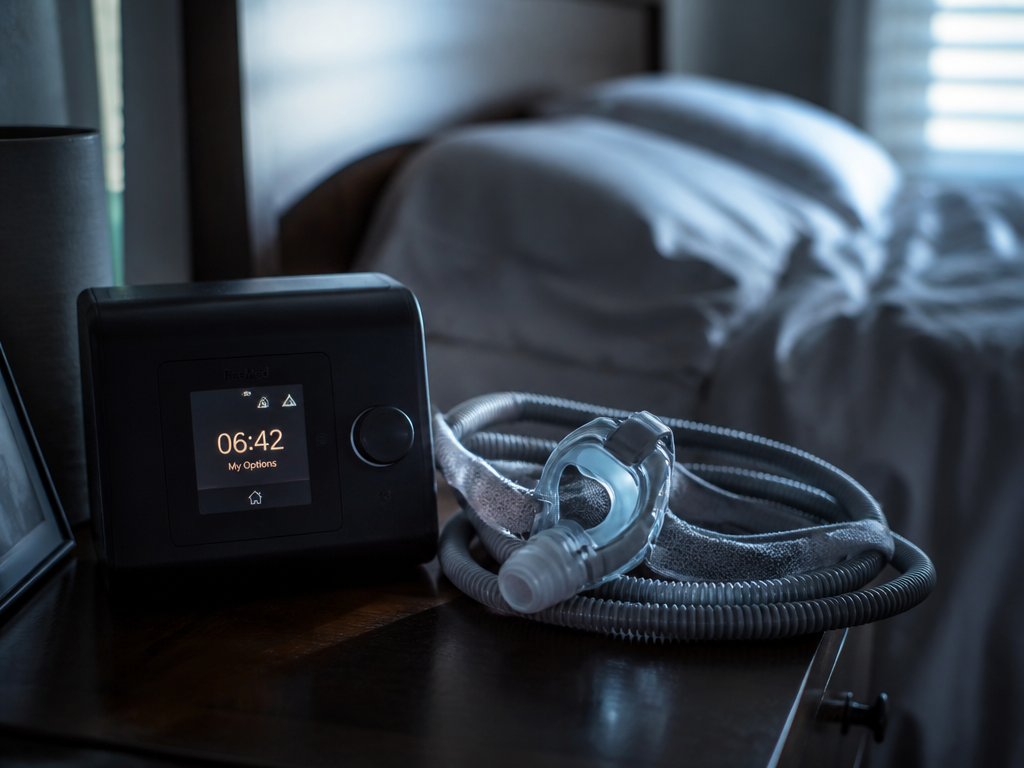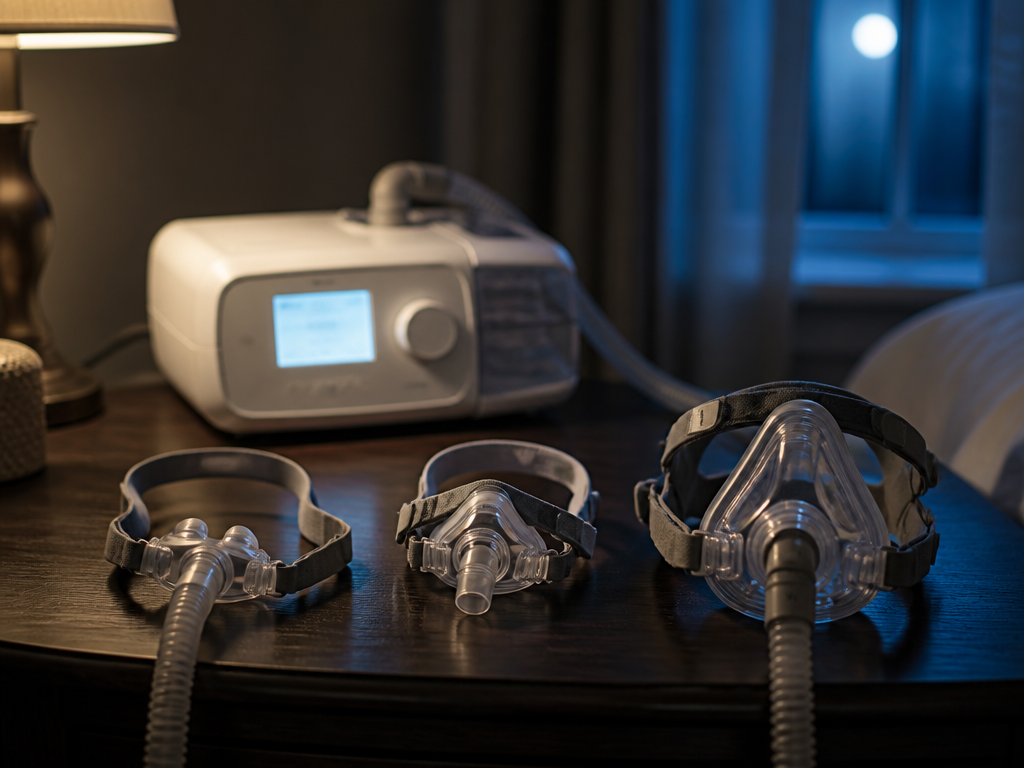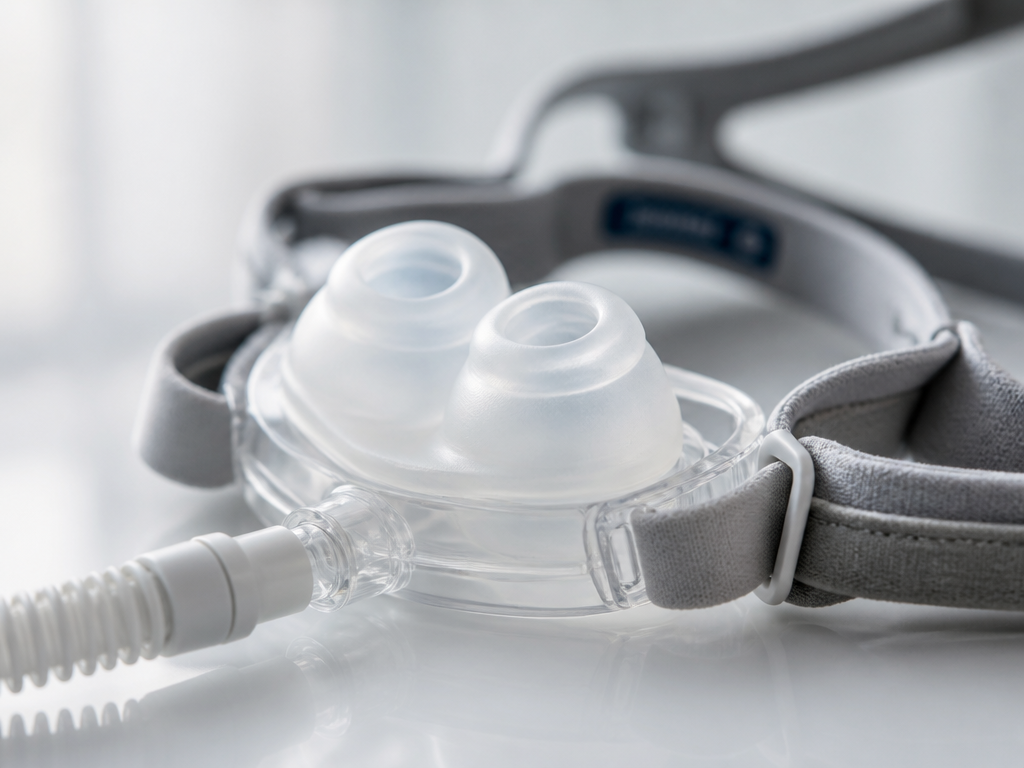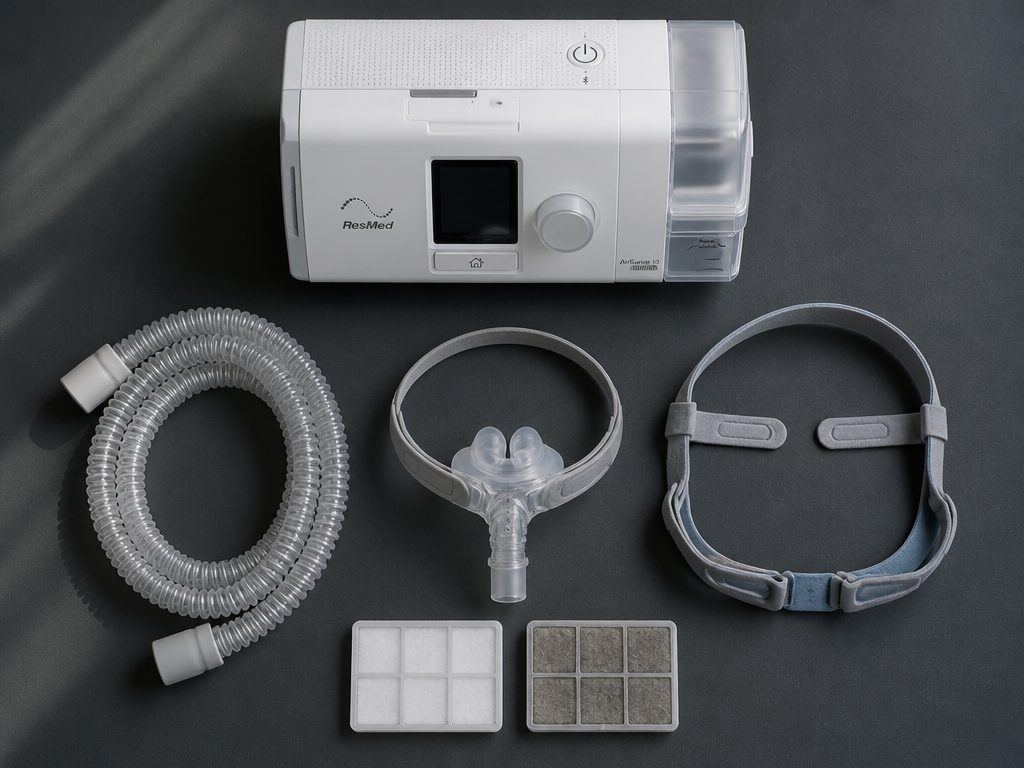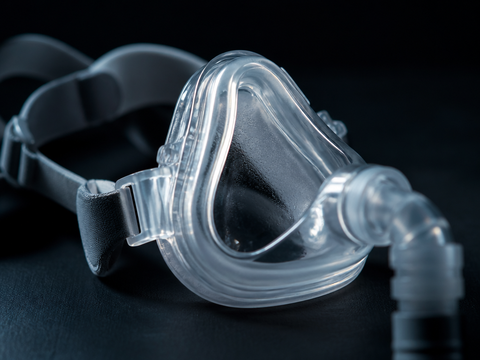
Ask around a sleep lab why a patient quit CPAP and the answer often arrives as a single word: compliance. The titration was clean. The machine worked. The patient just wouldn't wear it. It's a tidy story, and it has quietly shaped how the field treats CPAP mask innovation and design — as a comfort problem, a question of softer silicone and kinder padding, downstream of the real engineering happening inside the blower.
That framing is wrong in a specific, measurable way. The mask is not the soft part of the system. It is the part where the physics gets hardest.
The myth, stated plainly
It goes like this. Modern positive airway pressure devices are extraordinary — auto-titrating, humidified, quiet enough to sleep beside. The remaining problem is human. People don't like wearing things on their faces. Interface work is therefore styling: colors, strap webbing, packaging.
Two facts sit awkwardly against that. The first is Rotenberg, Murariu, and Pang (2016), Journal of Otolaryngology–Head & Neck Surgery, which pooled roughly two decades of published CPAP adherence data and found nonadherence sitting near 34%, with no meaningful improvement across the twenty years surveyed. Twenty years in which blowers shrank, algorithms learned to auto-titrate, heated humidification became standard, and expiratory pressure relief arrived. The curve did not move.
The second fact is vocabulary. The field stopped saying compliance and started saying adherence — an admission, embedded in a word, that something other than obedience was going on.
Neither fact proves the mask is the binding constraint. Adherence is multi-causal: claustrophobia, bed partners, insurance churn, how many times anyone follows up in the first month. But when you hold a system's output flat while dramatically improving one subsystem, you have learned something about where the limit actually lives.
What the research actually measured
The most useful evidence compares interface types head to head. The common citation is Andrade and colleagues' 2018 meta-analysis in Chest, pooling nasal versus oronasal CPAP studies: oronasal masks were associated with higher residual apnea-hypopnea indices, higher required pressures, and poorer adherence. Underneath it sit smaller mechanistic studies. Schorr and colleagues (2012, European Respiratory Journal) found in a small crossover group that switching the same patient from nasal to oronasal delivery at the same pressure left some with residual obstruction. Ebben and colleagues (2012, Sleep Medicine) titrated 21 subjects across three mask styles in a single night and found the optimal pressure differed systematically by style.
Call this what it is: mechanistically coherent and clinically useful, not settled. Most comparisons are observational or small crossovers, and one confound is glaring — patients are put into full-face masks because they mouth-breathe, and mouth-breathing tracks with more severe disease and higher pressures to begin with. The effect is probably real. Its size is thinner than the confidence with which it gets repeated at conferences.
Does the type of CPAP mask actually change how well the therapy works?
Yes — modestly, but enough to matter at the bedside. Averaged across studies, the same patient tends to need roughly 1–2 cmH₂O less pressure on a nasal interface than on an oronasal one to control the same airway. Lower pressure cascades: less leak, less aerophagia, less strap tension, fewer pressure-driven arousals. The interface is not a passive delivery accessory. It changes the pressure the airway demands.
What happens between the cushion and the airway
Here is the sequence in the order the body runs it, using the oronasal failure case because it's the one that shows the whole chain.
The cushion lands on two bones that move independently: the maxilla, which is fixed to the skull, and the mandible, which is not. Headgear tension resolves into a posteriorly directed force. During sleep the masseter and lateral pterygoid relax, and the mandible — now unbraced — translates and rotates backward. Imaging work suggests a few millimeters is enough to matter.
The genioglossus, the tongue's main protrusor, originates at the mandibular symphysis. Move the mandible posteriorly and the tongue base follows it into the retroglossal airway. The pharynx narrows at exactly the level the pressure is supposed to be splinting open.
The device sees the consequence. A flow-limited breath appears; the auto-algorithm raises pressure. Higher pressure raises the force trying to lift the mask off the face. The patient tightens the straps, or the seal breaks and leak begins. The algorithm chases the leak, the leak whistles across an eyelid, an arousal follows, and at 3 a.m. the mask comes off.

The chart records: noncompliant.
The force nobody prints on the spec sheet
The seal has to resist a blow-off force equal to pressure times the enclosed area. At 10 cmH₂O — about 980 pascals — the arithmetic is unforgiving, and it scales with how much face the mask encloses.
| Interface | Rough enclosed area | Blow-off force at 10 cmH₂O | Dominant failure mode |
|---|---|---|---|
| Nasal pillows | ~4 cm² | ~0.4 N (40 g) | Nare irritation, mouth leak |
| Under-nose cradle | ~8 cm² | ~0.8 N (80 g) | Upper-lip leak, sizing sensitivity |
| Nasal mask | ~20 cm² | ~2 N (200 g) | Bridge-of-nose pressure, mouth leak |
| Oronasal | ~60 cm² | ~6 N (600 g) | Mandibular displacement, side-sleep leak |
These are order-of-magnitude figures from typical cushion geometry, not manufacturer specifications. The ratio is the point: a full-face mask asks the headgear for roughly fifteen times the retention force of nasal pillows, and that force has to pass through skin.
Spread 6 N across a contact ring of maybe 15 cm² and you get about 4 kPa — roughly 30 mmHg. Landis's 1930 measurements put human capillary closing pressure near 32 mmHg. So the average interface pressure of a well-fitted full-face mask at moderate therapeutic pressure already sits at the edge of tissue ischemia, and real contact is never average. The bridge of the nose takes the peak because it is bone under about a millimeter of soft tissue. That is why nasal bridge ulcers are a recognized complication and not a fitting error.
What good design actually did about it
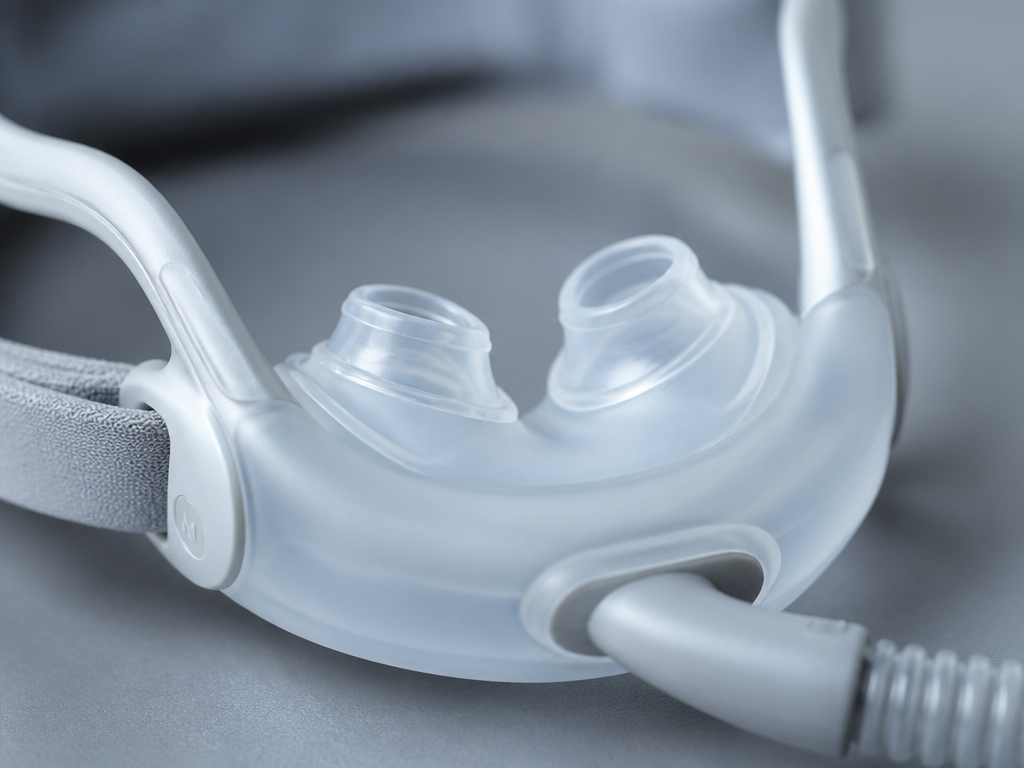
The better recent interfaces are not softer. They are smaller and better routed.
Minimum-contact geometry — pillows, under-nose cradles — attacks the enclosed area directly, cutting retention force by an order of magnitude and taking the nasal bridge out of the load path entirely. Routing the tube over the crown of the head, with the frame doubling as the air conduit, addresses a separate load: a 15 mm hose hanging off the front of a mask applies a lateral moment every time a side-sleeper rolls, and that moment breaks seals. Philips's DreamWear and ResMed's AirFit N30i are two commercial expressions of the same insight, which, as their engineers have been candid about, appears in older patents nobody productized.
Sizing is the unglamorous frontier. Facial anthropometry varies enormously — nasal width, bridge height, and nasofrontal angle differ meaningfully across ancestral populations, and craniofacial phenotyping work in sleep apnea has documented that the same AHI can arise from quite different face shapes. A three-size lineup fits the middle of a distribution well and the tails badly. Custom 3D-printed cushions have been trialed in small series with encouraging fit data; the barrier is not printing, it's reimbursement, resupply logistics, and the fact that a face changes with weight, age, and edema.
And the honest limit: most published evidence for these designs is short crossover preference data, often manufacturer-sponsored. Patients report liking them. Whether that converts into hours-per-night at twelve months is not well established.
An honest rule of thumb
Start nasal, and treat mouth leak as a problem to solve rather than a reason to enclose the mouth. Add heated humidity, check nasal patency, try a chin strap — and only escalate to oronasal when nasal has genuinely failed, not when the first night is rough. Do it fast: Budhiraja and colleagues (2007, Sleep) showed that use in the first week strongly predicts adherence at three months. The mask you fix on night three is worth more than the one you fix in month three.1
The myth is that patients fail CPAP because they can't tolerate a mask. The more accurate version is that masks fail patients, because sealing a pressurized volume against a warm, mobile, load-sensitive human face is one of the harder unsolved problems in respiratory engineering — and for two decades we graded the patient instead of the part.
-
The familiar adherence threshold — four hours a night on 70% of nights over thirty days — is a Medicare coverage rule, not a physiological finding. Benefit accrues roughly with dose, and the dose-response curve has no step in it at four hours. ↩