The picture in your head is probably twenty years old. A hard shell strapped over the whole face, a corrugated hose the diameter of a garden pipe, a hum like a small refrigerator. If you were diagnosed with sleep apnea last week and handed a prescription for a machine, that image is likely doing a lot of the emotional work right now — and it's outdated.
Modern CPAP masks are a different category of object. Some of them cover nothing but the rim of your nostrils. But the more useful thing to understand isn't that they look better. It's that mask comfort is not a matter of taste. It's a physical sequence — pressurized air enters your body at a specific point, does specific things to specific tissue, and gets held in place by straps that are either pulling correctly or pulling wrong. Comfort is what happens when each step in that chain behaves. Let's follow the air in the order your body meets it.
Are CPAP masks uncomfortable?
For most people who stick with therapy, no — but the honest answer is that comfort is highly individual and heavily front-loaded. The first two weeks are the hardest, and a mask that fits your face and your breathing style is comfortable in a way a poorly matched one never becomes. The discomfort people quit over is usually a fixable mismatch — wrong mask type, wrong size, wrong strap tension — not an inherent feature of the therapy. That distinction matters, because it means the problem is a fitting problem, and fitting problems have solutions.
Follow the air: what actually touches you, and when
CPAP stands for continuous positive airway pressure. The machine pushes a steady stream of room air at a prescribed pressure, usually somewhere between 4 and 20 centimeters of water (cmH₂O), enough to splint your airway open so the soft tissue at the back of your throat can't collapse and choke off your breathing. That's the whole therapeutic idea. Everything about the mask is in service of delivering that pressure without waking you up to complain about it.
First contact: the nostrils
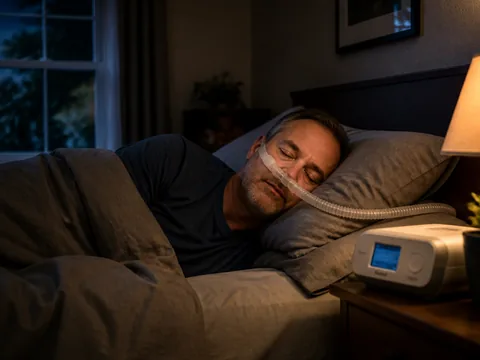
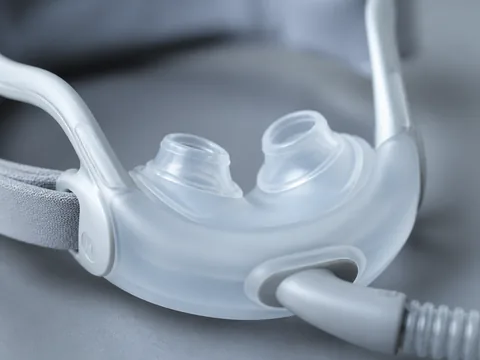
In the newest and smallest designs, the very first thing the air meets is the rim of your nose. Nasal pillow masks seat two soft silicone cushions just inside or against the nostrils, and that's nearly all the contact there is. There's no shell over the bridge of your nose, nothing across your cheeks. If you've read that this is the design that finally converts skeptics, this is why: the surface area touching your face is tiny, which means fewer pressure points, less to shift out of place when you roll over, and no wide plastic frame in your line of sight if you like to read in bed.
The tradeoff shows up immediately, though. All the pressure is concentrated at the nostrils, so at higher settings — say, above 12 cmH₂O — some people feel the airflow as a jet, drying or slightly stinging. Which brings us to the next thing the air does.
Downstream: the nose, the sinuses, and the drying problem
Once the air is moving through your nasal passages at pressure, it does what moving air always does to mucous membranes: it dries them. Nasal congestion, a raw feeling on waking, occasional nosebleeds in dry climates — these are the most common early complaints, and they're not really mask problems. They're humidity problems. Nearly every current machine has a heated humidifier and a heated hose precisely because dry pressurized air is the enemy of adherence. If your nose is unhappy, the first lever to pull is almost always the humidifier setting, not the mask.
The mouth: where the seal gets complicated

Here's where breathing style decides your fate. If you breathe through your mouth at night — and a lot of apnea patients do, because chronic nasal obstruction trained them to — a nasal mask will leak air straight out of your open mouth, and the machine will feel like it's failing. Two solutions exist. A chin strap can hold your jaw closed, or you move to a full-face mask that covers nose and mouth together and seals below the lip.
Full-face masks carry the old reputation for bulk, and it's partly deserved: there's simply more mask. But the current versions are lighter, and many now route the hose up over the forehead and off the top of the head, so a side sleeper isn't fighting a tube across the pillow. If you're a confirmed mouth-breather, this is not a compromise — it's the correct tool.
Last: the straps
The final link in the chain is the headgear, and it's the one people get wrong most often. The instinct, when a mask leaks, is to crank the straps tighter. This almost always backfires. Overtightening deforms the silicone cushion so it no longer seals evenly, creating new leaks and pressing red lines into your face by morning. A cushion is designed to inflate slightly with the machine's pressure and float against your skin. The straps are there to locate the mask, not to clamp it. Loose enough to slip two fingers under, snug enough not to shift — that's the target.
Three families, three honest tradeoffs
| Mask type | Contacts | Best for | The tradeoff |
|---|---|---|---|
| Nasal pillow | Nostril rims only | Side sleepers, readers, claustrophobia, low-to-mid pressure | Airflow can feel intense at high pressure |
| Nasal | Bridge and base of nose | Nose-breathers wanting a middle ground | Fails if you mouth-breathe; touches more face |
| Full-face | Nose and mouth | Mouth-breathers, high pressure, congestion | Largest footprint; more to seal |
There is no best mask. There's the mask that matches how you breathe and how you sleep, and the anxiety in the exam room usually comes from imagining you'll be assigned the wrong one for life. You won't. Most suppliers allow a fitting or exchange period in the first month, and using it is normal, not failure.
What the adherence numbers actually say
The uncomfortable truth in this field is that a lot of people stop using CPAP. Older studies put non-adherence somewhere between a third and half of patients — a frequently cited figure comes from Weaver and Grunstein's 2008 review in Proceedings of the American Thoracic Society, which framed poor adherence as the central problem limiting the therapy's benefit. That's the bad news, and pretending otherwise would insult you.
The better news is what the research points to as the fix. Adherence is strongly predicted by the first week of experience and by how well the mask is fitted — not by how severe your apnea is. Practical, hands-on interventions and troubleshooting in the early days move the numbers more reliably than willpower does. The equipment stopped being the main obstacle a while ago; the main obstacle now is getting through the adjustment period with someone paying attention.
An honest rule of thumb for the first two weeks
Wear it during the day before you sleep in it. Twenty minutes on the couch reading, mask on, machine running, teaches your face the sensation without the stakes of trying to fall asleep. If your nose dries out, raise the humidity before you touch anything else. If you leak, loosen — don't tighten — and check the cushion for a fold. And if it's still wrong after a week, call the supplier and swap it. That's not quitting. That's fitting.
You are not choosing between suffocating and sleeping. You are choosing the right small object for your particular face.