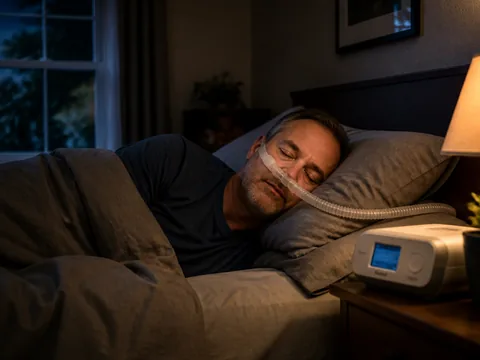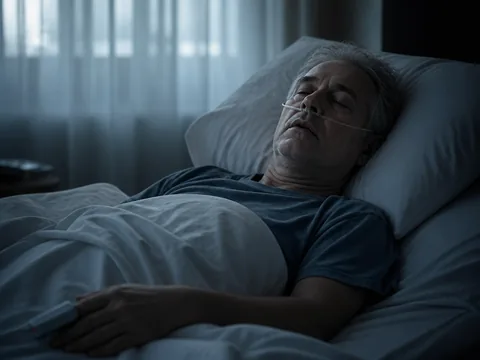
The number came back as 6.2. That was my apnea-hypopnea index — the AHI — from a home sleep test I'd worn for one night, a nasal cannula taped under my nose and a pulse sensor clipped to a finger. The report used a single word to describe it: mild. I read that word the way most people do, which is to say with relief. Mild sounds like a head cold. Mild sounds like something you wait out.
Then I looked at what the number was counting, and the relief got complicated. Because "mild" sleep apnea is not a description of how you feel. It's a line someone drew on a graph in the 1990s, and where you land relative to that line says less than you'd think.
What the number is actually counting
The AHI is a rate: the average number of times per hour that your breathing either stops entirely (an apnea) or drops to a shallow, oxygen-losing shadow of itself (a hypopnea) for at least ten seconds. My 6.2 means that, roughly six times an hour, all night, my throat closed enough to register.
The severity bands are simple, almost suspiciously so. An AHI under 5 is normal. Five to 15 is mild. Fifteen to 30 is moderate. Above 30 is severe. These cutoffs come largely from a 1999 American Academy of Sleep Medicine task force — the so-called Chicago criteria — which set them by expert consensus rather than by pinpointing thresholds where harm suddenly begins. That distinction matters. The line at 5 is real, but the body does not experience it as a cliff. Someone at 4.9 and someone at 5.1 are, biologically, the same person.
So the first honest thing to say is this: mild is a category, not a diagnosis of harmlessness. It tells you where you sit in a distribution. It does not tell you whether the arithmetic behind that number is doing something to you.
One obstructed breath, from the top
Here is what a single event looked like inside me, in the order it happened.
I fall asleep. The muscles that hold my upper airway open — the genioglossus chief among them — relax, as everyone's do. In a narrow or crowded airway, that relaxation is enough to let the soft tissue at the back of the throat collapse inward. I keep trying to breathe. My chest and diaphragm heave against a closed pipe, pulling harder, which only seals it tighter. No air moves.
Oxygen in my blood begins to fall. Carbon dioxide climbs. Chemoreceptors in the carotid arteries and brainstem notice, and they do the sensible thing: they trigger a surge of sympathetic nervous system activity — a jolt of adrenaline — and a brief arousal. I don't wake up in any way I'd remember. But my brain surfaces just enough to snap the airway muscles back to attention. I gasp, the airway opens, oxygen recovers. Then I sink back down and, often, the whole cycle begins again.
The breathing part is what the AHI counts. The adrenaline surge and the fragmented sleep are what the AHI misses, and they may be where the real cost lives.
What the research actually measured
The well-established finding is that severe untreated OSA raises cardiovascular risk — hypertension, stroke, atrial fibrillation. The classic reference is the Wisconsin Sleep Cohort, followed by Young and colleagues since the late 1980s; their 2008 analysis in Sleep reported markedly higher mortality in people with severe apnea over 18 years of follow-up.

The mild end is genuinely murkier, and it's worth being honest about that. The RICCADSA and SAVE trials, which tested CPAP treatment for cardiovascular prevention, mostly enrolled moderate-to-severe patients — so they don't cleanly answer the question of whether treating an AHI of 6 changes anything. The MOSAIC trial (Craig et al., 2012, Thorax), which did look at milder, minimally symptomatic patients, found CPAP improved daytime sleepiness but showed no clear effect on blood pressure or vascular markers over six months.
So the fair summary is: for mild OSA, the harm signal is plausible but thin, and it depends heavily on symptoms. An AHI of 8 in someone who sleeps like the dead and wakes refreshed is a different animal from an AHI of 8 in someone dragging through every afternoon. The number alone is a poor guide. The number plus how you actually function is a much better one.
Is mild sleep apnea worth treating?
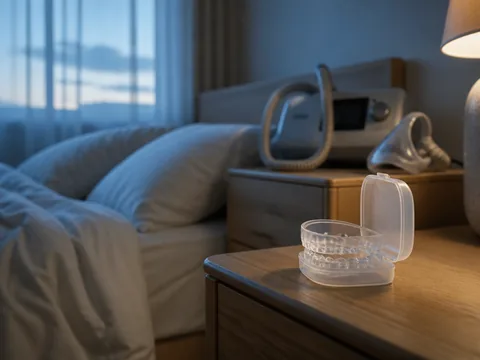
Usually it's worth evaluating, and sometimes worth treating — the decision hinges on symptoms and other risk factors more than on the AHI itself. If your mild reading comes with real daytime sleepiness, morning headaches, difficult-to-control blood pressure, or a bed partner reporting that you stop breathing, most sleep physicians will treat it, and treatment often helps. If you have no symptoms and no cardiovascular red flags, watchful monitoring and addressing the modifiable causes — weight, alcohol before bed, sleeping on your back, nasal congestion — is a defensible path. Mild apnea is frequently positional and frequently responsive to these changes, which is why it's the category where non-CPAP options genuinely earn their place.
An honest rule of thumb
Don't let the word "mild" make the decision for you, and don't let the number make it alone. Tonight, ask the two questions the AHI can't: Do I wake unrefreshed no matter how long I sleep? Has anyone told me I gasp or go silent in the night? If either answer is yes, the mild label deserves a conversation with a clinician regardless of how small the digit looks. If both are no, you have room to watch and adjust.
| AHI (events/hour) | Category | What it should prompt |
|---|---|---|
| Under 5 | Normal | Nothing, unless symptoms persist |
| 5–15 | Mild | Weigh symptoms + risk factors before deciding |
| 15–30 | Moderate | Treatment usually recommended |
| Over 30 | Severe | Treatment strongly recommended |
Back to 6.2
I wore the sensor a second night, partly out of curiosity and partly because a single night of data is a fragile thing to build a self-image on. Home tests are known to undercount — they can't detect the arousals a full lab study catches with EEG, so my true event rate might be higher.1 That night I slept on my side on purpose and skipped the glass of wine. The number came back 3.9. Below the line. Normal, technically.
Which told me exactly what the science had been telling me: my apnea was real, it was mild, and it was partly mine to move. Not a disease I have or don't have, but a rate I sit somewhere along, shifting with my body position and the last drink of the evening. The label was never the point. The behavior of the number was.
The myth is that mild sleep apnea is a lighter version of the same problem — serious apnea, scaled down, and therefore safe to ignore. The more accurate version is that mild apnea is the stretch of the spectrum where your symptoms, not your score, decide whether the number matters.
-
Home sleep apnea tests calculate events over total recording time rather than confirmed sleep time, and they miss cortical arousals. Both tend to pull the reported AHI downward compared with an in-lab polysomnogram. ↩