You come home from the sleep clinic with a folder. Inside are words that all seem to describe the same object: a machine that pushes air into your face while you sleep. CPAP. BiPAP. APAP. And then, if you started searching, a fourth term that keeps surfacing and refuses to explain itself — PEEP. They look like variations on one idea. They are not.
CPAP therapy is the most common treatment for obstructive sleep apnea, and it is probably the phrase written at the top of your prescription. But the reason the other acronyms crowd your search results is that they are genuinely related — they all describe positive airway pressure, air delivered above the pressure of the room. What separates them is smaller and more precise than the marketing copy suggests: when the pressure arrives, how many levels of it there are, and where the term actually lives in medicine. Get those three things straight and the folder stops being intimidating.
The plain difference, before anything else
If you only read one paragraph: CPAP delivers one steady pressure, all night, on both the breath in and the breath out. BiPAP delivers two pressures — a higher one when you inhale, a lower one when you exhale. APAP is a CPAP that adjusts its single pressure automatically, moment to moment. And PEEP is not a home device at all; it is a setting on a hospital ventilator that describes the pressure left in the lungs at the end of a breath out. CPAP, in a sense, is PEEP applied to a person who is breathing on their own. That last sentence is the whole knot, and we'll untie it below.
The mechanism, in the order your airway experiences it
To understand why pressure is the therapy, follow a single breath during an apnea.
You fall asleep. The muscles of the throat relax, as they are supposed to. In most people the airway stays open anyway. In obstructive sleep apnea, the soft tissue at the back of the throat — the soft palate, the base of the tongue, the walls of the pharynx — loses enough tone that it collapses inward, like a wet paper straw pulled on too hard. The airway narrows, then closes.
Now you try to inhale. Your diaphragm drops, your chest expands, and you generate suction — negative pressure — inside a tube that is already collapsing. The suction pulls the walls together harder. Airflow stops. Your blood oxygen begins to fall. After some seconds — sometimes ten, sometimes over a minute — the brain registers the problem and fires a brief arousal. You don't usually wake fully. But the arousal restores muscle tone, the airway pops open, you take a few recovery breaths, and the cycle resets. This can happen dozens of times an hour. The fragmentation, not the snoring, is what wrecks the sleep.
Positive pressure fixes this mechanically, not chemically. The machine holds the air in the airway at a pressure slightly above atmospheric, so that when the throat muscles relax, the column of air acts as a splint — the term of art is a pneumatic splint — propping the walls apart from the inside. There's no drug, no signal, no retraining of the muscles. It is plumbing. The collapse can't happen because the pressure inside the tube exceeds the pressure trying to close it.
Everything that follows — CPAP, BiPAP, APAP, PEEP — is a different answer to one question: how should that splinting pressure be delivered?
Three terms, one criterion at a time
Criterion one: when is the pressure delivered?
This is the cleanest divider between CPAP and BiPAP.
CPAP holds a single pressure through the entire respiratory cycle. Inhale, exhale, the pause between — the number stays put. The word inside the acronym does the work: the pressure is continuous. Your airway feels the same splint whether you're breathing in or out.
BiPAP — bilevel positive airway pressure — splits the pressure into two values. The higher value, called IPAP (inspiratory positive airway pressure), arrives when you breathe in. The lower value, EPAP (expiratory positive airway pressure), takes over when you breathe out. The machine detects the transition from your effort and switches between them.

Why bother with two levels? Because exhaling against a steady high pressure is uncomfortable, and for some people it's more than uncomfortable — it's counterproductive. If you have a condition where you struggle to move air out, such as certain neuromuscular disorders or COPD overlapping with apnea, lowering the pressure on exhale reduces the work of breathing. BiPAP is also used in central sleep apnea, where the problem isn't a collapsed airway but a missing signal from the brain to breathe, and some bilevel machines add a backup rate that delivers a breath if you don't take one on your own.
Criterion two: how many pressure levels, and who decides them?
CPAP: one pressure, fixed by your clinician after a titration study.
APAP — automatic positive airway pressure, sometimes written Auto-CPAP — is still a single pressure at any given instant, but the machine changes that pressure continuously in response to what it detects. It senses flow limitation, snoring vibration, and early signs of collapse, then nudges the pressure up until the airway is stable, and eases it back down when it can. You're prescribed a range — say, 6 to 14 cm H₂O — rather than a fixed number. APAP is useful when your pressure needs vary a lot across the night, across body positions, or across REM versus non-REM sleep.
BiPAP: two pressures, IPAP and EPAP, each set by a clinician (and, on auto-bilevel units, adjusted within ranges).
Criterion three: where does the term actually live?
This is where PEEP enters, and where the confusion is most understandable, because PEEP and CPAP are describing nearly the same physical thing in two different rooms of the hospital.
PEEP — positive end-expiratory pressure — is a setting on a mechanical ventilator, the kind used in an operating room or an intensive care unit. When a ventilator pushes a breath into a sedated or critically ill patient, PEEP is the amount of pressure the machine holds in the lungs at the end of the exhale, before the next breath. It keeps the small air sacs, the alveoli, from collapsing completely between breaths. That collapse-and-reopen cycle is damaging to lung tissue, and PEEP prevents it.
Here is the link that makes search engines shove PEEP into your CPAP results. CPAP is functionally the continuous application of a positive end-expiratory pressure to someone who is breathing on their own. In a ventilated patient, the machine does the breathing and PEEP is the floor pressure between machine-delivered breaths. In CPAP, you do the breathing and the machine simply maintains a constant floor pressure the whole time. Same physics — a pressure that never returns to zero — deployed for two different populations. Physiologists sometimes describe spontaneous CPAP as "PEEP in the awake, spontaneously breathing patient," which is exactly why the terms tangle online.
| CPAP | APAP | BiPAP | PEEP | |
|---|---|---|---|---|
| Pressure levels | One, fixed | One, auto-adjusting | Two (IPAP / EPAP) | One (a ventilator setting) |
| Changes during a breath? | No | Between breaths | Yes — inhale vs. exhale | It is the end-of-exhale pressure |
| Who breathes? | You | You | You (backup rate optional) | The ventilator (usually) |
| Where it's used | Home, sleep apnea | Home, sleep apnea | Home or hospital | ICU / OR ventilators |
| Common on your prescription? | Yes | Yes | Sometimes | Almost never |
The practical takeaway: if a term shows up in your discharge paperwork, it's almost certainly CPAP, APAP, or BiPAP. If you encountered PEEP, you probably met it while reading around your diagnosis, not on your own prescription. It belongs to a different setting.
The number after the acronym
Once you know which machine you have, the number matters more than the letters. Positive airway pressure is measured in centimeters of water — cm H₂O — an old unit that refers to how high a column of water the pressure could lift. Home therapy typically runs somewhere between about 4 and 20 cm H₂O.
A fixed CPAP prescription might read "CPAP 9 cm H₂O." An APAP prescription reads as a range: "APAP 5–15." A BiPAP prescription gives two: "BiPAP 14/8," meaning IPAP 14 on the way in, EPAP 8 on the way out — and the difference between those two numbers, called pressure support, is what does the breathing assistance. Where your number lands was determined either by an in-lab titration study, where a technician watched your airway respond to rising pressure overnight, or by a period of auto-titration where the machine found the pressure that kept you stable and a clinician read the data afterward.

If your therapy feels wrong — too forceful, too weak, impossible to exhale against — that number is what gets adjusted, and it should be adjusted by the prescribing clinician rather than guessed at from the menu. Many machines also offer exhalation relief (ResMed calls it EPR, Philips calls it C-Flex), which briefly drops the pressure at the start of the exhale to make it feel less like breathing against a wall. That's a comfort feature, not a change to your prescribed therapeutic pressure.
What's well-established, and what is thinner than it sounds
The mechanism above — collapse, splint, resolution — is well-established. That positive airway pressure eliminates obstructive events during sleep is not seriously in dispute; you can watch the apneas disappear on the overnight data the moment adequate pressure is applied. That treating apnea improves daytime sleepiness in symptomatic patients has solid support. A frequently cited synthesis here is the Cochrane review by Giles and colleagues (2006), which pooled dozens of randomized trials and found CPAP reduced subjective and objective sleepiness compared with control or placebo in people with moderate-to-severe apnea.
Where the confidence usually outruns the data is the claim that the therapy prevents heart attacks and strokes. This is plausible — untreated apnea is associated with hypertension and cardiovascular disease — but the large randomized trial that tested it directly, SAVE (McEvoy et al., 2016, New England Journal of Medicine, roughly 2,700 patients with existing cardiovascular disease and moderate-to-severe apnea), did not find that CPAP reduced cardiovascular events over an average of about 3.7 years. The likely reason is that participants used the device only around 3.3 hours a night on average — below the threshold most clinicians consider therapeutic. So the trial may have tested adherence as much as it tested the therapy. The honest position: the sleep and sleepiness benefits are firm; the cardiovascular protection is plausible but unproven at the level of a positive randomized trial, and adherence is the confounder haunting the whole question.
Adherence is the quiet center of all of this. The device only works on the nights you wear it, for the hours you wear it. A durable finding across the literature — the review by Sawyer and colleagues (2011, Sleep Medicine Reviews) is a standard reference — is that a large fraction of patients, on the order of a third to a half depending on how "adherent" is defined, use the machine less than recommended, and that early experience in the first week or two strongly predicts long-term use. Which is to say: the difference between a therapy that works and one that doesn't is often not the acronym on the box. It's whether the mask fits, whether the pressure feels tolerable, and whether the first few nights are bad enough to quit.
An honest rule of thumb
Read your prescription for three things, in this order, tonight. First, the acronym — that tells you whether the pressure is single (CPAP/APAP) or split into inhale and exhale (BiPAP). Second, the number or numbers in cm H₂O — one value means fixed, a range means auto-adjusting, two values means bilevel. Third, anything labeled a comfort or relief feature — ramp, EPR, C-Flex — which changes how the therapy feels without changing the therapeutic pressure itself. If you can name those three things, you understand your own prescription better than most people leaving the clinic do, and you'll know exactly what to ask about when something feels off.
And if you find PEEP in your notes, breathe easier: you've wandered into the ventilator literature, not your own treatment plan. It's the same idea as your machine — a pressure that never drops to zero — wearing hospital clothes.
What this looks like lived out
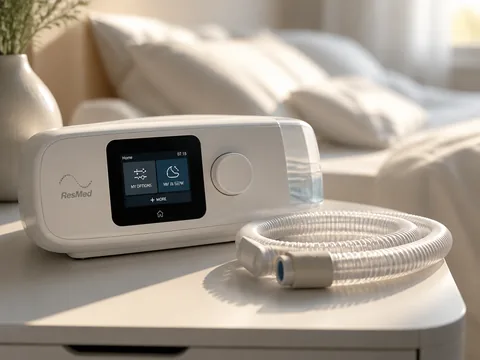
I keep the little card from my titration study in the drawer of the nightstand, and the number on it is 8. Not 8 to 12, not 14 over 8 — just 8, a fixed CPAP pressure, which is another way of saying my airway is the ordinary kind of unreliable and needed only one steady splint to stay open. The machine on the table doesn't hiss or announce itself. It holds a column of air at eight centimeters of water against the back of my throat, all night, and the paper straw stays round. That's the entire theory of it, sitting on the furniture.