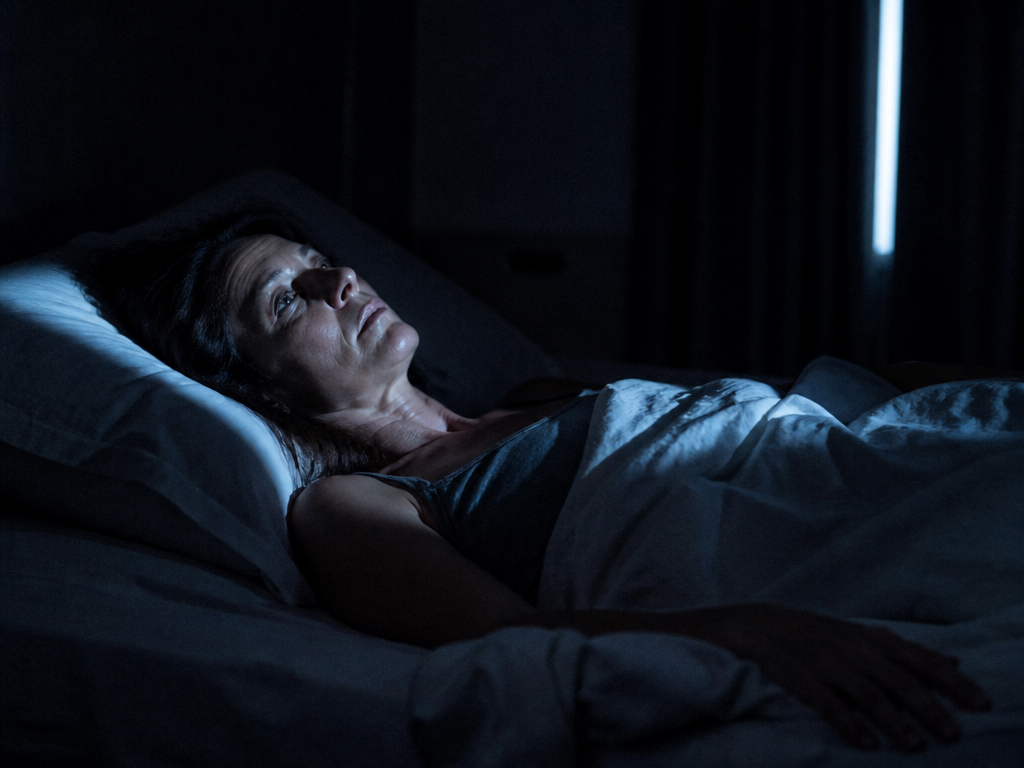
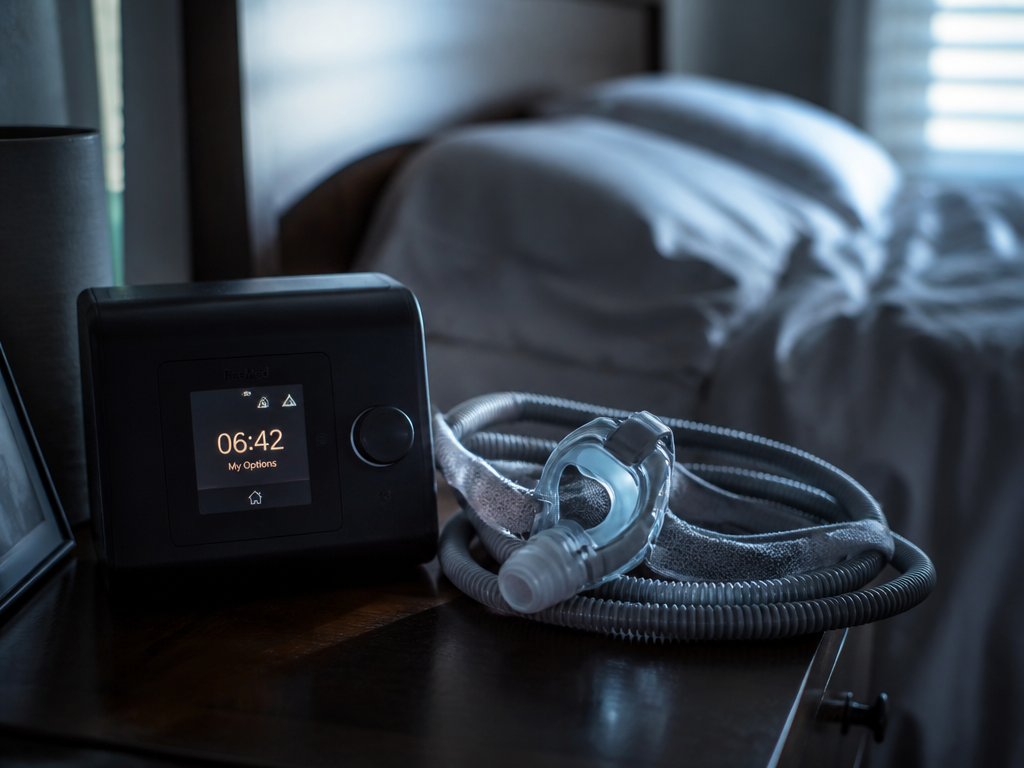
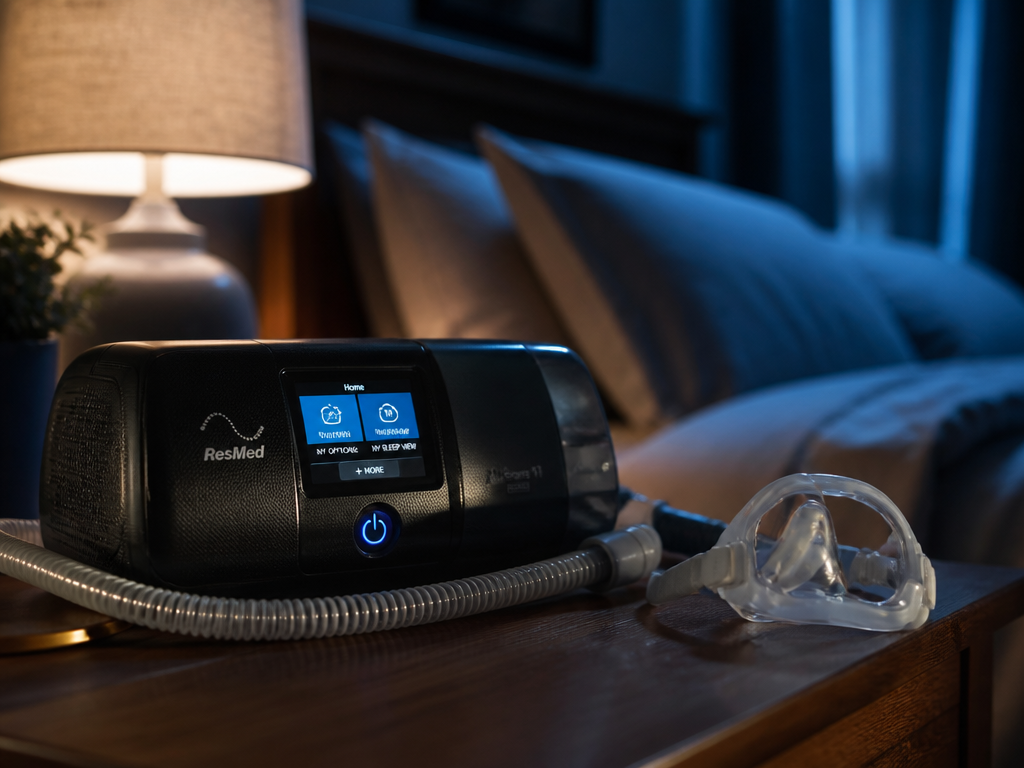
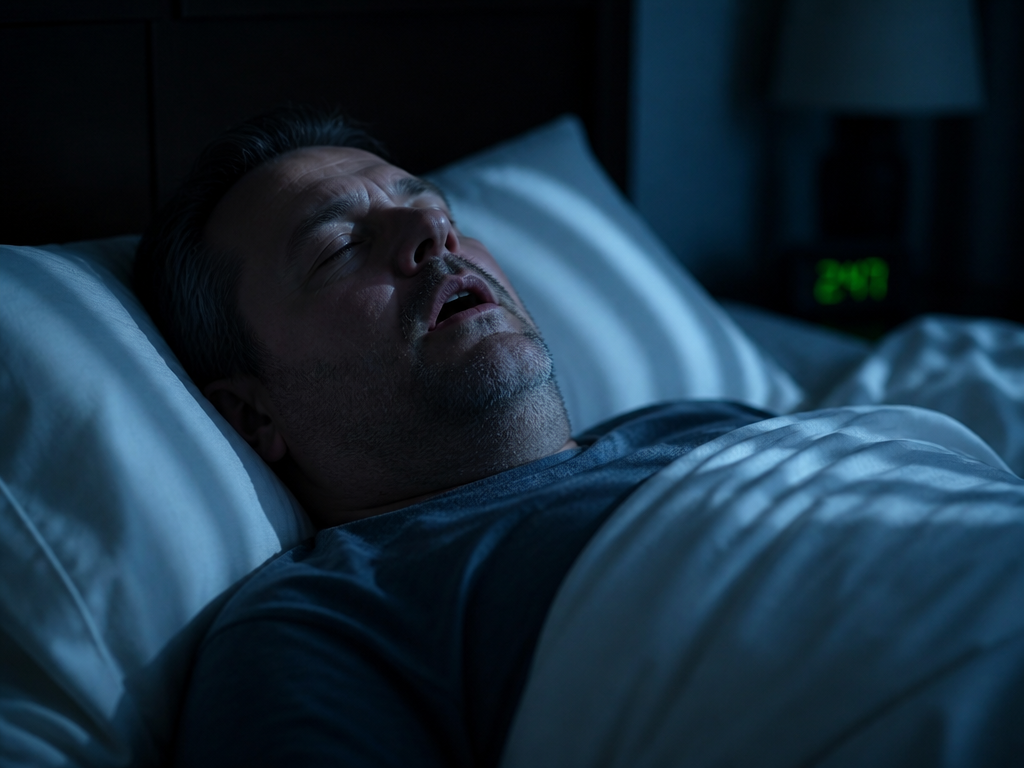
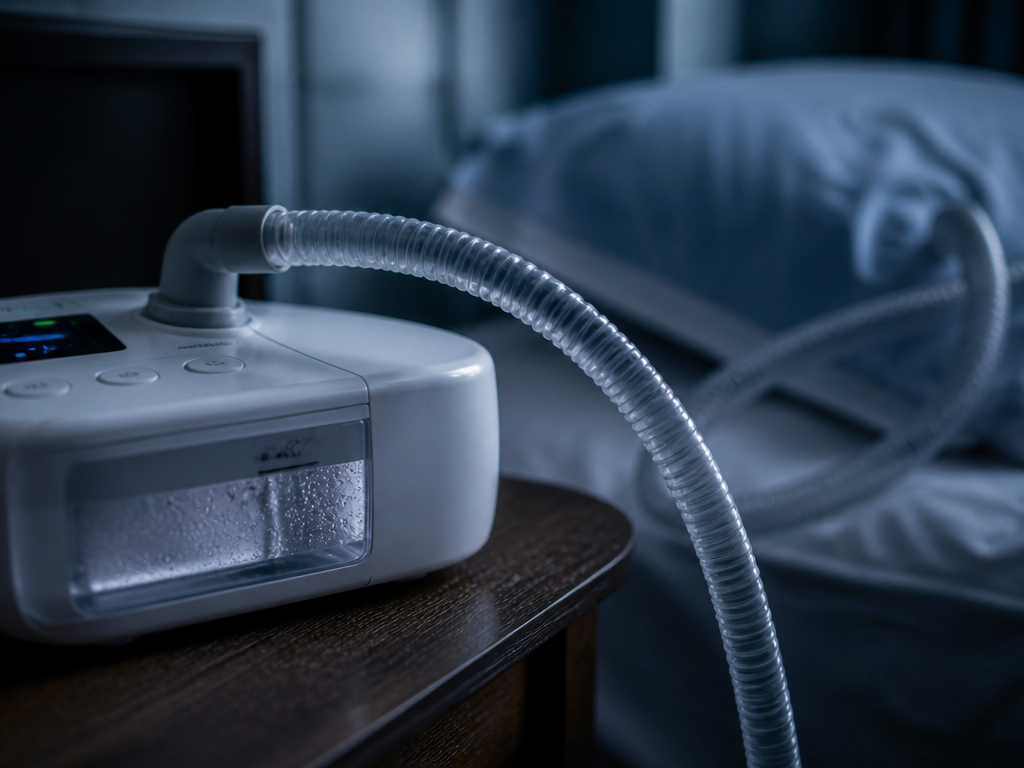
A man lies awake in the dark. He is not gasping for air — that's the point. The machine on the nightstand is doing its job, pushing pressurized air through a tube into a mask strapped to his face, and his oxygen is fine for the first time in years. What's keeping him up is the sound of his wife on the far edge of the mattress, very still, very quiet, the particular stillness of someone pretending to sleep so she doesn't have to talk about it.
This is the part of CPAP therapy that the prescription doesn't address. The device treats the airway. It does not treat the bed.
Continuous positive airway pressure is the standard treatment for obstructive sleep apnea, and on the medical merits it is not really in dispute. What's in dispute, in thousands of bedrooms, is what to do with the thing — whether to push through the discomfort together, retreat to separate rooms, or rebuild the sleeping arrangement around it. Three roads. People take all three. They don't lead to the same place.
Does CPAP affect your partner's sleep?
Yes — and usually for the better, which surprises people who expect the machine to be the problem. The honest comparison isn't CPAP versus silence. It's CPAP versus untreated apnea, and untreated apnea is loud, restless, and frightening to lie beside. Modern machines run around 26 to 30 decibels at the device, roughly the volume of a whisper or a quiet library. Habitual snoring from obstructive apnea routinely hits 50 decibels and can spike past 80 — somewhere between a dishwasher and a garbage disposal. So the partner who dreads the hum is often comparing it to a memory of quiet that hasn't existed in their bed for a long time.
There's a study people reach for here, and it holds up. Beninati et al. (1999), in Mayo Clinic Proceedings, recorded the sleep of ten bed partners of apnea patients across two nights — one with the patient untreated, one on CPAP. The partners gained an estimated 62 minutes of sleep per night when the machine was running, and their sleep efficiency improved measurably. Ten people is a small study. But it points the same direction as everything since.
What untreated apnea is actually doing, in order
Walk through a single obstructed breath, because the sequence is the whole story. The sleeper's throat muscles relax and the airway collapses. Airflow stops — that's the apnea, often for ten to thirty seconds. Blood oxygen drops. The brain, sensing the falling oxygen, fires a brief arousal: a partial waking the sleeper won't remember but that fragments the architecture of the night. The muscles snap back, the airway reopens, and the breath returns as a gasp or a snort. Then the cycle restarts, sometimes thirty or more times an hour in severe cases.
Now put a second person in the bed. Each gasp is a small alarm. The partner's own sleep fragments in sympathy — they surface, they listen, they wait for the next breath. Over months this is not neutral. It is two people losing sleep from one person's airway. The resentment that builds is rarely about love. It's about exhaustion, and exhaustion is corrosive to patience in a way few couples see coming.
Three arrangements, compared honestly
Couples mostly settle into one of three patterns. It's worth laying them side by side against the things that actually matter: how much noise lands on the partner, what happens to physical closeness, and — the quiet variable that decides everything — whether the patient keeps using the device at all.
| Noise on partner | Intimacy & closeness | Effect on adherence | |
|---|---|---|---|
| Tough it out, unchanged | Low machine noise, but mask leaks and tube tangles disrupt both | Preserved in proximity, strained by friction | Often poor — discomfort drives drop-off |
| Separate bedrooms | Eliminated | Eroded; the bed stops being shared space | Mixed — easier to skip with no witness |
| Adapt the shared setup | Low, and falling with each adjustment | Preserved and often improved | Strongest — comfort and accountability compound |
The first road, tough it out without changing anything, is where most people start and where many quietly fail. The machine itself is quiet, but an ill-fitting mask leaks a thin jet of air that whistles across a partner's cheek at 3 a.m., and a stiff hose yanks the mask sideways every time the patient rolls over. The couple stays in the same bed, which is good. But nothing about the setup is solved, and discomfort is the single best predictor of someone abandoning treatment. Roughly a third to half of patients stop using CPAP within the first year — the figures vary by how you define "using it," but the drop-off is real and well documented.
The second road, separate bedrooms, looks like a solution and sometimes is one. Nobody wakes anybody. The partner finally sleeps. For some couples this is a sane, generous accommodation, and there's no shame in a person needing rest. But it removes the one thing that may matter most: the witness. When no one is in the room, the mask is easier to leave on the nightstand. The bed stops being a place you share and becomes two separate logistics problems. The drift is gradual and hard to reverse.
The third road, adapt the shared setup, is the unglamorous one that tends to work. It means treating mask fit as a process, not a one-time fitting — trying a nasal pillow mask instead of a full-face one if leaks are the issue, running the hose over a headboard hook so it stops tugging, using the machine's ramp feature so the pressure starts gentle. It means the partner staying involved without becoming the enforcer. None of this is dramatic. It's the difference between a device you endure and one you forget you're wearing.
Set against the three criteria, the verdict isn't subtle once you look at it directly. Separate rooms solve the noise and sacrifice the relationship. Toughing it out preserves the relationship and sacrifices adherence. Only the third arrangement holds both, and it holds them precisely because comfort and closeness reinforce the one behavior the whole thing depends on.
An honest rule of thumb for tonight
If the mask is the problem, fix the mask before you fix the bedroom. Most people who quit CPAP quit over fit and comfort, not over the idea of treatment — so spend the appointment getting the interface right, ask specifically about leak and tube position, and give the shared bed two more weeks before anyone packs a pillow down the hall. Separate rooms should be a decision, not a slow accident.
And bring your partner into it as an ally, not an auditor. The bed partner is the one person who can tell you whether the leaks stopped and the gasping ended — information you literally cannot gather about your own unconscious self.
There's one thing the data can't yet settle. We know that patients with engaged, supportive bed partners use CPAP more consistently — that correlation is solid across multiple studies. What we don't cleanly know is the direction of the arrow. Does sharing a bed cause better adherence, by adding comfort and accountability? Or do the couples who stay in the same bed simply have stronger relationships to begin with, and would have stuck with treatment regardless? The machine can measure the air it moves to the tenth of a liter. It still can't tell us why the people next to it stay.