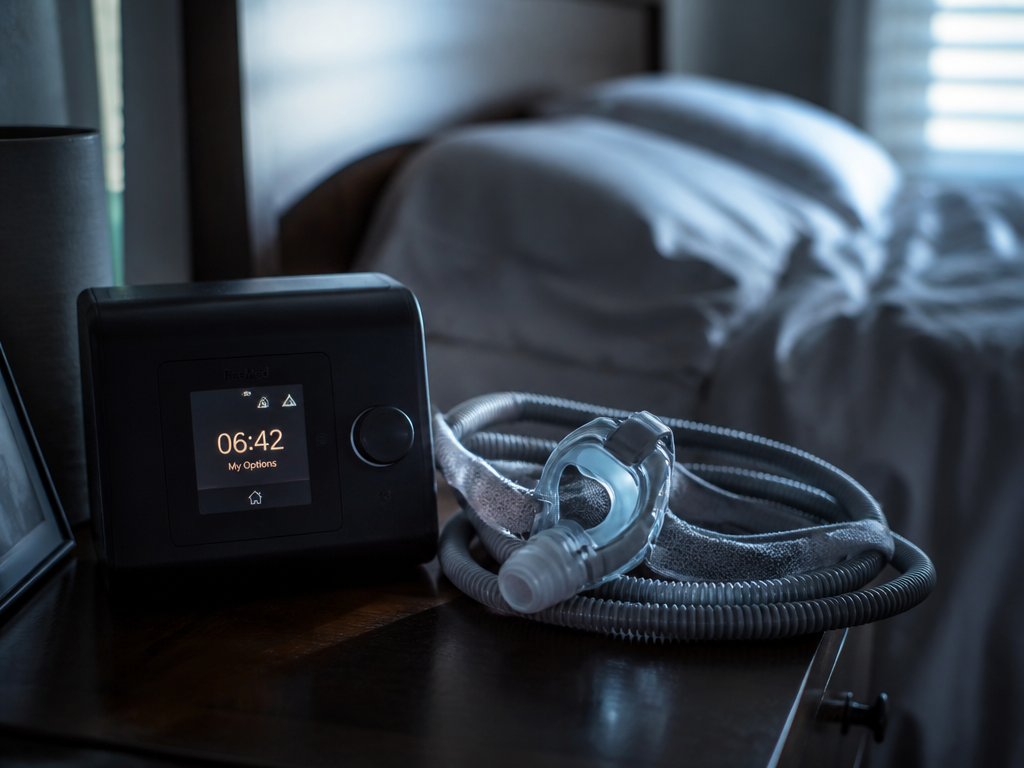
Sixty-five percent of CPAP users say the size of their machine keeps them from traveling with it. That figure has been attached to portable CPAP devices since 2017, when ResMed announced the AirMini, and it has the seductive shape of a real finding: specific, surprising, actionable. It is also a manufacturer-commissioned survey of a manufacturer's own customer list. It was never published in a journal and, as far as I can find, never replicated by anyone without a device to sell.1
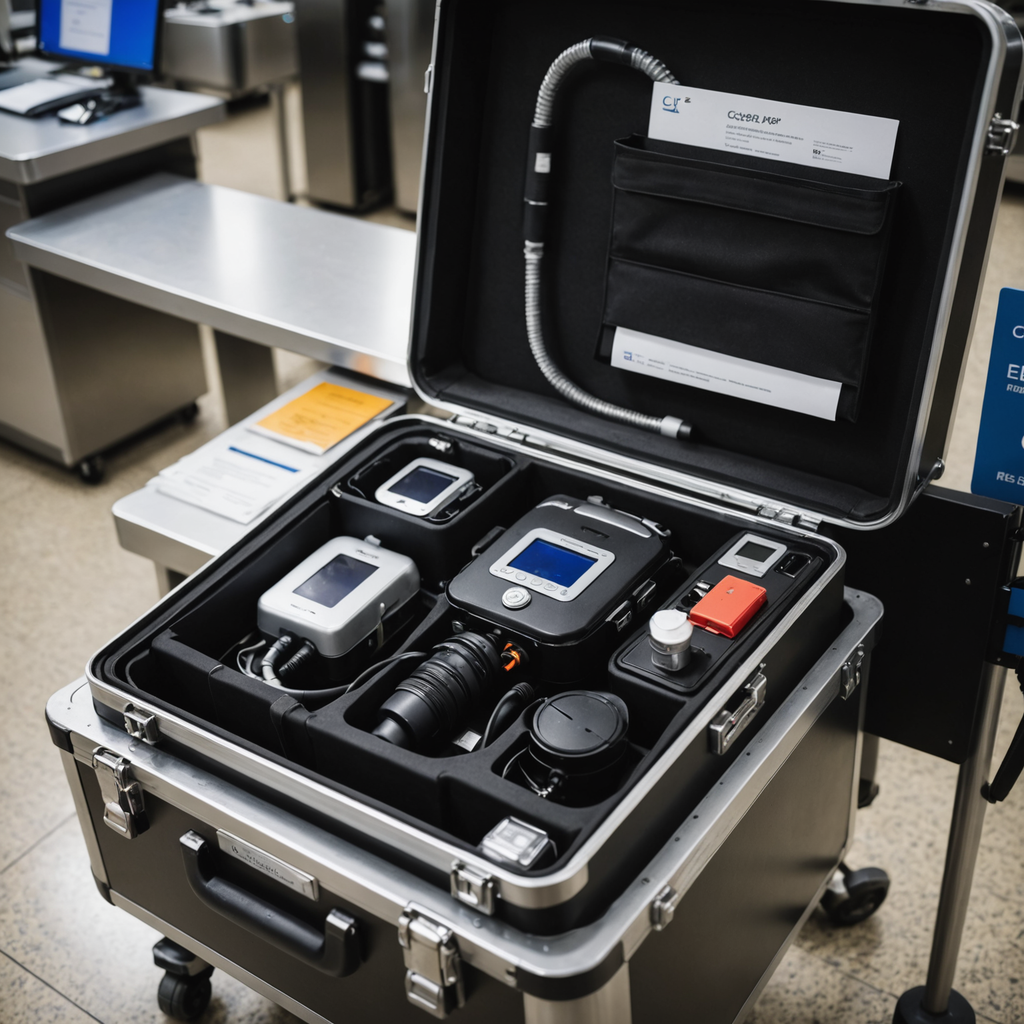
I've moved a CPAP through a lot of airports in the last two years. My honest read is that the number is directionally right and evidentially worthless — an awkward pair of ideas to hold at 5 a.m. while a stranger swabs your humidifier chamber for explosive residue. The barrier is real. The measurement of it is marketing.
So: what people actually do about it, what the physiology actually says, and what I do.
What most people do
The failure is never dramatic. Nobody decides to stop treating their sleep apnea. They decide that this trip is only two nights, that the case is in the closet, that the flight boards at six and the hotel might not have an outlet near the bed.
Four patterns, roughly in order of how often I hear them. Leave it home for short trips. Check it as luggage, against every manufacturer's advice and every baggage handler's résumé. Bring it and never run it, because the only outlet is behind an immovable headboard. Or bring it, run it, and spend the night with the dry mouth of a humidifier you couldn't fill.
None of this is new, and none of it is unique to travel. Adherence has been mediocre since Sullivan described the therapy in 1981 (Lancet, five patients). In 1993, Kribbs and colleagues, writing in the American Review of Respiratory Disease, hid monitors inside the machines of 35 patients and found what covert monitors always find: people used the device less than they reported. Under the threshold that later hardened into the Medicare standard — four hours a night on 70 percent of nights — fewer than half qualified as regular users. Weaver and Grunstein's 2008 review put non-adherence somewhere between 29 and 83 percent depending on the definition, which is another way of saying the field has never agreed on what counts.
Then there's the part that belongs in this magazine. A traveler who spent the night with an unsplinted airway does not wake up neutral. They wake up scraped out, and they treat it with coffee, often a lot of it, in a time zone their liver hasn't caught up to. Caffeine is an adenosine receptor antagonist, mostly at A1 and A2A. Adenosine accumulates in the basal forebrain across the waking day and is one of the signals the brain uses to keep score of how long you've been up. Caffeine parks in the receptor without activating it. The sleepiness signal is still being sent. You've just stopped receiving it.
Nothing in that sequence opens a pharynx.
What the evidence suggests
Here is what the press materials get right, for once: a night without treatment is not a gentle taper. It's a return to baseline.
One night off, in the order it happens
You fall asleep. Within minutes, muscle tone drops in the genioglossus and the other pharyngeal dilators — the muscles whose entire job, while you're unconscious, is holding a soft tube open. The palate and the base of the tongue drift backward. Airflow narrows, then stops, while the diaphragm keeps pulling against a closed door. Intrathoracic pressure swings sharply negative. Arterial oxygen falls, CO2 climbs, chemoreceptor drive escalates. Somewhere between ten and forty seconds in, the brain issues a cortical arousal — brief, almost never remembered — dilator tone snaps back, the airway pops open, and you take the gasp your bed partner describes the next morning. Heart rate and blood pressure spike with the sympathetic surge. You descend again. It repeats. At an apnea-hypopnea index of 30, that's roughly 240 times in an eight-hour night.
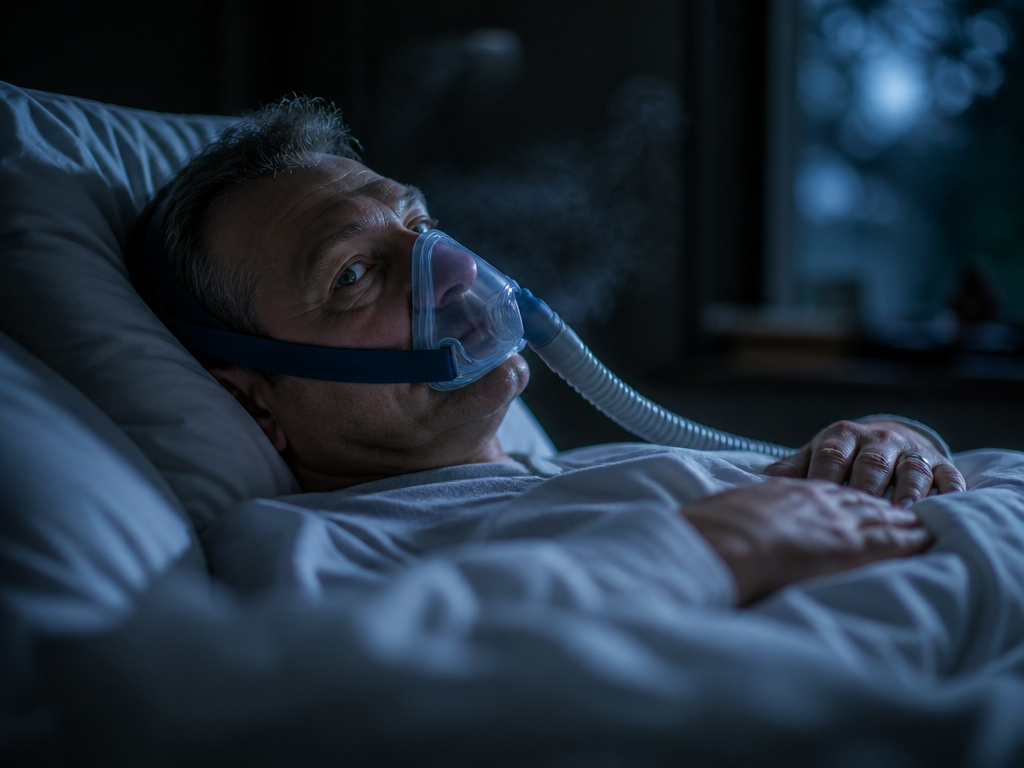
CPAP doesn't breathe for you. It's a pneumatic splint: a column of air, usually 5 to 15 cmH2O, holding the pharynx open from the inside. Remove the splint and the collapse returns the first night. Not the fifth.
The cleanest demonstration is a withdrawal trial. Kohler and colleagues (2011, American Journal of Respiratory and Critical Care Medicine) randomized 41 patients already established on CPAP either to continue therapeutic pressure or to switch, blinded, to a subtherapeutic version for two weeks. In the withdrawal arm, the apnea-hypopnea index was back near pre-treatment levels on the very first night. Across the two weeks, morning blood pressure rose on the order of 7 to 9 mmHg systolic, heart rate rose, urinary catecholamines rose, and endothelial function measured by flow-mediated dilation deteriorated. Two weeks. Not two years.
What that trial cannot tell you is what three scattered untreated nights a year do to a twenty-year cardiovascular outcome. Nobody has run that study. Nobody is going to. Anyone who states the answer confidently is extrapolating from a two-week withdrawal design and hoping you won't ask.
Worth separating by strength. Well-established: alcohol worsens obstruction — Issa and Sullivan showed in 1982 that a bedtime drink lengthens and multiplies events, plausibly by further suppressing dilator tone — and travel nights are alcohol nights. Plausible but thin: that the short sleep before a trip makes the following nights worse by shifting arousal thresholds. Folk wisdom: that caffeine helps apnea. Methylxanthines genuinely treat apnea of prematurity — Schmidt's 2006 NEJM trial randomized 2,006 preterm infants to caffeine citrate — but that is an immature central respiratory drive, not a collapsing adult airway. Different organ, different problem.
Is it okay to skip CPAP for one night?
Physiologically, no: your apnea comes back that night at close to full strength, and the pressure and catecholamine effects arrive with it. Clinically, one missed night inside an otherwise adherent year is a small risk, not a catastrophe. The honest framing is that skipping is neither free nor fatal, and the thing that actually decays isn't your vasculature — it's the habit.
The acute danger most people underweight isn't cardiovascular anyway. It's the rental car the next afternoon. Untreated apnea degrades vigilance in a way sufferers are famously bad at estimating, and caffeine will hide the feeling of it without restoring the function.
Some people shouldn't treat a night off as routine: severe apnea (AHI above 30), coexisting heart failure or atrial fibrillation, recent surgery, anyone taking opioids or sedatives, and anyone sleeping at real altitude, where central events can stack on top of the obstructive ones.
The honest packing math
Most travel barriers collapse into five problems, and only one of them costs money.
| The barrier | What it actually is | What removes it |
|---|---|---|
| Bulk | A full machine with humidifier runs 1.2–1.5 kg plus a case | Waterless setups; travel units near 300 g if you can pay for one |
| Baggage rules | Fear of the carry-on limit | Under US DOT rules (14 CFR Part 382), assistive medical devices don't count toward your allowance. Never check it |
| Power | Confusing voltage with plug shape | Most supplies accept 100–240 V. You need adapters, not converters. In-flight batteries: under 100 Wh unrestricted, 100–160 Wh needs airline approval, spares carry-on only |
| Water | Believing distilled means sterile | Distilled prevents mineral scale. A few nights on bottled water won't hurt you, and an HME needs none |
| Data | A second machine may report to a separate account | Tell your equipment provider before the insurance compliance window closes |
The HME — heat and moisture exchanger — is the underrated piece. A small cartridge sits between mask and tube; your exhaled breath deposits heat and water vapor in it, and your next inhale collects most of it back. It's less humidification than a heated chamber. It's also the difference between a device that goes in a backpack and one that needs a nightstand. This is where portable CPAP devices earn their premium: not by treating apnea better, but by lowering the activation energy of using them at all.
The rule of thumb, and you can do it tonight: stop making it a decision. Put the travel setup — machine, mask, cord, adapter — into the suitcase now, before any trip exists, and leave it there permanently. Adherence doesn't fail at the airport. It fails at 11 p.m. the night before, when packing becomes something you have to choose.
What I actually do
I own two machines. The second cost $940 out of pocket, because payers fund one device per five-year cycle and "I travel constantly" is not a covered indication. That's the part the product announcements leave out, and the part equipment suppliers field complaints about weekly: the barrier isn't grams, it's that the fix is a cash purchase.
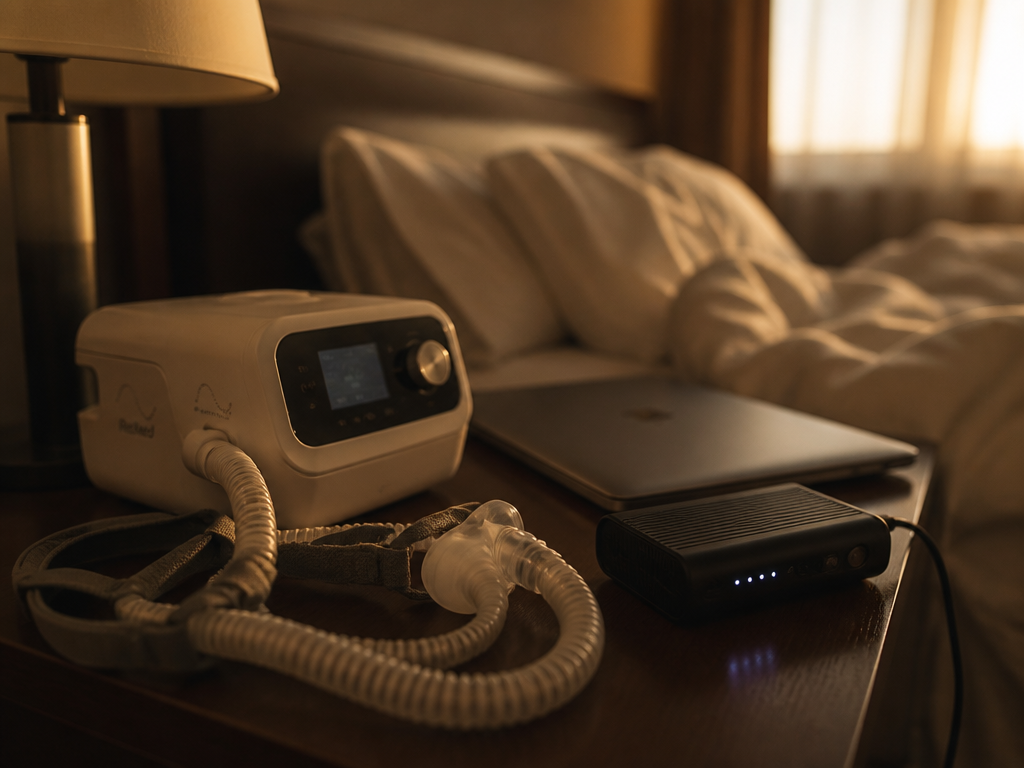
The travel unit lives in the suitcase. Not beside it — in it, year-round, with a mask, a spare cushion, the cord, and two plug adapters in the same mesh pocket. I don't unpack it when I get home, because unpacking it is precisely how it ends up in a closet.
No water. HME only. I gave up on hotel distilled water around the second time I found myself defining the word "distilled" for a front desk at midnight.
I carry it on, always, and have never checked it. I don't use it in the air — mine is labeled for in-flight use and my battery sits under 100 Wh, but I don't sleep sitting up, and a mask in seat 24B has never penciled out.
And the caffeine, since that's this magazine's beat: on arrival day I stop at early afternoon local time, not local-feeling time. Caffeine's half-life runs around five hours in most adults, but across CYP1A2 variants and smoking status the spread stretches from under two hours to more than eight, and jet lag is exactly the state in which I'd misjudge my own.
None of this is discipline. It's the removal of choices. The machine I actually use isn't the better one — the home unit is quieter, gentler, and has a humidifier I genuinely like. It's just the one I never have to decide to bring.
-
ResMed's 2017 launch materials cited an internal survey of CPAP users; the device itself weighs roughly 300 grams. I can find no independent replication of the 65 percent figure, which doesn't make it wrong. It makes it unverified, and those are different claims. ↩