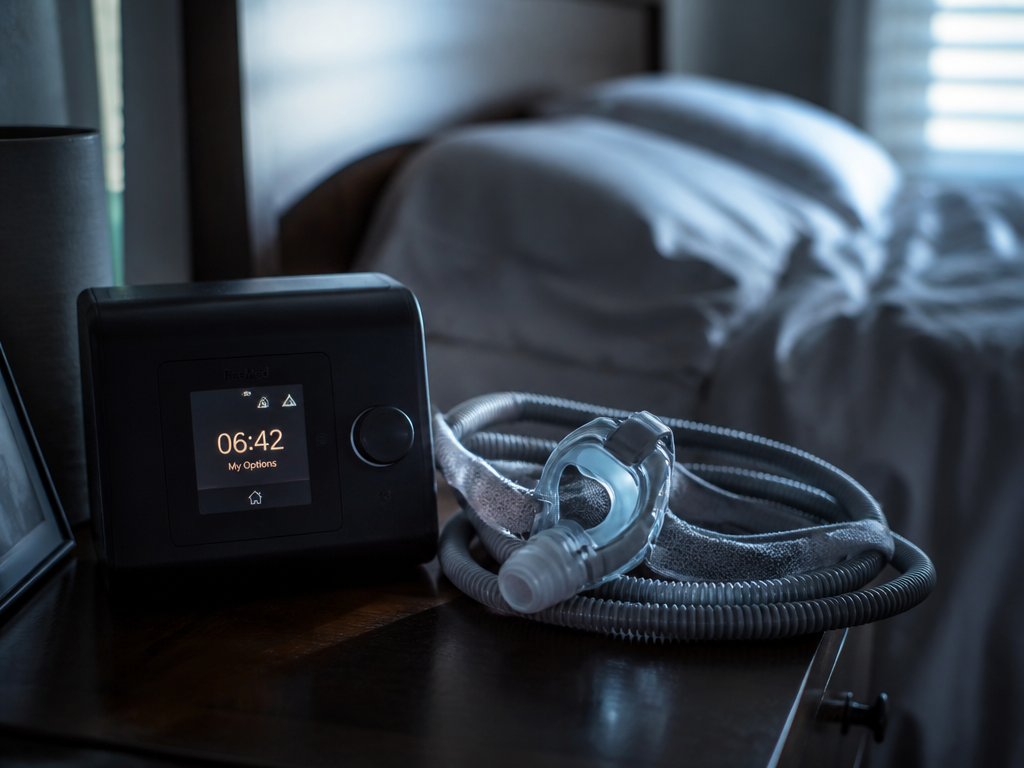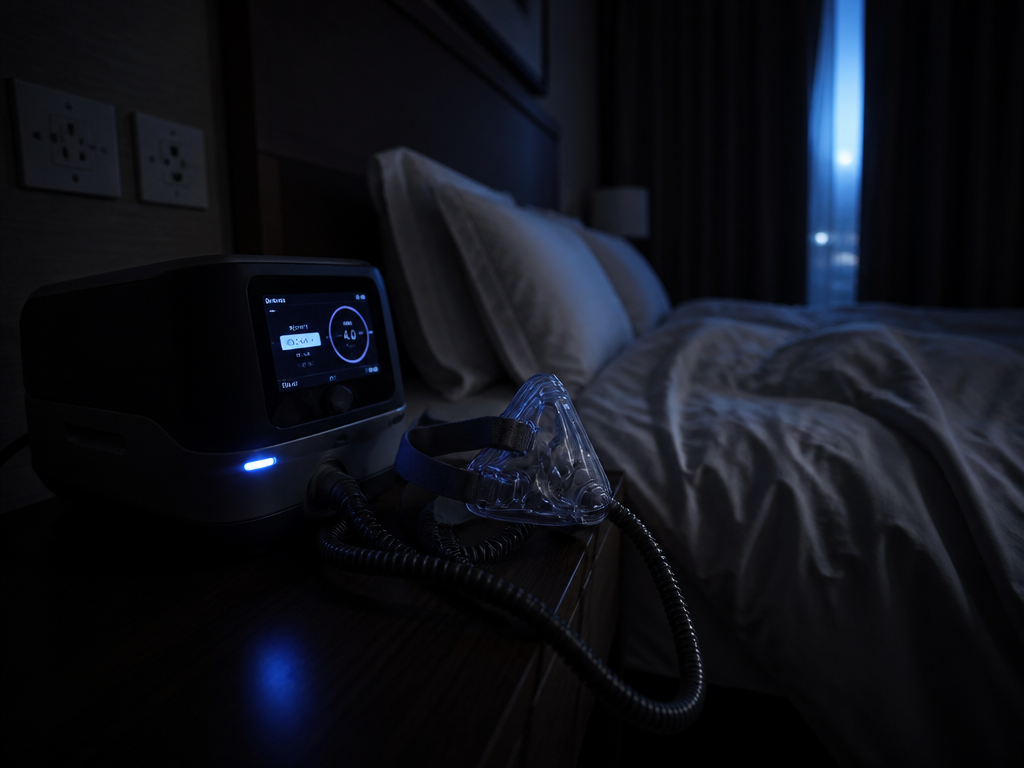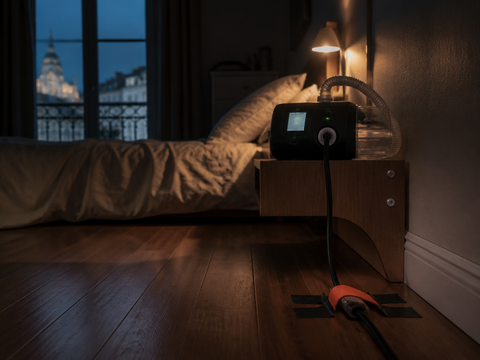
The first night in the rented apartment in Lisbon, I could not find an outlet within reach of the bed. There was one behind the headboard, blocked by a bolted-in nightstand, and one across the room by the window. I ran my machine's cord across the floor, taped it down with a luggage strap so I wouldn't trip at 3 a.m., and slept badly anyway — not because the therapy failed, but because I kept listening for the hum.
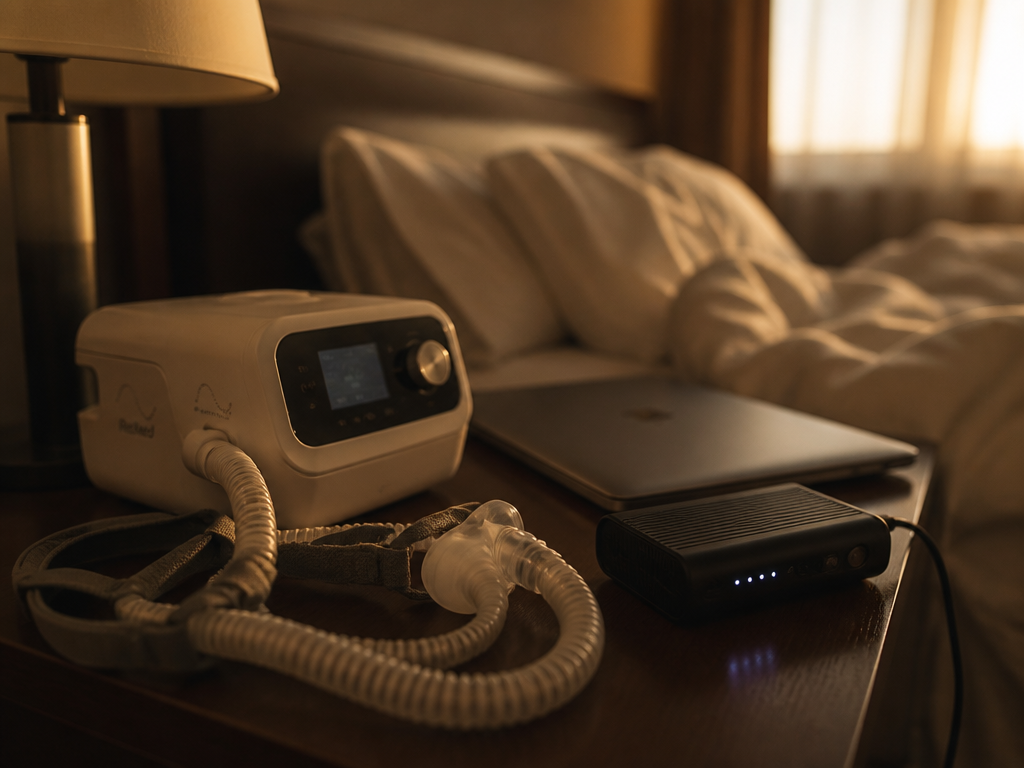
In the morning I pulled the SD card and read it on my laptop. AHI of 3.1. Leak within range. The machine had done its job across six time zones and one improvised extension. I had spent more energy worrying about my sleep apnea therapy than the therapy had spent keeping my airway open.
That gap — between the size of the worry and the size of the actual problem — is most of what this piece is about.
Do you need a special travel CPAP machine?
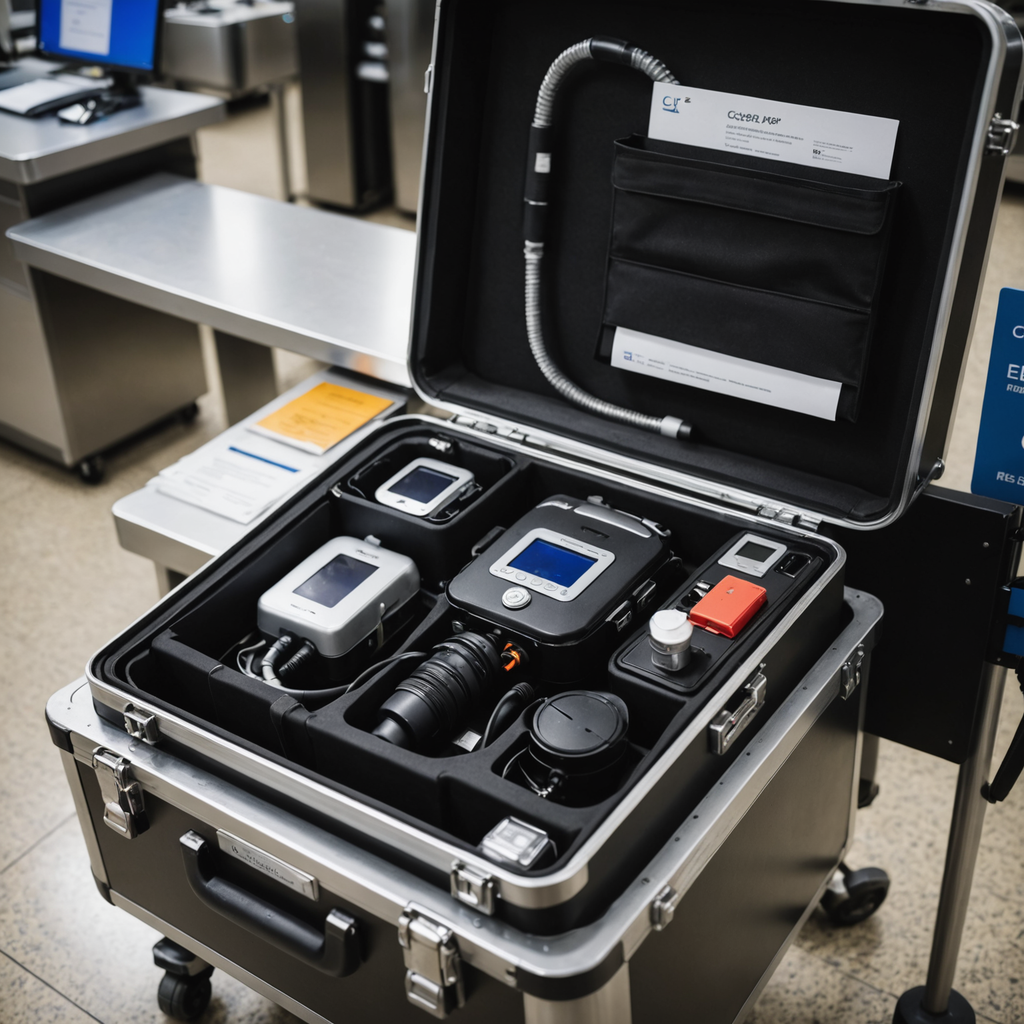
No. If you are established on therapy and your prescribed device fits in your carry-on, that device is your travel machine. The smaller "travel" units exist, and some people love them, but nothing about a hotel room or a long flight requires one. The pressure your titration study landed on is the pressure that treats you, whether the box delivering it weighs three pounds or one.
That answer tends to disappoint people, because the anxiety doesn't come from the hardware. It comes from a stack of smaller unknowns — outlets, voltage, security lines, what happens if the bag gets lost — and the hardware question is just the one that's easy to type into a search bar. The honest version is that travel with obstructive sleep apnea is a logistics problem, not a medical one, and logistics problems have solutions.
What a few untreated nights actually do
Here's the question most people are too polite to ask their pulmonologist: what if I just don't bring it for the weekend?
The data here is more reassuring than the guilt suggests, and also more pointed. When treatment stops, the apnea comes back — not gradually, but essentially overnight. Kohler et al. (2011), published in the American Journal of Respiratory and Critical Care Medicine, took 41 patients well-controlled on CPAP and randomized some of them to switch to a sham device for two weeks. Within the first night off real therapy, the apnea-hypopnea index climbed back toward baseline. By two weeks, morning blood pressure had risen measurably and daytime sleepiness had returned. The disease doesn't taper off treatment; it waits.
But two weeks is not a weekend. The same study tells you the recovery is fast in both directions: resume therapy, and the airway behaves again the next night. There is no withdrawal, no rebound penalty for restarting. For a single forgotten night, the realistic cost is one poor night's sleep and, if your apnea is severe, a genuinely higher cardiovascular load during those hours — worth avoiding, not worth a panic attack.
So the calculus is simple. Bring the machine. But if the bag is lost and the device is two days behind you in another country, you are looking at a stretch of bad sleep and elevated risk, not a medical emergency. Knowing which of those you're facing is the difference between a manageable trip and a ruined one.
What happens in the airway when the pressure stops
It helps to know the mechanism, because the mechanism is why a few nights matter and why restarting works so cleanly.
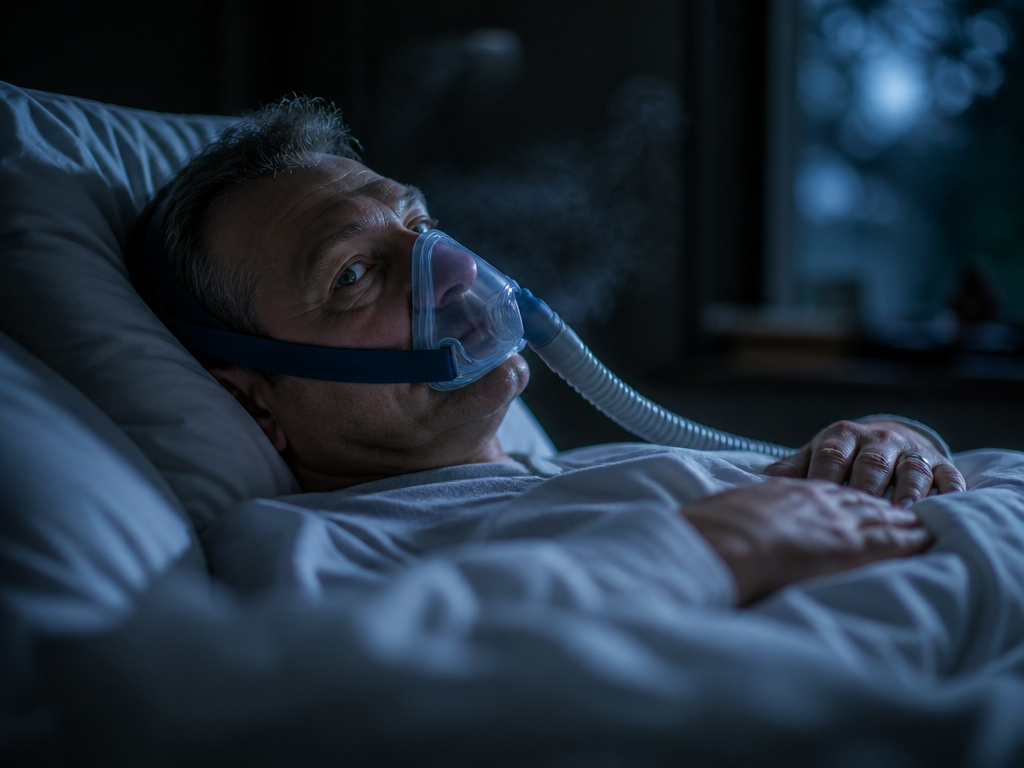
When you fall asleep, the muscles that hold your throat open — chiefly the genioglossus, which anchors the tongue — relax along with everything else. In an airway that's already narrow or crowded, that relaxation lets the soft tissue collapse inward on the inhale. The negative pressure of you trying to breathe pulls the walls together like a wet paper straw. Airflow drops or stops. Oxygen falls. After some seconds, the brain registers the problem and fires a brief arousal — often too short to remember — that stiffens the muscles, reopens the airway, and lets you gasp. Then sleep deepens, the muscles relax, and it happens again. Dozens of times an hour, in severe cases.
CPAP doesn't fix the muscles. It splints the airway open with a column of pressurized air, so the collapse can't happen in the first place. Take the air away and the anatomy is exactly what it was before your diagnosis — which is why night one without it looks like night one of your sleep study. Put the air back and the splint returns immediately. Nothing has to heal. That's the good news inside the bad news.
The logistics that actually trip people up
Power is the real adversary, not the machine. Most modern CPAP units accept 100–240V and switch automatically, so the device itself rarely cares which country you're in — but confirm yours does before you trust it. What you need is a plug adapter (changes the shape) and only rarely a voltage converter (changes the current). Heated humidifiers draw far more power than the blower; if you're running on a battery or a finicky outlet, skip the heated water chamber and use the machine dry for a night.
A few things worth knowing before you pack:
| Concern | What's true | What to do |
|---|---|---|
| Airport security | CPAP is a medical device; it doesn't count against your carry-on limit | Carry it on, never check it; declare it at screening |
| Altitude (planes, mountains) | Most machines auto-adjust; some need a manual setting | Check for an altitude-compensation mode |
| Distilled water abroad | Often unavailable or differently labeled | Run dry, or use cooled boiled water short-term |
| Lost luggage | The device is your therapy, not a souvenir | Keep it on your person, with mask and cord |
| Camping / off-grid | Wall power isn't a given | A purpose-built CPAP battery, sized to your pressure |
The single most consequential rule: the machine, mask, and cord ride in the bag that never leaves your hand. Everything else is replaceable on the road. Those three things are not, at least not quickly.
An honest rule of thumb for tonight
If you're packing for a trip in the next day or two, do this: put the machine, mask, hose, and power cord in your carry-on now, before anything else goes in — then add a universal plug adapter and either your distilled water plan or the decision to run dry. That's the whole kit. Skip the heated humidifier rather than skip the trip. And if you ever find yourself one night without it, sleep on your side, lay off the alcohol, and resume the next night without a shred of guilt.
Back in Lisbon
The second night, I gave up on the headboard outlet entirely and moved the nightstand. Took ten minutes and a little furniture-shoving. The card the next morning read an AHI of 2.4 — better than my home average, probably because I'd finally stopped straining to hear the motor and just slept.
What the trip taught me wasn't about equipment. It was that the device had been ready to travel all along; I was the part that needed reassurance. The machine asks for an outlet and a flat surface. The rest of the worry is ours to put down.
The myth is that traveling with sleep apnea means special gear and managed risk and a fragile routine you might break. The truth is that your everyday machine is a travel machine, a missed night is a setback and not a catastrophe, and the only thing you really have to protect is the bag it rides in.