For my obstructive sleep apnea, the weaker treatment turned out to be the better one. On paper, a CPAP machine beats a mandibular advancement device. It suppresses more breathing events, more reliably, in more people. In my bedroom, over six months, the plastic splint that holds my lower jaw forward did more for me. I wore it all night, and I never once wore the mask all night.
The verdict: if your case is moderate and your CPAP keeps ending up on the floor at 3 a.m., a custom-fitted mandibular advancement device is a real alternative, not a consolation prize. It only counts as treatment once a follow-up sleep test shows it working.
Where I started
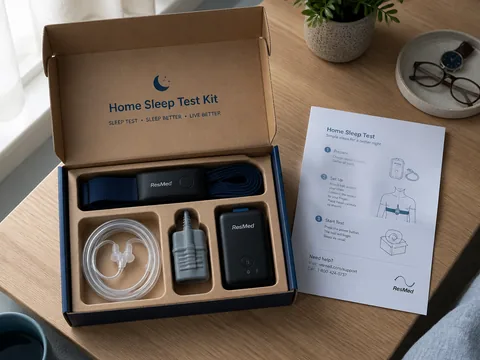
A home sleep test put my apnea-hypopnea index (AHI) at 24 events an hour. That is moderate. My oxygen saturation bottomed out at 84%. I was prescribed an auto-adjusting CPAP and used it, more or less, for fourteen months.
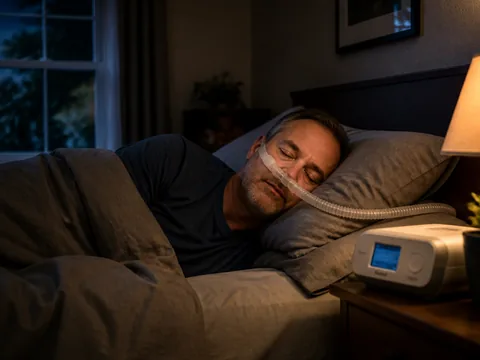
The machine logs every minute, and the logs were not kind. I averaged 3.9 hours a night across all nights and reached four hours on 52% of nights. The usual US insurance standard for "adherent" is four hours on 70% of nights in a 30-day window, so I failed it. While the mask was on, my AHI was 2.8, which is excellent. The trouble was the other half of the night. That stretch runs toward morning, where REM sleep is concentrated and where many people's airways collapse most.
This is the arithmetic behind my opening claim. A treatment works only while it is in place. Sleep researchers have formalized the idea as "mean disease alleviation": efficacy weighted by the share of sleep time you actually use the device. A CPAP that is nearly perfect for four hours of a seven-and-a-half-hour night leaves you largely untreated for the rest of it.
The evidence, and its limits
The best-known head-to-head comparison is a randomized crossover trial led by Craig Phillips in Sydney. It was published in 2013 in the American Journal of Respiratory and Critical Care Medicine. It enrolled 126 adults with moderate-to-severe OSA, and each person spent one month on CPAP and one month on a custom oral appliance. CPAP lowered AHI further, to roughly 4.5 against roughly 11 for the oral device. But participants wore the appliance about 6.5 hours a night against 5.2 for CPAP. After a month, the two treatments looked equivalent on 24-hour blood pressure, daytime sleepiness and several quality-of-life measures. Most participants preferred the oral device.
The limits matter as much as the findings:
- One month per arm is short. Blood pressure and sleepiness are stand-ins for the outcomes cardiologists actually care about, which are heart attacks, strokes and atrial fibrillation. The trial was not built to measure those.
- Response varies widely. Some patients, especially those with severe disease, get little benefit from moving the jaw. An average result cannot tell you which group you are in.
- CPAP is still the reference treatment. The 2015 joint guideline from the American Academy of Sleep Medicine and the American Academy of Dental Sleep Medicine recommends oral appliances for adults who cannot tolerate CPAP or prefer an alternative. It specifies a custom, adjustable device fitted by a qualified dentist, followed by a sleep test to confirm the effect.
I am one person with a moderate case. That is my sample size, and you should weigh my numbers accordingly.
What I tried
The boil-and-bite
First I spent $60 at a pharmacy on a thermoplastic tray you soften in hot water and bite into. I lasted two weeks. It came loose twice most nights, it advanced my jaw only a few millimetres, and I woke with a wet pillow and sore front teeth. I didn't bother retesting my AHI. The guideline's preference for custom devices exists for exactly these reasons. A boil-and-bite will tell you whether you can sleep with plastic in your mouth, and nothing more.
The custom device
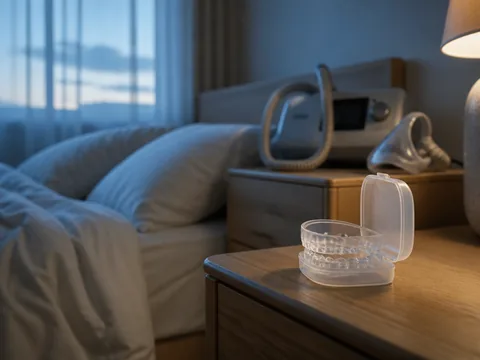
The custom device came from a dentist with dental sleep medicine training. She took a digital scan and fitted a two-piece adjustable appliance, with upper and lower trays joined by side connectors that set how far forward the lower jaw sits. The list price was $2,100. It was billed to my medical insurance rather than my dental plan, and I paid about $900.
We started at roughly 60% of my maximum forward reach and advanced half a millimetre every three or four nights for six weeks, about 6 mm in all. For the first three weeks my jaw ached for twenty minutes or so after waking. A small "morning repositioner," a wedge of plastic you bite for a few minutes to settle the jaw back into place, mostly fixed that. Extra saliva lasted about a week.
At ten weeks I repeated the home sleep test while wearing the device. My AHI was 8.6 and my lowest oxygen reading was 89%. That is clearly worse than CPAP's 2.8. My wear log showed 7.1 hours on 27 of 30 nights, or about 6.4 hours averaged over every night. One caveat: my device had no compliance chip, so those hours are self-recorded. Self-reported data is weaker than a machine log, and I'm saying so.
Side by side
| Auto-CPAP | Custom MAD | Boil-and-bite | |
|---|---|---|---|
| AHI while worn | 2.8 | 8.6 | Not retested |
| Avg hours, all nights | 3.9 (machine) | 6.4 (self-logged) | Under 3, then quit |
| Main complaint | Mask leaks, dry mouth, pulled off asleep | Jaw ache in first 3 weeks | Fell out, little advancement |
| My out-of-pocket cost | ~$400 over 14 months | ~$900 | $60 |
Now apply the whole-night arithmetic, assuming 7.5 hours of sleep and my untreated rate of 24 for any time without a device. My CPAP nights averaged about 13 events an hour. My appliance nights averaged about 11. That is rough arithmetic, not a measurement, and the gap is modest. But it points in the same direction as the Phillips trial, and the difference I noticed was larger than the number suggests. My Epworth sleepiness score fell from 13 to 7. For the first time in years, the second coffee of the morning became optional.
A device you wear all night can beat a better one you take off at 3 a.m.
What it costs you
The appliance has a real cost, and it shows up slowly. Long-term follow-up studies of oral appliance users find gradual bite changes: the lower teeth move forward and the overlap between upper and lower teeth shrinks. These changes keep progressing for years, and patients often don't notice them. That means a dental check at least once a year, for as long as you use the device. You also need enough healthy teeth to anchor it. Active gum disease or an existing jaw-joint disorder can rule it out.
Who this is for, and who it isn't
It's worth raising with your doctor if:
- your OSA is mild or moderate, and your CPAP data shows you consistently fall short of a full night;
- you have healthy teeth and gums;
- you will commit to a follow-up sleep test and annual dental checks.
It probably isn't for you if:
- your sleep apnea is severe and your oxygen drops deeply. For you, CPAP's margin of effect matters more;
- you already wear CPAP comfortably all night. You have the better tool, so keep it;
- you have heart disease or atrial fibrillation. Then the choice should be made by your sleep physician and cardiologist together. The blood pressure data is encouraging, but it covers weeks, not years.
One thing to do this week
Open your CPAP app, or ask your equipment supplier for a 30-day usage report. Look at average hours across all nights, not just the nights you used it. If that figure is under five hours, or the mask regularly comes off before dawn, take the printout to your sleep physician and ask one question: am I a candidate for an oral appliance, and who near me is qualified to fit one? The American Academy of Dental Sleep Medicine keeps a directory of member dentists.