You get the report and there's a number on it. The apnea-hypopnea index — the AHI — counts how many times an hour your breathing stopped or shrank. Five is the threshold. Fifteen is moderate. Thirty and up is severe. Most people, understandably, read that number, absorb the word severe, and stop.
But the AHI doesn't tell you the most useful thing on the page. That would be the type. Among the sleep apnea types, the distinction that changes what happens next isn't how often you stopped breathing — it's why. An airway that collapses is a different problem than a brain that forgets to send the signal. Same number, different disease.
What's the difference between obstructive and central sleep apnea?
Obstructive sleep apnea (OSA) is a plumbing problem: the airway physically collapses during sleep even though your body is still trying to breathe. Central sleep apnea (CSA) is a signaling problem: the airway is open, but the brainstem briefly stops telling the muscles to draw a breath. In OSA, the effort is there and the air can't get through. In CSA, the effort itself pauses. OSA is far more common — it accounts for the large majority of diagnoses. CSA is rarer and often tied to heart failure, stroke, opioid use, or high altitude.
That's the whole distinction, and it's worth holding onto, because the two respond to treatment differently.
What actually happens during an obstructive event
Walk through it in order. You fall asleep, and the muscles that hold your throat open — the genioglossus in the tongue, the muscles of the soft palate — relax like every other muscle. In a narrow or crowded airway, that relaxation lets the tissue sag inward. You keep trying to inhale. The chest and diaphragm pull harder, which lowers the pressure behind the blockage and, perversely, sucks the airway shut more firmly. No air moves. Oxygen in the blood drifts down; carbon dioxide climbs.
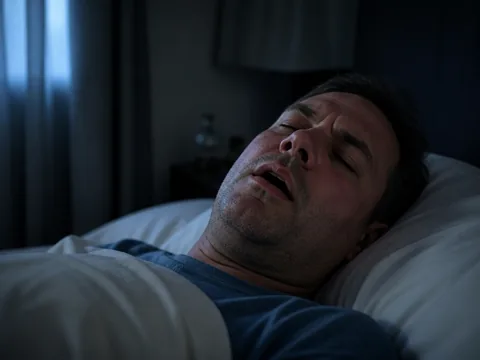
After ten, twenty, sometimes forty seconds, the brain registers the chemistry and triggers a micro-arousal — a burst of wakefulness too brief to remember. Muscle tone snaps back, the airway reopens, and you gasp. Then you fall back asleep and it happens again. The damage isn't one dramatic event. It's the repetition — dozens or hundreds of oxygen dips and arousals a night, each one a small stress on the heart and the sleep architecture you never consciously notice.
What most people do
They fixate on the AHI and the mask. The report says the number, the clinic hands over a CPAP machine, and the type gets treated as a formality. For most patients that's actually fine, because most patients have straightforward OSA and CPAP is the right answer. But "fine for most" quietly fails the minority whose picture is more complicated.
The other common move is to accept a home sleep test as the final word. Home tests — the small kits you wear in your own bed — are convenient and validated for detecting moderate-to-severe OSA. What they're not good at is central apnea. Most home devices don't measure the brain and breathing-effort signals (EEG, respiratory effort belts) that distinguish a central event from an obstructive one. The 2017 American Academy of Sleep Medicine clinical practice guideline (Kapur et al., Journal of Clinical Sleep Medicine) is explicit that home testing is meant for uncomplicated adults with a high likelihood of moderate-to-severe OSA — not for people with heart failure, neuromuscular disease, or suspected central apnea. A home test can also underestimate severity, because it often divides events by time in bed rather than time actually asleep.

What the evidence suggests
Start with scale, because it reframes the shame. A 2019 analysis in The Lancet Respiratory Medicine (Benjafield et al.) estimated that roughly 936 million adults worldwide, ages 30 to 69, have obstructive sleep apnea at the mild-or-worse level, with about 425 million at moderate-or-severe. This is not a rare misfortune. It's closer to a baseline feature of aging human airways, made worse by weight, anatomy, and alcohol.
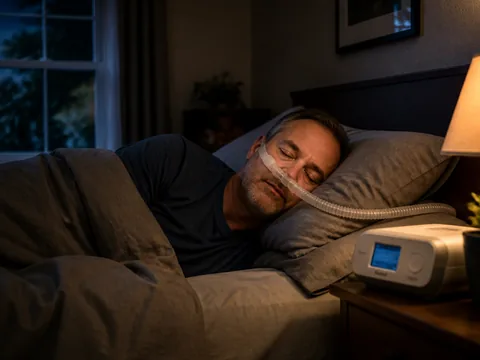
The type matters because the fix diverges. Standard CPAP — steady pressurized air splinting the airway open — is first-line for OSA and works precisely because it solves a mechanical collapse. For central apnea, blowing air at an open airway doesn't address the missing signal, and in some cases the wrong device makes things worse.
Which brings up the category people rarely hear about until it happens to them: treatment-emergent central sleep apnea, sometimes called complex sleep apnea. Here a patient starts CPAP for what looks like ordinary OSA, and central events appear or increase once the obstruction is removed. Estimates of how often this happens vary widely — figures from about 5% to 15% show up in different cohorts — and in many people it resolves on its own within weeks to months. The honest summary: it's real, it's usually transient, and the data on who develops the persistent form is thinner than the confidence with which it's sometimes discussed.
| Obstructive (OSA) | Central (CSA) | Complex / treatment-emergent | |
|---|---|---|---|
| Core problem | Airway collapses | No breath signal | Central events appear after CPAP |
| Breathing effort during event | Present | Absent | Mixed |
| Typical first-line treatment | CPAP | Treat cause; ASV in some cases | Often watchful waiting |
| Relative frequency | Common | Uncommon | Uncommon, often transient |
Note that adaptive servo-ventilation (ASV) — a device sometimes used for central apnea — carries a real caution: the 2015 SERVE-HF trial (Cowie et al., New England Journal of Medicine) found increased mortality when ASV was used in patients with central apnea and reduced-ejection-fraction heart failure. This is exactly why the type, and the underlying cause, aren't paperwork.
What I'd actually do
Read the whole report, not just the headline number. Find the AHI, then find the central apnea index — a separate count of central events. If it's a small fraction of the total, you're looking at ordinary OSA. If a meaningful share of your events are central, that's the line to raise with your doctor.
Then ask three specific things: Was this a home test or an in-lab study, and does the result warrant the lab version? What proportion of my events were central versus obstructive? And if I start CPAP, how and when will you check whether central events emerge? A clinician who can answer those clearly is worth keeping.
An honest rule of thumb: treat the AHI as the volume knob and the type as the actual song. The number tells you how loud the problem is; the type tells you what problem you're solving.
This week: pull up your sleep study report — the full PDF, not the summary text — and locate two lines, the AHI and the central apnea index. Write both numbers down and bring them to your next appointment. That single act moves you from diagnosed to informed, and it takes about four minutes.
The most important thing on your report isn't how badly you breathe at night. It's why.