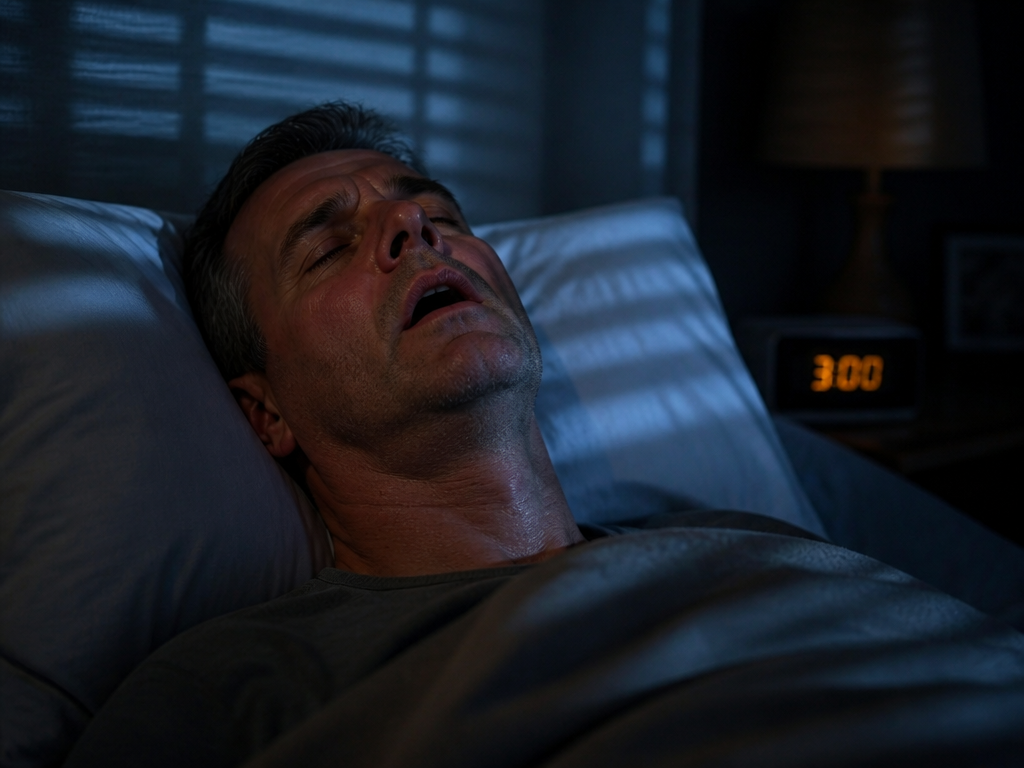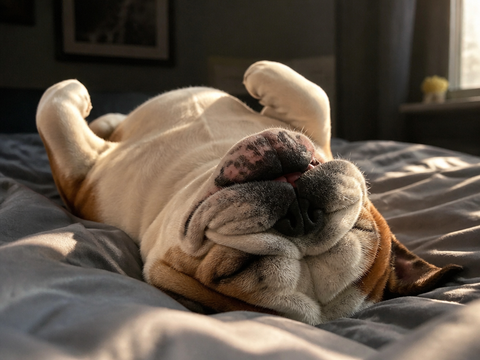
The English bulldog snore is one of the internet's reliable pleasures. A barrel-chested dog flat on his back, paws in the air, producing a sound somewhere between a chainsaw and a coffee percolator. It reads as comedy. For a lot of those dogs, it is also a clinical sign.
Obstructive sleep apnea in dogs is a real condition, not a folklore version of the human one, and the snore that makes you laugh is often the audible edge of an airway that keeps closing while your dog sleeps. The honest answer to whether your snoring dog has it is the frustrating one: maybe, and it depends a great deal on what he looks like in the face.
The myth worth correcting
Here is the belief a smart owner usually arrives with. Snoring is cosmetic. It's a quirk of the breed, like a pug's curled tail or a basset's ears. Flat-faced dogs snore because that's what flat-faced dogs do, and as long as he's eating and wagging, the noise is just ambiance.
The first half of that is true. Brachycephalic breeds — bulldogs, pugs, French bulldogs, Boston terriers, boxers, Pekingese — snore far more than long-nosed dogs because of how they're built. The leap is the second half: that the noise is therefore meaningless. Snoring is the sound of turbulent air forcing its way through a narrowed passage. In a person, we treat that turbulence as a thing to investigate, not dismiss. The biology doesn't change because the patient has four legs.
Can dogs actually have sleep apnea?
Yes. Dogs can have obstructive sleep apnea, and the dogs most likely to have it are the short-faced breeds whose anatomy crowds the upper airway. The condition involves repeated partial or complete closures of the airway during sleep, each one briefly cutting off airflow until the dog rouses enough to reopen it. The mechanism is genuinely the same as in humans. What differs is how confidently we can diagnose it, because the diagnostic tools were built for people who can be told to lie still in a sleep lab.
That last point matters more than it sounds. Much of what we "know" about canine apnea is inferred from a specific research lineage rather than from routine clinical testing.
What the research actually measured
The cornerstone is older than most people expect. In the 1980s, Allan Hendricks and colleagues at the University of Pennsylvania studied English bulldogs as a naturally occurring model of obstructive sleep apnea — the dogs already had the airway anatomy and the breathing disruptions, no induction required. Hendricks et al. (1987), in the Journal of Applied Physiology, recorded sleep and breathing in English bulldogs and documented frequent oxygen desaturations and disordered breathing during sleep, especially in REM. The sample was small, as these studies tend to be. The finding was durable: bulldogs became the textbook animal model for human apnea research, which tells you the resemblance is close.
That's the well-established part. The airway abnormalities that drive it are also well-mapped, bundled under the term brachycephalic obstructive airway syndrome (BOAS) — narrowed nostrils, an overlong soft palate, a small windpipe, and tissue that collapses inward on inhalation. Studies of BOAS in pet populations, including work by Jane Ladlow and colleagues at Cambridge over the past decade, have quantified how common and how severe these obstructions are in pugs, bulldogs, and French bulldogs. A meaningful fraction of these dogs are working hard to breathe even awake.
Here's the honest seam in the evidence. The leap from "bulldogs in a 1980s lab had apnea" and "many brachycephalic dogs have obstructed airways" to "your individual snoring dog has clinically significant sleep apnea" is plausible but thinner than it's often stated. Veterinary medicine does not run routine overnight polysomnography. Diagnosis usually rests on history, airway examination, and sometimes sleep videos rather than the channel-by-channel breathing data a human patient would get. So we have a strong mechanism, a good animal model, and a soft middle where individual diagnosis lives.
What one apneic event looks like, in order
Follow the air. Your dog drifts into deeper sleep, and the muscles holding his throat open relax — this is normal and happens to every mammal. In a long-nosed dog, the airway has room to spare. In a brachycephalic dog, it doesn't.
On the next inhale, the pressure drop pulls the soft, overlong palate and the surrounding tissue inward. The passage narrows. Air squeezing through the gap vibrates the tissue: that's the snore. If the narrowing tips into full closure, airflow stops. The chest keeps trying — the diaphragm pulls against a closed door — but no air moves. Within seconds to tens of seconds, blood oxygen falls and carbon dioxide climbs. The brain, registering the chemistry, fires a brief arousal: a partial waking just deep enough to restore muscle tone and reopen the airway. The dog gasps, the airway clears, oxygen recovers, and he sinks back toward sleep. Then it can happen again.
Repeat that cycle through the night and you get fragmented sleep and intermittent drops in oxygen. In humans this pattern is linked to daytime sleepiness and cardiovascular strain. In dogs the daytime consequences are harder to measure — a dog can't report grogginess — but owners of severely affected dogs often describe exactly what you'd predict: heavy daytime tiredness, low exercise tolerance, and restless, noisy nights.
And cats?
Thinner ground, smaller answer. Cats snore far less often, and when they do it's usually obesity or a brachycephalic build — think Persians and Himalayans — narrowing the same passages. There's much less published work on feline sleep-disordered breathing than canine. The cautious reading: it's biologically plausible, occasionally reported, and nowhere near as documented. A snoring cat is worth a mention to your vet, not a panic.
A rule of thumb you can use tonight
The distinction worth making is between snoring as sound and snoring as strain. Plenty of dogs snore softly and breathe easily otherwise. The dogs to take seriously are the ones whose breathing looks like work.
| Probably benign | Worth a vet visit |
|---|---|
| Soft, steady snore | Loud snore with pauses, then a gasp |
| Breathes quietly when awake | Noisy, raspy breathing while awake |
| Normal energy and stamina | Tires fast, struggles in heat or exercise |
| No color changes | Bluish gums or tongue, even briefly |
| Sleeps in any position | Only sleeps propped up or sitting to breathe |
The honest rule: if your dog stops, gasps, and startles awake — or if his gums ever look bluish — record a 60-second video and show your vet this week. A clip of the actual breathing is worth more than any description, because it shows the pause and the recovery a vet can't see in a calm exam room.
One more thing not to do: don't reach for the human fix. CPAP, the mask-and-air-pressure treatment that works for people, is essentially impractical for dogs — they won't tolerate a sealed mask, and there's no real evidence base for it in canine patients. When brachycephalic airway obstruction is severe, the standard treatment is surgical: widening the nostrils, trimming the overlong soft palate, addressing collapsed tissue. Weight loss helps too, because fat in the neck and chest narrows the margins further.1
None of this should make you anxious about a contented dog who saws logs in the corner. Most snoring is just snoring. But the comedy reel and the clinical sign can look identical from across the room, and the difference is whether the air is moving freely or fighting.
The snore is data. Listen to whether your dog is breathing or struggling.
-
This is general information, not a diagnosis. If your dog shows breathing pauses, daytime exhaustion, or any color change in the gums, that's a conversation for your veterinarian, not a comment section. ↩