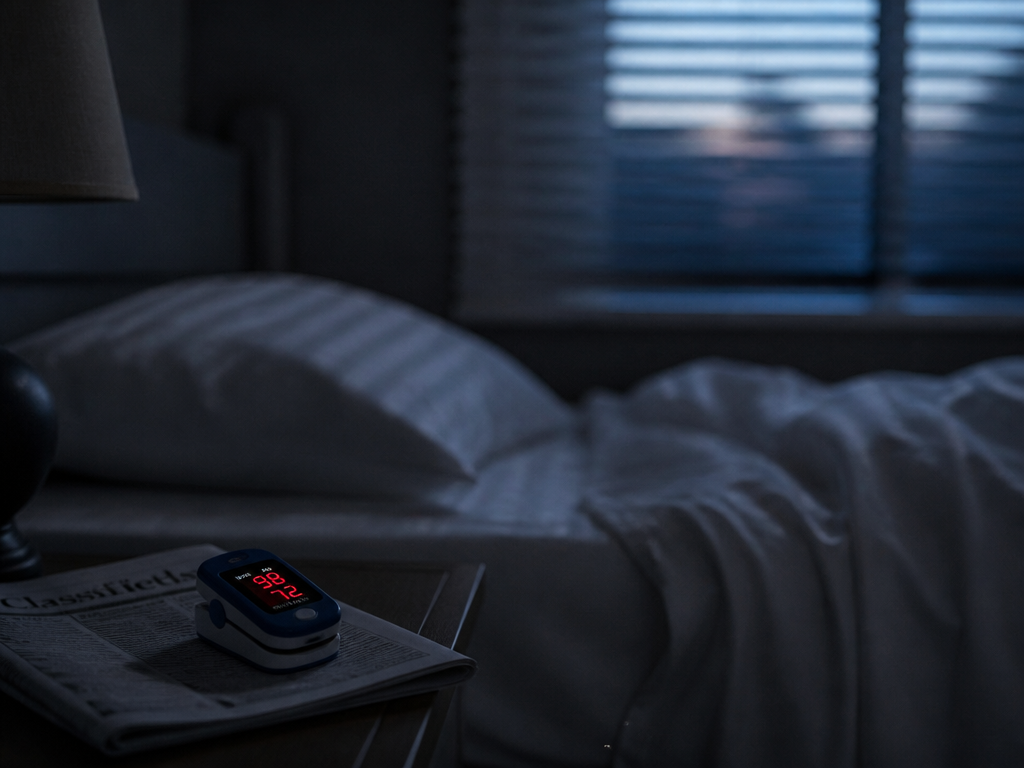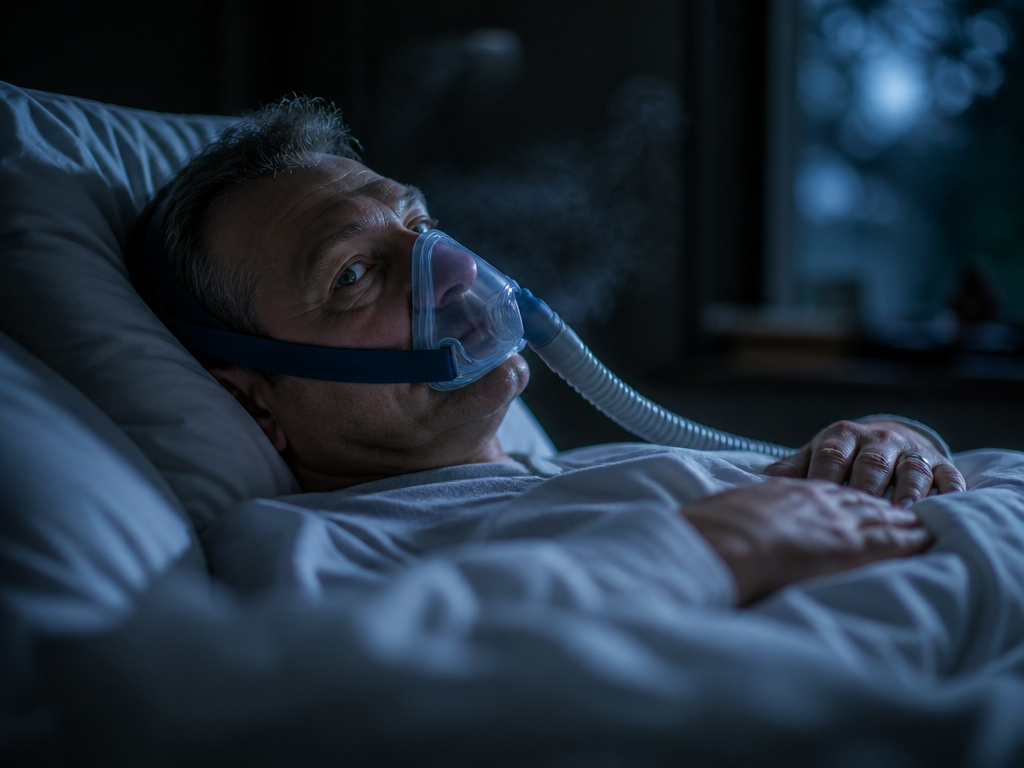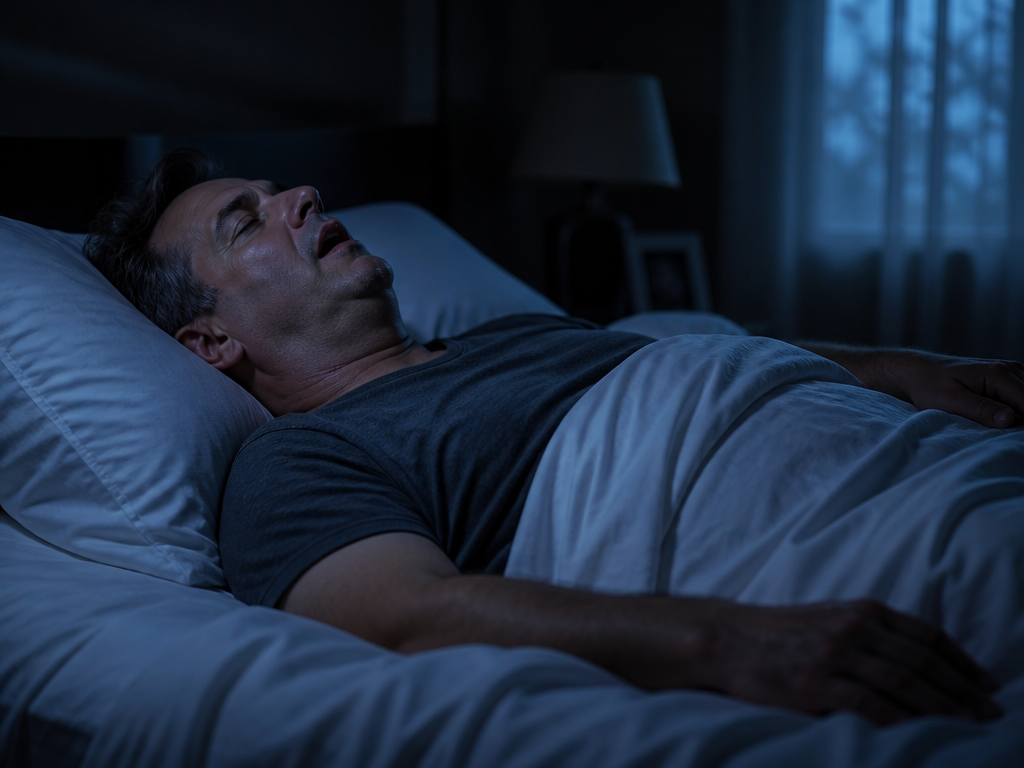
The loudest thing about sleep apnea is the silence. A partner learns the rhythm: the snore that builds, crests, and then — nothing. Five seconds. Ten. Twenty. The chest still heaves, but no air moves. Then a gasp, a snort, a body half-surfacing from sleep, and the cycle resets. It can happen thirty times an hour, all night, every night, and the person it's happening to remembers none of it.
Obstructive sleep apnea is a mechanical failure of breathing during sleep — the airway collapses, airflow stops, and the brain has to intervene to restart it. It is common and frequently missed. A widely cited 2013 analysis by Peppard and colleagues in the American Journal of Epidemiology, using the Wisconsin Sleep Cohort, estimated that 14 percent of men and 5 percent of women had at least moderate sleep-disordered breathing with daytime symptoms. The proportion who knew it was much smaller. The condition is not exotic. It is just quiet.
How do I know if I have sleep apnea?
You usually can't diagnose yourself, but a few signs cluster reliably. The most useful is something you can't observe: a bed partner reporting that you stop breathing, gasp, or choke in your sleep. Add loud habitual snoring, waking unrefreshed no matter how long you slept, morning headaches, and a heavy, fog-like sleepiness during the day — falling asleep in meetings, at red lights — and the suspicion gets stronger. Witnessed pauses plus daytime sleepiness is the combination clinicians weight most heavily. None of these confirm it. All of them justify a sleep study.
What they don't require is panic. Apnea is treatable, often dramatically. The point of recognizing it is not dread; it's diagnosis.
Follow the air
The clearest way to understand what goes wrong is to follow a single breath in the order your body takes it.
The air arrives
When you're awake, air travels from your nose and mouth down the pharynx — the soft tube at the back of the throat — and into the trachea. The pharynx has no rigid skeleton. Unlike your windpipe, which is held open by rings of cartilage, the upper airway stays open only because muscles hold it open. The genioglossus, the muscle that anchors your tongue, is the main one. Awake, it fires constantly, bracing the airway against the slight vacuum of each inhale.
The muscles let go
Sleep relaxes those muscles. For most people this is fine; the airway narrows but stays patent. For someone with obstructive sleep apnea, the geometry is against them. A thick neck, a recessed jaw, large tonsils, a low-hanging soft palate, fat deposited in the tissues around the throat — any of these narrows the tube to begin with. As muscle tone fades in deeper sleep, the negative pressure of inhaling pulls the slack walls inward until they touch. The airway seals. Airflow drops by at least 90 percent (an apnea) or partially, by 30 percent or more with a measurable oxygen dip (a hypopnea). The chest and diaphragm keep pulling. There is simply nothing getting through.
The oxygen falls
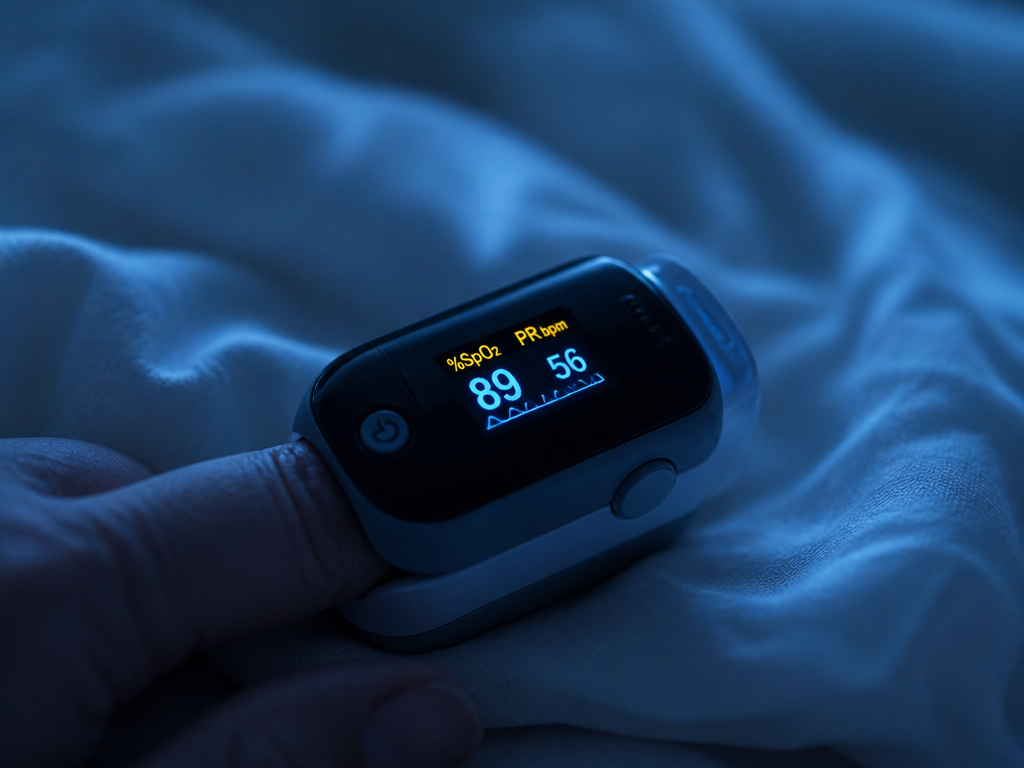
With no fresh air, blood oxygen begins to drop and carbon dioxide climbs. A healthy resting saturation sits at 95 to 100 percent. During a long apnea it can sag into the 80s or lower. The body has chemoreceptors in the carotid arteries and brainstem that monitor exactly this, and they don't tolerate the drift for long.
The brain pulls you out
Here is the part the sleeper never sees. The rising carbon dioxide and falling oxygen trigger a surge from the sympathetic nervous system — the fight-or-flight branch. Adrenaline spikes. Heart rate jumps. The brain produces a brief arousal, a flicker back toward wakefulness lasting a second or three, just long enough to snap muscle tone back into the airway. The throat reopens. The gasp you hear is the rush of delayed air. Then the person sinks back down, the muscles relax, and within a minute or two the whole sequence repeats.
The cruelty is in the repetition. Each arousal is too short to register as waking, so the person believes they slept eight hours. But the architecture of that sleep is shredded — fragmented out of the deep and REM stages that do the restorative work. That's why the exhaustion is so disproportionate to the hours logged.
The bill comes due
The intermittent oxygen drops and the repeated adrenaline surges are not free. Over years they appear to remodel the cardiovascular system. Observational data has long linked untreated moderate-to-severe OSA with hypertension, atrial fibrillation, stroke, and metabolic dysfunction. The mechanisms are plausible and partly demonstrated: oxidative stress, vascular inflammation, blood pressure that never gets its nightly dip. How much of the association is caused by apnea versus by the obesity that often accompanies it is genuinely harder to disentangle than the headlines suggest — a point worth holding onto.
Who gets it, and why
Risk is mostly about the airway's starting dimensions and the forces acting on them.
Excess weight is the largest modifiable factor; fat around the neck and tongue narrows the airway directly. Anatomy you're born with matters too — jaw shape, tongue size, the position of the hyoid bone. Men are diagnosed more often than women, though the gap narrows sharply after menopause, suggesting hormones play a protective role that fades. Risk climbs with age as tissues lose tone. And two everyday habits make any given night worse: alcohol, which relaxes airway muscles beyond normal sleep, and sedatives, which do the same. A nightcap can convert benign snoring into frank obstruction.
Getting it measured
You can't eyeball severity. It's quantified by the apnea-hypopnea index, or AHI — the number of apneas and hypopneas per hour of sleep.
| AHI (events/hour) | Classification |
|---|---|
| Under 5 | Normal |
| 5 to 14 | Mild |
| 15 to 29 | Moderate |
| 30 or more | Severe |
Two paths lead to that number. A home sleep apnea test sends you to bed with a few sensors — airflow, oxygen, effort — and works well for confirming clearly suspicious cases. In-lab polysomnography is the fuller picture: brain waves, eye movement, muscle activity, the works, scored by a technician. Labs catch things home tests miss, including central apneas, where the problem isn't a blocked airway but a brainstem that briefly forgets to send the signal to breathe at all.
An honest rule of thumb for tonight
If someone has told you that you stop breathing in your sleep, or you wake unrefreshed most mornings despite adequate time in bed, write down for one week how you feel at 3 p.m. each day — and ask whoever shares your bed what they hear. Take both to a doctor and request a sleep study. Don't try to fix it with a tennis ball sewn into your pajamas first. Get the number, then decide.
Treatment, briefly: continuous positive airway pressure (CPAP) splints the airway open with pressurized air and remains the most effective option for moderate and severe cases. Oral appliances that pull the lower jaw forward help milder cases and some who can't tolerate CPAP. Weight loss reliably lowers AHI. Surgery and newer nerve-stimulation implants exist for selected anatomies. The right choice depends on your number and your airway, not on a brochure.
The question that isn't settled
What's well-established is that treating severe OSA reduces daytime sleepiness and improves blood pressure and quality of life. What's far less certain is whether treating mild sleep apnea — that 5-to-14 band where most undiagnosed people actually live — changes long-term cardiovascular outcomes at all. Large trials like SAVE (McEvoy et al., 2016, New England Journal of Medicine, over 2,700 patients) failed to show that CPAP prevented cardiovascular events, though adherence was poor and the sickest sleepers were excluded.
So the real open question is this: for the millions of people breathing badly but not catastrophically every night, are we treating a disease, or a number — and how would we tell the difference?