For eight weeks I walked 30 minutes every morning and tracked what happened to my breathing at night, because I wanted to know whether the advice people give about sleep apnea — just move more — was a real lever or a comfortable thing to say.
The short version, since you came here for it: walking moved my numbers, but less than the internet promised and in a stranger direction than I expected. My measured events-per-hour dropped from 14.2 to 9.8 over the eight weeks. That is a real improvement. It is not a cure, and I cannot prove the walking caused it.
Where the belief comes from
The idea that exercise treats obstructive sleep apnea feels like settled common sense. Trace it back, though, and the foundation is narrower than the confidence around it.
The line most often cited leads to a single influential trial published in Sleep in 2011, out of a group at the University of Pittsburgh. Sedentary adults with moderate apnea did supervised aerobic and resistance training for twelve weeks. Their apnea-hypopnea index — the standard count of breathing interruptions per hour — fell by about 25 percent. The striking part, and the reason the study got quoted everywhere, was that the improvement happened with almost no weight loss. That broke the assumed mechanism. Everyone had believed apnea improved because exercise made you lighter, which widened the airway. Here was apnea improving while the scale barely moved.
That single counter-intuitive finding became a slogan. "Exercise helps apnea independent of weight." It is repeated in patient leaflets, on device-company blogs, in the mouths of well-meaning relatives. But the original sample was small — a few dozen people — supervised, and homogenous. A 2014 meta-analysis pooled the handful of trials that existed and found a consistent but modest effect: roughly a 25 to 30 percent reduction in AHI across studies, again often without major weight change. Consistent is reassuring. Modest is the word that gets dropped in transmission.
So the belief has a source. The source is real, repeatable, and thinner than the way people wield it. That is what I wanted to feel for myself.
How I set it up
I am 41, mildly overweight, and was diagnosed two years ago with mild-to-moderate apnea. I do not use a CPAP nightly; I should be more honest with my pulmonologist about that.
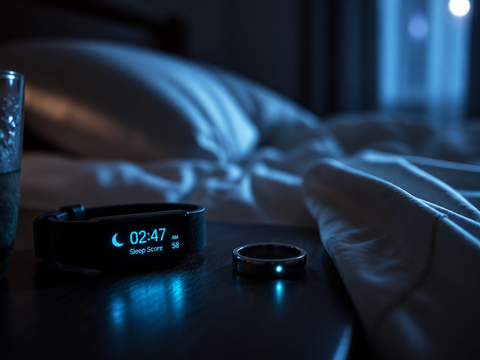
To measure, I used a wrist-and-ring home tracker that estimates AHI from blood-oxygen desaturation and movement. This is the central weakness of my experiment and I want it stated before the results, not buried after them. A consumer pulse-oximetry device is not a sleep lab. It systematically underreports events compared to in-lab polysomnography, and its night-to-night variation is large. I am reporting trends in one body, not validated diagnostics.
I took a two-week baseline before changing anything. Then:
- 30 minutes of brisk walking, six mornings a week, finished before 9 a.m.
- No change to diet, alcohol, or bedtime that I deliberately introduced.
- Same bedroom, same pillow, same tracker, worn every night.
I weighed myself weekly on the same scale.
What the numbers did
Here is the comparison that matters — baseline against the final week, plus the variable everyone fixates on: weight.
| Measure | Baseline (wks 1–2) | Final (wk 8) | Change |
|---|---|---|---|
| Estimated AHI (events/hr) | 14.2 | 9.8 | −31% |
| Avg overnight SpO₂ | 93.1% | 94.0% | +0.9 pt |
| Body weight | 188 lb | 184 lb | −4 lb |
| Resting heart rate | 68 bpm | 61 bpm | −7 bpm |
The AHI drop of 31 percent lands almost exactly where the pooled research said it might. That coincidence made me suspicious, then it made me trust the data slightly more, because I had not designed the experiment to hit that figure.
The weight question is the interesting one. I lost four pounds — about two percent of body weight. The literature suggests you need closer to a ten-percent loss to meaningfully shift apnea through weight alone. Four pounds should not, on its own, explain a 31 percent reduction. So either my measurement is noisy (very possible) or something other than weight was doing work: better upper-airway muscle tone, reduced fluid that pools in the neck overnight, lower overall inflammation. I cannot distinguish between these. Neither, honestly, could the original studies with much better equipment.
What I felt versus what the device said
The gap between subjective and objective is the part no chart captures.
By week three I was sleeping through the night without the 3 a.m. wake-up I'd assumed was just aging. My partner said I was quieter — not silent, quieter. I woke feeling like I had actually slept, which I'd half-forgotten was a sensation.
But here is the discipline this experiment demanded: I felt dramatically better by week three, and the measured AHI barely budged until week five. The feeling ran ahead of the data. If I had only trusted how I felt, I'd have declared victory at a point when the device said almost nothing had changed. Whatever improved my sense of rest in week three — possibly just the resting heart rate dropping, possibly placebo, possibly better sleep architecture the tracker can't see — was not the same thing as fewer breathing events.
That is the most useful thing I learned, and it cuts against most of what gets written here. Feeling rested and having fewer apneas are related but not the same measurement. A walking habit clearly improved the first. It improved the second more slowly and less than my mood suggested.
Who this is for, and who it isn't
This is worth trying if you have mild or mild-to-moderate apnea, you are currently sedentary, and you want a low-cost intervention you control. The downside is essentially zero and the resting-heart-rate benefit alone justified the eight weeks for me. A daily walk is not a treatment you can overdose on.
This is not a substitute for therapy if you have moderate-to-severe apnea, especially with daytime sleepiness behind the wheel. A 30 percent reduction off a high number still leaves a dangerous number. If your AHI is 40, walking it to 28 is not safety. Do not read this and quietly retire your CPAP, which is closer to what I did and what I'm now reconsidering.
And if you've already got a regular exercise habit, my eight weeks tell you nothing — I tested the move from zero to something, which the research suggests is where the steepest gains live. Going from active to very active is a different question I didn't touch.
If I had to put one screenshot-able line on it: walking is a real lever for mild apnea, but it's a nudge, not a fix — and your sense of feeling rested will lie to you about how big the nudge is.
What this didn't answer
Plenty.
I never validated my tracker against a real sleep study, so treat every number above as a personal trend line, not a measurement you could publish. I ran one body for eight weeks — no control, no second subject, no blinding to my own optimism.
I also can't tell you why it worked: weight, fluid, airway tone, or sleep quality feeding back on itself. And I can't tell you whether the improvement holds at week 24, or whether it decays the moment the walking stops.
If you want to go further than I did, two places to look. First, ask your clinician about a take-home polysomnography unit before and after a training block — real data, in your own bed. Second, watch the research on targeted upper-airway exercises and the so-called tongue-and-throat training protocols, where the early signals on muscle tone are more specific than "go for a walk" and might explain the weight-independent effect that started this whole belief in the first place.
I'm going to keep walking. I'm also going to call my pulmonologist.