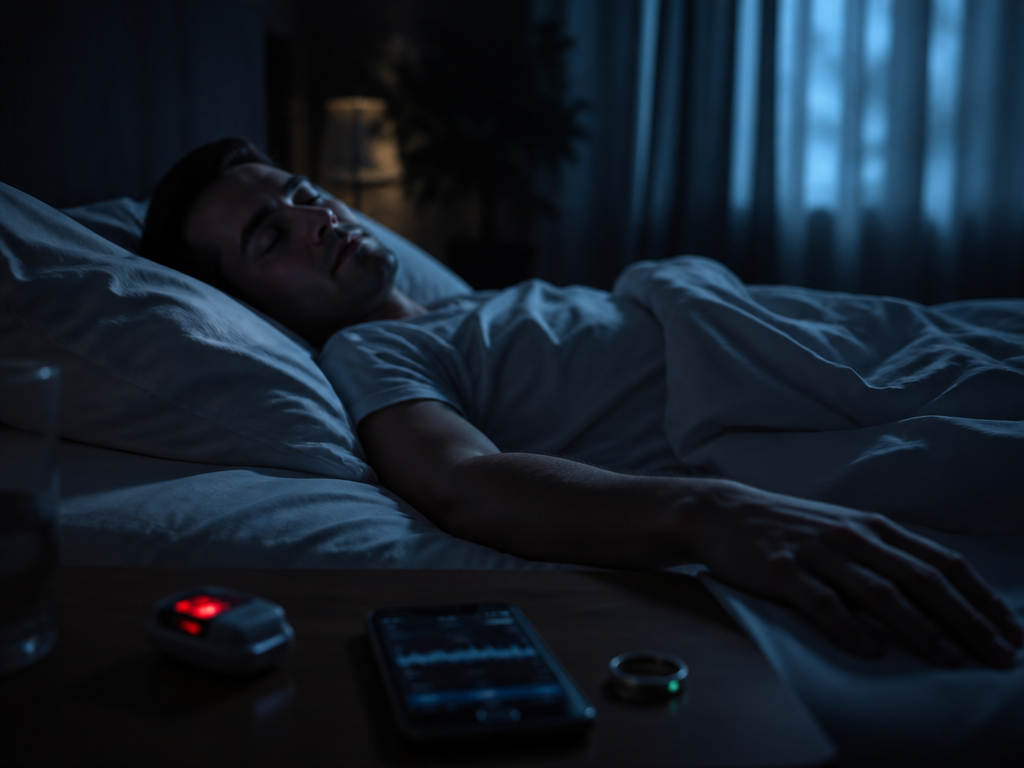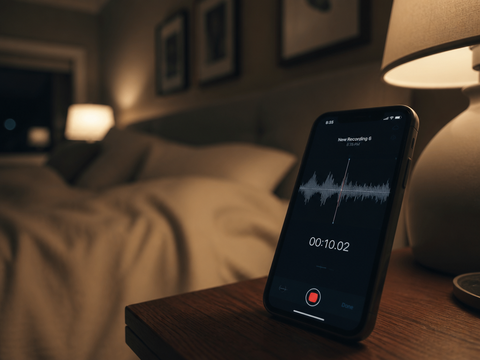
For thirty nights I left a phone running on the nightstand, recording the sound I make while asleep. The flat average came out to 53 decibels, with most nights sitting between 48 and 56, and one outlier peaking at 71 dB for roughly four minutes around 2 a.m. That number is the spine of this piece, because the honest version of the question "what are the snoring causes I should worry about?" starts with measuring the thing before reacting to it.
The short verdict, stated plainly so you don't have to read 1,300 words to get it: a decibel meter can tell you how loud you snore and what makes it louder or quieter, but it cannot tell you whether your snoring is dangerous. Those are two different questions, and most of us conflate them at 3 a.m.
What the number actually measured
The setup was deliberately ordinary, because I wanted results a normal person could replicate. A SnoreLab-style recording app on an iPhone 13, propped at the edge of the nightstand about 70 cm from my head, in a quiet suburban bedroom (ambient floor noise around 28–30 dB with the window shut). I logged each night's average, its peak, and four variables I could control: sleep position, alcohol, nasal congestion, and how late I ate.
This is consumer-grade measurement, and I want to be clear about its ceiling. A phone microphone is not calibrated. The absolute decibel figures are probably accurate to within a few dB, not a fraction of one, and the app's own "snore score" is a proprietary blend I treated as directional, not gospel. I trust the relative differences between nights more than any single absolute reading. One person, thirty nights, one room — this is an experiment, not a study.
Here is how 53 dB sits against sounds you already know:
| Sound | Approx. level |
|---|---|
| Quiet library | 40 dB |
| My average snore | 53 dB |
| Normal conversation | 60 dB |
| My loudest four minutes | 71 dB |
| Vacuum cleaner | 75 dB |
So my typical night is quieter than the dinner table and louder than a library. The 71 dB spike is the part a partner notices — and, not coincidentally, the part the rest of this piece is about.
Why the sound happens at all
Snoring is the sound of tissue vibrating in a partly narrowed airway. When you fall asleep, the muscles of the throat and tongue relax. In some people they relax enough that the soft palate (the soft rear roof of the mouth) and the airway walls behind it lose their rigidity. Air rushing past those loosened tissues sets them fluttering, the way a flag flutters in wind that a solid wall would simply block.
Narrow the channel and you do two things: you speed up the air moving through it, and you give the slack tissue more to flutter against. That is the entire physical story. Every variable I tested works by changing either the slackness of the tissue or the width of the channel.
The four things I could move
Position was the single biggest lever. On my back, the nightly average ran 55–58 dB and the peaks clustered. On my side, the average dropped to roughly 47–49 dB and the spikes mostly vanished. Gravity is the explanation: lying supine lets the tongue and soft palate fall backward into the airway. This is the mechanism behind the old tennis-ball-in-the-pajama-shirt trick, and the data made me a believer in a less ridiculous version of it.
Alcohol was the most dramatic single-night effect. Two glasses of wine within three hours of bed produced that 71 dB outlier — my loudest night of the month by a clear margin. Alcohol is a muscle relaxant; it deepens exactly the throat-muscle slackness that snoring depends on. The next dry night, the average fell back to 51 dB. I ran this comparison three times and the direction never reversed.

Nasal congestion mattered, but less than I expected. During a head cold, two congested nights averaged about 4–5 dB above my clear-nosed baseline. A blocked nose forces mouth-breathing and adds upstream resistance, but in my case it nudged the number rather than swung it.
Late eating showed up faintly — a reflux-adjacent effect when I ate within an hour of lying down — but it was small enough that I won't claim it against the noise of normal night-to-night variation.
The variables, ranked by what they did to the meter
| Variable | Effect on average | Reliability across repeats |
|---|---|---|
| Back vs. side sleeping | −7 to −9 dB on the side | Very consistent |
| Two drinks before bed | +12 dB on the loud night | Consistent, 3 trials |
| Nasal congestion | +4 to +5 dB | Moderate |
| Late heavy meal | +1 to +2 dB | Weak / within noise |
If you want one screenshot-able line: sleep on your side and skip the nightcap, and you have addressed the two largest, most controllable snoring causes before you spend a cent.
What the number does not measure
This is the part that matters most, and it's the part the phone is silent about.
My decibel meter recorded sound. It did not record oxygen. It did not record whether, during any of those quiet stretches, my airway closed completely and I stopped breathing for ten, twenty, thirty seconds before gasping back. Loud snoring and dangerous snoring are correlated but not identical — you can be a freight-train snorer with a perfectly open airway, and you can have obstructive sleep apnea while snoring at a polite 50 dB.
The signs a phone won't catch, and the ones worth taking to a doctor, are not about volume:
- Witnessed pauses — a partner reports you stop breathing, then gasp or choke awake.
- Daytime sleepiness that doesn't match your hours in bed — falling asleep in meetings, at red lights.
- Morning headaches or waking with a dry, sore throat and a racing heart.
- Loud, irregular snoring punctuated by silences, rather than the steady rhythmic kind.
Those symptoms point toward sleep apnea, which a recording app cannot diagnose and shouldn't be asked to. The only honest measurement there is a sleep study — increasingly an at-home one your doctor can arrange — that tracks airflow and blood oxygen, not just the noise. My thirty nights of data would be useless to a sleep physician except as the thing that prompts the question.
Who this experiment is for — and who it isn't
Do this if you snore, you're curious, and your partner's complaints feel vague. Thirty nights of cheap data will tell you whether position and alcohol are driving the problem, and they often are. It's a low-stakes way to find your two biggest levers and test whether changing them works.
Don't lean on this if you or your partner have noticed any of the red flags above. No app should stand between those symptoms and a clinician. The recording is a starting point for awareness, not a substitute for a diagnosis, and treating it as the latter is the one genuinely risky way to use it.
And don't expect precision the hardware can't deliver. My absolute decibel figures are ballpark. What I trust is the shape of the data: side beats back, sober beats not, and the night the meter screamed was the night I'd had wine.
The myth, and the more accurate version
The myth: snoring is just an embarrassing noise, and how loud it is tells you how worried to be.
The accurate version: how loud you snore is mostly a story about position, muscle tone, and what you drank — measurable, often fixable at home — while whether your snoring is dangerous is a separate question about breathing and oxygen that no nightstand recording can answer, and that only a doctor should.